
Landlord tax deductions documentation is the paper trail that turns rental expenses into actual tax savings. If you cannot prove an expense to the IRS, the deduction is gone, even if the money was real and the work was necessary. That is why recordkeeping affects far more than compliance, it affects ROI, audit defense, and how much time and money gets wasted at year-end.
Why Landlord Tax Deduction Documentation Directly Affects Tax Savings
Deductions lower taxable income only when supported by records the IRS accepts. For rental property, that means receipts, invoices, statements, lease records, logs, contracts, and summaries that show what was paid, why it was paid, when it was paid, and which property it relates to. Rental activity is generally reported on Schedule E, and the IRS expects you to keep records that substantiate both income and expenses.
The field data shows a simple pattern: landlords do not lose deductions because the expense category was wrong in theory. They lose deductions because the records are incomplete, mixed across properties, or impossible to trace back to a business purpose. A $9,800 HVAC replacement with a signed contract, permit, invoice, and placed-in-service date is manageable. Ten months of mixed Home Depot charges with no notes is a problem.
Think of documentation as the title record for your tax position. If ownership of a property depends on a clean chain of title, ownership of a deduction depends on a clean chain of proof.
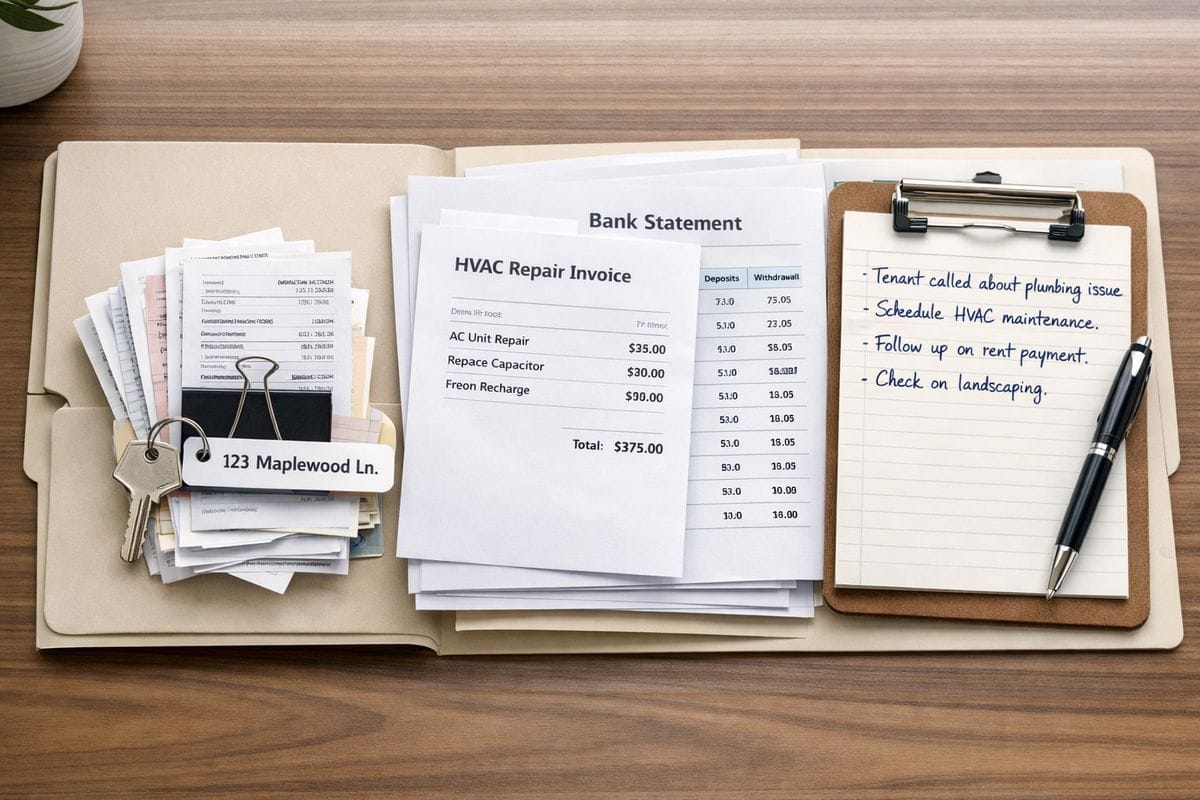
The Three Principles of Audit-Ready Rental Recordkeeping
Based on analysis of common audit failures and year-end cleanup work, three principles drive better outcomes: document every transaction, organize records property-by-property, and classify expenses correctly the first time. Those three habits reduce denied deductions, rework, and filing delays.
Document Every Dollar In and Out
The IRS standard is documentary evidence: receipts, canceled checks, bills, and similar records. For most landlords using the cash method, income is reported when received and expenses are deducted when paid. That makes payment timing and payment proof central.
A credit card statement alone is not enough for many categories because it usually shows only merchant name and amount. The stronger file includes the invoice, proof of payment, and a short notation of business purpose. For small expenses under $75, a bank or card statement plus a notation of business purpose is generally sufficient. Travel and auto are stricter. Those categories need contemporaneous logs, not reconstructed guesses.
Keep Records by Property, Not Just by Category
One insurance folder for the whole portfolio sounds efficient until tax prep starts. Then every charge has to be re-sorted by address, unit, and tax year. If you own four rentals, and one had $14,200 of repairs while another had $14,200 of improvements, poor sorting creates both reporting errors and bad depreciation schedules.
Property-by-property tracking also lines up with how rental activity is actually reported and managed. It improves visibility into NOI, helps reconcile rent ledgers to deposits, and makes additional Schedule E pages far easier once your portfolio grows past three properties.
Classify Repairs, Maintenance, and Improvements Correctly
This is the most common landlord documentation failure. The issue is not just tax theory. It is proof.
A repair gets deducted now because the records show the work kept the property in ordinary operating condition. An improvement gets capitalized and depreciated because the records show betterment, restoration, or adaptation. If the invoice says “full kitchen renovation” and the bookkeeping says “repair,” the documentation loses. If the file includes scope of work, itemized line items, and placed-in-service date, the classification is defensible.
What Income Records to Keep for Rental Properties
All rental income must be reported. The IRS includes rent, advance rent, lease cancellation payments, tenant-paid expenses, and non-cash rent in that definition. Income records should reconcile directly to deposits and rent ledgers.
Rent Ledgers, Lease Agreements, and Deposit Records
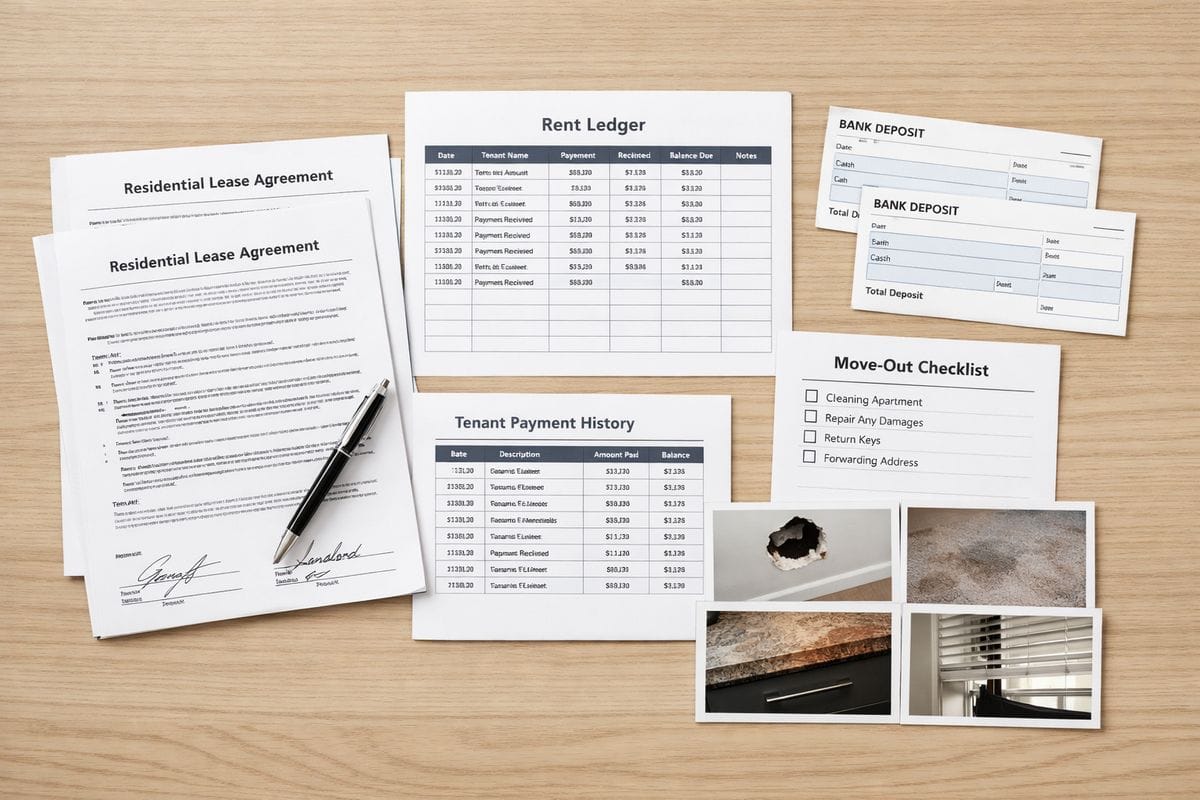
Keep signed leases, renewals, amendments, rent rolls, tenant payment histories, bank deposit records, and property management statements. Those records prove recurring rent, due dates, late fees, concessions, and actual cash received.
If a tenant pays $1,850 on the first of each month through a management portal, the ledger, platform statement, and bank deposit should match. If one month shows only $1,200 deposited, you need the backup showing a partial payment, credit, or refund.
Advance Rent, Security Deposits, and Lease Cancellation Payments
Advance rent is income when received, not when earned. Security deposits that are refundable are not income when received. If you keep a deposit for unpaid rent or damages, it becomes income at that point. Lease cancellation payments are rental income.
Keep the lease clause, deposit ledger, move-out statement, photos supporting damages, and accounting entry showing how the deposit was applied. Without those records, a $2,400 retained deposit can turn into a messy dispute over both income reporting and repair deductions.
Tenant-Paid Expenses and Non-Cash Rent
If a tenant pays a bill on your behalf, reimburses an expense, or performs services instead of paying cash, that can be reportable income. The records need to show the amount and fair value.
Keep utility bills, tenant correspondence, invoices, credits applied to the ledger, and proof of fair value for services or barter arrangements. If a tenant paints a unit in exchange for one month of rent, the file should show the rent value, the service agreement, and how it was posted.
What Expense Documents to Keep for Common Landlord Deductions
Most deductible rental expenses are ordinary and recurring. The recommendation is to keep both the source document and the payment proof.
Mortgage Interest, Property Taxes, Insurance, and Utilities
For mortgage interest, keep Form 1098, monthly statements, and year-end escrow summaries. For property taxes, keep county tax bills and proof of payment. For insurance, keep declarations pages, invoices, and canceled checks or bank confirmations. For utilities, keep monthly statements and the related payment record.
These documents support recurring fixed expenses that often make up the largest share of annual deductions.
Repairs, Maintenance, Cleaning, Advertising, and Management Fees
Keep invoices, store receipts, work orders, vendor contracts, before-and-after photos, management statements, and payment confirmations. Every file should show the date, amount, vendor, property address, and business purpose.
Photos matter more than many landlords realize. A photo of water damage before drywall patching helps prove a repair. A photo set showing a full room gut job points the other direction, toward an improvement.
Professional Fees, Software, Office Costs, and Bank Charges
Keep invoices for bookkeeping, legal work, tax prep tied to rental activity, software subscriptions, postage, dedicated phone charges, and bank fee statements. Separate rental-related costs from personal spending at the source. Year-end sorting is slower, less accurate, and more expensive.
Repairs vs. Improvements: What to Save and How to Prove the Difference
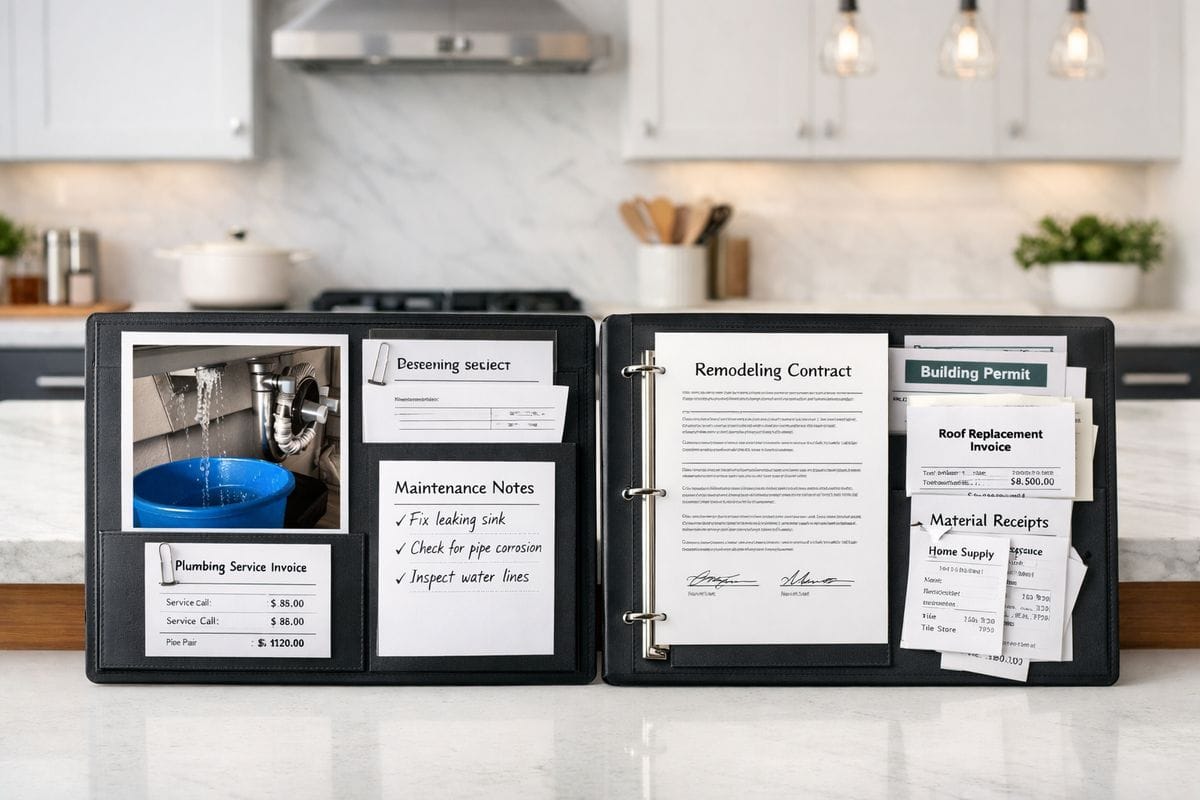
The tax outcome changes based on classification. Deducting a $600 faucet replacement now is very different from depreciating a $16,000 roof over years using Form 4562. Your records have to show why the item belongs in one bucket or the other.
Documents That Support a Current Repair Deduction
Current repairs keep the property in ordinary operating condition. Think patching drywall, fixing a leak under a sink, replacing a broken switch, or touching up a damaged section of flooring.
Keep itemized invoices, maintenance logs, short notes describing the problem, and photos showing existing damage. A strong file says: “Repaired leak under Unit 2 sink, replaced damaged shutoff valve, restored existing condition.” That language supports a repair deduction.
Documents That Support Capital Improvements and Depreciation
Improvements add value, extend useful life, or adapt the property to a new use. New roof, HVAC replacement, full flooring replacement across a unit, room additions, major remodels, and structural work fall here.
Keep signed contracts, permits, invoices, draw schedules, payment records, placed-in-service dates, and asset detail used for depreciation schedules. Also keep closing statements and prior basis records because improvements stack on top of basis, and basis drives gain or loss when you sell.
The Records Needed for Travel, Vehicle Use, and Local Property Visits
Travel and auto deductions are denied early and often because documentation is weak. The IRS recordkeeping rules in Publication 463 are strict for a reason: reconstructed logs are not persuasive.
Mileage Logs and Trip Documentation
For each local trip, track the date, destination, business purpose, mileage, and property address. Good examples include contractor meetings, inspections, supply runs, lock changes, and repair visits.
If you use the standard mileage method, the log must be contemporaneous. If you use actual vehicle expenses, keep gas, insurance, repairs, registration, and total-use records. The method chosen in the first year the vehicle is used for the activity affects future options, so documentation from day one matters.
Travel Receipts for Overnight Rental Activity
For overnight travel connected to rental management, maintenance, or conservation of income-producing property, keep airfare receipts, hotel invoices, parking, tolls, and any related confirmations. Payment proof is not enough. The file must also show the business purpose and direct connection to rental activity.
For meals during business travel, the log should include date, amount, business purpose, and who was present.
Contractor, Vendor, and Entity Records to Keep
Good tax files go beyond receipts. Contractor compliance records and entity records reduce downstream filing risk and protect deductions.
W-9s, 1099-NEC Support, and Contractor Agreements
If a contractor is paid $600 or more, keep the W-9, signed agreement, invoices, payment history, and year-end total paid. Those records support both the expense deduction and potential 1099-NEC filing obligations.
If you paid a handyman $4,800 across seven jobs, the IRS will expect a clean trail. No W-9, no agreement, and payments through random apps create unnecessary exposure.
Closing Statements, Asset Records, and Entity Documents
Keep settlement statements, loan documents, title fees, appraisal invoices, and purchase records from acquisition day forward. Those documents establish basis. Basis affects depreciation every year you own the property and gain calculations when you sell.
If the property sits in an LLC, also keep formation documents, EIN letter, operating agreement, annual filings, and separate bank account records. The documentation standard does not change. The need for separation gets tighter.
How Long to Keep Landlord Tax Records and How to Organize Them
Retention is not a minor admin detail. It is the backup system for your tax position.
Recommended Retention Timelines by Record Type
Keep annual tax returns and supporting expense records for at least the full IRS risk window. Keep purchase documents, depreciation schedules, and improvement records for as long as you own the property plus at least seven years after sale. Those basis records remain relevant the entire life of the asset.
For payroll-type contractor records and 1099 support, keep the same multi-year file. Destroying improvement records too early is expensive because basis cannot be rebuilt from memory.
The Best Filing System for a Growing Portfolio
Use a digital folder system by property, then by tax year. Under each year, create subfolders for income, expenses, mileage, improvements, financing, tax filings, and contractor compliance. Reconcile monthly. Capture receipts when the transaction happens. Generate a year-end profit and loss by property.
That system scales. A desktop folder named “Taxes” does not.
What to Hand a CPA or Real Estate Tax Advisor at Year-End
Organized records reduce prep cost, shorten turnaround time, and improve accuracy. More importantly, clean files make proactive planning possible instead of forcing expensive cleanup.
Your Year-End Tax Packet Checklist
Your year-end package should include rent summary, rent ledger, bank statements, mortgage interest statement, property tax bills, insurance totals, utilities, repair detail, improvement detail, contractor payments, W-9s, mileage logs, prior-year depreciation schedule, closing documents for acquisitions or sales, and entity records.
A clean packet gives your advisor enough information to test passive loss limits, confirm depreciation, review QBI treatment where relevant, and spot misclassified improvements before the return is filed.
Red Flags That Trigger Rework, Lost Deductions, or Audit Exposure
The most common red flags are commingled personal and rental accounts, missing receipts, undocumented contractor payments, no mileage log, deposit totals that do not match rent records, and improvements booked as repairs.
Those are preventable profit leaks. Fixing them after year-end costs time. Fixing them during an audit costs money.
Landlord Tax Deduction Documentation FAQs
Can a deduction be claimed without a receipt?
Sometimes, but only with other credible documentary evidence. For many expenses under $75, a bank or credit card statement plus a notation of business purpose is enough. For larger expenses, repairs, improvements, and contractor work, the recommendation is to keep the actual invoice or receipt plus payment proof. For travel and auto, logs are mandatory. If you cannot produce documentation, the deduction is denied.
What records matter most for landlords with short-term rentals?
Keep platform payout statements, booking reports, occupancy tax records, cleaning fee detail, host service fees, guest refund records, and bank deposits that reconcile back to each platform. Short-term rentals create more transaction volume, which means more reconciliation risk.
What changes when rental property sits in an LLC?
The deduction rules stay the same. The documentation discipline gets stricter. Keep separate bank accounts, separate bookkeeping, LLC formation records, EIN notice, and a clean file for owner contributions and reimbursements. Mixing personal and LLC spending weakens both tax reporting and entity separation.
When does it make sense to use a real estate tax advisor instead of basic tax prep?
The recommendation is to upgrade once your portfolio starts scaling, improvement activity increases, passive loss limitations matter, or QBI questions enter the picture. Basic tax prep records history. Real estate tax advisory work changes outcomes before year-end.
What documentation matters for a home office tied to rental activity?
Keep square footage records, floor plan or measurement notes, utility and internet bills, rent or mortgage records for the home, and a calculation showing either the simplified method or actual expense allocation. The home office has to be used regularly and exclusively for rental business activity.
Frequently Asked Questions
What is sufficient proof in an IRS audit for rental deductions?
The burden of proof falls on you. Sufficient proof usually means the source document plus payment proof plus business purpose. For example, an invoice from a plumber, a paid credit card statement, and the property address are sufficient. A card statement that only says “ABC Services $475” is not.
Can bank statements alone support landlord tax deductions?
Bank statements help, but bank statements alone are often insufficient. They show that money left the account, not what was purchased or why. Use them as payment proof, not as the entire file.
How should documentation be stored for multiple rental properties?
Store records digitally by property and by year. Within each property-year folder, separate income, expenses, mileage, improvements, financing, tax returns, and contractor files. That structure supports Schedule E reporting, audit defense, and faster year-end review.
What should be kept for depreciation?
Keep purchase closing statements, loan documents, appraisal and title records, settlement fees, improvement invoices, placed-in-service dates, and the current depreciation schedule. Depreciation is basis-driven, so losing acquisition and improvement records weakens every future return.
Which deductions need the strongest documentation?
Travel, auto, home office, repairs versus improvements, and contractor payments need the strongest documentation. Those categories get denied more often because business purpose, allocation, or classification is easier to challenge.
Documentation Requirements Matrix
The matrix below shows what the IRS expects by category, what formats are acceptable, how long to keep records, and what sufficient proof looks like in practice.
| Deduction category | Required documentation | Acceptable format | How long to keep it | Sufficient vs. insufficient |
|---|---|---|---|---|
| Repairs | Itemized invoice, payment proof, property address, business purpose, photos or notes if classification is close | PDF invoice, scanned receipt, contractor bill, bank record with note | At least IRS risk window, longer if tied to basis dispute | Sufficient: plumber invoice for leak repair at 123 Main plus card payment. Insufficient: hardware store charge with no notes |
| Travel | Receipt, date, destination, business purpose, amount, who was present for meals | Digital receipts plus contemporaneous log | At least IRS risk window | Sufficient: hotel folio plus note “inspection and contractor meeting for Dallas rental.” Insufficient: hotel receipt only |
| Auto | Contemporaneous mileage log or actual expense records, date, destination, purpose, miles | Mileage app export, spreadsheet kept in real time, odometer log | At least IRS risk window | Sufficient: log showing 18 miles to property for repair visit. Insufficient: year-end estimate of 2,400 miles |
| Home office | Square footage record, exclusive-use support, expense records or simplified method calculation | Floor plan, photos, utility bills, mortgage or rent statements, worksheet | At least IRS risk window | Sufficient: measured 180 sq. ft. office plus utility records and method calculation. Insufficient: vague claim that “part of a room” is used |
| Insurance | Policy declarations, invoice, proof of payment, property covered | PDF policy, invoice, bank statement | At least IRS risk window | Sufficient: landlord policy declaration and paid annual premium. Insufficient: bank draft with insurer name only |
| Professional fees | Engagement letter or invoice, payment proof, rental business purpose | PDF invoice, accountant bill, legal invoice | At least IRS risk window | Sufficient: tax prep invoice allocating Schedule E work. Insufficient: generic legal payment with no matter description |
| Supplies | Store receipt or statement under $75 plus business notation, date, amount, property | Receipt image, bank statement with annotation | At least IRS risk window | Sufficient: $22 lockbox purchase with note for Unit 4. Insufficient: $22 card charge with no property note |
| Depreciation | Closing statement, basis records, improvement invoices, placed-in-service date, depreciation schedule | Settlement statement, PDF invoices, fixed asset report | Life of asset plus at least seven years after sale | Sufficient: HUD/CD, roof contract, date placed in service, Form 4562 detail. Insufficient: rough estimate of purchase closing costs |
If documentation standards feel uneven across categories, that is because they are. A $42 supply purchase does not require the same substantiation package as a vehicle deduction or a $28,000 renovation. The recommendation is simple: keep less paper for low-risk small items, keep airtight files for travel, auto, home office, contractors, and anything that affects depreciation.
What Changes Once Documentation Is Handled Correctly
Once your documentation system is right, tax prep gets faster, audit exposure drops, and tax planning becomes useful instead of theoretical. You stop arguing about missing receipts in March and start making better decisions in June, when the decision still changes the tax result. That is the real payoff: cleaner records, better deductions, and a portfolio that runs like a business instead of a box of receipts.