

IRS Publication 527 is the IRS rulebook for residential rental property, and getting it wrong costs real money. If rental income, depreciation, personal-use days, or passive losses are handled incorrectly, cash flow drops, deductions get deferred, and audit risk goes up right as 2026 and 2027 tax-law changes put more pressure on after-tax returns.
What IRS Publication 527 Is and Why It Matters to Rental Owners
IRS Publication 527 is the IRS guide for residential rental property, including vacation homes and other dwelling units with mixed personal and rental use. It sits at the center of rental tax reporting because it tells you what counts as rent, which expenses belong on Schedule E, how depreciation works, when losses are limited, and how special rules apply if you also use the property yourself.
That sounds technical. It is. But the business outcome is simple: correct treatment protects deductions and keeps taxable income aligned with economic reality. Incorrect treatment does the opposite. A rental that should generate a clean deduction ends up showing taxable income. A property that should produce depreciation gets reported with no depreciation at all. A vacation home gets treated like a full-time rental even though personal-use days crossed the IRS threshold and capped deductions.
Based on analysis of common rental-tax disputes, Publication 527 matters most in three places. First, depreciation is mandatory, not optional. Second, the repair-versus-improvement line decides whether you get a deduction now or over many years. Third, personal use can completely change the tax formula. Most owners learn those rules only after a notice arrives. That is late.
Who Should Use Publication 527
Publication 527 applies to individual owners of residential rental property. That includes single-family landlords, condo owners, duplex owners, vacation-home owners, room-rental operators, and short-term rental hosts. It also matters if wage income is high and rental losses are getting trapped by passive activity rules.
It is especially relevant if a property has mixed use. The moment a dwelling unit serves both as a rental and a place for personal use, day counts and allocation rules start driving the return. W-2 earners with rental losses should also treat Publication 527 as required reading because loss limitations, active participation, and personal-use rules often determine whether a Schedule E loss helps this year or just carries forward.
Publication 527 is not the main authority for corporations, partnerships filing entity returns, or nonresidential rentals such as office buildings and warehouses. Those situations often pull in different guidance and more entity-level issues.
What Publication 527 Covers Versus Related IRS Guidance
Publication 527 is the rulebook, but it is not the whole filing package. The return itself usually runs through Schedule E, Form 4562, and Form 8582. Schedule E reports rental income and expenses. Form 4562 handles depreciation and amortization. Form 8582 applies passive activity loss limits.
Other IRS guidance fills in parts Publication 527 references but does not fully unpack. Publication 925 covers passive activity and at-risk rules in more detail. Publication 551 explains basis, which is where depreciation starts. Publication 547 addresses casualty losses. Publication 523 comes into play when a former residence or mixed-history property is sold and home-sale exclusion rules intersect with rental history.
Think of Publication 527 as the operating manual for residential rental taxation. Filing the return still requires the supporting forms and, for many owners, separate basis schedules, depreciation schedules, and day-count records.
The Four Rules That Drive Almost Every Rental Tax Outcome
Most rental tax outcomes trace back to four decision drivers: income classification, expense allocation, depreciation, and loss limitations. Everything else is detail layered on top.
Income classification determines what gets reported as rent. Expense allocation determines what lands on Schedule E and what stays personal. Depreciation turns acquisition and capital costs into annual deductions, but it also sets up recapture later. Loss limitations decide whether a paper loss helps now or gets suspended.
Those four rules control taxable income, ROI, and recordkeeping burden. If classification is wrong, the rest of the return is wrong. If allocation is sloppy, deductions get overstated or left on the table. If depreciation is missed, current deductions shrink and future sale calculations get distorted. If passive or at-risk limits are ignored, a loss that looks usable on paper never actually offsets W-2 income.
Rule 1: Every Dollar of Rental Value Must Be Classified Correctly
The IRS definition of rental income is wider than monthly rent checks. It includes cash, non-cash payments, advance rent, tenant-paid owner expenses, retained deposits, and lease cancellation payments. Miss one of those categories and gross income is underreported.
Rule 2: Personal Use Changes the Entire Tax Formula
A property with personal use is not taxed like a pure rental. Once personal-use days exceed the IRS threshold, the dwelling is treated as a home for tax purposes and deductions are limited by special vacation-home rules. That changes allocation, ordering, and loss treatment.
Rule 3: Depreciation Delivers Ongoing Deductions but Creates Recapture Exposure
Depreciation reduces taxable income every year the property is in service, which is why it is one of the highest-value deductions in rental real estate. But the deduction is not free forever. When the property is sold, prior depreciation reduces basis and can create depreciation recapture.
Rule 4: Loss Rules Decide Whether Deductions Help This Year or Later
A property can show a clear economic loss and still provide no current tax benefit. Passive activity limits, at-risk rules, and participation standards decide whether the loss offsets current income or gets suspended for future years.
What Counts as Rental Income Under Publication 527
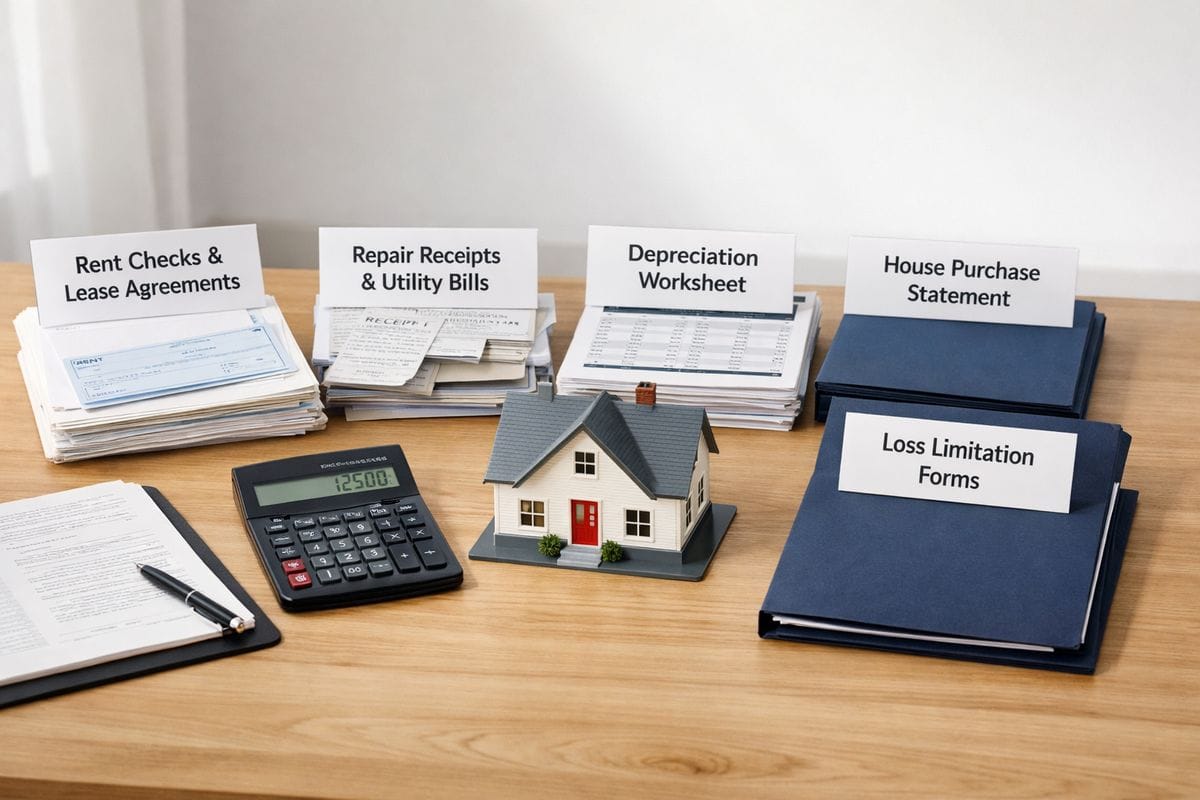
Rental income includes far more than base rent. Based on analysis of the IRS framework, this is where many owners underreport because the term “rent” sounds narrower than the tax rule actually is.
The IRS treats rental income broadly. If value is received in exchange for use of the property, that value generally belongs in rental income unless a specific exclusion applies. That includes normal rent, prepaid rent, cancellation payments, certain deposits, tenant-paid expenses, and non-cash arrangements.
Rent Received in Advance
Advance rent is income when received, not when the rental period occurs. If rent for next January arrives in December, it belongs in the current tax year. The timing rule follows receipt, not occupancy.
That matters for year-end cash planning. A landlord on the cash method does not get to defer rent recognition because the tenant’s stay occurs later. The IRS specifically treats advance rent as current-year income. If two months or two years of rent arrive at signing, the entire amount is generally reported in the year received.
Security Deposits: When They Are Taxable and When They Are Not
A refundable security deposit is not rental income when received if the obligation is to return it at lease end. It becomes income only if the amount is kept because the tenant failed to satisfy lease terms and the amount is applied to unpaid rent, damages, or another landlord claim.
Lease terms matter here. If a so-called deposit is actually the final month’s rent, it is rent when received because the amount is not truly refundable. If part of a deposit is retained after move-out for unpaid rent or damage, that retained amount becomes rental income in the year retained.
Tenant-Paid Expenses and Reimbursements
If a tenant pays an expense that is the owner’s legal obligation, that payment generally counts as rental income. Common examples include utilities billed in the owner’s name, repair invoices the owner was responsible for, or property taxes the lease shifts to the tenant while the tax remains the owner’s liability.
The tax treatment can feel counterintuitive. The tenant never handed cash directly to the owner, yet income still exists because the tenant satisfied an owner expense. On the return, the amount is generally included in rental income and the corresponding expense is deducted in the proper category.
Lease Cancellation Payments and Non-Cash Rent
A payment received because a tenant ends a lease early is rental income. So is value received through barter. If the tenant provides services instead of cash, or transfers property instead of writing a check, the fair market value belongs in rental income.
That broad definition catches informal arrangements that owners often ignore. A tenant replaces flooring in exchange for a month of free rent. A contractor occupies the unit and performs work instead of paying cash. Those are not invisible transactions. They are non-cash rent.
The Core Deduction Categories Publication 527 Allows
Publication 527 allows ordinary and necessary rental expenses tied to operating, managing, conserving, or maintaining rental property. Categorizing them correctly improves filing speed and reduces notice risk because Schedule E is built around specific expense lines.
Interest, Taxes, Insurance, and Utilities
Mortgage interest is usually one of the largest rental deductions. Real estate taxes, insurance premiums, electricity, gas, water, sewer, trash, and similar recurring operating costs also belong in the core deduction set when tied to the rental activity.
The catch is mixed use. If the property is purely rental, these expenses generally flow fully to Schedule E. If the property is also used personally, allocation rules apply. Mortgage interest and property taxes get especially technical under vacation-home rules, so clean records matter.
Repairs, Maintenance, and Operating Costs
Repairs and maintenance keep a property in rentable condition without materially improving it. Painting, patching drywall, fixing a leak, replacing broken hardware, servicing an HVAC system, lawn care, pest control, and appliance repairs often fall here.
Publication 527 specifically recognizes operating costs such as painting and utilities as deductible rental expenses. These are current-year deductions when they maintain existing condition rather than improve the property.
Professional Fees, Advertising, and Management Costs
Legal fees tied to rental operations, accounting fees for rental books and tax preparation, listing costs, leasing commissions, screening costs, and property management fees are generally deductible. So are advertising costs used to find tenants.
The dividing line is purpose. Legal fees to collect rent or review a lease are operating expenses. Legal fees tied to acquiring the property or defending title are capital in nature and usually added to basis instead.
Local Travel and Other Ordinary Rental Expenses
Local transportation for rental activities can be deductible when tied to managing the property, collecting rent, supervising repairs, or meeting vendors. For 2025, Publication 527 states the standard mileage rate is 70 cents per mile for rental activity vehicle use.
Documentation is where most travel deductions fail. A mileage log should show date, destination, purpose, and miles. Commuting to a regular office is not transformed into rental travel just because rental work happens later in the day.
Repairs vs. Improvements: The Line That Changes Your Deduction Timing
This is one of the highest-value distinctions in Publication 527. Repairs are generally deductible now. Improvements must be capitalized and recovered over time through depreciation. Misclassify enough work and current-year cash flow changes sharply.
Based on review of common filing errors, owners lose money both ways. Some capitalize obvious repairs and delay deductions for no reason. Others expense major renovations that should have been capitalized, which invites adjustment and penalties.
Plain English helps here. A repair fixes what is already there. An improvement makes the property better, restores it after major deterioration, or adapts it to a new use.
What the IRS Treats as a Repair
A repair restores property to efficient operating condition without materially adding value, substantially prolonging useful life, or changing use. Think small and targeted.
Ten common repair examples, translated into plain language:
- Fixing a broken window pane.
- Patching part of a roof leak.
- Repainting interior walls between tenants.
- Repairing a faulty light switch.
- Replacing a few cracked floor tiles.
- Servicing an existing furnace.
- Repairing a section of damaged gutter.
- Fixing a leaking faucet or toilet.
- Replacing broken cabinet hardware.
- Repairing part of a fence rather than rebuilding it.
Those examples share one trait: the property remains fundamentally the same. The work keeps it rentable. It does not create a new asset or materially extend the life of the whole system.
What the IRS Treats as an Improvement
An improvement is a betterment, restoration, or adaptation. It adds value, significantly extends useful life, replaces a major component, or changes the property to a different use.
Examples include replacing the entire roof, gut-renovating a kitchen, installing central air where none existed, replacing all windows, upgrading electrical service for a major new load, rebuilding a deck, replacing the entire HVAC system, adding a bathroom, converting a garage to living space, or reconstructing a damaged structural wall.
The tax result changes immediately. Those costs are added to basis and depreciated. They do not become a full current-year deduction just because cash left the bank this year.
Why This Classification Matters for Cash Flow and Audit Risk
If $18,000 of work is a repair, the deduction generally lands this year. If it is an improvement, recovery may be spread across years. That timing difference changes tax owed now, which changes cash available for reserves, debt service, and new acquisitions.
Audit risk rises when the invoice and the tax treatment do not match. “Full roof replacement” booked as repairs is easy for an examiner to challenge. So is “complete kitchen remodel” deducted as maintenance. The recommendation is straightforward: code work by project scope, keep invoices with detailed descriptions, and maintain a capital-improvements file separate from ordinary repairs.

Depreciation Under Publication 527
Depreciation is the central long-term deduction for residential rental property, and it is not elective in the practical sense. If property is depreciable, the tax system assumes depreciation was allowed or allowable. Failing to claim it does not preserve basis for later. It usually just wastes deductions now and still leaves recapture issues later.
That is why depreciation deserves more attention than most owners give it. A rental building is not deducted all at once when purchased. The cost of the building is recovered over time under MACRS, while land is never depreciated.
When Depreciation Starts
Depreciation begins when the property is placed in service as a rental. That means it is ready and available for rent, not merely purchased. Closing on June 10 does not start depreciation if renovation continues until September and the unit is unavailable. Advertising alone is not enough if the property is not actually ready for occupancy.
Placed in service is an operational test. The property has to be in rentable condition. Once that happens, depreciation begins even if no tenant has moved in yet.
Determining Basis Before Depreciation
Basis starts with purchase price, then gets adjusted by certain settlement costs and capital expenditures. You must allocate basis between land and building because only the building is depreciable. Publication 551 is the IRS guide for basis rules.
A simple example makes this concrete. Assume the purchase price is $400,000. Closing costs allocable to basis add $8,000. Total basis is $408,000. If land is valued at $80,000 and building at $328,000, only the $328,000 building basis is depreciable.
That allocation cannot be guessed casually. Appraisals, assessor records, and purchase documents should support the land-building split.
MACRS Recovery Periods for Residential Rental Property
Residential rental buildings are generally depreciated under straight-line MACRS over 27.5 years using the mid-month convention. The IRS states that 27.5 years is the standard recovery period for residential rental property, and land is not depreciable.
The plain-language calculation is straightforward. If depreciable building basis is $328,000, annual straight-line depreciation is roughly $11,927.27 before the mid-month convention adjustment in the first and last year. That comes from $328,000 divided by 27.5.
Another example: building basis of $275,000 produces annual depreciation of $10,000. Building basis of $550,000 produces annual depreciation of $20,000. The numbers are not exotic. The tax impact is. A missed $20,000 depreciation deduction means taxable income is overstated by $20,000.
Separate Assets: Appliances, Carpeting, and Improvements
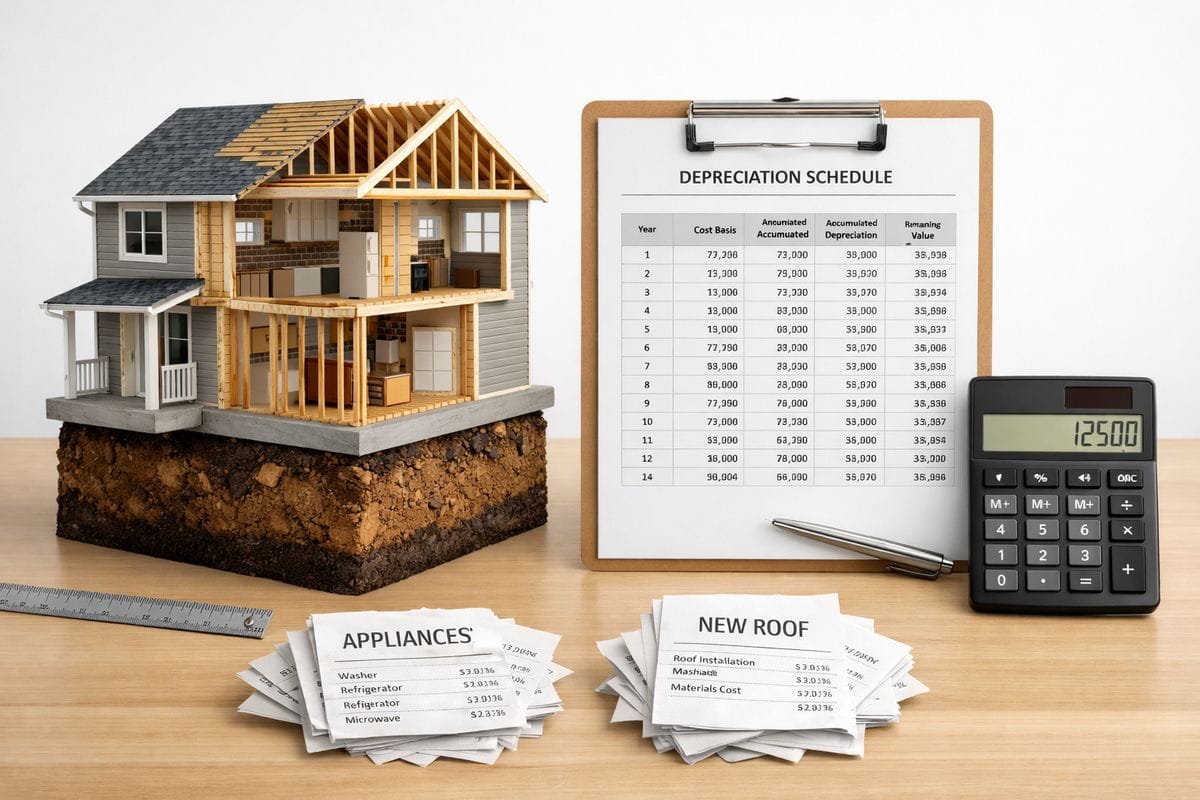
Not every cost rides on the same 27.5-year schedule. Appliances, carpeting, furniture, and certain land improvements can have shorter recovery periods. Later improvements also become separate depreciable assets starting when placed in service.
That separate-asset tracking drives accurate deductions. If a refrigerator is replaced, you do not bury it inside the building basis. If a new roof is installed five years after acquisition, that roof is a new asset with its own depreciation schedule. If the property is furnished for short-term guests, furniture and equipment require separate treatment.
This is where poor bookkeeping causes long-term drag. A single undifferentiated “property basis” number makes later deductions, dispositions, and recapture far harder to calculate.
Form 4562 and Depreciation Reporting
Depreciation is generally claimed through Form 4562 and then flows through the return. That form is where current-year depreciation, newly placed-in-service assets, and certain elections get reported.
For some owners, Form 4562 appears only in the first year an asset is placed in service. For others, especially with ongoing improvements or separate asset additions, it remains part of the annual filing cycle. Either way, the depreciation schedule supporting Form 4562 should be maintained year after year, not rebuilt in a panic at sale time.
Mixed-Use Property and Vacation Homes: Where Publication 527 Gets More Complicated
This is the section many owners actually need most. A dwelling with both rental and personal use does not follow the same tax rules as a full-time rental. Once personal use enters the picture, day counts, fair rental value, and allocation methods start driving the result.
The 14-Day or 10% Rule for a Dwelling Used as a Home
A dwelling is treated as a home for tax purposes if personal use exceeds the greater of 14 days or 10% of the days rented at fair rental value. Cross that line and the vacation-home rules apply, which can limit deductions to rental income.
Use the required example. The property is rented 150 days at fair rental value and used personally for 20 days. Ten percent of 150 is 15. Compare 15 to 14, and the greater threshold is 15. Personal use is 20 days, which is more than 15. Result: the property is treated as a home, personal-use rules apply, and deductions are limited.
That example is exactly why day counting matters. Fifteen personal days would not exceed the threshold. Twenty does. Five days changed the tax outcome.
What Counts as Personal Use Days
Personal use includes days you or your family use the property for personal purposes. It also includes days rented below fair rental value. If a friend stays there at a bargain rate, that generally counts as personal use, not rental use. Use exchanged with another owner also counts.
Below-market occupancy is where many vacation-rental owners get into trouble. Charging a relative or friend a token rate does not create fair-rental days just because money changed hands. The IRS looks at fair rental value, not whether a payment existed.
Days Spent on Repairs and Maintenance
Days spent primarily on substantial repairs and maintenance generally do not count as personal-use days. But intent alone is not enough. The day must actually be work-focused, and documentation has to support that.
If a weekend at the beach house includes two hours fixing a sink and two days of recreation, that is not a repair trip for tax purposes. If the stay is substantially full-time repair work, documented with receipts, contractor calls, supply purchases, and work logs, the treatment is stronger.
How to Determine Fair Rental Value
Fair rental value is what an unrelated person would pay for the property in that market. The clean approach is to compare local market rents using size, condition, furnishings, location, seasonality, amenities, and lease terms.
For a short-term rental, use comparable listings and booking data from the same season. For a long-term rental, use comparable leases in the same area. Save screenshots, broker opinions, listing histories, and lease comps. If your rate is substantially below market, the IRS has a reason to question whether those are true rental days.

The Fewer-Than-15-Days Rule
If a dwelling unit is rented for fewer than 15 days during the year, rental income is generally not reported and rental expenses are not deducted as rental expenses. The IRS treats fewer than 15 days as a special exclusion rule for a dwelling used as a home.
This is one of the clearest tax advantages in Publication 527. Rent the property for 14 days or less, keep the income out of federal taxable income, and do not treat the activity as rental activity for those days. The rule is narrow, but when it fits, it is powerful.
When This Rule Produces a Tax Advantage
High-rate event rentals are the classic example. A home near a major tournament, festival, or college football venue rents for a premium during two weekends, producing substantial income in under 15 rental days. That income is generally excluded.
The advantage is strongest when the property is primarily personal and the owner was not depending on rental deductions anyway. For a property with meaningful operating costs and high expected deductions, the exclusion is less exciting because rental expenses do not become Schedule E deductions under this rule.
What You Still Need to Track
Even when income is excluded, records still matter. You need proof of rental days, personal-use days, rental rates, and expenses. If the IRS questions whether the 14-day limit was exceeded, casual calendar memory will not help.
Track booking dates, occupancy dates, payment records, and any owner-use periods. The exclusion is simple only if the supporting records are clean.
How Expense Allocation Works for Mixed Personal and Rental Use
Once a dwelling has both rental and personal use, expenses must be split. This is the point where many returns go wrong because owners know the property was “partly rental” but do not run a disciplined allocation.
Direct Expenses Versus Indirect Expenses
Direct expenses relate only to the rental activity. Guest cleaning, booking-platform commissions, rental advertising, and repairs affecting only rented space are direct rental expenses. Those usually stay with the rental side.
Indirect expenses benefit the whole property and must be prorated. Mortgage interest, property taxes, insurance, utilities, HOA dues, and general maintenance usually fall here. If the property is mixed use, these costs cannot simply be deducted in full on Schedule E.
Allocating by Rental Days and Total Use Days
Publication 527 generally uses a day-based allocation approach for many mixed-use dwelling expenses. The common formula is rental days divided by total days of use, then applied to indirect expenses.
Example: the property is rented at fair rental value for 150 days and used personally for 20 days. Total use days equal 170. The rental-use percentage is 150 divided by 170, or about 88.24%. If insurance is $3,400, about $3,000 is allocable to rental use under that method.
That is the broad concept. The actual mechanics get more technical for mortgage interest and property taxes when a dwelling is treated as a home, which is why Publication 527’s worksheet structure matters.
Ordering Rules for Limited Deductions
When a dwelling is treated as a home and deductions are capped by rental income, expenses are not deducted in any order you want. There is an ordering structure. Certain expenses, such as allocable mortgage interest and taxes, generally get considered before operating expenses, and depreciation comes later.
The result is practical, not academic. If rental income is limited, depreciation is often the first deduction pushed out of the current year. That means many mixed-use vacation properties show less current tax benefit than owners expect even when cash expenses were substantial.
Reporting Rental Income, Expenses, and Losses on the Return
Publication 527 explains the rules, but filing happens through forms. Understanding where the numbers land is the bridge between theory and execution.
Schedule E Basics
Schedule E is the main form for reporting rental real estate income and expenses. Each property is typically shown separately, with rents received, expense categories, and the net result before passive-loss limitations are applied.
That property-by-property view matters for accuracy. It also matters for analysis. If one rental is highly profitable and another is generating losses, those facts should be visible in the records long before filing season.
Net Rental Income Versus Net Rental Loss
Net rental income is what remains after deductible expenses and depreciation are subtracted from rental income. Net rental loss arises when those deductions exceed rental income.
The presence of a tax loss does not mean the loss is immediately usable against salary or business income. That is where many owners stop too early. Schedule E shows the starting answer. Other forms decide whether that answer changes.
When Form 8582 Enters the Picture
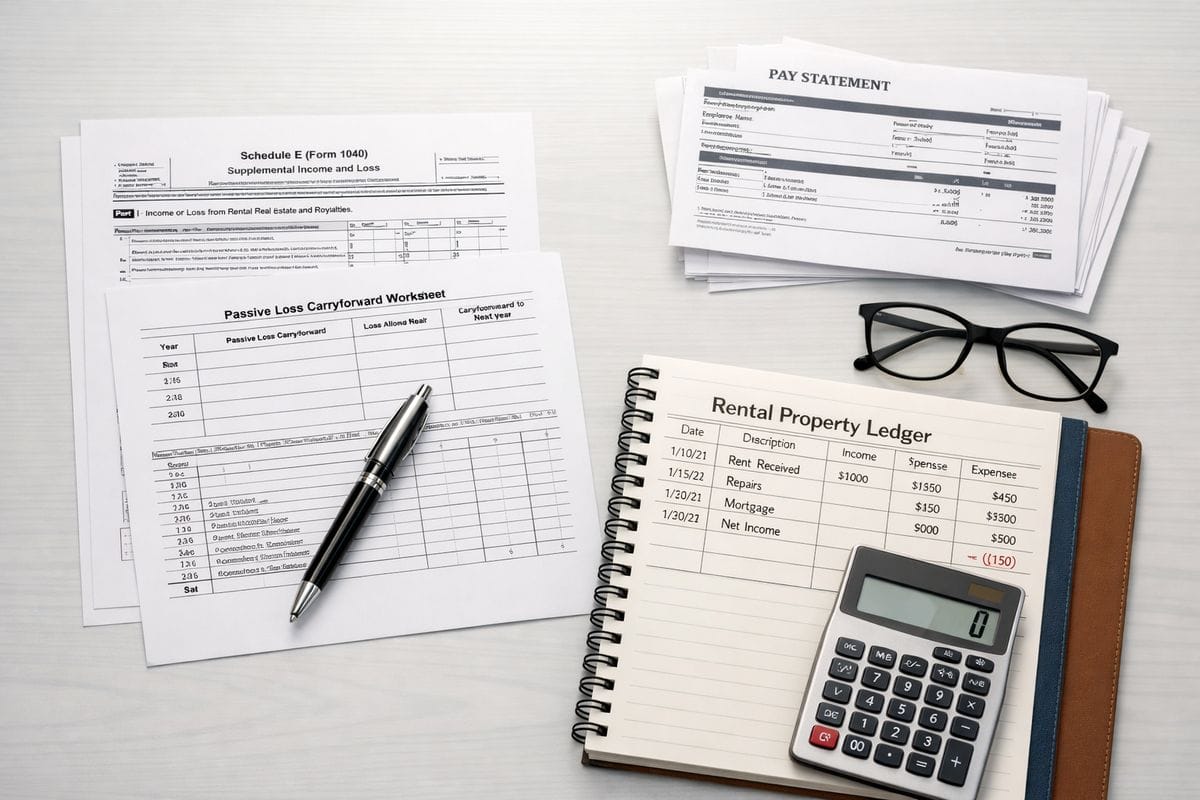
If Schedule E shows a loss and passive activity rules apply, Form 8582 may limit how much of that loss is currently deductible. Publication 527 specifically points owners to passive activity rules because rental real estate is generally passive by default.
This is the form many W-2 earners discover after assuming a rental loss would automatically reduce wages. It often does not. The loss gets partially allowed, fully disallowed, or carried forward based on participation and income limits.
Passive Activity Loss Rules: Why Many Rental Losses Do Not Offset W-2 Income
This is the main pain point for many investors. A rental loss on paper does not automatically offset W-2 income because rental real estate is generally passive activity. Passive losses usually offset only passive income unless an exception applies.
Why Rental Activities Are Usually Passive
The tax code generally treats rental activities as passive regardless of how much day-to-day involvement exists. That default rule blocks many wage earners from using rental losses against salary.
From a planning perspective, this means depreciation-heavy rentals often create suspended losses rather than immediate wage offsets. The economics of the property still matter, but the timing of tax benefit changes.
The $25,000 Special Allowance
There is a special allowance for certain owners who actively participate in rental real estate. Under IRS rules, up to $25,000 of losses can offset nonpassive income if active participation requirements are met and modified adjusted gross income stays within the threshold.
Active participation is a lower bar than material participation. Approving tenants, deciding on rental terms, and authorizing repairs can support active participation. But the allowance is not unlimited, and high income phases it out.
Income Phaseouts That Reduce the Special Allowance
The special allowance phases out as modified adjusted gross income rises above $100,000 and disappears at $150,000 or more. That is why many W-2 earners lose some or all of the benefit.
The business takeaway is blunt: if compensation is already strong, the tax value of rental losses may shift from immediate offset to future carryforward unless another planning route changes the result.
Suspended Passive Losses
Disallowed passive losses do not disappear. They are suspended and carried forward. Future passive income can absorb them, and a taxable disposition of the entire activity can free them under the applicable rules.
Suspended losses are a balance-sheet asset for tax planning. But only if tracked correctly. Lost schedules, inconsistent software carryovers, or poor grouping records can turn valid suspended losses into a filing mess years later.
Active Participation, Material Participation, and Real Estate Professional Status
These concepts get confused constantly, and the confusion leads to bad planning. They are not interchangeable.
Active Participation for the $25,000 Allowance
Active participation is the lower standard. If you make management decisions in a meaningful way, such as approving new tenants, setting lease terms, or authorizing repairs, active participation may exist.
This standard matters mainly for the $25,000 special allowance. It does not turn rental activity nonpassive by itself.
Material Participation for Activity-Level Tests
Material participation is a much more demanding standard used in activity-level tests under the passive activity rules. It generally requires significant, regular, and documented involvement.
For many traditional long-term rentals, material participation alone does not override the default rule that rentals are passive. That is why owners who hear “I materially participate” and assume wage-offset treatment are often disappointed.
Real Estate Professional Status
Real Estate Professional Status changes the framework if you satisfy the statutory tests. The two headline tests are well known: more than half of personal service time during the year must be in real property trades or businesses in which participation is material, and more than 750 hours must be performed in those real property trades or businesses.
Meeting those tests matters because rental real estate activities are no longer automatically passive if material participation also exists in the relevant activities. This is where grouping elections, hour tracking, and factual support become decisive. A loose estimate is not enough. Logs, calendars, and role descriptions should support the position.
Why Short-Term Rentals Follow Different Participation Logic
Certain short-term rentals follow different passive-activity logic because an activity with an average period of customer use of 7 days or less can fall outside the usual rental-activity definition under Section 469. That planning area is heavily discussed because it can convert losses into nonpassive losses if material participation is met.
The opportunity is real, but so is the compliance burden. You need the average stay calculation, booking records, personal-use analysis, and hour tracking. If those facts are weak, the planning thesis collapses.
At-Risk Rules and Other Limits Publication 527 References
Passive loss limits are not the only filter. At-risk rules can limit losses before passive rules are even applied.
What “At Risk” Means
“At risk” refers to the amount of money and property you have economically exposed to loss in the activity. Cash invested usually counts. Certain borrowed funds count if you are personally liable or otherwise economically exposed. Other borrowed amounts do not.
This matters because a paper loss larger than your at-risk amount is not currently deductible. The loss is limited at that stage first.
How At-Risk Limits Interact With Passive Loss Limits
The sequence matters. A loss can be limited under the at-risk rules before passive activity rules are applied. If the loss survives the at-risk test, passive-loss limitations then determine current deductibility.
That layering explains why some owners are surprised twice. First, part of the loss is blocked because insufficient amount is at risk. Then the remaining allowed loss is still passive and gets suspended.
Special Situations Rental Owners Need to Watch
The less-common scenarios are where expensive mistakes happen because owners rely on general landlord advice instead of applying the actual rules.
Casualty Losses and Disaster-Related Damage
Publication 527 points owners to casualty-loss rules for rental property, and the IRS confirms that casualty losses are part of its coverage. If rental property is damaged by fire, storm, flood, or another casualty event, separate rules govern the loss calculation, insurance recovery, and timing.
Do not mix casualty treatment with ordinary repairs. A post-disaster rebuild often includes both restoration costs and casualty-loss analysis, and those are not the same question.
Renting Part of a Property
If only part of a property is rented, such as a basement unit, spare bedroom, or one side of an owner-occupied duplex, expenses must be allocated between rental and personal portions. Square footage is often relevant, and time-based allocation may also matter if the space is not rented for the full year.
This is one of the clearest examples of why “my house has rental income” does not mean the whole property became a rental. Only the rented portion gets rental treatment.
Changing a Property From Personal Use to Rental Use
When a former home or second home is converted to rental use, depreciation does not simply start from original purchase price without adjustment. Basis rules become more technical, and fair market value on the conversion date can matter for loss calculations.
This is another area where owners routinely import the wrong number into the depreciation schedule. The property history matters. So does the capital-improvement history before conversion.
Selling Rental Property and Depreciation Recapture
Depreciation lowers basis, which increases gain at sale. Part of that gain may be taxed as depreciation recapture. Owners who ignored depreciation during ownership are often shocked here because the IRS generally looks to depreciation allowed or allowable, not just depreciation actually claimed.
Publication 523 becomes relevant if the property has both residence history and rental history. Mixed-history sales require care because the home-sale exclusion and depreciation recapture rules do not erase each other.
Short-Term Rentals, State Rules, and the Limits of Publication 527
Publication 527 addresses federal income tax treatment for residential rentals. It does not solve every tax issue facing a short-term rental operator.
Federal Income Tax Versus Local Lodging Tax
Schedule E reporting is a federal income-tax matter. Occupancy tax, hotel tax, sales tax, and local lodging taxes are different obligations imposed by states and municipalities.
A short-term rental can be fully compliant on federal income tax and still be out of compliance locally. Registration requirements, permit rules, zoning restrictions, and transient occupancy taxes often sit outside Publication 527 entirely.
Why Airbnb-Style Hosts Need Extra Documentation
Platform statements, booking calendars, cleaning-fee records, refund records, occupancy-tax collections, and host payout reports are all part of the documentation stack for short-term rentals. Those records support both federal tax treatment and local compliance.
Short-term rentals also create more classification pressure. Average stay length, guest-fee structure, owner-use days, and platform-collected taxes all affect the analysis. Loose bookkeeping is not workable here.
Recordkeeping: The Documentation That Protects Deductions
What the field data shows is clear: owners who document day counts, fair rental value, and capital costs correctly preserve more deductions and spend less time responding to notices. Recordkeeping is not clerical overhead. It is tax defense.
The Five Records Every Rental Owner Should Maintain
Five record sets matter most:
- Rent records
- Expense receipts
- Day-count logs
- Basis and improvement files
- Depreciation schedules
Rent records should tie lease terms, deposits, reimbursements, and payment dates together. Expense receipts should be organized by category and property. Day-count logs should show rental, personal, vacancy, and repair periods. Basis files should include purchase documents, settlement statements, land-building allocation support, and capital-improvement invoices. Depreciation schedules should be retained every year, not just when the return is first filed.
How to Track Rental Days, Personal Days, and Repair Days
Use a calendar system that identifies each day’s status. Rented at fair value. Personal use. Repair or maintenance day. Vacant but available. That record should tie to bookings, invoices, travel receipts, and communications.
This matters most for vacation homes. If 20 days were personal and 150 were rented, you need proof. If six days were repair days and not personal days, you need stronger proof. Unsupported memory is not documentation.
Documentation for Fair Rental Price
Support fair rent with comparable listings, seasonal market data, screenshots, rate histories, and lease terms. For long-term rentals, keep comparable lease listings or broker analyses. For short-term rentals, save local comp data by season and bedroom count.
If below-market occupancy exists, mark it clearly. Trying to treat a discounted family stay as fair-rent occupancy is how personal-use disputes start.
TCJA Sunset and 2026-2027 Planning: What Changes and What Stays the Same
Publication 527’s core rules are not the part of the tax system scheduled to vanish when TCJA provisions sunset. Rental income inclusion, expense classification, depreciation structure, vacation-home rules, and passive-loss architecture remain the baseline framework.
That distinction matters because many owners are focusing on future tax rates while ignoring the mechanics that determine taxable rental income in the first place. Strategic planning for 2026 and 2027 starts with a clean Publication 527 foundation.
What Publication 527 Rules Stay Intact
The core rental-tax mechanics remain intact: what counts as rent, how personal use is measured, how expenses are allocated, how residential rental property is depreciated, and how passive-loss rules apply. Those rules are the chassis of the return.
That means cleanup work should happen now, not later. If basis schedules are wrong, if improvements were expensed improperly, or if day counts were never documented, sunset planning built on those records will be weak.
Which Broader Tax Rules Deserve Immediate Review Before Sunset
The broader tax rules outside Publication 527 that deserve immediate review include individual rate structure, the qualified business income deduction where applicable, and itemized deduction limits. Those provisions affect after-tax returns even though they are not defined by Publication 527 itself.
For some portfolios, the larger planning question is timing. If individual rates rise after sunset, accelerating income or deductions across years becomes more valuable. If QBI eligibility is in play for a rental operation, entity structure and recordkeeping deserve immediate review.
Portfolio Moves to Evaluate Before 2026
The recommendation is to evaluate five areas before 2026. Review timing of major improvements. Revisit grouping elections and participation records. Reassess Real Estate Professional Status support. Validate suspended-loss schedules. Prepare sale, conversion, or disposition decisions with recapture in mind.
This is where Publication 527 becomes a strategic tool. A portfolio with clean depreciation schedules and documented use patterns gives you options. A portfolio with guessed numbers does not.
Common Misconceptions About IRS Publication 527
Misconceptions around Publication 527 are expensive because they sound plausible. Here are the ones that cause the most damage.
“If the Property Loses Money, the Loss Always Offsets Salary”
False. Rental losses are generally passive, and passive losses do not automatically offset wages. The $25,000 special allowance is limited and phases out at higher modified adjusted gross income. Real Estate Professional Status and certain short-term rental structures operate under different rules, but default salary offset treatment is not the rule.
“All Time Spent at the Property Counts as Rental Use”
False. Personal use, repair days, and below-market occupancy are different categories. A day at the property does not become rental use because a task was completed while there. If the stay was primarily personal, the day is personal.
“Everything Fixed in a Rental Is Immediately Deductible”
False. Repairs are generally deductible now. Improvements are capitalized and depreciated. Replacing a few shingles is not the same as replacing the entire roof. Repairing part of a fence is not the same as building a new one.
“If an Airbnb Is a Rental, the Rules Are Always the Same as a Long-Term Lease”
False. Short-term rentals can follow different passive-activity logic depending on average period of customer use and participation standards. They also create extra recordkeeping demands and local tax exposure.
How to Use Publication 527 as a Decision Tool, Not Just a Reference Manual
The best use of Publication 527 is not occasional lookup during tax season. It is an annual operating framework for classification, bookkeeping, and loss planning.
Phase 1: Classify the Property Correctly
Start by determining whether the property is a full-time rental, mixed-use dwelling, vacation home treated as a home, room rental, or occasional rental under the fewer-than-15-days rule. That classification decides which sections of Publication 527 control everything that follows.
If this first step is wrong, every downstream number is suspect.
Phase 2: Categorize Income and Expenses Cleanly
Set up books so rent, reimbursements, deposits, repairs, improvements, and personal costs are separated from day one. Do not rely on year-end reconstruction from a bank statement.
Current deductions come from clarity. Capitalization decisions come from clarity. Audit defense comes from clarity.
Phase 3: Test Loss Eligibility Before Filing
Before assuming a Schedule E loss is usable, test active participation, passive-loss limits, at-risk amount, and any Real Estate Professional Status position. If short-term rental logic is part of the strategy, verify average customer-use period and material participation records.
This phase protects expectations. A tax loss that cannot be used this year is not worthless, but it should not surprise you in April.
Phase 4: Coordinate Publication 527 With Related Forms and Advisors
Mixed-use property, large losses, short-term rentals, conversions from personal use, and major capital projects are the situations where professional review pays for itself fastest. A CPA or tax attorney should be involved before filing positions harden, not after the IRS questions them.
Publication 527 gives the core rules. Advisors help apply them when facts are layered, disputed, or unusually high-value.
The Recommendation for Rental Owners Reviewing Publication 527 This Year
The recommendation is direct: run an annual review around three priorities. Validate day counts. Confirm basis and depreciation schedules. Test passive-loss usability before year-end.
That process protects deductions, improves filing accuracy, and positions the portfolio for 2026 and 2027 planning. If a property has mixed use, day counts decide deduction limits. If depreciation schedules are wrong, every year compounds the error. If passive losses are assumed usable without testing, projected tax savings are fiction.
Publication 527 is not just an IRS booklet. It is the control document for rental-property tax outcomes. Owners who treat it that way preserve cash flow and keep more options open across the portfolio.
Frequently Asked Questions
Is IRS Publication 527 only for vacation rentals?
No. Publication 527 covers residential rental property broadly, including long-term rentals, vacation homes, room rentals, and mixed-use dwellings. Vacation rentals get more attention because personal-use rules complicate the analysis, but the publication is not limited to that category.
Do you have to depreciate a residential rental property?
Yes. If the property is depreciable, depreciation is effectively mandatory because the IRS treats depreciation as allowed or allowable. Skipping the deduction usually means losing current tax benefit without avoiding basis reduction issues later.
If a vacation rental is used personally for 20 days and rented for 150 days, is it still a rental?
It is still a rental activity, but it is also treated as a home for tax purposes because personal use exceeds the greater of 14 days or 10% of fair-rental days. Ten percent of 150 is 15, and 20 is greater than 15. That triggers the vacation-home limitation rules.
Can rental losses offset W-2 income?
Usually not by default. Rental real estate is generally passive. Some owners qualify for the $25,000 special allowance through active participation, subject to income phaseouts. Other owners use Real Estate Professional Status or short-term rental rules if the facts support those positions.
What is the biggest mistake owners make under Publication 527?
The highest-cost mistakes are missing depreciation, expensing improvements as repairs, and miscounting personal-use days. Those three errors directly affect current deductions, future recapture, and the IRS classification of the property.
What forms usually go with Publication 527?
The most common forms are Schedule E for rental income and expenses, Form 4562 for depreciation, and Form 8582 for passive activity loss limitations. Depending on the facts, Publication 925, Publication 551, Publication 547, and Publication 523 also become relevant.