

IRS Pub. 527 for rental property is the IRS rulebook that tells you what rental income to report, what expenses to deduct, how depreciation works, and why so many rental losses get trapped instead of reducing current tax. If rental real estate affects your cash flow, your after-tax ROI, or your 2026 to 2027 planning, this publication matters far more than most owners realize.
What IRS Publication 527 Is and Why It Matters for Rental Property Owners
Publication 527 is the IRS guide for residential rental property. In plain English, it explains how your rental activity gets translated into taxable income, deductible expenses, depreciation deductions, and loss limitations on your federal return.
That is not just filing trivia. It affects how much taxable income your property produces, how fast improvements turn into deductions, whether a paper loss helps you now or gets suspended, and how exposed your return is if the IRS reviews it. For rental owners, those are business outcomes: cash flow, audit risk, and long-term return.
A lot of owners treat Pub. 527 as a once-a-year reference. That is the wrong approach. Based on analysis of how rental tax problems show up in practice, the owners with the best results use it as an operating framework. Classification happens up front. Recordkeeping happens monthly. Loss testing happens annually. Timing decisions happen before the year closes, not after.
What Pub. 527 Covers
Pub. 527 covers the full core of residential rental taxation: rental income, rental expenses, depreciation, casualty-related rules, passive activity limits, at-risk limits, and rules for vacation homes and personal use. It is broad enough to answer most day-to-day landlord tax questions, but focused enough to stay usable.
That breadth is exactly why it matters. A single property can move through several tax categories in one year. A former primary residence becomes a rental. A security deposit turns into income after a lease violation. A new roof becomes a capital asset instead of an expense. A loss gets limited by the passive activity rules. Pub. 527 is where those mechanics start.
Who Should Use It
If you own a long-term rental, this applies to you. If you converted a home into a rental, this applies to you. If you rent a vacation property part of the year and use it personally the rest of the year, this applies to you. If you are comparing long-term rental tax treatment against short-term rental treatment, this still applies to you, though other rules become just as important.
That last group deserves extra attention. Short-term rental owners often assume the tax treatment is the same as a standard rental because the property is still real estate. It is not that simple. Average stay length, personal services, and material participation can move the activity into a different framework entirely.
What Pub. 527 Does Not Do by Itself
Pub. 527 is the starting point, not the entire tax code. Most individual landlords report activity on Schedule E. Depreciation often runs through Form 4562. Losses interact with at-risk rules and passive activity rules. Some situations also pull in capitalization regulations, material participation standards, and entity-level rules.
That distinction matters because a lot of expensive mistakes happen when an owner reads one sentence from Pub. 527 and assumes the analysis stops there. It does not. The publication tells you the framework. Your actual tax result depends on the forms, code sections, and facts underneath it.


The Three Core Questions Pub. 527 Helps You Answer
At a practical level, Pub. 527 helps you answer three questions. First, what counts as rental income. Second, what expenses are deductible now versus recovered later through depreciation. Third, whether your losses are usable this year or suspended for future use.
Those three questions drive almost every federal tax outcome for residential real estate. If you answer them correctly, your return is usually in good shape. If you answer them badly, the errors compound fast.
What Must Be Reported as Rental Income
Rental income is more than the monthly rent check. You generally must report regular rent, advance rent, tenant-paid expenses, payments for cancelling a lease, and forfeited deposits that you keep. Owners miss this constantly, especially when money never hits the “rent” line in the bookkeeping system.
That is why gross rental receipts should be tracked broadly, not narrowly. Late fees, lease break payments, nonrefundable deposits, and utility bills paid directly by a tenant on your behalf all belong in the review.
What You Can Deduct Immediately vs. Depreciate Over Time
This is the highest-value distinction in the publication. Some costs are current expenses. You deduct them now. Others are capital expenditures. You recover them over time through depreciation.
The difference is not academic. Deducting a $9,000 roof repair now when it is actually a capital improvement does not improve your strategy. It weakens your return. On the other hand, capitalizing a true repair delays a deduction you were entitled to take immediately. Both errors reduce ROI.
Whether Your Losses Are Usable This Year
A rental can show a tax loss and still give you no current tax benefit. That is the frustration behind passive loss rules. Many W-2 investors assume depreciation and operating losses will offset salary income. In many cases, they do not.
Pub. 527 introduces this limitation, but the real planning issue is simple: you need to know whether your loss is passive, whether the $25,000 active-participation exception applies, whether at-risk rules limit you first, and whether special classifications such as short-term rental treatment or Real Estate Professional Status change the result.
How Rental Property Gets Classified Under IRS Rules
Classification drives the tax outcome. Two properties with the same revenue and the same expenses can produce very different tax results if one is a standard residential rental, one is a dwelling used as a home, and one is a short-term rental with hotel-like services.
Residential Rental Property
This is the standard case. You rent a property to tenants for residential use, you have little or no personal use, and the activity is treated as residential rental real estate. Income goes on Schedule E. Expenses are deducted under the rental rules. The building is generally depreciated over 27.5 years. Losses are generally passive.
This is the baseline from which most of Pub. 527 operates.
Dwelling Unit Used as a Home
A property becomes more complicated when it is both rented and used personally. At that point, you are no longer dealing with a clean rental-only asset. You are dealing with a dwelling unit used as a home, often called a vacation-home or mixed-use property.
Once personal use crosses the IRS threshold, deductions become limited. You still allocate income and expenses, but the ordering and amount of deductions change. The property stops behaving like a straightforward long-term rental from a tax perspective.
The 14-Day Rule
If a dwelling unit is rented for fewer than 15 days during the year, the rental income is not reported, and rental expenses are not deducted. That rule is one of the rare clean breaks in rental taxation.
For owners in vacation markets, that creates a very specific planning lane. A property rented for 10 high-value days during a local event can generate tax-free rental income at the federal level, but only if the annual rental period stays under the threshold. Once you hit day 15, the normal reporting rules return.
Short-Term Rentals and When They Stop Being “Rental Activities”
Here is where classification gets interesting. Under IRS rules, a short-term rental is not always treated as a rental activity for passive loss purposes. An average stay of 7 days or less often removes the activity from the default rental category. An average stay of 30 days or less with significant personal services can do the same. Short-term rental rules can move the activity into trade-or-business analysis instead of passive rental treatment.
That change matters because passive loss treatment, material participation, self-employment tax exposure, and even planning around the qualified business income deduction all become more relevant once the activity stops being a standard rental activity.

What Counts as Rental Income Under Pub. 527
Owners underreport rental income most often by thinking too narrowly. If money or value comes in because of the rental arrangement, it usually belongs in gross rental income unless a specific rule says otherwise.
Regular Rent and Advance Rent
Regular periodic rent is easy. Advance rent is where owners get caught. Advance rent is generally taxable when received, not when earned. If a tenant prepays last month’s rent today, that amount is income today.
That timing rule matters in lease-up periods, commercial-style residential arrangements, and long leases with prepaid rent. It can also distort annual results if you are not tracking cash receipts precisely.
Security Deposits
A refundable security deposit is generally not income when received if you plan to return it and the tenant is entitled to get it back under the lease. Once you keep part or all of that deposit because of unpaid rent, lease violations, or unrepaired damage, the retained amount becomes income.
The line is intent plus outcome. If the deposit is a true refundable deposit, it stays off income at receipt. If it is kept, it converts into income at that point.
Tenant-Paid Expenses and Reimbursements
If a tenant pays your expense directly, that payment is generally rental income to you. A simple example: your tenant pays a water bill that you were legally required to pay as owner. You received economic value because your obligation was satisfied. That amount generally counts as rent.
This rule matters most when leases are informal. Owners frequently leave these items off the books because no money passed through the operating account. That is exactly why the IRS looks at them.
Lease Cancellation Payments and Other Less-Obvious Income
Payments for cancelling a lease are rental income. Barter arrangements also count. If a tenant provides services instead of cash and that service satisfies rent, the value belongs in income.
These are the entries that disappear in casual bookkeeping. They should not. Based on field data from rental audits and cleanup engagements, less-obvious income items are where inaccurate gross receipts start, especially in self-managed portfolios.
Which Rental Expenses Are Deductible
Pub. 527 allows deductions for the ordinary and necessary costs of operating rental property. The broad categories are familiar. The classification inside those categories is where the real tax value sits.
Typical Current Deductions
Typical rental deductions include mortgage interest, property taxes, insurance, utilities, management fees, advertising, legal and professional fees, HOA dues where applicable, supplies, and routine operating costs. If the expense relates directly to keeping the rental in service and producing income, it usually belongs somewhere in this group.
That said, “usual landlord cost” is not the same as “current deduction.” Plenty of common landlord spending is capital in nature. The label on the invoice does not control the tax treatment. The substance does.
Repairs vs. Improvements
This is the section most owners need to get right, because it directly drives current deductions and future depreciation.
A repair keeps property in ordinary operating condition. An improvement betters the property, restores it, or adapts it to a new or different use. Restoration and adaptation are not separate from capitalization. They are reasons capitalization is required.
The cleanest way to apply the rule is to use a decision tree.
Start here: did the expenditure simply fix existing damage or wear without materially adding value, extending useful life in a major way, or changing use? If yes, you are usually looking at a repair.
If not, ask whether the work made the property better than it was before. If yes, it is an improvement.
If not, ask whether the work returned the property to service after major deterioration, casualty, or replacement of a major component. If yes, it is a restoration.
If not, ask whether the work changed the property to a new or different use. If yes, it is an adaptation.
That framework is decisive. It also lines up with how capitalization rules are actually applied in practice.
Repair examples and tax treatment
Repairs are generally deducted currently because they maintain the property rather than materially improve it. Five common examples make the distinction clearer:
Replacing a broken window pane after tenant damage is a repair. You are fixing an existing component, not upgrading the building.
Patching a roof leak in one area is a repair. You are stopping a leak, not replacing the roofing system.
Fixing a leaking faucet or replacing a defective garbage disposal with a comparable unit is a repair.
Repainting interior walls between tenants is generally a repair or maintenance item when it restores ordinary condition.
Repairing a section of damaged drywall after a plumbing leak is a repair.
In each case, the tax treatment is current deduction, assuming the work is not part of a larger capital project.
Improvement examples and tax treatment
Improvements are capitalized and depreciated because they make the property better or add new value. Five clear examples:
Installing a new roof is an improvement. It replaces a major building component and gets capitalized.
Remodeling a kitchen with new cabinets, countertops, and layout changes is an improvement.
Adding central air conditioning where none existed before is an improvement.
Replacing all windows in the building with upgraded energy-efficient units is generally an improvement.
Building a new deck or adding a room is an improvement.
For residential rental property, many of these costs are recovered over 27.5 years if treated as part of the building, though some components can fall into shorter lives if properly classified.
Restoration examples and tax treatment
Restorations also get capitalized. The tax treatment is not “repair” simply because the property was damaged first. Five useful examples:
Rebuilding major portions of a house after a fire is a restoration.
Replacing the entire HVAC system after the prior system failed beyond repair is generally a restoration or major-component replacement.
Replacing substantial structural framing after severe water damage is a restoration.
Restoring the property after casualty damage that required major reconstruction is a restoration.
Replacing an entire plumbing system in an older building is generally a restoration.
These are capital expenditures because you are returning a major component or substantial structural part to operating condition.
Adaptation examples and tax treatment
Adaptations are capitalized because you are changing the use of the property. Five examples:
Converting a garage into a rentable bedroom suite is an adaptation.
Turning a residential basement into a separate rental unit with new use and function is an adaptation.
Converting a former personal office space into a rentable studio apartment is an adaptation.
Reworking a single-family layout into a duplex configuration is an adaptation.
Converting a house into office space is an adaptation, even if the property remains income-producing.
The recommendation is simple: if the expenditure changes what the property is for, capitalize it.
Routine maintenance safe harbor
The routine maintenance safe harbor is frequently missed by self-preparing landlords. Recurring activities you reasonably expect to perform more than once during the property’s life to keep it in ordinary operating condition are generally treated as repairs, not improvements.
That includes recurring painting, replacing HVAC filters, caulking around tubs and windows, servicing a furnace, cleaning gutters, and similar repeated work. The point is maintenance, not betterment. If the work is expected to recur and simply keeps the property functioning, the tax treatment usually stays current.
Small taxpayer safe harbor
The small taxpayer safe harbor is another missed opportunity. For qualifying taxpayers with average annual gross receipts under $10 million, certain building improvements can be expensed if the annual amount paid for repairs, maintenance, and improvements on the building does not exceed the lesser of $10,000 or 2 percent of the building’s unadjusted basis.
A clear example shows the value. If your building’s unadjusted basis is $200,000, 2 percent is $4,000. Because $4,000 is less than $10,000, you can expense up to $4,000 of qualifying amounts for that building under this safe harbor instead of capitalizing them. That is immediate deduction value, and many landlords miss it entirely.
This is one reason year-round categorization matters. A safe harbor election only helps if your records separate buildings, basis, and annual spending accurately.
Travel, Local Transportation, and Home Office Limits
Travel tied directly to rental activity can be deductible, but only with discipline. Local mileage to inspect property, meet contractors, collect rent, or buy supplies belongs in the file only if you maintain a credible log. Driving around “for rental business” with no dates, miles, and purpose is not supportable.
The same standard applies to broader travel. If a trip has a clear rental business purpose and the documentation proves it, the related expense can be deductible. If the trip is mixed with personal activity and the business purpose is thin, the deduction fails. Home office deductions face the same problem. If the office is not used regularly and exclusively for the rental activity, the deduction is weak.
Casualty and Theft Loss References
Pub. 527 touches casualty-related issues, but additional IRS rules take over quickly once the facts get serious. Property damage from storms, fire, water, or theft often raises separate basis questions, insurance reimbursement issues, and restoration capitalization issues.
That is why casualty losses should never be treated as a simple “repair deduction” issue. You need the rental rules, the casualty rules, and the capitalization rules to line up.
Depreciation: The Tax Rule That Changes Your Real Return
Depreciation is one of the highest-value rules in residential rental taxation. It gives you a noncash deduction for the wear, aging, and use of income-producing property over time. That means your taxable income can be lower than your actual cash flow.
For rental owners, this changes the economics of ownership. Two properties with identical rent and identical loan payments can produce very different after-tax results depending on how depreciation is calculated and tracked.
What Property Can Be Depreciated
You can depreciate the building itself, certain building improvements, and depreciable assets used in the rental activity. You cannot depreciate land.
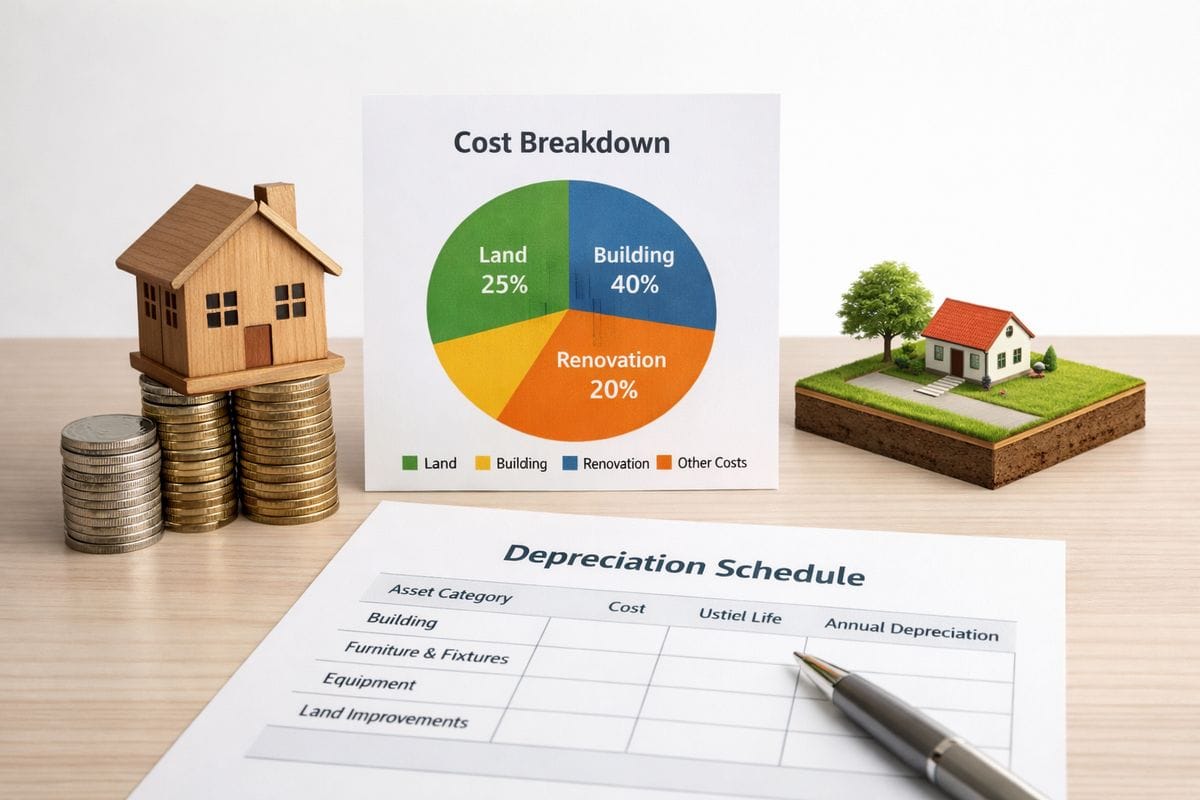
That land-versus-building split matters immediately at acquisition. If you buy a rental for $350,000 and assign the full amount to the structure, your depreciation deduction is inflated and wrong. Part of the purchase price must be allocated to land, which is nondepreciable.
When Depreciation Starts and Stops
Depreciation starts when the property is placed in service as a rental, not when you buy it and not when you first think about renting it. “Placed in service” means ready and available for rent. If you convert a former residence into a rental, the placed-in-service date is when it is ready and offered for rental use.
Depreciation stops when the property is retired from service, sold, converted back to personal use, or otherwise disposed of. That timing affects annual deductions and, later, gain calculations and depreciation recapture.
Residential Rental Property and the 27.5-Year Recovery Period
Residential rental buildings are generally depreciated over 27.5 years. That is the standard MACRS recovery period for residential rental real estate.
This period matters because it governs the annual deduction on the building portion of your basis. Longer life means slower deductions. That is why cost segregation studies get attention. If some assets can be separated into shorter-lived categories, deductions accelerate. But the building itself remains on the residential rental schedule unless another rule applies.
Basis: How to Calculate the Amount You Depreciate
Basis is the amount you recover through depreciation, subject to the proper life and method. Start with acquisition cost. Add certain closing costs that must be capitalized. Then allocate between land and building.
If you inherit property, basis rules are different. If you convert a personal residence into a rental, special care is required because the depreciable basis may depend on fair market value and adjusted basis at conversion. This is one of the most error-prone areas in rental taxation.
The practical rule is straightforward: basis is not just the purchase price, and the entire property cost is not depreciable. If you converted a home into a rental, you need a defensible basis file with purchase documents, improvement history, and value support as of conversion.
Form 4562 and Depreciation Schedules
Depreciation and amortization are commonly reported on Form 4562 in the proper circumstances. More important than the form itself is the fixed-asset schedule behind it. Every property should have a depreciation schedule showing placed-in-service dates, original basis, land allocation, each capital improvement, each asset life, and annual depreciation claimed.
If you skip depreciation, the problem does not disappear. Your basis still gets reduced by depreciation allowed or allowable. That means you can lose the current deduction and still face recapture or reduced basis later. That is a double cost. It is one of the most expensive unforced errors in rental tax reporting.
How to Report Rental Income, Expenses, and Losses
Pub. 527 becomes useful when it connects to the filing process. The publication explains the rules. The tax return applies them.
Schedule E as the Main Reporting Form
Most individual landlords report rental activity on Schedule E, usually property by property. Schedule E is where rental income, expenses, and net profit or loss usually land on an individual return.
Property-level reporting matters because one building can have improvements, casualty costs, mixed-use issues, or passive limitations that another property does not. Combining everything in a single internal ledger without property separation is a recipe for errors.
When Form 4562 Is Required
Form 4562 is used for depreciation and amortization reporting, especially in years involving new assets, new improvements, or other first-year depreciation items. If you place property in service, add capital improvements, or claim depreciation for qualifying assets, this form often enters the filing package.
That is why a year-end list of “major spending” is not enough. The preparer needs date, amount, description, asset category, and placed-in-service date for each capital item.
Information Reporting Rules, Including Form 1099-NEC
If you pay contractors $600 or more, information reporting rules may require Form 1099-NEC. That means collecting W-9 forms before payment becomes the smart move, not an afterthought. Owners who skip contractor documentation often find out in January that the information needed to file is missing.
This is basic compliance, but it also protects deductions. If the contractor payment records are weak, the entire expense file gets weaker.
Property-Level Recordkeeping That Supports the Return
The minimum standard is straightforward: track rent collected, deposits, expenses by category, improvements separately from repairs, basis data, placed-in-service dates, contractor payments, and digital receipts. Every entry should tie to a property.
That level of detail reduces tax prep time, lowers error rates, and creates time-to-value from professional support. A CPA cannot fix missing basis records or vague invoice descriptions after the fact. Good reporting starts with property-level records all year.
Passive Activity Rules: Why Rental Losses Often Get Suspended
This is the part that frustrates high-earning landlords most. Your rental shows a tax loss. Your W-2 income is high. You expect the loss to offset salary. Then it does not.
Why Rentals Are Usually Passive by Default
Rental real estate is generally passive by default, even if you spend substantial time managing it. That rule surprises owners because active management feels nonpassive in ordinary language. Tax law does not use ordinary language here.
Under the passive activity rules, rental real estate losses are generally passive losses and do not offset wages, portfolio income, or business income unless a specific exception applies. Passive rental loss rules are the reason many depreciation-driven losses produce no current benefit for W-2 earners.
How Suspended Passive Losses Work
If your passive loss is disallowed this year, it is generally carried forward. It does not vanish. Suspended passive losses usually stay with the activity and can be used against future passive income from that activity or become usable on a fully taxable disposition.
That carryforward has value, but delayed value is still delayed. From a planning standpoint, the question is not just whether the loss exists. The question is when it monetizes.
At-Risk Rules vs. Passive Loss Rules
These are separate systems, and they apply in sequence. At-risk rules come first. Passive loss rules come after.
At-risk rules limit deductions to the amount you actually have at economic risk in the activity. If debt is nonrecourse or your exposure is otherwise limited, your deductible loss may be reduced before passive analysis even begins. Only after the at-risk amount is determined do passive loss limitations apply.
This distinction matters because a lot of owners talk only about passive losses when the first bottleneck is actually at-risk limitation.

The $25,000 Special Allowance for Active Participation
For many smaller landlords, this is the most important exception in the rental loss rules. It is also one of the most misunderstood.
What Active Participation Means
Active participation is a relatively low threshold compared with material participation. If you make management decisions in a meaningful way, you may meet it. Approving tenants, setting rental terms, and authorizing repairs are classic examples.
That is hands-on involvement, but it is not the same thing as full-scale operational dominance. You do not need 500 hours. You do not need to do everything yourself. You need a real role in management decisions.
Ownership Requirements
To qualify for the special allowance, you generally must own at least 10 percent of the property by value and actively participate. Limited partnership interests do not qualify for this exception.
That ownership test gets overlooked in syndicated or partially owned arrangements. If your stake is structured the wrong way, the active-participation allowance is gone before the analysis even starts.
MAGI Phaseout: $100,000 to $150,000
The special allowance can permit up to $25,000 of rental real estate losses to offset nonpassive income. But the benefit phases out as modified adjusted gross income rises. The phaseout starts at $100,000 and is fully gone at $150,000.
The reduction is mechanical: the allowance falls by 50 cents for every dollar of modified AGI above $100,000. If modified AGI is $120,000, you are $20,000 into the phaseout range, so the allowance is reduced by $10,000. That leaves a maximum allowance of $15,000. If modified AGI is $140,000, the reduction is $20,000, leaving only $5,000. At $150,000, the allowance is zero.
For W-2 earners, this is where tax planning stops being theoretical. Income timing, retirement contributions, and above-the-line deductions can directly affect whether rental losses are usable.
Why This Rule Drives Tax Planning Before 2026-2027
The 2026 to 2027 planning issue is not that Pub. 527 changes at its core. The planning issue is that broader tax law changes affect taxable income, rate structure, and deduction value. If your modified AGI hovers around the phaseout zone, small changes in taxable income can determine whether the $25,000 allowance produces current value.
That means tax planning should focus on total household income, timing of deductions, and timing of income recognition. For owners near the threshold, preserving loss usability can produce a better after-tax result than chasing gross income growth with no tax coordination.
Real Estate Professional Status and When It Changes the Outcome
Real Estate Professional Status, often shortened to REP status, is one of the most overused terms in real estate tax conversations. It is also one of the most misunderstood. It does not mean “serious investor.” It means you satisfy a specific statutory test.
Active Participation vs. Material Participation
Active participation belongs to the $25,000 special allowance. Material participation belongs to the broader passive activity analysis. They are not interchangeable.
That distinction matters because some owners hear that they “actively manage” properties and assume rental losses are fully deductible. That is wrong. Active participation can unlock the special allowance, but it does not turn the activity nonpassive by itself. Material participation is a separate and higher standard.
The Two Main Tests for Real Estate Professional Status
To qualify as a real estate professional for passive loss purposes, you generally must satisfy two tests. More than half of your personal services during the year must be performed in real property trades or businesses in which you materially participate. You also must perform more than 750 hours of services during the year in those real property trades or businesses.
Both tests matter. Passing the 750-hour test alone is not enough if your primary job still consumes most of your personal service time. This is why REP status is often unrealistic for full-time W-2 earners with demanding non-real-estate jobs.
Why Real Estate Professional Status Does Not Automatically Solve Everything
Even if you qualify as a real estate professional, rental losses do not automatically become deductible. You still need material participation in the rental activity, and grouping decisions can matter. If your rentals are separate activities and your participation is spread thinly, you can still lose the nonpassive treatment you expected.
Recordkeeping also matters more than owners admit. Hour logs, calendars, task descriptions, and grouping consistency matter because REP positions get tested on documentation. Informal statements like “real estate is basically my full-time job” do not survive scrutiny.
Best-Fit Scenarios for Evaluating REP Status
The best-fit scenario is a high-income household with meaningful rental losses, enough hours in real estate to support the tests, and enough discipline to maintain strong records. That usually means a spouse with substantial real-estate involvement, a portfolio large enough to justify formal tracking, or a real transition away from non-real-estate work.
If that is not your fact pattern, the recommendation is not to force REP status. Focus on the $25,000 allowance, short-term rental classification where appropriate, and strong long-term loss planning instead.
Vacation Homes, Personal Use, and Mixed-Use Properties
Mixed-use property is where simple rental tax rules become fact-heavy fast. Personal use changes deduction limits, expense allocation, and the overall treatment of the property.
Counting Personal-Use Days Correctly
Personal-use days include more than your own vacations. Family use, below-market rentals to relatives, and certain non-income uses can count as personal use. That means your calendar is part of your tax file.
Accuracy matters because day count drives classification. Cross the threshold for a dwelling used as a home, and the deduction rules tighten. Stay below it, and the property may remain a straightforward rental.
Allocating Expenses Between Rental and Personal Use
When a property has both rental and personal use, expenses must be allocated. Mortgage interest, taxes, utilities, insurance, maintenance, and similar costs get divided between rental use and personal use based on the applicable allocation method.
That split affects both current deductions and loss treatment. You do not get to treat a mixed-use vacation property as if every dollar was a pure rental expense.
Deduction Limits for a Home Used as a Residence
If personal use crosses the applicable threshold, the dwelling is treated as a home for tax purposes. At that point, rental deductions become limited, and losses generally cannot be used to create or increase a rental loss beyond the income limitation framework for that type of property.
This is one reason mixed-use property needs property-level calendars and disciplined booking records. Without them, the classification is guesswork.
Short-Term Rental Tax Treatment: Where Pub. 527 Intersects With Business Rules
Short-term rentals sit at the intersection of rental rules and business-activity rules. Owners often focus only on Airbnb income and expense categories. The actual tax result depends on classification first.
Average Stay of 7 Days or Less
If the average customer use is 7 days or less, the activity often stops being a rental activity for passive loss purposes and moves into trade-or-business analysis. That can be a major planning advantage because material participation may allow losses to offset nonpassive income.
This is why short-term rental investors track booking data carefully. Average stay is not a side metric. It is a tax classification metric.
Average Stay of 30 Days or Less With Significant Personal Services
The second threshold applies when the average stay is 30 days or less and significant personal services are provided. Services such as daily cleaning, concierge support, meals, or similar guest-facing labor can push the activity further away from passive rental treatment.
The key issue is not basic maintenance between guests. The issue is service level and frequency relative to the rental charge. If your operation looks increasingly like hospitality, your tax analysis should reflect that.
Material Participation Tests That Matter for Short-Term Rentals
Once the activity is outside default rental treatment, material participation becomes central. The most practical tests include more than 500 hours of participation, doing substantially all the work, or spending more than 100 hours with no one else participating more than you.
For short-term rentals, logs are not optional. You need dates, tasks, hours, and a clear record of who performed the work. Without that file, the nonpassive position is weak.
Why Short-Term Rental Classification Changes Tax Strategy
Short-term rental classification changes passive loss usage, trade-or-business analysis, self-employment tax questions, and the value of planning around material participation. It also affects whether the activity behaves more like a classic rental or more like an operating business.
That means your tax strategy should follow your operating model. If the property functions like hospitality, tax planning should not be built on assumptions meant for long-term leases.
Tax Law Changes Through 2026-2027: What Changes and What Stays the Same
A lot of rental owners are asking the wrong question here. The question is not “Will Pub. 527 disappear or be rewritten?” It will remain foundational because the core mechanics of rental taxation do not depend on one temporary tax package. The real question is how broader federal tax changes affect the value and timing of deductions, losses, and income from rental property.
What Stays the Same Inside Pub. 527
The core mechanics remain the same: what counts as rental income, what qualifies as a deductible rental expense, how residential rental property is depreciated, how personal use affects treatment, and how passive activity architecture limits losses.
Those rules are the foundation. Even when rate structures and expensing incentives change, the underlying rental accounting framework remains the same.
TCJA Sunset Pressure Points for Rental Owners
The pressure points are outside the basic definition of rental income and expenses. Rate changes, deduction structure changes, income thresholds, and the value of loss utilization are where planning matters. If ordinary rates increase, current deductions become more valuable. If income thresholds move, passive loss exceptions become more or less useful depending on your income profile.
That is why 2026 to 2027 planning is a tax-rate and timing problem as much as a rental-rule problem. The property rules tell you what is allowed. The broader tax environment determines how valuable those allowed deductions are.
Bonus Depreciation, Section 179, and Interest Deduction Changes
Based on current guidance discussed in industry analysis, 100% bonus depreciation has been restored for qualifying property placed in service after Jan. 19, 2025 through Dec. 31, 2030. This matters for rental owners because certain components identified through cost segregation, such as land improvements and shorter-life personal property, can qualify even though the residential building itself remains on a longer recovery schedule.
Section 179 limits have also increased, which improves expensing flexibility for qualifying property, though rental real estate has limitations and does not get blanket access to full expensing on building costs. Business interest deduction rules using an EBITDA-based calculation also improve deductibility for some real-estate-related operations.
The recommendation is to separate building basis from bonus-eligible components instead of treating every acquisition as one undifferentiated 27.5-year asset. If the property has enough value in short-life components, the tax acceleration can materially improve after-tax ROI.
What the Field Data Shows About Timing Decisions
Field data shows that timing decisions matter most in four areas: acquisition timing, improvement timing, income recognition, and depreciation acceleration. Owners who place qualifying assets in service within favorable windows capture more current deductions. Owners who misclassify spending or delay documentation lose value even when the tax law is favorable.
That points to a clear recommendation. Review acquisition and renovation timelines now, not after year-end. If deductions are more valuable in the current rate environment or before broader law changes take effect, accelerate the work and document it properly. If passive limits block current use anyway, evaluate whether deduction timing should be coordinated with income timing or classification changes.
State and Local Rules That Pub. 527 Does Not Control
Federal rental tax rules do not control local property tax classification, licensing rules, occupancy restrictions, or state income-tax treatment. That mismatch creates real planning risk.
Property Tax Classification Differences
Montana is a good example. Under Montana’s 2026 property tax rules, long-term rentals generally need 28 or more days of rental use for at least 7 months of the year to qualify for reduced residential treatment. Second homes and short-term rentals are taxed at a higher flat rate.
That local classification has obvious cash-flow consequences. A property that works fine under federal rental rules can still face less favorable local tax treatment if it is used as a short-term rental or second home.
Why Federal Classification and Local Classification Can Diverge
A property can be a rental for federal income-tax purposes and still be classified differently for local property-tax purposes. It can also satisfy local rental definitions and still trigger short-term rental business analysis under federal passive activity rules.
That divergence means one label is never enough. You need a federal income-tax classification, a state income-tax treatment review, and a local property-tax and licensing review. Treating them as the same system creates avoidable compliance risk.
The Most Common Pub. 527 Mistakes That Cost Owners Money
Most rental tax mistakes are not exotic. They are basic classification failures repeated year after year.
Missing Income Items
Owners miss advance rent, tenant-paid bills, retained deposits, and informal payments. If your rent ledger does not reconcile to bank deposits and lease events, your gross rental income is probably wrong.
That is why every payment related to occupancy should be reviewed, not just the monthly rent line.
Deducting Improvements as Repairs
This is a repeat audit issue for a reason. Owners want the current deduction. The IRS wants the correct classification. If you replace a roof, remodel a kitchen, or upgrade major systems, you are usually dealing with a capital expenditure, not a repair.
Correct classification protects the deduction because it places the cost on the right depreciation schedule instead of inviting adjustment later.
Failing to Start Depreciation on Time
Skipped depreciation is expensive because basis still gets reduced by depreciation allowed or allowable. You lose the annual deduction and still absorb the basis impact. That means less current tax benefit and potentially more gain or recapture later.
Once a rental is placed in service, depreciation needs to start on time.
Confusing Active Participation, Material Participation, and REP Status
These are different standards with different roles. Active participation is for the $25,000 allowance. Material participation is for passive analysis. REP status is a gateway test for certain rental activities, not a blanket permission slip.
Mix them together and your tax planning falls apart.
Weak Documentation
Weak documentation is the common denominator behind bad outcomes. The minimum standard is digital receipts, contracts, mileage logs, before-and-after records for improvements, and property-level accounting. Anything less creates preventable friction, missed deductions, and weaker audit defense.
A Practical Recordkeeping System for Using Pub. 527 Correctly
Good tax outcomes come from systems, not memory. The recommendation is to run each property with a tax file that is current at all times.
The Five Records to Maintain for Every Property
Every property should have five core records:
- Income ledger
- Expense ledger
- Depreciation schedule
- Personal-use calendar
- Contractor and payment file
That set covers the core tax questions: what came in, what went out, what gets depreciated, how the property was used, and who got paid.
Monthly Review Process
Use a monthly review process, not a year-end scramble. Reconcile rent receipts to bank deposits. Categorize each expense. Flag anything that looks like an improvement, restoration, or adaptation. Update the depreciation schedule when capital work is placed in service. Store invoices and contracts in digital form tied to the property and month.
That process takes less time than reconstructing a year from bank statements and text messages. It also reduces errors before they become filing problems.
What to Hand to a CPA or Tax Preparer
The best package includes a property-by-property income summary, categorized expenses, a list of capital improvements with dates and invoices, contractor payment totals, prior depreciation schedules, loan interest statements, property tax statements, and a personal-use calendar where relevant.
That package lowers prep time, reduces cleanup work, and improves accuracy. It also gives your preparer enough information to test passive loss eligibility instead of guessing from a net income number.
Frequently Asked Questions About IRS Pub. 527 for Rental Property
Does Pub. 527 Apply to an LLC-Owned Rental?
Yes. The underlying rental income, expense, depreciation, and personal-use concepts still apply. The filing mechanics depend on how the LLC is taxed. A single-member LLC usually flows to the owner’s individual return, while a partnership or corporate structure changes the reporting form. The rental rules still matter either way.
Can Rental Losses Offset W-2 Income?
Usually not by default, because rental real estate losses are generally passive. The main exceptions are the $25,000 special allowance for active participation, Real Estate Professional Status combined with material participation, and certain short-term rental situations that fall outside default rental activity treatment.
Is a Short-Term Rental Covered by Pub. 527?
Yes, but not exclusively. Pub. 527 still helps with income, expenses, and depreciation. The bigger issue is classification. If average stay length or guest services push the activity out of the default rental category, material participation and trade-or-business analysis become just as important as Pub. 527.
What Happens If a Primary Residence Becomes a Rental?
You need to determine the placed-in-service date, establish the correct depreciable basis, allocate land and building, and begin depreciation on time. This is one of the most detail-sensitive transitions in rental taxation, so records from the original purchase and all later improvements need to stay with the file.
Where to Find the Current Version of Pub. 527
Use the current IRS page for Publication 527 and download the latest revision directly from the IRS website. Check that page for related forms, including Schedule E and Form 4562, and review recent developments before filing.
The Recommendation: How to Use Pub. 527 as a Tax-Planning Tool, Not Just a Filing Reference
The recommendation is direct: use Pub. 527 as a classification system, not just a filing reference. Classify each property correctly. Separate repairs from improvements, restorations, and adaptations as costs occur. Apply the routine maintenance and small taxpayer safe harbors where available. Maintain a real depreciation schedule instead of recreating one at sale. Test passive loss eligibility every year, not only when a loss appears. Review 2026 to 2027 timing decisions now, while acquisition timing, improvement timing, and income timing can still be shaped.
That is how rental tax reporting stops being reactive. More important, that is how rental property produces stronger after-tax ROI with fewer surprises.