
Apartment building tax depreciation is the IRS-approved write-off that lets you recover the cost of an apartment building over time, and it is one of the biggest cash-flow advantages in multifamily investing. If single-family rentals taught you the value of 27.5-year depreciation, apartment building tax depreciation shows what happens when that same rule meets larger basis, more components, and far more opportunities to accelerate deductions.
Why Apartment Building Tax Depreciation Is a Major Cash-Flow Advantage
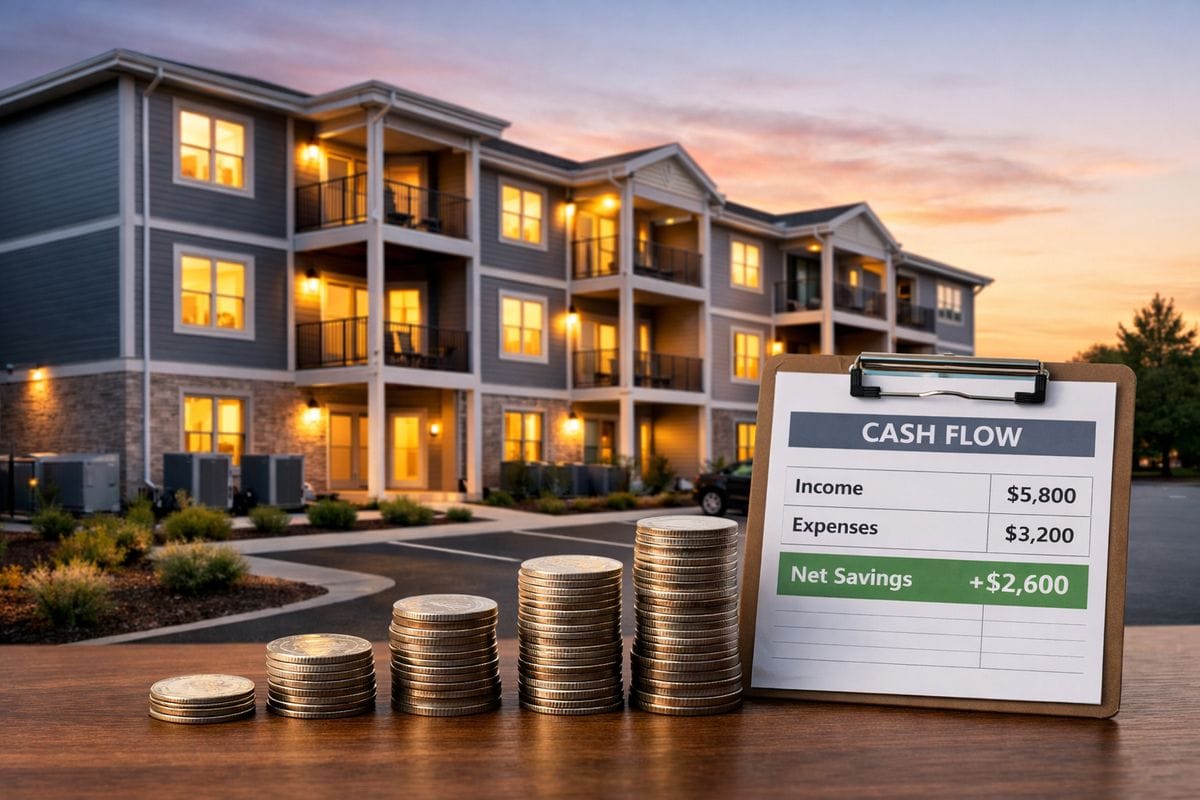
The strategic stake is simple: depreciation lowers taxable income without requiring a current cash outlay. That changes your after-tax cash flow, your debt service coverage, and your ability to reinvest. On apartment deals, that effect is stronger than many first-time multifamily buyers expect.
An apartment building already starts from an advantaged position because qualifying residential rental property uses a 27.5-year recovery period instead of the 39-year period that applies to standard nonresidential property. That means your baseline deduction arrives faster. Based on analysis of the recovery periods alone, residential rental depreciation runs about 30% faster than standard commercial property.
But the real big tax win is not the baseline schedule. It is acceleration. When a cost segregation study identifies shorter-life assets inside the property, and when bonus depreciation applies to those assets, a large share of deductions moves into the first year instead of being spread over decades. That front-loaded deduction improves time-to-value immediately. It gives you more cash to fund renovations, reserves, distributions, or the next acquisition.
That is why apartment buildings occupy such a strong tax position. You get the faster base schedule of residential rental property and the asset complexity of a commercial-size building. A 20-unit building contains repeated appliances, flooring, cabinets, unit-specific HVAC equipment, parking surfaces, site lighting, landscaping, and common-area fixtures. A single-family rental has some of that. An apartment building multiplies it across units.
What Apartment Building Tax Depreciation Actually Means
Depreciation is the tax system’s way of letting you recover the cost of income-producing property over time. In plain English, instead of deducting the cost of a building all at once, you deduct it gradually across a set IRS recovery period. That deduction applies to the building and qualifying improvements, not the land.
That distinction matters. Depreciation is not an estimate of market value. Your apartment building can appreciate in the real world while still generating annual depreciation deductions on your tax return. Tax depreciation follows code-based schedules, not Zillow, broker opinion, or sale comps.
The foundation is your depreciable basis. That usually starts with the portion of your acquisition cost allocable to the building, plus certain capitalized costs. Land never enters the depreciation schedule because land is not depreciable.
The Core Rule for Apartment Buildings
Apartment buildings generally qualify as residential rental property and use 27.5-year straight-line depreciation under MACRS when at least 80% of gross rental income comes from dwelling units. That is the rule that matters for most traditional multifamily deals.
Straight-line means the deduction is spread evenly over the recovery period, subject to the applicable convention in the first and last year. For practical underwriting, you can think of it as a steady annual deduction based on the building portion of basis.
For investors stepping up from single-family rentals, this part feels familiar. The difference is scale. The same tax framework applies, but the basis is larger, the improvements are more numerous, and the opportunities for reclassification are much richer.
Why Apartment Buildings Depreciate Faster Than Many Commercial Properties
Office buildings, most retail buildings, and many NNN properties fall under nonresidential real property and use a 39-year recovery period. Some property under ADS stretches to 40 years. By comparison, apartment buildings that qualify as residential rental property recover basis materially faster.
The practical result is not subtle. If two buildings each have the same depreciable basis, the apartment building produces larger annual deductions from day one. Based on 27.5 years versus 39 years, the apartment schedule is roughly 30% faster.
Use a simple comparison. Assume a $2 million apartment building and a $2 million office building, each with $400,000 allocated to land and $1.6 million allocated to depreciable building basis.
The apartment building produces about $58,182 of annual building depreciation before convention adjustments: $1,600,000 divided by 27.5. The office building produces about $41,026: $1,600,000 divided by 39.
That is a first-order gap of roughly $17,156 per year.
Year after year, the gap compounds:
- After 1 year: apartment ahead by about $17,156
- After 5 years: apartment ahead by about $85,780
- After 10 years: apartment ahead by about $171,560
- After 20 years: apartment ahead by about $343,120
That is before cost segregation. Apartments start ahead and stay ahead.
How To Determine Whether a Building Qualifies as Residential Rental Property
Classification drives the recovery period, and the recovery period drives the size of your annual deduction. Get the classification wrong and the entire depreciation schedule is wrong.
For investors moving from duplexes and small rentals into larger assets, this becomes a live issue on mixed-use properties. A 20-unit apartment building with no retail space is easy. A building with apartments above stores, or a mixed-use redevelopment, requires more attention.
The 80% Gross Rental Income Test
The main test is the 80% gross rental income threshold. If 80% or more of gross rental income for the tax year comes from dwelling units, the building is treated as residential rental property.
A straightforward apartment building typically qualifies without drama. If the income comes almost entirely from residential units, the 27.5-year schedule applies.
A mixed-use building requires actual income analysis. Assume a property has 16 apartment units and 2 street-level retail suites. If residential rents account for 84% of total gross rental income and retail accounts for 16%, the building qualifies as residential rental property. If residential falls to 72%, the building fails the test and the base building depreciation moves to the nonresidential schedule.
This is not a cosmetic distinction. It changes the write-off materially.
When a Building Is Treated as Nonresidential Instead
If the 80% test is not met, the building is treated as nonresidential real property and generally depreciated over 39 years. Certain circumstances can force ADS and extend the schedule further.
That matters most in mixed-use acquisitions and NNN-style assets under review. An investor familiar with 27.5-year residential depreciation often assumes a multifamily-heavy property automatically qualifies. That assumption causes expensive errors. A building with large commercial rent streams can easily land on the 39-year schedule even if apartments are present.
The recommendation is direct: classify the building before underwriting the tax benefit, not after closing.
The Three Drivers of Your Depreciation Deduction
Every apartment deal can be evaluated through three drivers: basis, recovery period, and placed-in-service date. If those three items are right, your depreciation model is grounded. If any of them are wrong, the numbers drift fast.
Driver 1: Cost Basis
Your cost basis starts with the purchase price and then adjusts for capitalizable amounts tied to the acquisition. A portion is allocated to land and a portion to improvements and building components. Only the depreciable portion generates deductions.
For multifamily deals, the allocation between land and building is a big economic driver. Push too much value into land and you leave deductions on the table. Push too little into land without support and you create audit exposure. Defensible allocation matters more than aggressive allocation.
Driver 2: Recovery Period and Method
For qualifying apartment buildings, the base building generally uses 27.5-year straight-line MACRS. Nonresidential buildings generally use 39-year straight-line MACRS. Shorter-lived components identified through proper classification or cost segregation can move into 5-year, 7-year, or 15-year categories.
This is where the tax outcome changes sharply. The building shell stays on the long-life schedule. Components that are personal property or land improvements do not have to stay buried there.
Driver 3: Placed-in-Service Date
Depreciation starts when the property is placed in service, meaning ready and available for rent, not when it reaches full occupancy. A building in lease-up can still be in service. A temporarily vacant unit can still be depreciated if it remains available for rent.
That date controls the start of depreciation and interacts directly with year-end timing and bonus depreciation windows. Placed in service is a tax trigger, not a financing milestone.
How To Calculate Apartment Building Depreciation
The baseline math is not complicated. Complexity enters when you accelerate deductions, not when you calculate the standard schedule.
Step 1: Separate Land From Building Value
Start by allocating the total acquisition cost between nondepreciable land and depreciable building value. Use a defensible method such as an appraisal, county assessment ratio adjusted to market, or another documented allocation method supported by your tax adviser.
Assume a $2,000,000 purchase price with 20% allocable to land. That produces $400,000 of land and $1,600,000 of depreciable building basis.
Step 2: Apply the 27.5-Year Recovery Period
Next, divide the building basis by 27.5. In the example above, $1,600,000 divided by 27.5 produces about $58,182 of annual depreciation before first-year convention adjustments.
At a high level, residential rental property uses the mid-month convention. That means the first-year deduction depends on the month the property is placed in service rather than a full-year amount in every case. For underwriting, the full-year annual number is still the right baseline.
Step 3: Add Capital Improvements Separately
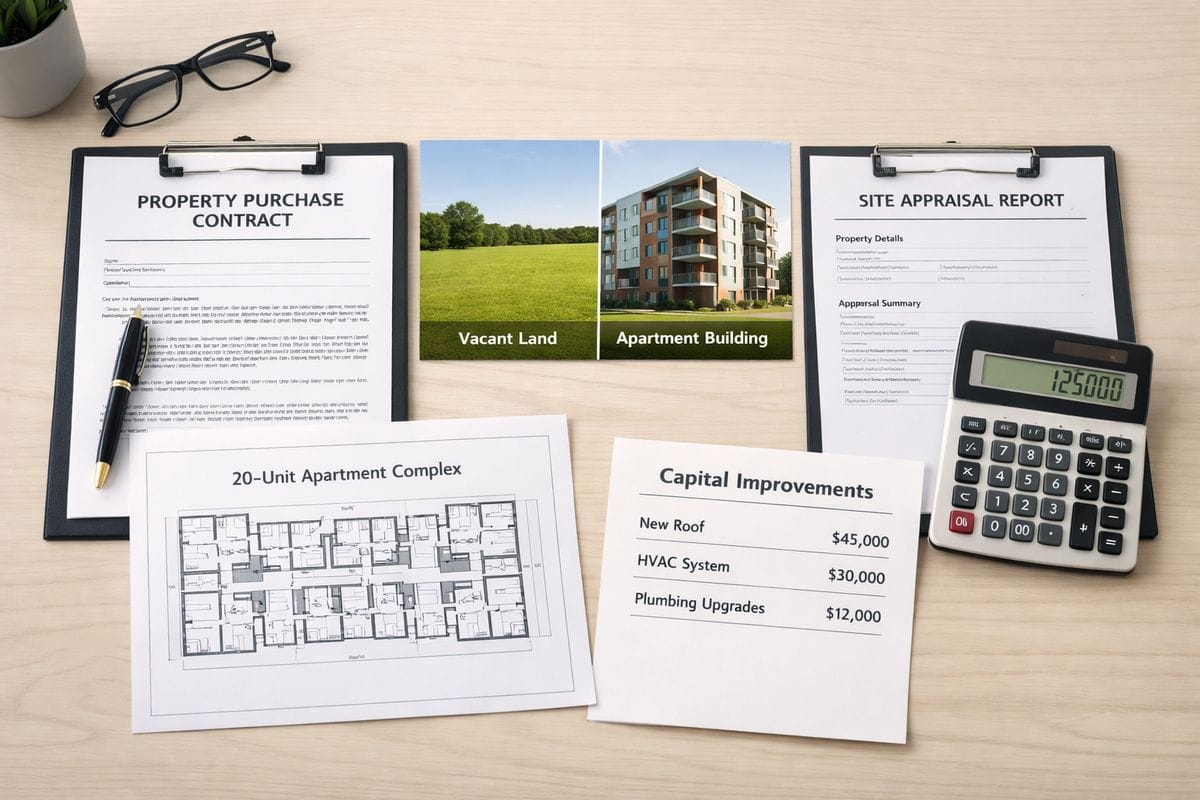
Capital improvements are not immediately expensed. A new roof, major HVAC replacement, unit addition, elevator modernization, or significant interior renovation starts its own depreciation schedule. The original building continues on its existing schedule, and each new capital item is depreciated based on its own classification and placed-in-service date.
This is where many apartment owners lose money. A roof is not treated the same way as carpet. A parking lot is not treated the same way as the structural frame. One line called “renovation” hides too much.
Dollar Example: Standard Apartment Building Depreciation
Assume you buy a 20-unit apartment building for $2,000,000. Allocate $400,000 to land and $1,600,000 to the building. Ignore first-year convention details for a clean annual view.
Your baseline annual depreciation is:
$1,600,000 ÷ 27.5 = $58,182
If your combined federal and state marginal tax rate is 35%, that deduction reduces current-year taxes by about $20,364. The building did not hand you $20,364 in rent. The tax code reduced your tax bill by that amount because you own a depreciable asset.
That is the baseline. It is already strong. But it is not the big win yet.
What the Big Tax Win Looks Like in Real Numbers
The business outcome of acceleration is front-loaded tax savings. That is the core advantage. You are not creating more total depreciation than basis allows. You are changing when the deduction arrives.
Example: 27.5-Year Depreciation Only
Use the same $2,000,000 apartment building with $1,600,000 of depreciable basis.
Without cost segregation, annual building depreciation is about $58,182.
At a 35% tax rate, estimated current-year tax savings are about $20,364.
That is the slow-and-steady version.
Example: Cost Segregation Plus Bonus Depreciation
Now assume a quality cost segregation study reclassifies 30% of the depreciable basis into short-life categories. On a $1,600,000 depreciable basis, that means $480,000 is moved out of 27.5-year property.
Assume the reclassified amount breaks down like this:
- $280,000 into 5-year property
- $40,000 into 7-year property
- $160,000 into 15-year land improvements
The remaining $1,120,000 stays in 27.5-year property.
If qualifying property is eligible for 100% bonus depreciation, the $480,000 of short-life assets is deducted immediately in year one. The remaining building basis generates about $40,727 of annual 27.5-year depreciation.
That produces first-year depreciation of roughly:
$480,000 bonus depreciation
- $40,727 base building depreciation
= $520,727 total first-year deduction
At a 35% tax rate, estimated year-one tax savings are about $182,254.
Compare that with the baseline $20,364 tax savings from the unsegregated schedule. The difference is about $161,890 in year-one cash flow.
That is the big tax win.
What Field Data Shows About Time-to-Value
Based on analysis of common multifamily cost segregation outcomes, apartment buildings often reclassify 20% to 35% of depreciable basis into shorter-life categories. That is why a $2 million apartment building can realistically generate $200,000 to $350,000 of first-year deductions depending on land allocation, asset mix, and placed-in-service timing. In stronger cases, the deduction goes higher.
The gain is concentrated in years 1 through 5. That improves liquidity when you need it most, during lease-up, early capex, refinance preparation, or portfolio expansion. A deduction in year 12 has value. A deduction in year 1 has more value because it preserves cash exactly when your business is still shaping the asset.
Now compare apartments and office after cost segregation.
Assume both the $2 million apartment building and the $2 million office building have $1.6 million of depreciable basis and both undergo cost segregation. Assume the apartment building reclassifies 30%, or $480,000, because multifamily has repeated unit-level assets and site improvements. Assume the office building reclassifies 20%, or $320,000, because the structure includes fewer repeated residential components.
The apartment building keeps $1,120,000 on a 27.5-year schedule, producing $40,727 of annual base depreciation, plus immediate deduction on the $480,000 short-life portion.
The office building keeps $1,280,000 on a 39-year schedule, producing $32,821 of annual base depreciation, plus immediate deduction on the $320,000 short-life portion.
So even after cost segregation, apartments stay ahead in two ways: more basis often moves into short-life buckets, and the remaining long-life basis still depreciates faster. That is why apartments retain the advantage even when both asset classes use the same strategy.
Cost Segregation: The Main Strategy Behind the Big Win
Cost segregation is an engineering-based tax study that identifies building components eligible for shorter depreciation lives. It turns a generic building schedule into a component-by-component tax model.
Think of the building like a grocery bill. If every item is thrown into one bag labeled “building,” you recover too much over 27.5 years. Cost segregation opens the bag, identifies what each item actually is, and assigns the right tax life. Appliances are not structural concrete. Parking lots are not apartment walls. Dedicated electrical for appliances is not the same thing as the roof deck.
A cost segregation study is the main tool that supports those allocations in an IRS-defensible way.
What a Cost Segregation Study Reclassifies
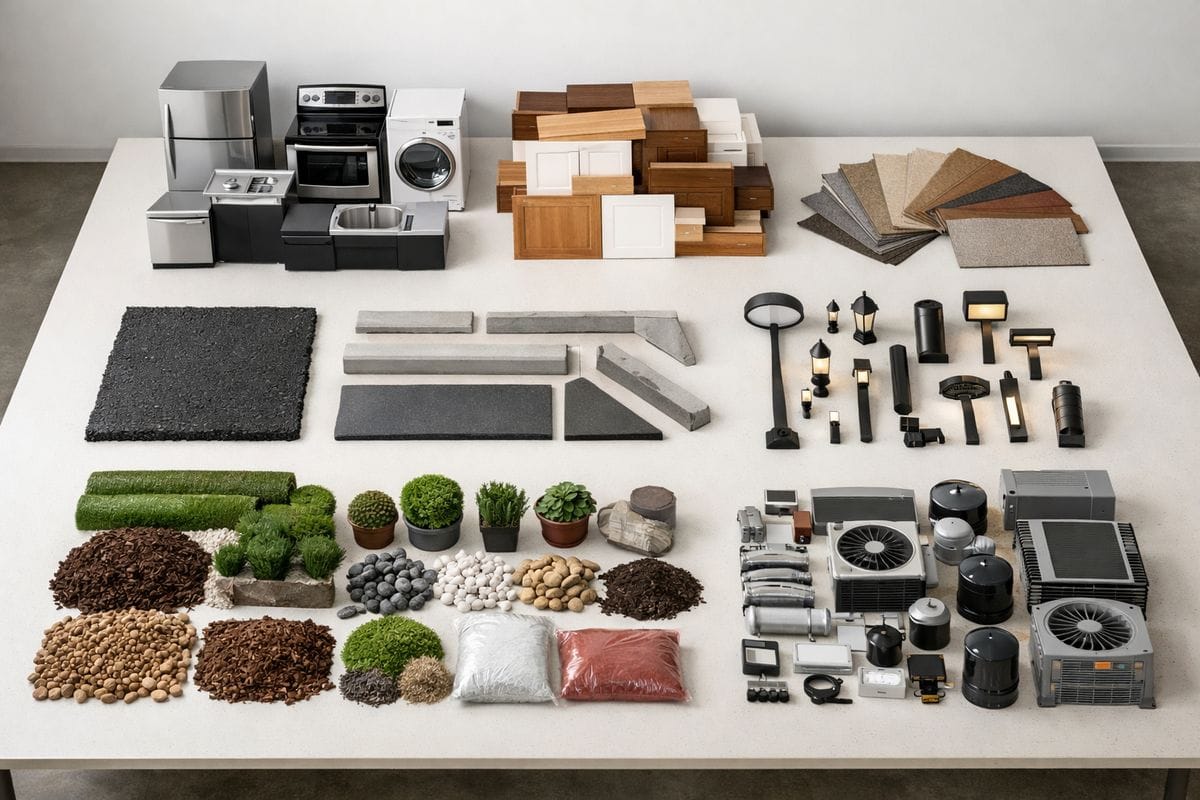
In multifamily, common reclassified components include appliance packages, carpeting and floating floors, cabinets, countertops, removable fixtures, unit-specific window treatments, individual HVAC components, dedicated plumbing and electrical tied to short-life assets, signage, parking lots, sidewalks, curbs, retaining walls, fences, site lighting, stormwater systems, irrigation, and landscaping elements.
This is where apartments shine. A 10-unit to 50-unit property has enough repetition for the numbers to matter. Ten sets of appliances. Twenty bathrooms. Repeated flooring packages. Multiple condensers. Common-area mailrooms, lighting, clubroom fixtures, and exterior improvements. Those components stack quickly.
Why Engineering Support Matters
Informal estimates leave deductions exposed. A credible study uses engineering-based measurement, construction cost analysis, and tax-law classification standards. That creates documentation for the allocations, especially on larger deductions tied to bonus depreciation.
The recommendation is direct: use qualified tax and engineering specialists. Apartment owners who rely on rough percentages pulled from a broker memo usually overstate some categories, understate others, and lose audit support in the process.
When a Cost Seg Study Produces the Best ROI
The strongest ROI usually appears on larger acquisitions, recently built properties, renovation-heavy deals, and multifamily assets with meaningful personal property and site improvements. Based on market practice, the sweet spot is often apartment buildings with 10 to 50 units.
That range works for a practical reason. The property has enough complexity to justify the study, but it is still small enough that the owner directly feels the cash-flow benefit. At five units, the savings can be meaningful but the economics are tighter. At 200 units, the study still works, but ownership structures and passive loss constraints often make the immediate benefit less direct for some investors.
For many owner-operators and private multifamily buyers, 10 to 50 units is where tax efficiency and operational control line up best.
Bonus Depreciation Rules That Matter Right Now
Bonus depreciation allows immediate expensing for qualifying property with a useful life of 20 years or less. In apartment investing, that usually means assets identified through cost segregation, not the building structure itself.
Which Apartment Building Components Qualify
Common qualifying components include parking lots, curbs, sidewalks, stormwater systems, fences, decks, landscaping elements, appliances, cabinets, countertops, fixtures, flooring, and certain electrical and communications components. Qualifying assets often exist in high volume across multifamily properties.
That is why the apartment asset class responds so well to bonus depreciation. The building contains many components with useful lives under 20 years, and those components repeat across units.
The 100% Bonus Depreciation Window
Current law matters here. Under the OBBBA, 100% bonus depreciation is restored for qualifying property placed in service after Jan. 19, 2025 and before Jan. 1, 2031, provided construction begins between Jan. 20, 2025 and Dec. 31, 2029.
That creates a major planning window for acquisitions, renovations, and build-to-rent or redevelopment projects involving multifamily assets.
Why Placed-in-Service Timing Changes the Tax Outcome
Timing changes the deduction materially. A property or qualifying component placed in service earlier in 2025 can fall under a lower bonus percentage. Under summaries of current guidance, some projects begun before Jan. 20, 2025 may be limited to 40% bonus depreciation absent specific elections.
That means completion timing, renovation sequencing, and placed-in-service documentation are not back-office details. They directly affect cash flow. A short delay into the restored 100% window can change a six-figure deduction.
Improvements, Renovations, and Tenant-Ready Work
Post-acquisition spending is where many apartment owners make their most expensive classification mistakes. The tax question is not just “How much was spent?” It is “What was the spending for?”
Repairs vs. Improvements
Routine repairs and maintenance are generally expensed in the current year. Capital improvements are not. Betterments, restorations, and adaptations must be capitalized and depreciated.
Fixing a broken faucet is generally a repair. Replacing all plumbing in a unit renovation is capital work. Patching part of a parking lot is not the same as full resurfacing. Repainting between tenants is not the same as a full repositioning project.
Common Apartment Building Improvements and Their Tax Lives
Roofs, major HVAC systems, elevators, structural additions, and major interior buildouts often stay on longer recovery periods because they relate to the building structure. Appliances, flooring, unit cabinetry, decorative lighting, parking areas, and site improvements often qualify for shorter lives if properly classified.
Apartment-specific cost seg components deserve attention here: appliance packages in each unit, flooring per unit, individual HVAC units or components, signage, parking lots, landscaping, and common-area fixtures. Those are exactly the items that disappear into a generic renovation line item if no study is performed.
Depreciation During Vacancy and Turnover
Depreciation continues during temporary vacancy as long as the property remains available for rent. That applies during normal turnover, repair periods, and lease-up phases. Temporary vacancies do not stop depreciation when the property is still held out for rental use.
This matters for apartment owners repositioning units one by one. Vacancy hurts revenue. It does not end depreciation.
Section 179D and Other Tax Rules Multifamily Owners Should Review
Depreciation is the headline benefit, but adjacent tax rules can materially improve the after-tax result on apartment ownership.
Section 179D for Larger Multifamily Buildings
Section 179D applies to qualifying energy-efficient buildings, including multifamily buildings that are four stories or more. For projects placed in service after Dec. 31, 2022, the deduction can be worth up to $5.80 per square foot.
That can be meaningful on larger apartment properties with qualifying HVAC, lighting, envelope, or other efficiency upgrades. Timing matters here too, because current law phases out 179D for projects beginning construction after June 30, 2026.
Section 179 Expensing and Why It Usually Plays a Smaller Role Here
Section 179 expensing has increased to $2.5 million with a $4 million phaseout threshold, but it usually plays a smaller role in apartment building planning than bonus depreciation and cost segregation. Building structure does not qualify the same way shorter-lived personal property does.
So yes, Section 179 has value in some fact patterns. No, it is usually not the main tax engine in multifamily acquisitions.
Business Interest Deduction Changes
The business interest deduction now uses an EBITDA-based calculation instead of EBIT. That generally increases allowable interest deductions, especially for debt-heavy acquisitions.
For apartment buyers using meaningful leverage, this improves total tax efficiency alongside depreciation. The financing structure and the depreciation plan should be modeled together, not separately.
The Limits: Passive Loss Rules, Taxable Income, and Real Use of the Deduction
A large paper loss is not the same as an immediately usable tax benefit. This is where many investors overstate the outcome of cost segregation.
Passive Activity Loss Rules
Rental real estate losses are generally passive. If your losses exceed passive income, the excess can be suspended unless you meet the applicable exceptions, including material participation and real estate professional standards where relevant.
So the deduction size matters, but usability matters more. A $300,000 paper loss that you cannot use this year does not produce the same year-one cash benefit as a $300,000 loss that offsets taxable income now.
Why Your Tax Bracket and Income Profile Matter
The value of accelerated depreciation depends on what income it offsets. A deduction that offsets highly taxed current income drives stronger near-term savings than one carried forward into future years. That is why tax bracket, passive income profile, filing structure, and ownership participation all matter when evaluating a study.
Based on analysis of real investor outcomes, the recommendation is to model the actual tax value, not just the gross deduction.
Suspended Losses Are Not Lost
Suspended losses still retain value. They carry forward and can offset future passive income or become usable in later disposition events subject to the tax rules that apply then.
That means a deduction with limited current-year use is not worthless. It just has delayed time-to-value. Your underwriting should reflect that honestly.
The Exit Cost: Depreciation Recapture and Sale Planning
Accelerated depreciation improves present cash flow, but it also affects the tax bill at sale. That is the tradeoff, and it should be addressed upfront.
How Recapture Works in Plain English
Depreciation recapture means prior depreciation deductions can increase the tax cost when the property is sold. In simple terms, the tax code lets you deduct basis faster now, then asks for part of that benefit back later through recapture rules when you exit.
That does not make acceleration a bad strategy. It means the strategy has a full life cycle.
Why Hold Period Changes the Outcome
The longer you hold, the stronger the economics of acceleration. A deduction taken now is worth more than the same deduction taken years later because of the time value of money. If recapture arrives 10 years from now, you have had a decade to reinvest the tax savings, reduce debt, fund improvements, or acquire more property.
Short holds reduce that time-value advantage. Long holds strengthen it.
How 1031 Exchanges Fit the Strategy
A 1031 exchange can defer gain and recapture into the replacement property. That turns depreciation planning into part of a wider acquisition-to-exit strategy rather than an isolated tax return decision.
The recommendation is to connect depreciation planning, hold period, refinance timing, and exit strategy from the beginning. Tax planning works best when the acquisition model and the disposition model speak to each other.
Common Mistakes That Reduce the Tax Benefit
The most common errors are not exotic. They are basic classification, timing, and documentation failures.
Misclassifying a Mixed-Use Property
Applying 27.5-year treatment without confirming the 80% residential rental income test is a direct error. Mixed-use buildings need annual classification discipline. Getting this wrong compresses the schedule improperly and creates audit exposure.
Forgetting To Allocate Land Correctly
Unsupported land allocation is one of the easiest ways to distort depreciation. Too much land allocation suppresses deductions. Too little land allocation without support invites challenge. Use a defensible method and document it.
Skipping the Cost Segregation Study
Leaving short-life assets buried in a 27.5-year schedule is lost ROI. In a multifamily property, that usually means appliances, flooring, parking surfaces, site lighting, common-area fixtures, and landscaping components are all being recovered too slowly.
Missing Timing Deadlines
Placed-in-service dates, construction-begin dates, and year-end execution mistakes can materially alter bonus depreciation treatment. Delays of days or weeks can change six figures of deductions on a larger apartment project.
Letting the Tax Tail Wag the Deal
A weak acquisition stays weak even with large deductions. Apartment building tax depreciation improves a sound deal. It does not rescue poor location, bad debt structure, weak rent roll, or excessive basis. The recommendation is clear: underwrite the real estate first, then optimize the tax treatment.
Frequently Asked Questions About Apartment Building Tax Depreciation
Can an apartment building be depreciated over 27.5 years?
Yes. An apartment building generally uses 27.5-year depreciation if it qualifies as residential rental property, which usually means at least 80% of gross rental income comes from dwelling units.
When does depreciation start and stop?
Depreciation starts when the property is placed in service, meaning ready and available for rent. It stops when the basis is fully recovered or when the property is sold, retired, or otherwise removed from service.
Can depreciation be claimed during vacancy?
Yes. If the apartment building remains available for rent during temporary vacancy, depreciation continues.
Are appliances and flooring depreciated separately?
Often yes, if they are properly classified. Through direct asset classification or a cost segregation study, many appliances, flooring components, cabinets, fixtures, and similar items can be assigned shorter tax lives than the building itself.
Is cost segregation worth it on a smaller apartment deal?
The answer depends on basis size, renovation scope, hold period, and whether the losses can actually be used. In practice, 10-unit to 50-unit apartment properties are often the sweet spot because they have enough complexity to justify the study and enough direct ownership benefit to make the savings meaningful.
The Recommendation: How To Capture the Big Tax Win
The recommendation is a four-phase process.
First, confirm property classification. Determine whether the building qualifies as residential rental property under the income test before modeling a 27.5-year schedule.
Second, establish a defensible basis allocation. Separate land from building value using supportable methods, then identify capitalizable acquisition and improvement costs correctly.
Third, run a cost segregation analysis before filing. Apartment buildings combine fast 27.5-year base depreciation with unusually strong short-life reclassification potential. That is the core reason this asset class produces such strong early-year tax performance.
Fourth, coordinate depreciation with passive loss rules, financing, and exit planning. The deduction only reaches full value when it is usable, timed well, and aligned with your hold strategy.
That is the clearest path to stronger cash flow, faster time-to-value, and higher after-tax ROI. In plain business terms, apartment buildings give you a rare combination: faster base depreciation than office or retail, plus enough component density to make cost segregation hit hard. That is the big tax win, and it is one of the clearest reasons multifamily remains such a strong asset class for scaled real estate ownership.