
Bonus depreciation commercial real estate is an accelerated tax deduction that lets you write off qualifying parts of a property far faster than the standard 39-year schedule. That matters because front-loaded deductions improve early cash flow, which directly affects debt coverage, renovation budgets, and acquisition capacity.
What Bonus Depreciation Means for Commercial Real Estate
In plain English, bonus depreciation lets you deduct the cost of certain qualifying property in year one instead of spreading that deduction over many years. In commercial real estate, that usually means specific building components and site improvements, not the structural shell itself.
The business outcome is straightforward: less taxable income today, more cash preserved today. On a commercial or multifamily deal, that cash can support tenant improvements, reserves, debt service, or the next acquisition. For investors moving up from single-family rentals, this is often the first time depreciation stops feeling like a slow drip and starts acting like a real capital allocation tool.
The current headline rule is especially favorable. Under 100% bonus depreciation restored, qualifying property placed in service after Jan. 19, 2025 and before Jan. 1, 2031 can receive full first-year expensing, subject to the construction timing rules tied to the new law. Before that change, 2025 had been heading toward a much smaller deduction.
That is the strategic stake. Timing now drives tax value in a way that materially changes underwriting.

Why the Savings Are So Large in Commercial Deals
Commercial deals often produce larger bonus depreciation deductions than small residential rentals because the asset mix is different. A strip center, medical office, apartment complex, or NNN retail property usually contains more paving, curbs, sidewalks, drainage, specialty electrical, interior finishes, signage, and other shorter-life components than a typical duplex or small rental home.
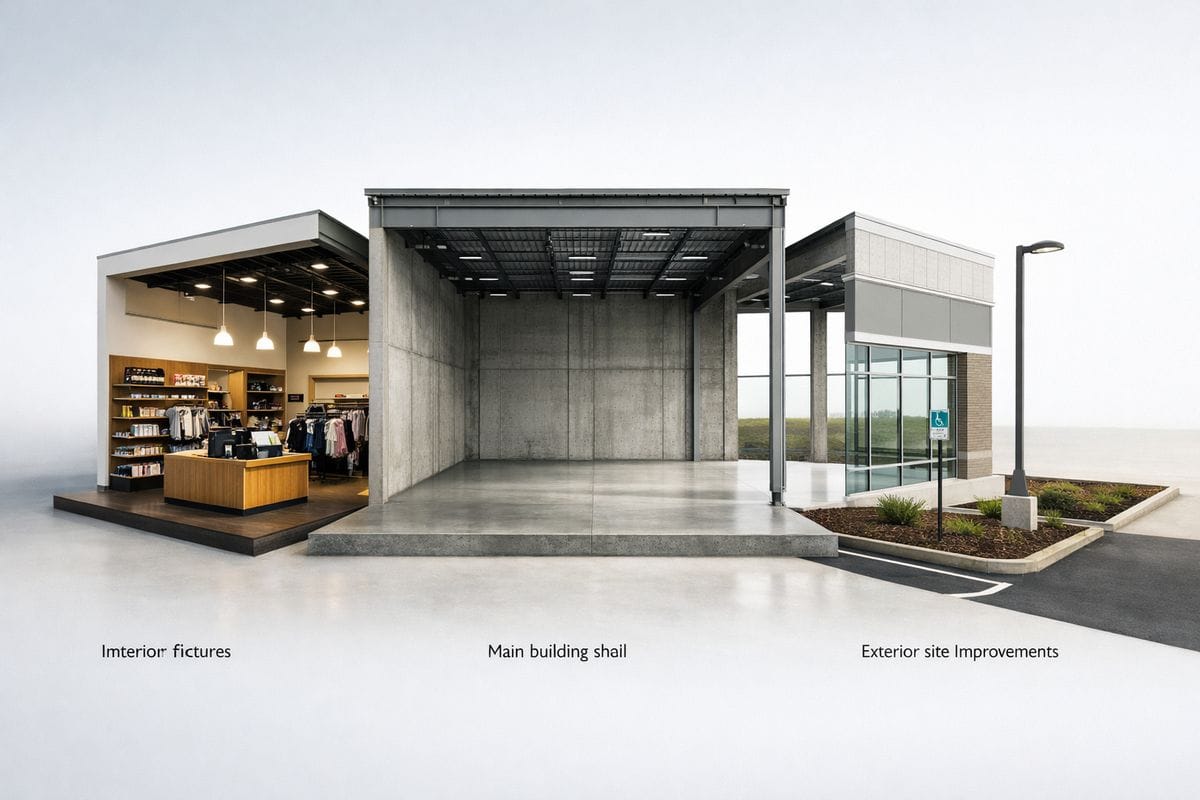
Based on analysis of commercial cost segregation results across property types, the field data shows that site work is one of the biggest drivers. Parking lots, landscaping, irrigation, fencing, retaining walls, monument signs, and decorative lighting all sit outside the 39-year shell. So do many interior items that support occupancy but are not part of the core building structure.
Larger purchase prices amplify the effect. Reclassifying 20 percent of a $6 million property produces a very different tax result than reclassifying 20 percent of a $350,000 rental house. Same concept, larger basis.
Commercial vs. Residential Depreciation at a Glance
Residential rental property is generally depreciated over 27.5 years. Nonresidential commercial property is generally depreciated over 39 years. Investors coming from residential already understand straight-line depreciation, but the jump into commercial changes two things at once: the base building life gets longer, and the opportunity to carve out shorter-life assets gets much bigger.
Here is the point that gets missed all the time: bonus depreciation does not apply to the whole building. Your roof, structural walls, foundation, and primary building shell stay on their normal recovery period. The tax benefit comes from identifying components with shorter tax lives, usually 5, 7, or 15 years, then applying bonus depreciation to those components if timing rules allow.
The Three Drivers of Bonus Depreciation Savings
Three drivers determine the size of your benefit: shorter-life assets, timing, and cost segregation. If those three line up, the year-one deduction can be substantial. If one breaks, the savings shrink fast.
Shorter-life assets create the eligible pool. Timing determines what percentage of that pool is deductible immediately. Cost segregation is the process that proves what belongs in that pool in the first place.
That is the mental model. Everything else is detail.
Driver 1: Qualifying Assets Must Have a Tax Life of 20 Years or Less
The main threshold is simple. To qualify for bonus depreciation, the asset generally must be new or used property that is new to your tax return and have a recovery period of 20 years or less. The 20 years or less rule is the gatekeeper.
In commercial real estate, common qualifying assets include 5-year property such as carpeting, appliances, certain fixtures, cabinets, countertops, and some dedicated electrical or plumbing serving specific equipment. Seven-year property often includes furniture and certain equipment. Fifteen-year property usually includes land improvements such as parking lots, sidewalks, curbs, landscaping, irrigation, fencing, stormwater systems, and retaining walls.
Those categories are why commercial and multifamily deals are so attractive. A lot of value sits outside the shell if your property is analyzed correctly.
Driver 2: Timing Rules Control the Deduction Percentage
Timing controls the percentage you can deduct immediately, and this is where many investors get sloppy. Acquisition date matters. Construction start date matters. Placed-in-service date matters. Contract timing matters. Get one of those wrong and the tax model changes.
The current rule is favorable: qualifying property placed in service after Jan. 19, 2025 and before Jan. 1, 2031 gets 100% bonus depreciation, with construction required to begin between Jan. 20, 2025 and Dec. 31, 2029 under the OBBBA framework. Before that law change, 2025 had been scheduled for a 40% deduction.
Your brief also requires the year-by-year phaseout schedule, and it remains useful because many investors still underwrite deals using the older framework or encounter assets tied to earlier timing rules. Under the prior TCJA phase-down, the schedule was: 2022, 100%; 2023, 80%; 2024, 60%; 2025, 40%; 2026, 20%; 2027, 0%.
That older schedule still matters for planning discussions, legacy deals, and transactions that fail the new law’s timing requirements. If a property falls outside the restored 100% window, the deduction can drop sharply. That is why investors considering a 2026 acquisition must review dates before assuming full expensing.
Driver 3: Cost Segregation Creates the Deduction
Here is the blunt version: most of the benefit does not appear automatically on a closing statement or a standard fixed-asset schedule. A purchase price allocation by itself usually leaves too much value buried in 39-year property.
A cost segregation study identifies which parts of the property belong in 5-, 7-, or 15-year classes and documents why. Without that study, the faster depreciation often goes unclaimed. With it, a meaningful part of the purchase price becomes eligible for accelerated treatment.
The recommendation is simple. If the deal size is large enough for tax strategy to matter, cost segregation is not optional analysis. It is part of underwriting.
How Cost Segregation Works in a Commercial Property
A cost segregation study is an engineering-based tax analysis that breaks a property into components and assigns each to the proper depreciation class. It does not create new deductions. It changes the timing of deductions that already exist under tax law.
That timing shift is where the ROI comes from. You recover more of your basis sooner, which improves present-value tax savings and near-term cash flow.
What a Cost Segregation Study Reclassifies
The study generally separates the property into three buckets: personal property, land improvements, and the remaining building structure. Personal property includes items tied to the operation or use of the space rather than the core structure. Land improvements cover exterior site features. The remaining shell stays in 27.5-year or 39-year real property, depending on use.
This reclassification does not increase your total lifetime depreciation. Over the full hold period, the total deduction is the same. What changes is timing. Instead of waiting decades, you deduct a large portion upfront.
A quality provider supports those allocations with engineering review, construction data, plans, site inspection, and tax classification logic. That documentation matters if the return is ever challenged. A bargain report that just guesses percentages is cheaper for a reason.
When a Study Produces the Best ROI
The strongest ROI usually shows up in recently acquired apartment buildings, retail centers, office properties, industrial assets, medical buildings, and NNN properties with meaningful site work or interior buildout. Higher-value properties and improvement-heavy deals tend to justify the fee most easily.
Based on analysis of observed market results, many professional studies generate 10x to 30x ROI on study cost, with five- to six-figure tax savings on larger assets. Retail properties are especially interesting because 20% to 40% of purchase price can often be reclassified into shorter-life categories, and infrastructure-heavy properties can exceed that.
If your property has parking, signage, landscaping, tenant fit-out, decorative finishes, or specialized systems, the economics usually justify a serious review.
A Dollar Example: Commercial Bonus Depreciation vs. 27.5-Year Residential Depreciation
Tax strategy becomes real when the numbers are side by side. Residential investors often know what a year-one depreciation deduction looks like on a rental house. Commercial and multifamily properties can look dramatically different once shorter-life assets are separated.
Example: Apartment Building Acquisition
Assume you buy a $3.5 million apartment building. Land is allocated at $700,000, leaving a depreciable basis of $2.8 million. Without a cost segregation study, that $2.8 million is depreciated over 27.5 years, producing about $101,818 of annual depreciation before convention adjustments.
Now assume a cost segregation study reclassifies 25 percent of the depreciable basis, or $700,000, into shorter-life assets. Say $250,000 goes to 5-year property, $50,000 to 7-year property, and $400,000 to 15-year land improvements. If the property qualifies for 100% bonus depreciation under the restored rule, that $700,000 becomes a year-one deduction, while the remaining $2.1 million continues on the 27.5-year schedule.
That changes the first-year picture fast. Instead of roughly $101,818, your depreciation deduction jumps to roughly $776,364, made up of the $700,000 bonus amount plus about $76,364 of straight-line depreciation on the remaining residential basis. Same building, same total lifetime depreciation, radically different timing.
Now compare that to a smaller residential rental. A $500,000 single-family rental with $100,000 allocated to land leaves $400,000 to depreciate over 27.5 years, or about $14,545 annually. Useful, yes. Transformational, no.
Example: NNN or Retail Property Acquisition
Assume you acquire a $2 million NNN retail property with $300,000 allocated to land, leaving $1.7 million of depreciable basis. Without cost segregation, the building sits on a 39-year schedule, producing about $43,590 of annual depreciation.
Now assume a study reclassifies 30 percent of the depreciable basis, or $510,000, into shorter-life property. That amount includes parking lot improvements, curbs, sidewalks, monument signage, landscaping, interior finishes, certain electrical serving tenant improvements, and removable non-structural elements.
Under the restored 100% rule, the first-year deduction on that $510,000 is immediate. The remaining $1.19 million stays on the 39-year schedule and adds about $30,513 of annual depreciation. Total first-year depreciation becomes about $540,513.
Your custom instruction also requires a current-rate comparison with and without bonus depreciation. Using the old 2026 phase-down schedule as a planning model, if bonus depreciation were only 20%, that same $510,000 short-life bucket would generate $102,000 of bonus depreciation in year one, plus regular MACRS on the remaining short-life basis, plus the $30,513 on the 39-year portion. That is still better than no cost segregation, but far less powerful than full expensing. Timing is money, literally.

What Qualifies for Bonus Depreciation in Commercial Real Estate
Qualifying property generally includes new or used property that is new to your tax return and has a recovery period of 20 years or less. In real estate, that means the opportunity sits in identified components, not in raw land or the entire building structure.
This is why generic advice like “commercial real estate gets bonus depreciation” is incomplete. Some parts do. Some parts do not. Classification decides the outcome.
Common Asset Categories That Usually Qualify
The common qualifying categories in commercial real estate include personal property and land improvements: paving, parking lots, sidewalks, landscaping, irrigation, stormwater systems, fences, retaining walls, decorative lighting, cabinets, countertops, specialty plumbing, removable partitions, floor coverings, appliances, signage, and communication or A/V systems.
Not every item qualifies in every fact pattern. Function, permanence, and relationship to the building matter. But these are the categories that repeatedly produce accelerated deductions in commercial and multifamily studies.
Property Types Where the Opportunity Is Strongest
Multifamily, retail, office, industrial, self-storage, hospitality, medical office, and NNN lease properties are all strong candidates. The opportunity gets stronger when the property includes heavy site work, specialty finishes, or operator-specific buildout.
A basic warehouse with minimal improvements usually produces a lower short-life percentage than a retail center with extensive paving, lighting, landscaping, signage, and tenant-specific interior work. An apartment complex with clubhouses, mail areas, outdoor amenities, parking, fencing, and finish-heavy units often performs well for the same reason.
Bonus Depreciation vs. Section 179, Section 179D, and Other Tax Breaks
Bonus depreciation is one tax tool, not the entire playbook. Commercial real estate returns improve when these provisions are coordinated instead of treated as isolated deductions.
Bonus Depreciation vs. Section 179
Section 179 and bonus depreciation both accelerate deductions, but they are not built for the same job. Section 179 has an annual dollar limit of $2.5 million, with phaseout starting at $4 million, and it is limited by taxable business income. Bonus depreciation has no annual dollar cap and can create a federal net operating loss.
For larger commercial acquisitions, bonus depreciation usually fits better because deal size can outrun Section 179 fast. Section 179 still matters for certain equipment and selective planning across entities, but bonus depreciation is generally the stronger tool for real estate assets identified through cost segregation.
Where Section 179D Fits
Section 179D is a separate energy-efficiency deduction for qualifying commercial buildings. For eligible post-2022 buildings, the deduction can reach up to $5.80 per square foot. That is meaningful on larger properties, especially office, medical, industrial, and institutional-type space.
The planning window matters. OBBBA phases out the deduction for projects beginning construction after June 30, 2026. If your property includes qualifying HVAC, lighting, or envelope improvements, 179D belongs in the same tax conversation as bonus depreciation.
Other CRE Tax Provisions That Affect the Full Return
The wider tax picture also matters. QBI is now permanent. The business interest limitation is calculated using EBITDA instead of EBIT, which generally increases allowable deductions. Opportunity Zones are permanent under the new rules beginning in 2027. And 1031 exchange treatment was preserved.
That matters because bonus depreciation improves one part of the return, current tax liability. Your actual ROI depends on how it interacts with financing, interest deductions, entity structure, future sale planning, and exchange strategy.
Risks, Limits, and Misconceptions to Address Before Filing
Bonus depreciation is powerful, but filing mistakes are expensive. Most errors come from overstating what qualifies, ignoring state treatment, or treating a tax election like a default setting.
Misconception: The Entire Building Gets Written Off Immediately
No. The entire building does not get written off immediately. The structural shell still follows its normal recovery period, usually 39 years for commercial property and 27.5 years for residential rental property.
Only identified short-life assets qualify for accelerated treatment. If nobody separates those assets from the shell, the benefit largely disappears.
State Tax Conformity Can Change the Outcome
Federal bonus depreciation does not automatically carry over to every state return. States such as California, New York, New Jersey, and Pennsylvania are commonly cited as decoupled or partially decoupled from federal bonus rules, which can reduce the immediate state-level benefit or require addbacks and separate calculations.
That does not kill the strategy. It means your federal win may not equal your state win. Model both before filing.
Electing Out and Recapture Considerations
Electing out is not a mistake if it fits the broader plan. Some taxpayers opt out to manage state complexity, smooth taxable income across years, or preserve future deductions where current losses provide limited benefit. The election rules are formal and must be handled correctly on a timely filed return.
You also need to understand recapture. Accelerated depreciation front-loads deductions, which means a later sale can trigger depreciation recapture and alter after-tax exit proceeds. That does not make the strategy bad. It means the benefit belongs in a hold-period model, not just a year-one tax projection.
How to Execute the Strategy Without Leaving Money on the Table
Based on analysis of the ranking content and supporting research, the best execution follows four phases: confirm timing, order a real study, coordinate filing, and deliberately redeploy the cash-flow gain.
Phase 1: Confirm Eligibility and Timing
Start with dates. Review acquisition timing, contract dates, construction start dates, placed-in-service dates, and whether the assets are new to your tax return. This is where restored 100% treatment is won or lost.
Do not assume the closing date tells the whole story. In this area, details control outcomes.
Phase 2: Order a Quality Cost Segregation Study
Use a qualified provider that performs an engineering-based study with defensible classifications and audit-ready support. The cost segregation study is what creates the short-life buckets that unlock the deduction.
Cheap desktop estimates often miss assets, overstate others, and weaken support. That hurts both tax value and defensibility.
Phase 3: Coordinate Federal and State Filing Strategy
Your CPA should review bonus treatment, state adjustments, passive activity limits, entity structure, and hold strategy before the return is filed. The recommendation is to model at least two scenarios: accelerated deductions now versus smoother deductions over several years.
That is not overkill. It is standard planning for a meaningful commercial acquisition.
Phase 4: Use the Cash-Flow Gain Deliberately
The tax savings should not disappear into general operating noise. Treat the benefit like released capital. Deploy it into reserves, capital improvements, debt reduction, leasing costs, or the next acquisition.
That is the recommendation. Bonus depreciation works best when it is treated as a capital allocation decision with measurable ROI, not just a tax line item that makes April feel better.
Frequently Asked Questions
Does bonus depreciation apply to the building itself?
No. The building shell generally stays on a 39-year commercial or 27.5-year residential schedule. Bonus depreciation applies to qualifying components with tax lives of 20 years or less, usually identified through a cost segregation study.
Is cost segregation required to claim bonus depreciation on commercial real estate?
For meaningful real estate deductions, yes in practice. Some obvious assets can be classified without a full study, but most of the value in a commercial deal stays buried in long-life property unless a cost segregation analysis separates it properly.
Can bonus depreciation create a loss?
Yes. Unlike Section 179, bonus depreciation is not limited by taxable income in the same way and can create a federal net operating loss. That can be useful, but it needs to be coordinated with passive activity rules and your broader tax position.
What if a state does not follow federal bonus depreciation rules?
Then your federal deduction and state deduction will differ. You may need to add back some or all of the federal bonus amount on the state return and recover it over time under state rules. That is why state modeling belongs in the strategy before filing, not after.
Should a commercial investor ever elect out of bonus depreciation?
Yes, when doing so improves the full tax outcome. Common reasons include state decoupling, limited current-year benefit, income smoothing, or long-term planning around future taxable income and exit strategy.
What changes once you understand bonus depreciation correctly?
You stop viewing depreciation as a fixed accounting expense and start treating it as an underwriting variable. That shift changes acquisition analysis, after-tax cash flow projections, and how aggressively you pursue cost segregation on larger deals.