
Active vs passive income real estate is really a classification problem with tax consequences. Get the label wrong, and the result is bad underwriting, unusable losses, or an IRS position that does not survive scrutiny. The real issue is not just effort level, it is how your income, losses, and time are treated under the tax rules.
What Active vs. Passive Income Means in Real Estate
In plain English, active real estate income comes from deals or operations that require ongoing involvement. Passive real estate income comes from holdings designed to produce returns with limited day-to-day work. That sounds simple, but real estate uses these words in two different ways: the investing definition and the IRS definition. Those do not always line up.
From an investing standpoint, this classification drives time commitment, control, liquidity, and management burden. From a tax standpoint, it drives whether losses offset salary or business income, whether deductions are suspended, and what your after-tax ROI actually looks like.
The investing definition: time, control, and operational involvement
In investing terms, active real estate means direct operational responsibility. Self-managing long-term rentals, overseeing renovations, running flips, and operating short-term rentals all fit this category. You control pricing, vendors, financing, tenant standards, and exit timing. You also absorb the friction: vacancies, maintenance, legal issues, and decision fatigue.
Passive real estate reduces that workload, but it does not eliminate risk. REITs, syndications, and professionally managed properties are the clearest examples. You trade control for convenience, and often for liquidity. Public REITs are especially hands-off, and as of early 2026 some market data placed the average 5.3% dividend yield well above the broader stock market yield, but you also accept market volatility and limited asset-level control.
The tax definition: passive activity rules under IRC §469
For tax purposes, the baseline rule is blunt: rental real estate is generally passive. That remains true even when substantial effort goes into the property. The IRS framework under IRC §469 is not asking whether the work feels active. It is asking whether the activity falls into the passive bucket or qualifies for an exception.
That distinction determines whether your rental losses can offset W-2 income, self-employment income, or business income. It also determines whether losses sit on Form 8582 for years instead of reducing current tax.

The Three IRS Rules That Determine How Real Estate Income Is Treated
Three rules drive most real-world outcomes for rental owners.
Rule 1: Rental activities are generally passive by default
This is the rule that surprises high-income owners. A rental can generate strong cash flow and still show a tax loss because depreciation, interest, taxes, insurance, and repairs exceed taxable income. But if you earn a salary and your rental loss is passive, that loss does not offset your W-2 income.
Take a concrete example. Assume $300,000 of W-2 income and $40,000 of rental paper losses from depreciation. Unless an exception applies, the full $40,000 is suspended. It becomes a passive loss carryforward, not a current-year deduction. That is the tax trap.
Rule 2: Active participation is not the same as material participation
Active participation is a lower standard. If you own at least 10% and make meaningful management decisions, such as approving tenants, setting lease terms, or authorizing repairs, you generally meet it. The benefit is narrow but real: up to $25,000 of rental real estate losses can offset nonpassive income.
The catch is income. The special $25,000 allowance phases out once modified adjusted gross income exceeds $100,000 and disappears at $150,000. At $300,000 of W-2 income, that exception is gone. Active participation helps some smaller landlords, but it does not convert rental income into nonpassive income.
Rule 3: Real Estate Professional Status can convert rental losses into nonpassive losses
Real Estate Professional Status, or REPS, is the exception with the biggest tax impact. To qualify, you must spend more than 750 hours in real property trades or businesses during the year, and more than half of your total personal service time must be in those activities. Then you still must materially participate in the rental activity itself. The IRS separates those tests for a reason.
Grouping elections matter here. Each rental is generally a separate activity unless you elect to combine them. That changes the material participation analysis and can determine whether losses are usable. Based on the statutory framework, REPS plus material participation is the dividing line between suspended losses and current deductions for many owners.
Active Participation, Material Participation, and Real Estate Professional Status: Key Differences
Most reporting errors start here. These are not interchangeable terms.
Active participation: the lower bar with a limited tax benefit
Active participation usually fits small landlords who make real management decisions but are not working real estate full-time. The business outcome is limited access to the special loss allowance, assuming income falls within the IRS threshold. It does not reclassify the rental as nonpassive. That point gets missed constantly.
Material participation: the seven-test framework that governs many nonrental activities
Material participation is the higher standard used across passive activity rules. The IRS provides seven tests, including the familiar 500-hour test and other fact-specific standards. Investor-type review does not count. For rentals, material participation matters only after REPS applies, or when the activity is not treated as a rental under the tax rules.
Real Estate Professional Status: the highest bar with the biggest tax impact
REPS is where tax strategy becomes business strategy. If you qualify and prove material participation, rental losses can offset nonpassive income. If you claim it without time logs, calendars, and operational reality to support it, audit exposure rises immediately. Documentation is not an afterthought. It is the position.
Here is the clean classification framework:
| Income type | Common examples | Loss interaction |
|---|---|---|
| Active or ordinary income | W-2 wages, self-employment, flipping business income | Offset by nonpassive losses only |
| Passive income | Rental income, limited partnership income, many syndication K-1 items | Offset by passive losses, plus $25,000 rental exception if eligible |
| Portfolio income | Dividends, interest, capital gains, most REIT dividends | Not offset by passive losses |
Passive losses generally offset only passive income. The main exceptions are the limited $25,000 rental allowance and REPS with material participation.
How Passive Loss Limits Work for Rental Owners
This is where planning either creates time-to-value or delays it for years.
Why rental losses are often suspended on Form 8582
Form 8582 is where passive losses are limited. A property can be cash-flow positive and still produce a tax loss because depreciation is a non-cash deduction. Add mortgage interest, property taxes, insurance, and repairs, and taxable income often drops below zero even while money lands in your bank account.
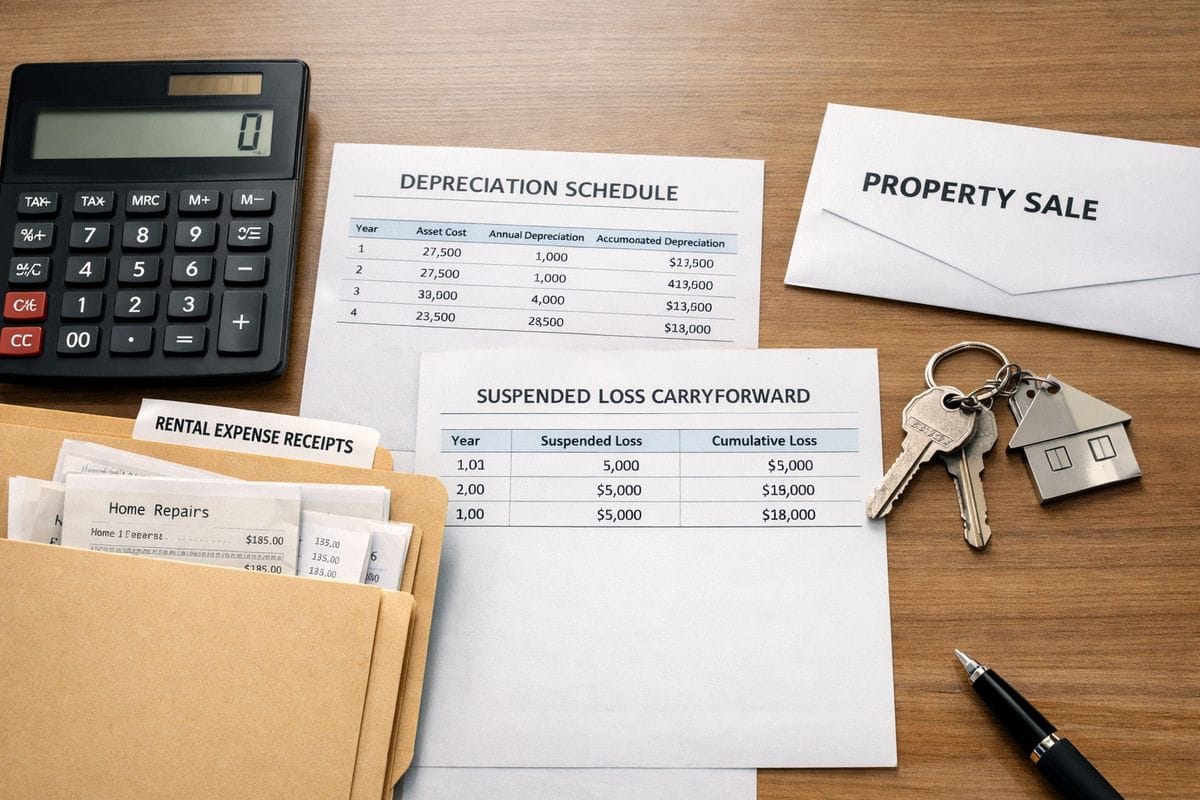
If you do not have passive income to absorb that loss, the loss is disallowed for the current year and carried forward. That is not a permanent loss of value. It is delayed value.
When suspended losses become valuable
Suspended losses become usable in three main ways: passive income from other sources, qualification under an exception, or a taxable sale of your entire interest in the passive activity. That last point matters. The IRS focuses on the entire interest, not a partial exit or internal restructuring.
Planning strategies follow directly from this rule. Positive cash-flow rentals can absorb losses from other passive rentals. Passive business interests can do the same. Grouping elections can improve participation analysis when multiple activities function as one business. REPS can move rental losses out of the passive bucket altogether.
Why tax benefits should be modeled over the full hold period
Placed-in-service timing drives depreciation timing. Cost segregation accelerates deductions. Bonus depreciation affects how much of that acceleration hits early years. Sale triggers recapture. Those are not side notes. Those are return drivers.
The recommendation is simple: underwrite the asset without assuming tax benefits save a weak deal. Based on analysis of rental return models, a sample property with a 15.9% total ROI still depended on cash flow, appreciation, and principal paydown, not tax benefits alone. Tax deductions improve early-year ROI. They do not fix bad financing, weak rents, or poor management.
Common Real Estate Income Types and Where They Usually Land
The label changes by strategy.
Long-term rentals, short-term rentals, and self-management
Long-term rentals are generally passive by default. Self-management does not change that. You can spend every weekend handling tenants and still be passive for tax purposes.
Short-term rentals are different. If average guest stay is short enough and the activity avoids rental classification, the tax analysis can shift. In some cases, an average guest stay of 7 days or less moves the activity out of the default rental bucket, which opens the door to material participation analysis. That is why short-term rentals get so much attention in tax planning.
REITs, syndications, and fractional ownership
These are the clearest passive-investing structures. You get convenience, reduced control, and in REITs, much better liquidity than direct ownership. Private syndications can still pass depreciation through Schedule K-1 allocations, but usability depends on passive loss rules. Deductions matter only if you can use them.
That is the strategic tradeoff. REITs are easier to buy and sell. Direct ownership offers more control and often more tax shelter. Syndications sit in the middle.
Flips, development, and real estate businesses
Not all real estate income is passive. Flips, dealer activity, development, and construction-related businesses are usually analyzed as trade or business activities, not rental activities. If your participation is regular, continuous, and substantial, income is often active or nonpassive. That means different tax treatment, different self-employment issues, and a different audit story.
What Changes in 2026-2027 and What Stays the Same
Sunset planning matters, but the wrong focus leads to bad decisions.
What the field data shows on bonus depreciation and front-loaded deductions
Bonus depreciation no longer delivers the same immediate tax punch many investors built into older models. The practical effect is lower first-year deductions unless a deal was placed in service under more favorable rules. Timing still matters because placed in service controls depreciation timing, not commitment date.
That changes investor behavior. It does not change the recommendation. Buy for durable economics first, then treat depreciation as support.
What stays the same under passive activity rules
The passive activity framework remains the core decision system: rental-by-default treatment, Form 8582 limitations, active participation rules, REPS standards, and suspended-loss carryforwards. TCJA sunsets do not erase IRC §469. The tax architecture that matters most to rental owners is still here.
The recommendation before sunset planning
Evaluate four issues now: REPS eligibility, grouping elections, placed-in-service timing, and existing suspended losses. If current losses are trapped, a sale, regrouping analysis, or passive income matching strategy can materially improve time-to-value. If REPS is close but not supportable, do not force it. Choose a strategy your records can prove.
The Best Way to Decide Between Active and Passive Real Estate Income
The right choice comes from business outcomes, not branding.
The four decision drivers: time, control, loss usability, and liquidity
Time and control favor direct ownership. Liquidity and convenience favor REITs and some funds. Loss usability depends on IRS status, not on how hard you work. Financing costs matter too. With investment-property mortgage rates around 6.51%, active ownership now demands better underwriting discipline than it did in cheap-debt years.
Questions to ask before choosing a strategy
Ask the questions that affect ROI, not just taxes. Is the property attractive without tax benefits? When will it be placed in service? Is a cost segregation study planned? How will depreciation be allocated? Can current losses actually be used? What is the exit plan, and what does recapture do to net proceeds?
A clear recommendation based on investor profile
If you are a W-2 earner with suspended losses, assume rental losses stay passive unless a real exception applies. Build around passive income matching, hold-period planning, and disciplined disposition strategy.
If you are close to REPS, pursue it only when hours, documentation, and actual operations support the position. That is where the tax upside justifies the effort.
If you want low-effort exposure, choose REITs or syndications and accept that convenience and diversification matter more than current loss deductions.
Frequently Asked Questions
Is rental income active or passive for tax purposes?
Rental income is generally passive for tax purposes, even if you spend substantial time on the property. The main exception is when you qualify for Real Estate Professional Status and materially participate in the rental activity.
Can passive rental losses offset W-2 income?
Usually no. Passive losses offset passive income, not salary. The main exceptions are the limited $25,000 special allowance for qualifying active participants under the income thresholds, or REPS with material participation.
Does self-managing a rental make it nonpassive?
No. Self-management alone does not convert a rental into nonpassive income. It can support active participation, and in some fact patterns it supports material participation, but rental real estate is still passive by default unless an exception applies.
What happens to passive losses I cannot use this year?
Unused passive losses are suspended and carried forward, generally on Form 8582. You use them later against passive income or, in many cases, when you dispose of your entire interest in the activity in a taxable transaction.
Are REIT dividends passive income?
No. REIT dividends are generally portfolio income, not passive income. That matters because passive losses do not offset portfolio income.
Which strategy fits best if tax deductions matter most?
Direct ownership only makes sense when your hours, records, and operating structure support the tax position. If that standard is not met, passive structures are cleaner, but current deductions will usually be less usable. The recommendation is to choose the structure that matches provable tax status, not the one with the most attractive marketing pitch.