
Accelerated depreciation commercial real estate means recovering part of a property’s cost far faster than the default 39-year schedule, and that changes deal economics immediately. The result is not just a tax deduction on paper. It is stronger near-term cash flow, better after-tax ROI, and more flexibility to fund debt service, renovations, and the next acquisition.
What Accelerated Depreciation Means for Commercial Real Estate
Accelerated depreciation is a tax strategy that shifts deductions into earlier years instead of spreading nearly all building costs evenly over decades. In plain English, it lets more of a commercial property’s depreciable basis hit current-year tax returns now, when cash is most valuable.
That business outcome matters because commercial real estate is often underwritten on cap rate, debt yield, and rent growth, while tax timing gets treated as a side note. That is a mistake. Faster cost recovery improves after-tax cash flow in year one, reduces the capital trapped in tax payments, and changes the real return profile of an acquisition. A deal that looks average before tax planning can become materially stronger once shorter-life assets and immediate write-offs are modeled correctly.
The field data shows that the building shell still follows long recovery periods. Office, retail, industrial, and many single-tenant commercial buildings remain mostly 39-year property. The value comes from identifying the pieces inside and outside the building that do not belong in that 39-year bucket. Those pieces are where accelerated depreciation starts doing real work.
Standard Depreciation vs. Accelerated Depreciation
Standard depreciation for commercial real estate is straight-line depreciation over 39 years. Residential rental property generally uses 27.5 years. If your background is single-family rentals or small multifamily, that difference alone resets expectations.
Take a simple example. A $1.95 million depreciable commercial building basis generates about $50,000 of annual straight-line depreciation over 39 years. A $1.95 million residential rental building basis generates about $70,909 annually over 27.5 years. Same basis, very different pace. Commercial property starts slower by default.
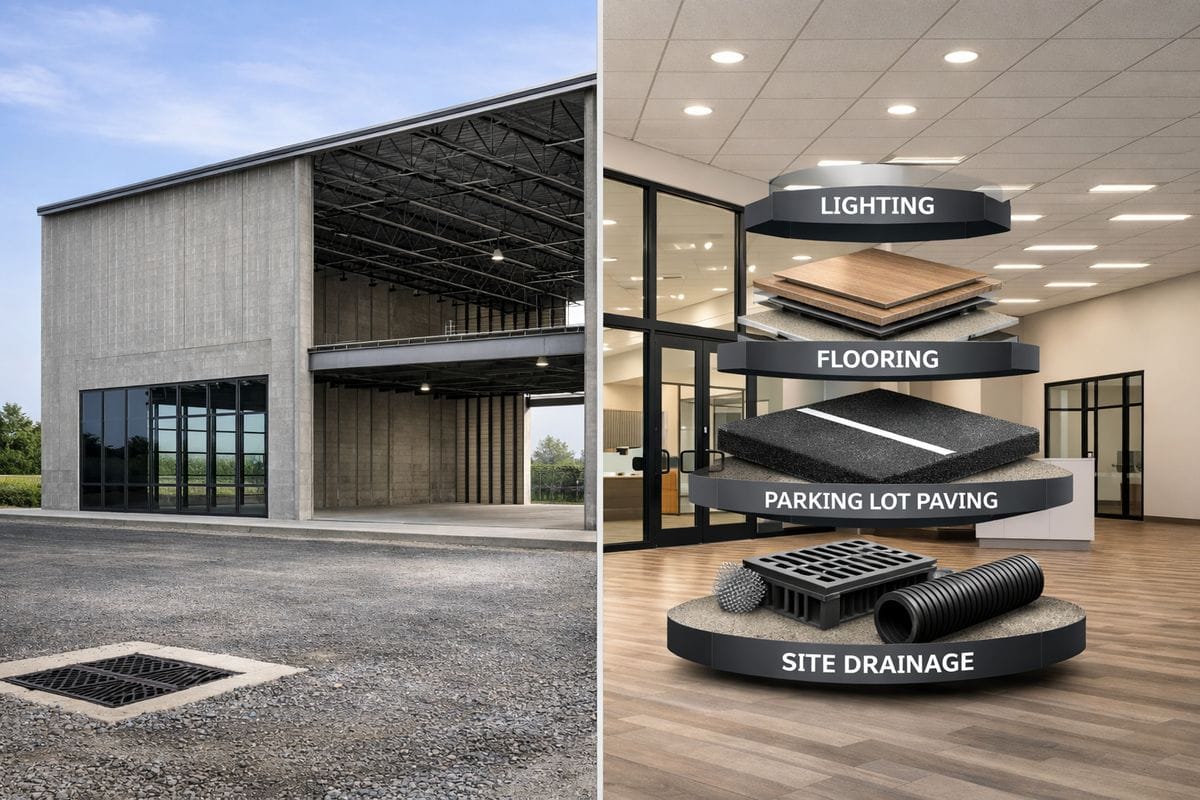
Accelerated depreciation changes that by separating qualifying components into shorter class lives, usually 5, 7, or 15 years. That does not mean the whole building suddenly becomes short-life property. It means the tax treatment gets more precise. Flooring, dedicated electrical, parking lots, site drainage, cabinets, specialty finishes, and similar assets stop being buried inside 39-year recovery and start being depreciated on timelines that reflect how the tax rules actually classify them.
Why This Topic Matters More After Jan. 19, 2025
Based on analysis of current law changes, the strategic value of accelerated depreciation increased sharply after Jan. 19, 2025. Under IRS Notice 2026-11, qualifying property placed in service after that date can receive permanent 100% bonus depreciation under the current federal framework. That is a major shift from the prior first-year cap.
The practical result is simple: cost segregation is no longer just a way to speed up deductions modestly over several years. It is again a way to pull qualifying short-life basis into the current year at full value. Capital planning changes because the placed-in-service date now has immediate cash consequences. For owners buying, renovating, or delivering projects in phases, timing is no longer a detail. It is the difference between an average deduction and a transformative one.
The Three Drivers of Accelerated Depreciation in Commercial Real Estate
Accelerated depreciation in commercial real estate runs on three drivers: cost segregation, bonus depreciation, and special deduction or election rules. If those three pieces are understood as one system rather than three separate topics, the planning gets much sharper.
Driver one determines which costs qualify for shorter tax lives. Driver two determines how fast those shorter-life costs can be deducted. Driver three determines whether special elections and adjacent incentives increase the result, protect the deduction, or change the timing. Miss one driver and the cash-flow outcome drops.
Driver 1: Cost Segregation
Cost segregation identifies building components that qualify for shorter recovery periods instead of remaining inside 39-year commercial real property. That is the foundation. Without it, most of the purchase price stays trapped in slow straight-line depreciation.
In practice, a cost segregation study reviews the property in detail and classifies qualifying assets into 5-year, 7-year, or 15-year categories. That includes personal property and land improvements that the tax rules treat differently from the building structure. Based on analysis of thousands of real estate studies across the field, this is the main reason owners unlock six-figure first-year deductions on properties that otherwise produce modest annual write-offs.
Driver 2: Bonus Depreciation
Bonus depreciation is the engine that turns reclassification into immediate first-year impact. Once a cost segregation study identifies qualifying short-life assets, bonus depreciation allows those assets to be expensed immediately if they meet the applicable federal rules.
That matters because shorter lives alone help, but not nearly as much as immediate expensing. A 15-year parking lot is useful. A fully deductible 15-year parking lot in year one is far more valuable. The same logic applies to 5-year and 7-year property. This is where accelerated depreciation shifts from accounting detail to liquidity tool.
Driver 3: Elections and Related Incentives
The third driver is the set of elections and related incentives that expand planning beyond standard cost seg and bonus depreciation. This includes the component election, Section 179, Qualified Improvement Property, Section 179D, and the de minimis safe harbor for smaller items.
These rules do different jobs. Some accelerate basis. Some allow immediate expensing. Some reward energy-efficient design. Some help on phased or self-constructed projects where asset timelines do not line up cleanly. Put together, they determine how much tax benefit is available, how soon it arrives, and how defensible it is on audit.
How Commercial Real Estate Is Normally Depreciated
Before acceleration strategies make sense, the baseline rules need to be clear. Commercial depreciation starts with the placed-in-service date, the depreciable basis, and the land allocation. If any of those inputs are wrong, every later deduction is wrong too.
The default treatment often understates first-year tax opportunity because it treats the property too broadly. A purchase contract has one price. Tax depreciation does not. The tax law breaks that price into nondepreciable land, long-life building basis, and shorter-life components. Owners who stop at the top-line purchase price leave money on the table.
Commercial Property: 39-Year Straight-Line
Commercial property is generally depreciated over 39 years using straight-line depreciation. That covers office buildings, retail centers, industrial properties, medical offices, warehouses, and many NNN lease properties. The structure and its structural framework follow that schedule.
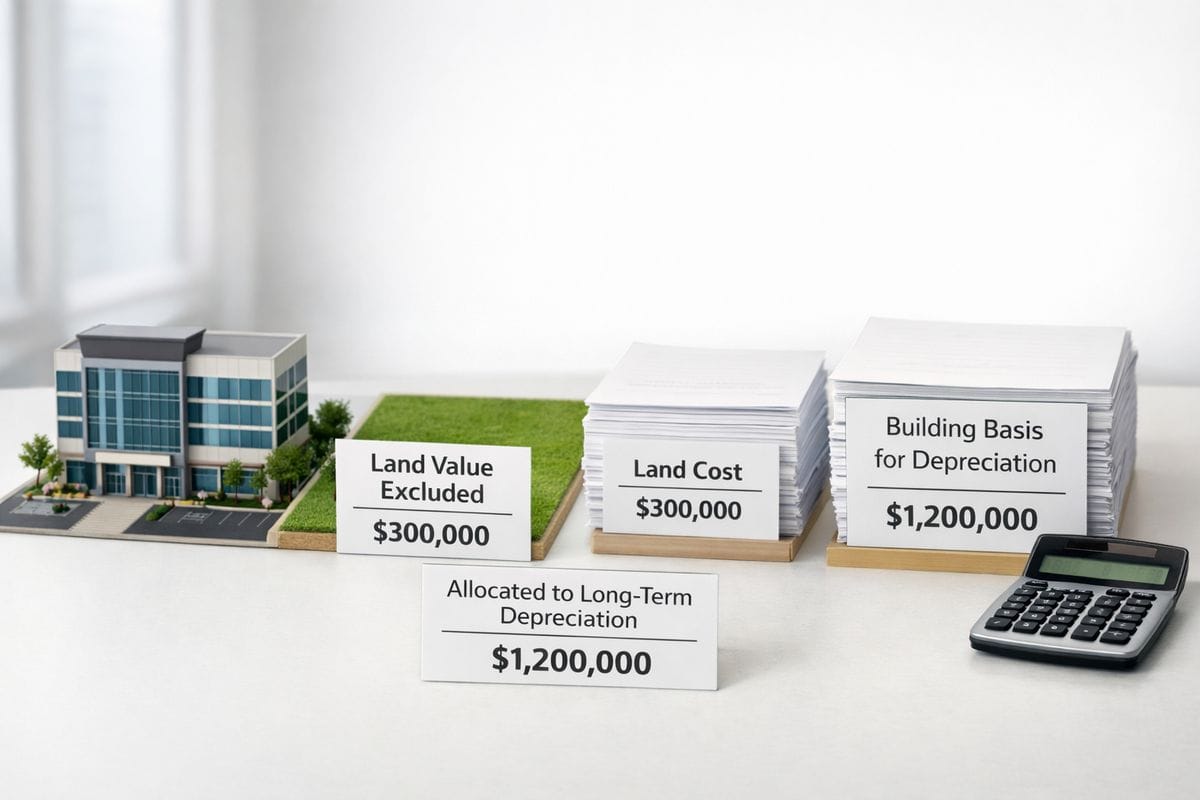
Land is never depreciated. If you buy a property for $3 million and allocate $600,000 to land, only $2.4 million enters the depreciation schedule. On straight-line alone, that $2.4 million building basis produces about $61,538 of annual depreciation before first-year convention adjustments. That is useful, but it is rarely the best available result.
Residential Rental Property: 27.5-Year Straight-Line
Residential rental property generally uses 27.5 years, which includes apartment buildings and other property where at least 80 percent of gross rental income comes from dwelling units. This is why investors moving from residential into commercial often feel commercial depreciation is stingy. It is. At baseline, commercial recovery is slower.
Confusion shows up most often with multifamily and mixed-use assets. A five-unit apartment building is residential rental property, not commercial real property for depreciation purposes. A storefront with apartments above it is not one thing. The residential portion and the commercial portion require separate analysis. If the classification is sloppy, the depreciation schedule is distorted from day one.
What Basis Is Actually Depreciated
Depreciable basis starts with the purchase price allocated to the building and certain capitalized costs. Land allocation is removed first. Then capitalizable closing costs are added where appropriate. Title fees, legal costs tied to acquisition, recording fees, surveys, and similar items often increase basis rather than get deducted immediately.
Improvements and repairs also matter. A repair is generally deducted currently. An improvement gets capitalized and depreciated. That distinction changes both current deductions and future gain calculations. The recommendation is to treat land allocation, capitalized closing costs, and improvement classification as core tax controls, not bookkeeping cleanup.
Which Assets in a Commercial Property Qualify for Faster Write-Offs
The practical question is always the same: what actually gets accelerated? The answer is narrower than aggressive marketing suggests, but wider than many owners assume.
Broadly, commercial properties contain three buckets. First, short-life personal property. Second, 15-year land improvements. Third, long-life building structure and core structural systems. Accelerated depreciation lives in the first two buckets.
Five-Year and Seven-Year Personal Property
Five-year and seven-year property includes items that serve a business function, tenant function, or removable function rather than the inherent operation of the building itself. Typical examples include specialty electrical for dedicated equipment, decorative lighting distinct from general building lighting, fixtures, carpeting, certain flooring, cabinetry, appliances, countertops, window treatments, communication wiring, A/V systems, and similar components.
In retail, medical, hospitality, and certain office properties, this category can be substantial because interior build-outs often include many function-specific components. In apartment buildings, short-life assets often include carpeting, appliances, cabinets, counters, and certain specialty finishes. In a plain industrial box, the percentage is usually lower. Property type matters.
Fifteen-Year Land Improvements
Fifteen-year property often delivers more value than owners expect because site work is expensive and easy to overlook. Parking lots, sidewalks, curbs, fencing, retaining walls, landscaping, irrigation, outdoor lighting serving site functions, and stormwater systems commonly fall into this category. According to NAR guidance, these land improvement classes are among the main assets that qualify for bonus depreciation when properly identified.
NNN investors miss this constantly. A single-tenant retail pad with a simple lease still includes paving, striping, signage foundations, exterior drainage, and other site assets. Even when tenant operations are simple, the site often carries real accelerated depreciation value.
What Does Not Qualify for Acceleration
The building structure does not generally qualify for bonus depreciation. That includes the structural framework, load-bearing walls, roof structure, standard building systems that serve the entire structure, and many core components tied to the operation of the building as a building.
This point matters because one of the most common misconceptions is that a cost segregation study turns the entire building into bonus-depreciable property. It does not. The study identifies the qualifying parts. The rest remains 39-year property in commercial real estate, or 27.5-year property in residential rental real estate. That is why engineering detail matters. Overclassification creates audit exposure fast.
Cost Segregation: The Main Tool That Makes Accelerated Depreciation Work
Cost segregation is the central tool in accelerated depreciation planning for commercial real estate. It is the process that converts a broad property basis into defensible tax categories with different recovery periods.
Without a study, shorter-life assets often remain buried inside 39-year property because no one has documented them separately. With a study, those costs are identified, assigned to the correct class life, and supported with methodology that can survive scrutiny. That is not tax theater. It is the difference between taking the deduction and merely talking about it.
What a Cost Segregation Study Does
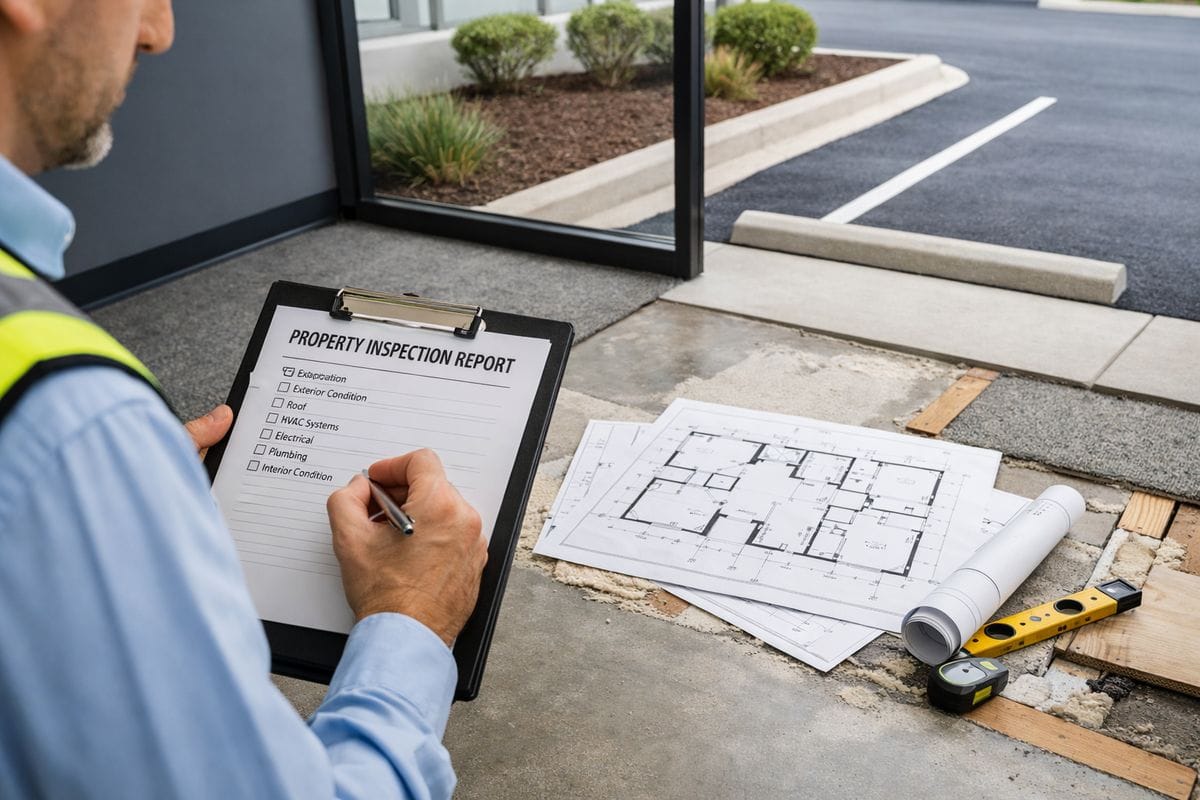
A cost segregation study is an engineering-based and tax-based analysis of a property’s components and costs. It reviews plans, construction documents, invoices, settlement statements, appraisals, site improvements, and building systems. Physical inspection is often part of the process, especially for larger assets or renovation projects.
The output is a report that assigns costs to 5-year, 7-year, 15-year, and long-life categories, with support for each classification. The best studies include asset descriptions, photographs, cost sourcing, tax authority support, and depreciation schedules. Based on analysis of IRS practice and field experience, detailed engineering methods remain the strongest standard for audit defense.
How a Study Reclassifies Components Into 5-, 7-, and 15-Year Property
The mechanics are simple even if the work behind them is detailed. A property is acquired or constructed with one large basis. The study breaks that basis into components. Certain interior finishes and function-specific assets move into 5-year or 7-year property. Site improvements move into 15-year property. The building shell and structural systems stay in long-life real property.
Once that reclassification happens, first-year deductions increase sharply. Without the study, the owner deducts a small slice each year. With the study, qualifying portions shift to shorter schedules and, when bonus depreciation applies, are deducted immediately.
Typical Property Types That Benefit Most
The best-fit property types are apartment buildings, office buildings, medical offices, retail centers, hotels, warehouses with significant office build-out, and NNN properties with meaningful site work or tenant improvements. What the field data shows is that asset mix drives value more than property label alone.
Multifamily often performs well because interior unit components and common-area finishes create a meaningful short-life bucket. Office and medical buildings often produce strong results because of specialized electrical, millwork, interior finishes, and dedicated systems. Retail benefits from heavy tenant improvements and site work. Hotels are often among the strongest candidates because furnishing, finish, and functional assets are extensive.
Look-Back Studies for Existing Owners
A cost segregation study does not need to happen in the acquisition year to create value. Existing owners can complete a look-back study and claim catch-up depreciation through an accounting method change rather than amending prior-year returns. That makes the strategy useful even after a property has been held for several years.
This matters for owners who bought a commercial property without tax planning, completed renovations without classification detail, or moved from small residential investing into more sophisticated commercial ownership. A missed opportunity is not always lost. It can often be recovered with the right method change filing and support.
How Bonus Depreciation Applies to Commercial Real Estate
Bonus depreciation applies to qualifying property with a useful life of 20 years or less, which means it generally attaches to the shorter-life assets identified in a cost segregation study, not to the building itself. Cost segregation studies are therefore the bridge between real estate ownership and immediate expensing.
The practical sequence is straightforward. First, identify qualifying 5-, 7-, and 15-year assets. Second, determine the applicable bonus rate based on the current federal rules and timing. Third, claim immediate expensing on the eligible basis. That sequence is where large first-year deductions come from.
Current Federal Bonus Depreciation Rules
Current federal rules create a sharp dividing line. For qualifying property placed in service after Jan. 19, 2025, 100% bonus depreciation is available under the restored permanent rules. For property acquired between Jan. 1 and Jan. 19, 2025, the 40% bonus depreciation rate remains relevant under transition rules, as explained in Bloomberg Tax’s summary.
That date split is not trivia. It directly changes how much of the same qualifying basis becomes deductible in year one. On a property with $900,000 of short-life basis, the difference between 40% and 100% bonus depreciation is $540,000 of immediate deduction. Few line items in real estate underwriting move that much money that quickly.
Why Placed-in-Service Date Controls the Result
Investors often focus on contract date or closing date. Tax law often cares more about placed-in-service date. Those are not the same thing.
Acquisition date is when ownership transfers. Construction start date is when work begins under the applicable standards. Placed-in-service date is when the property or component is ready and available for its intended use. That is the date that often controls depreciation start and bonus eligibility. A retail shell closed in December but not ready for tenant occupancy until February is not a December placed-in-service asset. A parking lot completed and open for use before year-end is.
When these dates are misunderstood, deductions get overstated or deferred. Either result is expensive.
How Bonus Depreciation Creates Immediate Cash-Flow Impact
The cash-flow effect is direct. A large first-year deduction lowers taxable income in the current year. Lower taxable income means less cash leaving the business for tax payments. That cash stays available for debt service, capital expenditures, reserves, or the next acquisition. According to CBIZ analysis, that immediate reduction in taxable income is one of the main reasons owners use bonus depreciation as a reinvestment tool.
Bonus depreciation can also create or increase a net operating loss. That is not automatically good or bad. It is a planning outcome. If the NOL offsets future high-income years efficiently, it is valuable. If the owner cannot use the loss effectively because of passive loss limits or state drag, the benefit is reduced. The right answer comes from modeling, not slogans.
The Component Election and Why It Matters for Phased and Self-Constructed Projects
The component election is one of the most important planning developments for owners delivering projects in phases, renovating occupied properties, or self-constructing improvements over time. It addresses a common real-world problem: project timelines are messy, but tax rules are date-sensitive.
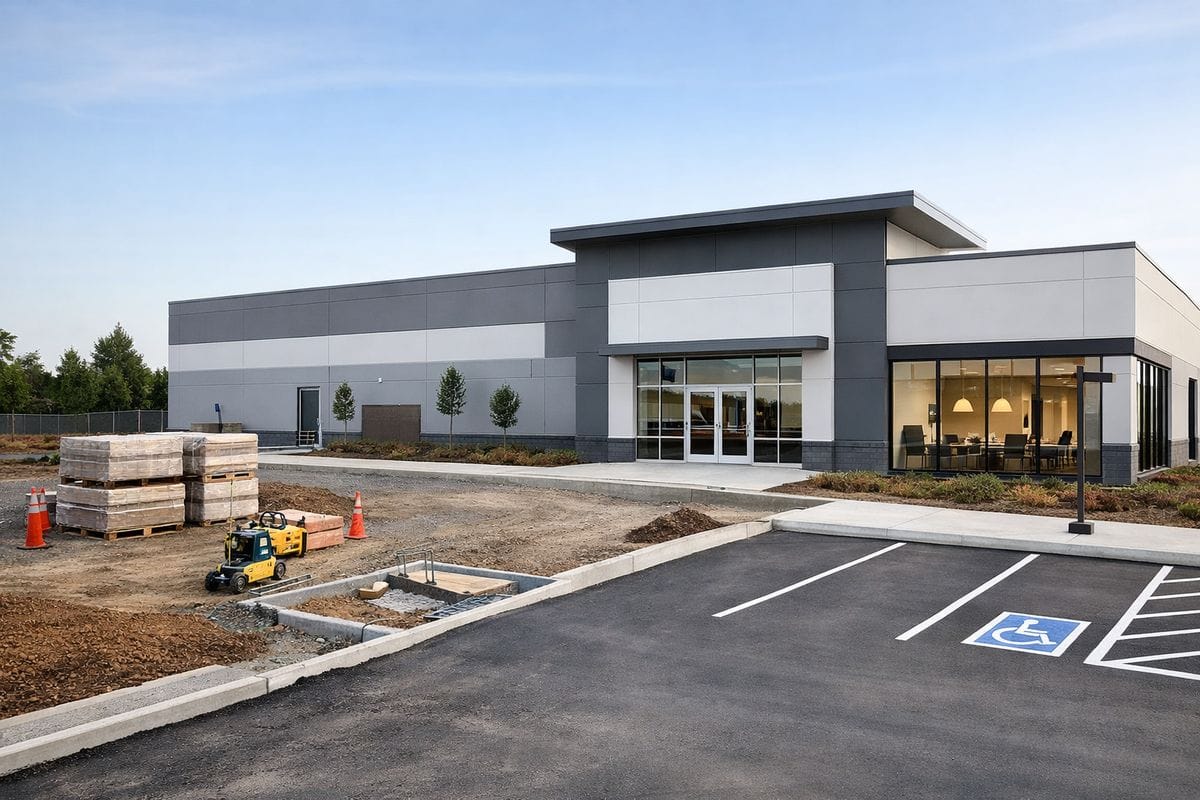
A single commercial project often includes site work in one quarter, tenant build-outs later, and separate systems delivered months apart. Treating the whole project as one undivided asset can reduce available bonus depreciation. The component election fixes that.
What the Component Election Is
The component election, clarified in IRS Notice 2026-11, allows separate components of a larger project to be treated individually for bonus depreciation purposes. That means specific components can qualify for 100% bonus depreciation even if the overall project began earlier or follows a more complicated timeline.
For phased projects, this is a serious planning advantage. It allows tax treatment to follow actual project delivery rather than forcing everything into one blunt timeline.
Construction Start Rules and the 10% Safe Harbor
For self-constructed or renovated projects, construction is treated as underway when significant physical work begins or when more than 10% of total project costs have been incurred under the safe harbor. Those tests are not abstract. They determine whether certain assets fall under transition rules or restored 100% bonus rules.
This is why project tracking matters. Draw schedules, contractor pay applications, lien waivers, and owner-approved invoices all become tax evidence. If construction start is not documented at the component level, owners lose the ability to prove which pieces qualify for the better outcome.
Where This Election Delivers the Most Value
The component election delivers the most value in phased tenant build-outs, mixed renovation schedules, ground-up projects delivered in stages, and self-constructed improvements where site work, shell completion, and interior finish-out happen on different timelines.
Think about a medical office development delivered suite by suite. One phase opens in March, another in August, and common-area improvements continue through year-end. Treating each component based on its own timeline often preserves more immediate deduction than treating the project as one block of basis. Same asset, better timing discipline, better tax outcome.
Qualified Improvement Property, Section 179, and Section 179D
These provisions often get lumped together, but they solve different problems. The recommendation is to think of them as adjacent tools, not substitutes.
Qualified Improvement Property deals with interior nonresidential improvements. Section 179 is a narrower immediate expensing rule with dollar caps and income limits. Section 179D is an energy-efficiency deduction tied to qualifying building systems and design performance. Each one can improve tax results when coordinated correctly.
Qualified Improvement Property (QIP)
Qualified Improvement Property generally covers improvements made to the interior of nonresidential real property after the building is first placed in service. Federal rules treat QIP as 15-year property. Because it is 15-year property, it also becomes bonus-eligible under the federal bonus depreciation framework when timing requirements are met.
This creates a major planning opportunity for office, retail, and other commercial properties undergoing interior renovation. Tenant refreshes, lobby upgrades, interior partitions, ceilings, finishes, and similar work often belong in the QIP conversation. But QIP does not include building enlargements, elevators, escalators, or the internal structural framework. Misclassifying those costs is a common error.
Section 179 for Commercial Property Owners
Section 179 allows immediate expensing for certain qualifying property, but it is narrower than many commercial owners assume. The current limit is $2.5 million, with phaseout beginning at $4 million. It is also limited by taxable business income, which means it does not offer the same flexibility as bonus depreciation for very large deductions or loss creation.
That distinction matters. Bonus depreciation has no annual dollar cap and can create a federal NOL. Section 179 cannot do that. For many rental real estate owners, especially those holding property in pass-through structures, Section 179 is useful but secondary. It is a tactical rule, not the main engine.
Section 179D for Energy-Efficient Commercial Buildings
Section 179D provides a deduction for qualifying energy-efficient commercial buildings and certain multifamily buildings that are at least four stories high. For eligible buildings placed in service after Dec. 31, 2022, the deduction can be worth up to $5.80 per square foot.
That is real money on larger projects. A 50,000-square-foot qualifying building can generate up to $290,000 of deduction under the top rate. Timing matters here too, because the current framework phases out the incentive for projects beginning construction after June 30, 2026. Owners planning energy upgrades cannot treat that deadline casually.
How to Coordinate These Rules Without Double Counting
One dollar of basis can only be claimed once. That sounds obvious, but overlapping incentives make it easy to lose track of what has been assigned where.
The correct approach is sequencing and clean allocation. Separate costs into structural property, short-life property, QIP, Section 179-eligible property, Section 179D-qualified systems, and de minimis items. Then apply the relevant rule to each cost bucket based on eligibility. Clean cost mapping prevents double counting, supports the return, and keeps audit defense intact.
Commercial vs. Residential Depreciation: The Differences That Change Deal Math
Investors moving from residential rentals into commercial property often assume depreciation works the same way with a longer life. It does not. The differences change underwriting, renovation planning, and after-tax returns.
Residential investors are used to 27.5-year straight-line on the building, plus some upside from cost seg. Commercial deals require more attention to interior improvements, site work, QIP, and mixed-use allocations. The framework is broader, and the timing stakes are higher.
Apartment Building vs. Office Building
Take two properties with the same total purchase price and the same land allocation. The apartment building uses 27.5-year straight-line for the residential structure. The office building uses 39 years for the nonresidential structure. Out of the gate, the apartment building produces more annual building depreciation.
But the office building may generate more QIP opportunities and more specialized interior components after acquisition. A renovated office asset with significant tenant improvements often creates larger short-life buckets than a plain apartment acquisition. That means the right comparison is not just 27.5 versus 39. It is total accelerated basis potential. The slower baseline on office can be partly offset, or in some years fully overwhelmed, by better acceleration opportunities.
NNN Lease Property vs. Residential Rental
A common assumption is that an NNN lease property has limited depreciation value because the tenant handles operations and the building looks simple. That is incomplete thinking.
NNN properties still include land improvements, allocated personal property, and tenant improvements. A quick-service restaurant pad, pharmacy, or bank branch often has significant site work, dedicated utility components, signage infrastructure, and tenant-specific finishes. The lease structure does not erase the asset classification. Tax value is tied to the property components, not to whether the lease is triple net.
Mixed-Use Properties and Common Classification Errors
Mixed-use properties create some of the most persistent depreciation mistakes. The residential portion and the commercial portion are not depreciated on the same schedule. Costs need to be allocated between the two uses, and improvements need to be classified correctly.
Poor allocation distorts everything that follows. If too much basis is assigned to 39-year commercial property, deductions are understated. If residential and commercial improvements are blended carelessly, QIP analysis breaks down. Mixed-use assets need a deliberate split, not a rough estimate buried in the fixed-asset schedule.
Dollar Examples: How Accelerated Depreciation Changes First-Year Deductions
This is where the strategy becomes concrete. Straight-line depreciation produces a predictable annual deduction. Accelerated depreciation changes the first-year number dramatically by pulling forward qualifying costs.
The point is not that every property gets the same percentage. It does not. The point is that even conservative reclassification can reshape year-one tax results.
Example 1: $2 Million Apartment Building
Assume a $2 million apartment building with $400,000 allocated to land and $1.6 million to depreciable building basis. Under standard 27.5-year straight-line depreciation, annual depreciation is about $58,182 before convention adjustments.
Now assume a cost segregation study reclassifies 25 percent of the $1.6 million basis, or $400,000, into shorter-life assets. Use a simple breakdown: $250,000 to 5-year property and $150,000 to 15-year land improvements. Under post-Jan. 19, 2025 rules, that $400,000 qualifies for 100% bonus depreciation if properly placed in service and eligible. The remaining $1.2 million stays on the 27.5-year schedule, generating about $43,636 annually.
First-year deduction under straight-line only: about $58,182.
First-year deduction with cost seg and 100% bonus on qualifying assets: about $443,636.
That is the difference between a routine deduction and a deduction large enough to materially shelter rental income from multiple properties.
Example 2: $3 Million Retail or Office Building
Assume a $3 million retail or office acquisition with $500,000 allocated to land and $2.5 million to depreciable basis. Straight-line commercial depreciation over 39 years produces about $64,103 annually.
Now apply the three-mechanism stack that serious investors actually care about.
Layer 1 is cost segregation. Assume 30 percent of the $3 million property economics, or $900,000 of qualifying basis inside the depreciable asset pool, is reclassified into short-life categories. That is a realistic planning model for a property with meaningful site work, interior improvements, and functional components.
Layer 2 is bonus depreciation. Using the required transition example for the 40% bonus rate, 40 percent of that $900,000 short-life bucket produces an immediate deduction of $360,000.
Layer 3 is the de minimis safe harbor. Assume $45,000 of individual items under $2,500 each are expensed immediately rather than capitalized.
Total first-year deductions from Layers 2 and 3 alone: $405,000. Add regular depreciation on the remaining long-life basis and the first-year result moves above that figure. Compare that with straight-line only. Using a simple 39-year baseline on the full $3 million example, the annual write-off is $76,923. The contrast is dramatic because it should be. $405,000-plus versus $76,923 is exactly why high-income investors use commercial acquisitions as tax planning vehicles, not just yield vehicles.
For investors with high W-2 income or business income, this paper loss becomes especially valuable when it can offset active income through real estate professional status or qualifying short-term rental activity. Without that status, the deduction still has value, but the immediate benefit may be limited by passive loss rules. With that status, the cash-flow impact becomes much stronger.
Example 3: Renovation Project With QIP and Site Improvements
Assume a commercial building owner spends $700,000 on renovations. Of that, $400,000 is interior nonresidential improvement that qualifies as QIP. Another $180,000 is parking lot replacement, curbs, and drainage improvements. The remaining $120,000 is structural work tied to the building shell.
The $400,000 QIP bucket is 15-year property. The $180,000 site work is also generally 15-year property. If those costs are placed in service under qualifying bonus rules, $580,000 becomes immediately deductible. The remaining $120,000 structural cost stays in 39-year property.
If the project is delayed and not placed in service until the next tax year, the current-year deduction is lost. Same invoices, different tax year, materially different cash result. That is why project completion tracking belongs in tax planning from the start.
Example 4: When Accelerated Depreciation Creates an NOL
Assume your portfolio generates $250,000 of taxable rental income before depreciation, and a newly acquired commercial property adds $500,000 of accelerated first-year deductions through cost seg, bonus, and related expensing. The result is a $250,000 net operating loss at the federal level.
What the field data shows is that this outcome is common in larger acquisitions and renovation-heavy years. The NOL can carry tax value into future periods, but only if it fits the broader return profile. If current-year active income can be offset because status and grouping rules support it, the benefit is immediate. If not, the deduction still exists, but time-to-value stretches out. The deduction is not the same as usable tax savings. That distinction matters.
The Four Timing Rules That Determine Whether You Capture the Deduction
Accelerated depreciation is driven by timing rules, not by intention. Owning the property is not enough. Finishing the project is not enough. The tax benefit depends on dates, elections, and support.
The recommendation is to treat timing under four rules: acquisition date, placed-in-service date, construction start date, and filing deadlines. Those four drivers determine the result more than almost anything else.
Rule 1: Acquisition Date
Acquisition date matters because transition rules often refer to when property is acquired under a binding contract or when ownership transfers. It affects which version of the law applies and which bonus percentage governs certain assets.
For purchased real estate, this is usually straightforward. For phased acquisitions, seller-funded improvements, or transactions with construction elements embedded in the contract, the analysis gets more detailed fast.
Rule 2: Placed-in-Service Date
Placed-in-service date is the most important timing rule for most owners. Property is placed in service when it is ready and available for its intended use. Not when it is mostly complete. Not when the contractor says the hard part is done. Ready and available.
A tenant improvement completed on December 29 but still lacking occupancy approval or operational readiness is not in service. A finished parking area that is open and functioning is. Small delays into January can shift a six-figure deduction into the next tax year. That is a real underwriting issue, not a technical footnote.
Rule 3: Construction Start Date
Construction start date matters for self-constructed and renovated property under current bonus depreciation rules. Under the applicable standards, construction starts when significant physical work begins or when more than 10 percent of total cost is incurred under the safe harbor.
For qualifying property under the current federal framework, this date interacts with the Jan. 20, 2025 through Dec. 31, 2029 construction window cited in industry guidance. That makes cost tracking by component and by timeline a hard requirement on larger projects.
Rule 4: Election Filing and Documentation Deadlines
The deduction is only as strong as the return that claims it. Elections need to be made correctly. Statements need to be attached when required. Method changes need to be filed when a look-back study is used. Component elections require separate support by asset or project component.
This is where otherwise good planning fails. The property qualifies. The study is done. The schedules are incomplete or the election statement is missing. Result: a weaker position and a harder audit defense. Tax strategy without filing discipline is not strategy.
State Tax Conformity: Why Federal Savings Do Not Always Match State Savings
One of the biggest commercial real estate tax mistakes is assuming state treatment follows federal treatment automatically. It often does not.
Federal bonus depreciation can create a large current deduction while certain states require addbacks, deny full conformity, or force separate depreciation schedules. That means your federal tax savings and state tax savings can diverge sharply.
States That Commonly Decouple From Federal Bonus Depreciation
Several large states commonly decouple from federal bonus depreciation, including California, New York, New Jersey, and Pennsylvania. Bloomberg Tax notes that this often means state addbacks and separate state depreciation schedules.
The practical effect is friction. Your federal return may show a large year-one deduction, while your state return adds some or all of it back and recovers it over time under a different schedule. Multistate ownership amplifies the problem because every jurisdiction can follow a different rule set.
When Electing Out of Bonus Depreciation Produces a Better Outcome
Based on analysis of multistate filings, electing out of bonus depreciation is sometimes the better business decision. This happens when state addbacks are heavy, NOL creation is not useful, passive loss limits delay the federal benefit, or income smoothing produces stronger multi-year tax efficiency than one massive first-year deduction.
That recommendation surprises owners who think faster is always better. It is not. Faster is better when the deduction is usable, state drag is manageable, and the cash savings arrive where they matter most. If those conditions are absent, a slower schedule can produce a stronger total outcome.
How Multistate Owners Should Model the Tradeoff
Model the federal and state result together. Compare current-year federal cash tax savings, state addback impact, compliance burden, future depreciation schedules, and partner reporting consequences. Then test the scenario with and without bonus depreciation.
For partnerships and investor groups, reporting complexity also matters. A large federal paper loss paired with fragmented state adjustments creates K-1 complexity and follow-on tax work. That does not kill the strategy, but it affects the real after-tax ROI.

Audit Defense and Documentation Standards
Documentation is not administrative cleanup. It is part of the tax asset. If your records are weak, your depreciation strategy is weak.
Accelerated depreciation attracts scrutiny because it reclassifies costs and front-loads deductions. That does not make it aggressive by default. It does mean the file needs to prove the classifications and dates clearly.
What Records a Cost Segregation Study Should Include
A defensible study should include engineering detail, asset descriptions, methodology, cost sourcing, photographs, building plans, tax authority support, and depreciation schedules by class life. The stronger reports trace conclusions back to actual costs or detailed engineering estimates rather than rough percentages.
This is one reason high-quality studies command real fees. They are not spreadsheets with optimistic labels. They are technical documents built for return preparation and audit defense.
How to Track Renovations, Tenant Improvements, and Partial-Year Service Dates
Track invoices, draw schedules, certificates of occupancy, contractor completion notices, internal turnover approvals, and service dates for each asset group. Tenant improvements should be separated by suite or phase where relevant. Site work should be tracked apart from structural work. Partial-year placed-in-service dates should be documented as they occur, not reconstructed months later.
Owners who do this well usually coordinate accounting and construction reporting from the start. Owners who do it poorly end up trying to rebuild a project from email chains and bank statements after year-end. That is expensive and avoidable.
Common Red Flags That Trigger Problems
The most common red flags are aggressive classifications, missing basis support, poor land allocation, deductions claimed without a defensible study, and failure to distinguish structural property from personal property. Another frequent problem is claiming a project was placed in service before it was actually ready for use.
If the deduction is large, assume the support needs to be equally strong. That is the standard.
When Accelerated Depreciation Is a Strong Fit and When It Is Not
Accelerated depreciation is powerful, but it is not automatically the right move on every property. The right use case depends on current taxable income, asset mix, state exposure, hold period, and ability to use the losses.
The recommendation is to use a business-case framework, not a blanket rule.
Best-Fit Scenarios
The best scenarios include newly acquired commercial buildings, large multifamily assets, properties with significant site improvements, recent renovations, and owners with strong current taxable income. Based on analysis of cost seg outcomes across the field, properties with larger bases and meaningful improvement detail consistently produce the highest ROI from a study.
The strongest fit is an owner with income to offset now. That includes business owners, high-income professionals, and investors with large portfolio income. For active income offset, the deduction is especially valuable when real estate professional status or qualifying short-term rental treatment makes the paper losses immediately usable.
Cases Where the Recommendation Changes
The recommendation changes when current taxable income is low, passive loss limitations prevent immediate use, state nonconformity creates heavy drag, the property is expected to be sold in the near term, or the owner wants to avoid creating an NOL. In those cases, full acceleration is not automatically wrong, but it needs tighter modeling.
Short hold periods deserve special attention because depreciation recapture becomes more immediate on exit. That does not erase the time-value advantage, but it narrows it. If disposition is likely in the next few years, the sale model needs to sit beside the acquisition model.
Cost-Benefit Threshold for Ordering a Study
A cost segregation study needs a business case. Property size, short-life asset percentage, study fee, state complexity, and current income profile all matter. As a practical benchmark, larger returns usually show up when building basis exceeds $1 million or renovations exceed roughly $300,000, though strong smaller-property cases still exist.
The field data also shows that many studies reclassify roughly 10 percent to 40 percent of depreciable basis into shorter-life property depending on asset type. That range is wide, but it is useful for modeling. If the expected reclassification is tiny and current income is limited, the study may not clear the ROI threshold.
Related Tax Planning Issues That Should Be Considered Alongside Depreciation
Accelerated depreciation works best when coordinated with the rest of your tax profile. Handled in isolation, it produces deductions. Coordinated properly, it improves total tax efficiency.
That means looking beyond depreciation itself and into loss use rules, interest limitations, incentive stacking, and long-term ownership planning.
Passive Activity Loss Rules and Material Participation
A large depreciation deduction does not automatically offset all income immediately. Passive activity loss rules determine whether losses from rental real estate can be used currently or suspended for later use. That is why status matters.
For investors with high W-2 or business income, accelerated depreciation becomes especially powerful when real estate professional status is available or when qualifying short-term rental activity avoids passive treatment. Without that, the paper loss may sit on the shelf. With that, the deduction can offset active income and change total tax liability materially.
Business Interest Deduction Under the EBITDA Standard
The business interest limitation now uses EBITDA rather than EBIT, which generally increases allowable interest deductions for many real estate businesses. That matters because commercial properties often carry substantial debt, and interest deductions interact with depreciation in shaping taxable income.
A stronger interest deduction regime makes it easier to pair aggressive depreciation with current deductibility of financing costs. In practical terms, more of the economic cost of ownership gets recognized earlier. That improves tax efficiency in leveraged acquisitions.
Opportunity Zones, QBI, and Estate Planning Coordination
Opportunity Zone rules beginning in 2027, QBI treatment for qualifying pass-through income, and estate planning strategy all interact with depreciation planning. Current law changes make Opportunity Zones a longer-term planning topic again, including a 10 percent basis step-up after five years and enhanced rural incentives under the updated framework.
The business outcome is broader than one return year. Accelerated depreciation affects basis, future gain, cash retention, and transfer planning. Owners holding assets long term should coordinate depreciation with entity structure, distribution policy, succession planning, and refinance timing. Tax strategy works best when it matches the ownership strategy.
Frequently Asked Questions About Accelerated Depreciation for Commercial Real Estate
Can the Entire Commercial Building Be Bonus Depreciated?
No. The building structure itself generally does not qualify for bonus depreciation. Only qualifying components with shorter class lives, usually 5-, 7-, or 15-year property identified through cost segregation or related analysis, receive bonus depreciation.
Is a Cost Segregation Study Worth It for a Small Commercial Property?
It depends on basis, renovation scope, and usable income, but the decision is economic rather than theoretical. A smaller property with meaningful site work, tenant improvements, or interior components can justify a study. A simple low-basis property with limited short-life assets often does not.
Can a Study Be Done Years After Purchase?
Yes. A look-back study can often be completed years after acquisition or construction, and the missed depreciation can usually be claimed through an accounting method change rather than amended returns. That makes late planning far better than no planning.
Does Accelerated Depreciation Increase Recapture on Sale?
Yes, faster depreciation generally increases depreciation recapture exposure on sale. That is the tradeoff. But the right comparison is present cash flow versus future tax cost. If the deduction is used effectively and the property is held long enough, the time-value benefit is often still favorable.
What Happens if the State Does Not Follow Federal Bonus Depreciation?
State nonconformity usually means addbacks, separate depreciation schedules, or both. The federal deduction still exists, but the state benefit is reduced or delayed. In some multistate situations, electing out of bonus depreciation produces a cleaner and more efficient overall result.
The Recommendation: How to Approach Accelerated Depreciation Strategically
The recommendation is a four-phase approach.
Phase one: establish depreciable basis precisely. Allocate land correctly, capitalize the right acquisition costs, and separate repairs from improvements. If the basis work is weak, everything after it is compromised.
Phase two: run cost segregation wherever the expected reclassification justifies the fee. That is the primary driver of accelerated depreciation in commercial real estate. It converts broad basis into actionable tax categories.
Phase three: model federal and state outcomes before filing. Test bonus depreciation, elect-out scenarios, passive loss usability, NOL creation, and near-term sale assumptions. The right answer is the one that maximizes after-tax ROI, not the one with the biggest headline deduction.
Phase four: file with full documentation. Include elections, support placed-in-service dates, preserve component-level records, and maintain a study that can survive review.
Used this way, accelerated depreciation is not just a deduction strategy. It is a recurring capital-planning tool. It improves liquidity, shortens time-to-value on acquisitions and renovations, and gives commercial real estate owners a sharper way to turn tax law into investment performance.