
A commercial property 1031 exchange rules guide is really a buying-power guide. If sale proceeds get taxed instead of deferred, portfolio growth slows fast. This tutorial shows exactly how to preserve equity, move into larger commercial assets, and avoid the mistakes that turn a planned exchange into a taxable sale.
What this tutorial covers and what a 1031 exchange changes for commercial ROI
A 1031 exchange lets you sell investment or business real estate and defer current capital gains tax by acquiring other qualifying real property. At the portfolio level, that changes ROI because more equity stays in the deal. Instead of sending a large check to the IRS after selling a duplex, strip center, or warehouse, you keep that capital working in the next acquisition.
That matters most when you are trading up. Based on analysis of commercial exchange structures, the recommendation is simple: treat the exchange as a capital preservation tool first and a tax tool second. Preserved equity supports larger down payments, stronger debt coverage, and better asset quality. It also gives you room to shift from active management into apartment, industrial, retail, office, NNN, or DST ownership without shrinking purchasing power.
Prerequisites: What to line up before starting a commercial 1031 exchange
Before Step 1, build the exchange file before the sale closes. Most failed exchanges do not fail on tax theory. They fail on timing, documents, or cash control.
Confirm that both properties qualify as investment or business-use real property
Section 1031 applies to real property held for investment or productive use in a trade or business. That includes many commercial assets, multifamily rentals, and investment land. It does not apply to personal-use property or property held mainly for resale.
Assemble the required team
Put the right people in place before listing. Your qualified intermediary holds proceeds and documents the exchange. Your CPA models gain, depreciation recapture exposure, and basis carryover. Your closing attorney or escrow officer coordinates assignments and settlement statements. Your lender confirms replacement debt capacity. Your broker keeps the search pipeline moving, which matters because commercial diligence burns time fast.
Gather property numbers before listing
Pull the numbers before the property hits the market: sale price estimate, adjusted basis, depreciation taken, loan payoff, closing costs, target replacement value, and projected equity rollover. Without those numbers, you cannot know the purchase target required for full deferral.
Step 1: Verify that the relinquished property is eligible
Start with the property being sold. If that asset fails the use test, the exchange fails before it starts.
Apply the held-for-investment or business-use test
Commercial buildings, apartment properties, vacant land held for investment, and qualifying long-term leaseholds generally pass the test. The rule focuses on why you held the property, not whether it is glamorous or plain.
Exclude dealer property, flips, and primary residences
Property held primarily for sale is out. The IRS is clear that property held for sale does not qualify. A flip, inventory home, or primary residence does not become exchange property because it is real estate.
Check special cases such as leaseholds and mixed-use assets
Leaseholds generally need more than 30 years remaining, including renewal options, to be treated as like-kind real property. Mixed-use assets demand allocation and clean records. If part of a property is personal-use and part is investment-use, document the split before closing.
Step 2: Confirm that the replacement property meets the like-kind rule
This is where residential investors often overcomplicate the rule. For U.S. real estate, like-kind is broad.
Understand what “like-kind” means for commercial investors
Like-kind refers to nature and character, not grade or quality. Like-kind real estate can include apartments, retail centers, warehouses, office buildings, NNN properties, and vacant investment land. You are not required to exchange retail for retail or multifamily for multifamily.
Avoid nonqualifying property swaps
Since 2018, Section 1031 applies only to real property. Personal property and most intangible interests no longer qualify. U.S. real estate also is not like-kind to foreign real estate.
Compare common trade-up scenarios with plain-English examples
A duplex can be exchanged into a 12-unit apartment building. A small retail strip can be exchanged into a single-tenant NNN pharmacy. Vacant land can be exchanged into an industrial flex building. A management-heavy apartment asset can be exchanged into a DST or NNN property if your goal is passive income and lower operational drag.
Step 3: Structure the exchange before closing and use a qualified intermediary
The mechanical rules decide the tax result. Get this part wrong and the sale becomes taxable, even if the replacement property was perfect.
Assign the sale contract to the qualified intermediary
Your exchange agreement, assignment, and notice language should be in place before or at closing. The intermediary steps into the transaction under safe-harbor procedures so proceeds never land under your control.
Do not take receipt of sale proceeds
You cannot receive, pledge, borrow, or freely access the cash during the exchange period. A qualified intermediary must hold proceeds until replacement property is acquired. If money touches your account, deferral is blown.
Keep the taxpayer name consistent
The same taxpayer that sells must buy. If the relinquished property is owned by one LLC or individual taxpayer and the replacement is acquired by another, deferral can collapse. Title changes, entity restructuring, and partnership breakups need planning before closing, not after.

Step 4: Calculate the value, equity, and debt targets for full tax deferral
This step protects against boot. Three principles control the math: replace value, reinvest equity, and replace debt.
Buy equal or greater value replacement property
For full deferral, buy replacement property at least equal to the net sale price of the relinquished property. Trading down creates taxable gain on the difference.
Reinvest all net equity
If you pull cash out, you create cash boot. That amount becomes taxable gain to the extent received.
Replace debt or add new cash
Debt relief also creates boot. If your old mortgage is paid off at sale and your new financing is smaller, you must add cash to offset the drop. Otherwise the debt reduction is taxable.
Walk through a commercial dollar example
Assume you sell an apartment building for $2,000,000. Closing costs are $100,000. Loan payoff is $700,000. Net sale price is $1,900,000 and net equity is $1,200,000.
To defer fully, buy at $1,900,000 or more, reinvest the full $1,200,000 of equity, and take on at least $700,000 of new debt unless you replace the shortfall with additional cash. If you buy a $1,700,000 NNN property with $1,200,000 down and only $500,000 debt, you created $200,000 of value boot and $200,000 of mortgage boot exposure. That tax drag is avoidable if you model the numbers before listing.
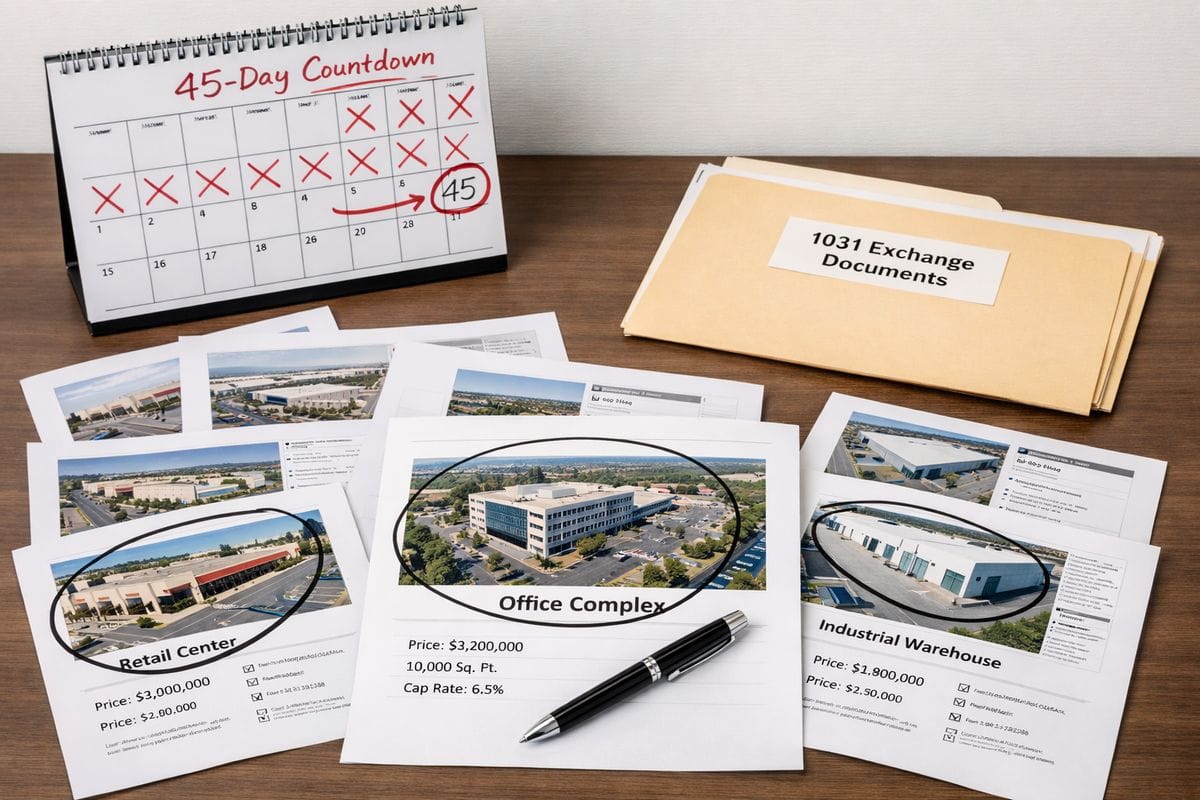
Step 5: Identify replacement property within the 45-day deadline
This is the hardest deadline in commercial deals because underwriting, lender review, and negotiation all move slower than in small residential transactions.
Track the 45-day clock from the day after closing
The clock starts the day after closing on the relinquished property. The 45-day and 180-day deadlines are hard statutory rules. Weekends and holidays do not save you.
Use a valid written identification notice
Your identification must be in writing, signed, and delivered to the qualified intermediary or another permitted party. Use an unambiguous legal description, street address, or distinguishable asset description. “Industrial building in Dallas” is not good enough.
Choose an identification strategy that fits your pipeline
Most investors use the three-property rule and name one primary target plus backups. If you identify more than three, stay within the 200 percent rule unless you plan to satisfy the 95 percent exception. In practice, naming backup deals is not optional. It is risk control.
Step 6: Close on the replacement property within 180 days and document the exchange
Identification is not success. Closing is success.
Track the 180-day completion deadline
You must receive the replacement property by the earlier of 180 days after transfer of the relinquished property or your tax return due date, unless an extension applies. Reverse exchanges deserve extra scrutiny here because you buy first and sell later under a more complex structure.
Apply exchange proceeds to qualified uses only
Exchange funds should go to replacement property, certain closing costs, or secured debt payoff tied to the relinquished property. If funds are diverted to unrelated expenses, recognized gain follows.
Report the transaction on IRS Form 8824
The exchange must be reported on Form 8824. That filing captures the properties, dates, values, boot, and basis calculations. Your basis carries over, adjusted for additional money invested and any gain recognized.
Step 7: Evaluate advanced commercial exchange issues before moving into larger assets
This is where underwriting gets more technical, especially when you move from residential rentals into commercial or larger multifamily assets.
Understand basis carryover and future depreciation
A 1031 exchange defers tax. It does not erase it. Your replacement basis is not the same as a fresh purchase basis, so future depreciation changes and deferred gain remains embedded for a later taxable sale.
Factor in commercial depreciation and cost segregation strategy
Residential rentals are generally depreciated over 27.5 years. Commercial buildings are generally depreciated over 39 years. Multifamily stays in the residential bucket, but commercial components and personal-property allocations can shift deductions. Cost segregation accelerates portions of basis into shorter lives, which improves near-term cash flow and underwriting ROI after the exchange. That is one reason exchanged multifamily and commercial assets deserve a fresh depreciation study rather than autopilot assumptions.
Know when reverse or related-party exchanges need extra scrutiny
A reverse exchange is useful when the replacement must be acquired before the old property sells. A related-party exchange faces holding-period restrictions and audit attention. DST acquisitions also require scrutiny on timing, debt structure, and sponsor documentation, even though they are often used for passive ownership after selling active-management property.
Troubleshooting: Common 1031 exchange mistakes that create taxable gain
Missing the 45-day or 180-day deadline
Miss either deadline and the exchange fails. No informal extension fixes that in a standard exchange.
Receiving cash, credits, or non-like-kind property
Cash-out, excess seller credits, and non-like-kind consideration create boot. The IRS rule is direct: cash or other property received triggers recognized gain up to the amount received.
Buying down in value or debt without planning for tax
Lower value or lower debt reduces deferral. If the business plan requires trading down, price the tax into the decision instead of pretending it is a full exchange.
Changing entities or title carelessly
Partnership interests do not qualify, and casual LLC or title changes can break the same-taxpayer rule. Entity cleanup belongs in pre-sale planning.
Expected outcome: What a successful commercial 1031 exchange delivers and the next move to make
A properly executed exchange gives you more deployable equity, better asset selection, stronger market positioning, and less immediate tax drag. The recommendation is direct: model value, debt, timing, and carryover basis before listing any commercial asset. That is how you protect ROI instead of donating it to avoidable tax.
Frequently Asked Questions
Can a residential rental be exchanged into commercial property?
Yes. Investment real estate is broadly like-kind to other investment real estate. A rental house, apartment building, retail strip, warehouse, or NNN property can be exchanged across asset classes if both properties are held for investment or business use.
Does a DST qualify for a 1031 exchange?
Yes, a properly structured Delaware Statutory Trust interest can qualify as replacement property for a 1031 exchange. It is often used when you want passive ownership, institutional management, and a backup option during the 45-day identification window.
What happens if replacement debt is lower than the old loan?
The reduction can create mortgage boot. To preserve full deferral, replace the lost debt with new financing or add cash equal to the shortfall.
Are 1031 exchanges still allowed in 2026?
Yes. Current federal law still allows exchanges of qualifying investment and business real property. Reform discussions continue, but there is no current repeal for real-property exchanges.
Can you buy the replacement property before selling the old one?
Yes, through a reverse exchange. It is more complex, more expensive, and less forgiving on documentation, but it solves the problem when the replacement opportunity appears before the sale closes.