
Commercial building depreciation life is the IRS tax recovery period for nonresidential real property, and it directly changes your after-tax cash flow, your underwriting, and your exit math. If you are moving from single-family rentals into office, retail, industrial, self-storage, medical, or NNN assets, the 39-year rule is the first tax rule that materially changes how a deal performs.
Why the 39-Year Rule Matters to Commercial Real Estate ROI
Depreciation is not an accounting side note. It is a cash-flow tool. Every dollar of depreciation reduces taxable income, which means the recovery period assigned to a building affects annual tax savings, debt service coverage comfort, and early-year returns.
That is why commercial building depreciation life matters so much. A building depreciated over 39 years produces a slower annual deduction than one depreciated over 27.5 years. On the same purchase price, that difference can shift thousands of dollars per year out of your pocket and into the IRS.
The recommendation is simple: treat 39 years as the baseline for nonresidential real estate, but never stop the analysis there. Based on the field data, the highest-value tax planning begins after the default rule is identified, not before. Once the building is classified, the next question is how much of the total basis truly belongs in the 39-year bucket and how much belongs in shorter recovery periods.

What Commercial Building Depreciation Life Means
Commercial building depreciation life means the tax period over which you recover the cost of a nonresidential building through annual deductions. It is a tax rule under MACRS, not a statement that the property physically wears out in exactly 39 years and not a statement that the property loses market value.
That distinction matters. A warehouse can appreciate sharply in market value while you still claim depreciation every year. A medical office can produce rising rent and rising value while the tax code still allows an annual deduction based on a fixed recovery period. Tax depreciation and real-world economics are different systems.
The exact definition of the 39-year rule
For federal income tax purposes, commercial property is generally depreciated over 39 years if it is nonresidential real property placed in service under the current MACRS framework. The building itself uses the straight-line method, so the deduction is spread relatively evenly across the recovery period.
In plain English, that means the IRS does not let you write off the full cost of the building in the year you buy it. Instead, you recover the building basis gradually over 39 years, subject to first-year timing rules and any reclassification opportunities.
What counts as nonresidential real property
Nonresidential real property includes the broad set of commercial asset classes most investors think of first: office buildings, retail centers, industrial facilities, warehouses, self-storage, medical offices, manufacturing space, hospitality properties with transient use characteristics, and many NNN-leased assets.
If a tenant rents a drugstore building under a long-term triple-net lease, that is still nonresidential real property. If you own a suburban office building, a flex industrial property, or a warehouse leased to a logistics operator, that is nonresidential real property. The lease structure does not change the building classification.
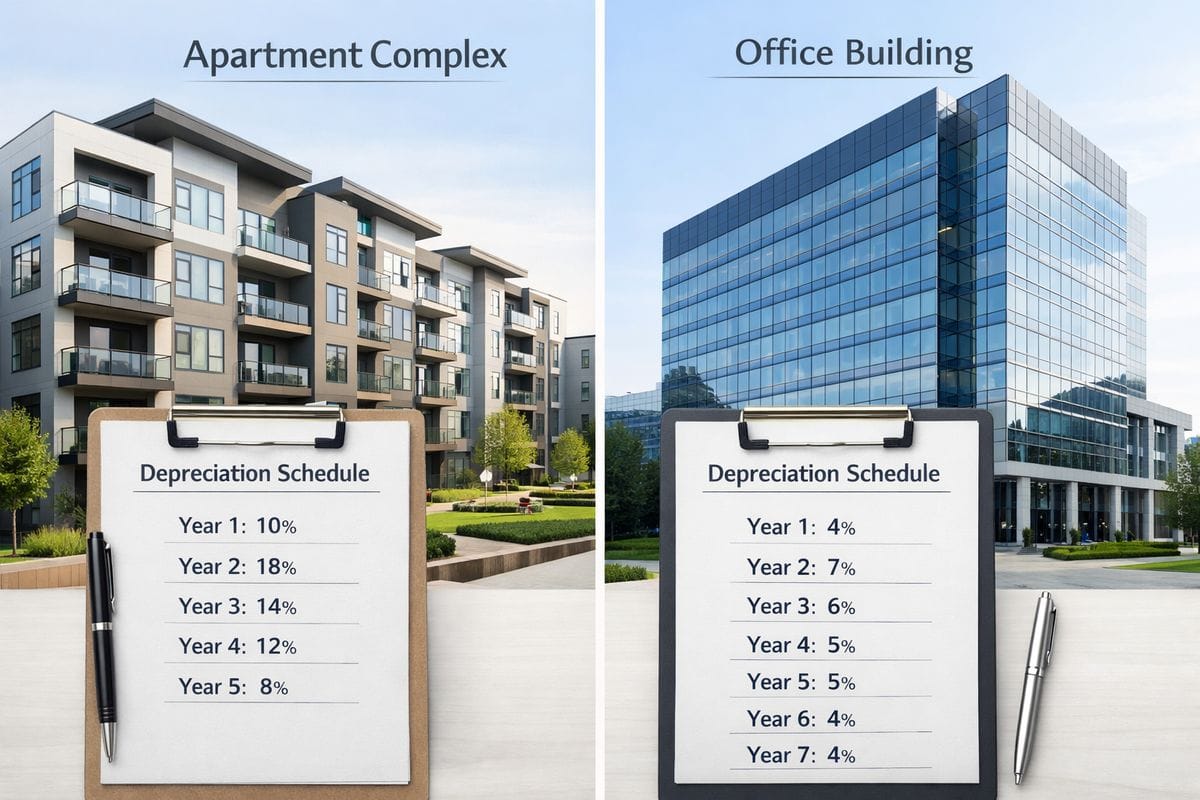
The line gets more interesting with multifamily and mixed-use buildings. Large apartment buildings feel commercial from an investment standpoint, but for depreciation they are usually residential rental property, not nonresidential real property. That means they generally use the 27.5-year schedule, not 39 years.
A mixed-use asset requires a classification analysis. The most important test is the 80% gross rental income rule. If 80% or more of the gross rental income comes from dwelling units, the property is residential rental property and uses the 27.5-year life. If it fails that test, the nonresidential portion drives treatment differently and allocations become more important.
A concrete example makes this much easier. Assume a mixed-use building generates $120,000 of annual rent from apartments and $25,000 from ground-floor retail. Total gross rental income is $145,000. The apartment portion is $120,000 divided by $145,000, or 82.76%. Rounded, apartments are 83% of revenue. That building qualifies as residential rental property because more than 80% of gross rental income comes from dwelling units.
Now flip the numbers. Assume a building generates 60% of gross rental income from apartments and 40% from retail. That property fails the 80% test. It does not qualify as residential rental property under the dwelling-unit rule, so you do not get to place the whole building on the 27.5-year schedule.
The dwelling-unit issue also matters. Furnished apartments, houses, and condos generally count as dwelling units. The fact that a unit is furnished does not disqualify it. Hotels and motels with average stays under 30 days do not count as dwelling units for this purpose. That is why an apartment building and an extended-stay lodging asset can land in different tax categories even if both look similar from the street.
Misclassification is expensive. If you depreciate a building over 27.5 years and the property actually belongs on a 39-year schedule, you have overstated depreciation. That creates adjustment risk, depreciation recapture exposure, interest, and penalties. This is not a technical footnote. It changes reported taxable income and sale calculations.
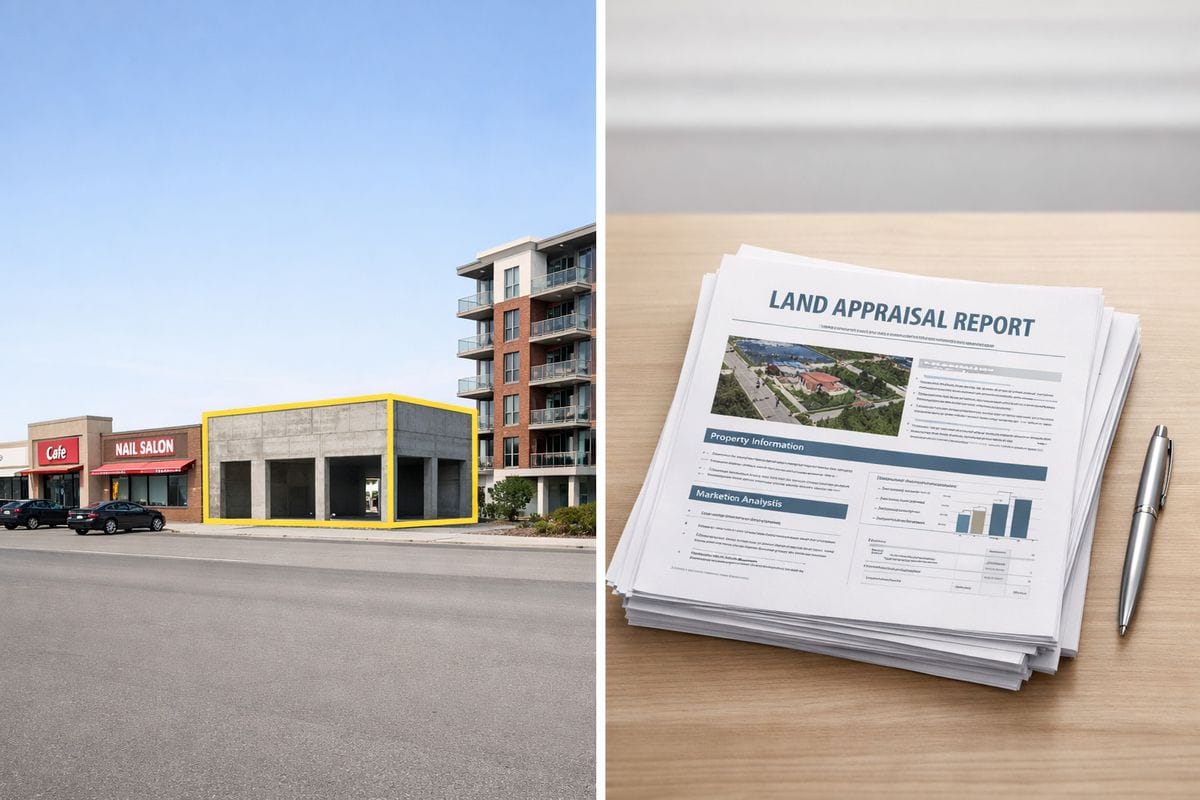
Why land is never depreciated
Land is never depreciated because land does not wear out, get used up, or become obsolete in the tax sense applied to depreciable property. You can depreciate the building sitting on the land. You can depreciate certain land improvements. You cannot depreciate the dirt itself.
That is why every acquisition starts with an allocation between land and building. If you buy a property for $1,000,000, not all $1,000,000 produces depreciation. The portion assigned to land does not generate an annual deduction. Only the depreciable basis, meaning the building and certain qualifying improvements, enters the depreciation schedule.
This is one of the first transition points for residential investors entering commercial deals. Residential underwriting often treats depreciation as a familiar background benefit. Commercial acquisitions require a much sharper basis allocation because land values vary widely across retail corridors, infill industrial, suburban office, and high-density mixed-use assets. A weak allocation leaves money on the table. An aggressive one without support creates audit risk.
The Three Core Rules That Control Commercial Building Depreciation
Commercial building depreciation follows three controlling rules: recovery period, method, and timing convention. Once these are clear, the annual deduction becomes predictable and the advanced planning becomes much easier to evaluate.
Rule 1: Recovery period
The recovery period is the number of years over which the IRS allows you to depreciate the property. For nonresidential real property, that period is 39 years. For residential rental property, the period is 27.5 years.
This is the comparison most investors need. If you spent years buying single-family rentals or small apartment assets, you are used to a faster write-off. Then you buy a retail strip center, office building, or warehouse and discover the building itself recovers over a much longer period. Same concept, slower result.
A quick comparison shows the impact. If your depreciable basis is $800,000, a 39-year schedule produces about $20,512.82 of annual depreciation before first-year convention adjustments. A 27.5-year schedule on that same $800,000 basis produces about $29,090.91. That is a difference of about $8,578 per year. At a 37% marginal tax rate, that is roughly $3,174 of annual federal tax savings lost when the asset shifts from residential to commercial treatment.
The classification line matters even more in mixed-use buildings. If a property qualifies as residential rental property under the 80% gross rental income test, the entire building treatment can change. That is not a small detail. It affects annual deductions for the entire hold period.
Rule 2: Method
The method for commercial buildings is straight-line depreciation. That means the building basis is recovered in equal increments over the recovery period rather than front-loaded through an accelerated method.
That is why the building shell itself is tax-efficient, but not tax-aggressive. The walls, structural frame, roof, and core systems generally do not move quickly from a deduction standpoint. The tax code spreads those deductions over decades.
This is also why cost segregation matters so much. The building shell stays straight-line over 39 years, but certain components inside and outside the building can be separated into shorter-lived categories. Without that separation, too much basis gets trapped in the slowest category.
Rule 3: Convention and placed-in-service date
Depreciation begins when the property is placed in service, not when you sign the contract and not necessarily when you close. Placed in service means the property is ready and available for its intended income-producing use.
If you close on December 20 but the property is not actually ready for rent until January after renovation, depreciation starts in January. If you close on a fully functioning NNN-leased pharmacy with a tenant already operating, the building is generally placed in service right away because it is ready and available for business use.
First-year and final-year deductions are also affected by convention rules. In practical terms, that means the first-year depreciation is prorated rather than equal to a full annual amount. Many investors underwrite a full-year deduction and are surprised when the tax return shows a lower first-year number. The schedule is doing exactly what the rules require.
Timing is an operational issue, not just a tax issue. Closing date, certificate of occupancy, tenant delivery, renovation completion, and rent-ready status all control the deduction year.
Commercial vs. Residential Depreciation: The Comparison Most Investors Need
The biggest mental shift for residential investors entering commercial real estate is that the building life changes. The concept is familiar. The numbers are not.
27.5 years for residential rental property
Residential rental property is generally depreciated over 27.5 years. That includes apartment buildings, duplexes, triplexes, single-family rentals, condos rented to tenants, and similar assets where the building is used as a residence.
The dwelling-unit concept is the anchor. Apartments, houses, and condos qualify as dwelling units. Furnished apartments still qualify. The presence of furniture does not convert a residential rental into a hotel asset. By contrast, hotels and motels where occupants stay under 30 days do not count as dwelling units for this classification test.
A large multifamily asset can feel commercial in every business sense. Institutional ownership, professional management, and sophisticated financing do not change the depreciation classification. If it is residential rental property, it uses 27.5 years.
39 years for offices, retail, industrial, and many NNN assets
Nonresidential buildings such as offices, shopping centers, warehouses, distribution buildings, manufacturing facilities, and many single-tenant NNN assets use the 39-year recovery period. That longer life means smaller annual deductions on the same building basis.
The difference is easy to see when you compare the same number across both schedules. On an $800,000 building basis, 39-year straight-line depreciation generates $20,512.82 annually. At 27.5 years, the same basis generates roughly $29,090.91. The commercial building gives you a slower tax benefit even if the deal has stronger actual cash flow.
This is one reason residential investors sometimes overestimate the early-year tax shelter on their first commercial deal. They apply apartment expectations to a commercial schedule and discover the tax shield is materially thinner.
Mixed-use properties and the allocation trap
Mixed-use assets create the most confusion because investors often use the word commercial to describe the deal type while the tax rules ask a different question. The issue is not what brokers call the asset. The issue is how the property is classified under depreciation rules.
Start with the 80% gross rental income test. If a mixed-use building earns $120,000 from apartments and $25,000 from retail, apartments represent 83% of total rental income. That property qualifies as residential rental property. If a building runs at a 60/40 split, it fails the test and does not qualify.
The trap is assuming the whole property gets one life without testing the facts. A mixed-use property that fails the 80% test may require allocation between residential and commercial portions rather than a blanket 27.5-year schedule. The numbers change fast when the classification changes.
Misclassification also compounds over time. If you over-depreciate under the 27.5-year schedule when 39 years should apply, every annual return overstates deductions. On sale, you also face recapture issues tied to depreciation actually claimed or allowable. The tax code does not forgive the error because the property looked like an apartment building from the outside.
How the 39-Year Depreciation Calculation Actually Works
The mechanics are straightforward once the basis is set correctly. The hard part is getting the classification and allocation right before the math begins.
Step 1: Determine purchase price allocation
Start by dividing the acquisition cost into categories: land, building, personal property, and land improvements. This is not a cosmetic exercise. It determines which dollars are nondepreciable, which go into the 39-year bucket, and which may qualify for shorter lives.
A supportable allocation usually draws from the appraisal, county assessor data adjusted for market reality, engineering detail, construction records, or a cost segregation analysis. An arbitrary allocation is a bad practice. If you assign an unrealistically low land value to increase building basis, you are manufacturing deductions without support.
For a first-time commercial buyer, this is often the first major shift from simple residential tax prep. Commercial acquisitions contain more asset layers. Parking lots, decorative site lighting, specialty wiring, interior finishes, and outdoor improvements all need proper classification.
Step 2: Establish depreciable basis
Depreciable basis generally includes the building purchase allocation plus capitalizable acquisition costs and later capital improvements, reduced by the amount assigned to land. Closing costs that must be capitalized become part of basis. Capital improvements made after acquisition create new depreciable basis and often new depreciation schedules.
If you buy a building for $1,000,000 and allocate $250,000 to land and $750,000 to the building, the starting building basis is $750,000. If $20,000 of capitalizable costs are added to basis, and those costs relate to the building, basis becomes $770,000 before any further asset classification.
That number is not static. Roof replacements, HVAC upgrades, tenant improvement projects, parking lot work, and major interior renovations can all create additional depreciable basis after closing.
Step 3: Apply the 39-year straight-line schedule
Once the building basis is fixed, the annual straight-line formula is simple: depreciable building basis divided by 39 years.
The research-backed example is useful because it reflects a common-scale transaction. An $800,000 building basis produces an annual depreciation deduction of $20,512.82 under the standard 39-year schedule. That is the baseline before first-year proration and before any cost segregation adjustments.
The same logic scales upward. A $10,000,000 commercial building basis produces about $256,410 of annual depreciation over 39 years, which aligns with field examples from advisory firms analyzing commercial cost segregation opportunities.
Step 4: Handle first-year timing
The first-year deduction is usually lower than the full annual amount because depreciation begins when the property is placed in service and is prorated under convention rules. That means you do not simply take the full annual number if the property entered service partway through the year.
A deal closed late in the year often produces a noticeably smaller first-year deduction than underwriting assumes. That is not an error. It is a timing rule.
This matters even more when renovations delay service. A building that sits offline during repositioning does not generate depreciation until it is ready and available for its intended use. If your business plan depends on a year-one tax shield, service date discipline matters.
A Simple Example: Commercial Building Depreciation on an Actual Deal
The numbers become real when the calculation is tied to a plausible acquisition.
Example: $1,000,000 purchase with land allocation
Assume you buy a small retail or office property for $1,000,000. A supportable allocation assigns $200,000 to land and $800,000 to the building. The land generates no depreciation. The $800,000 building basis enters the 39-year straight-line schedule.
The annual depreciation deduction is $800,000 divided by 39, or $20,512.82 before first-year proration. If the property is placed in service at the beginning of the tax year, that is the baseline annual deduction for the building shell.
This is the part many investors underestimate. A $1,000,000 commercial acquisition does not produce a six-figure annual depreciation deduction unless a large amount of short-life property is identified separately. Left on the default schedule, the deduction is modest relative to total purchase price.
What the annual deduction looks like at different tax rates
Depreciation matters because it creates tax savings, not because it creates a line item on a return. Translate the deduction into after-tax cash flow.
On a $20,512.82 annual deduction, estimated federal tax savings are about $4,308 at a 21% rate, about $6,564 at a 32% rate, and about $7,590 at a 37% rate. The deduction does not put cash into the property directly. It reduces the taxes owed on income generated elsewhere or on the property itself, depending on your tax profile.
That is the business outcome. A longer recovery period means less annual tax shelter. A shorter one means more cash retained in the early years.
Why cash flow improves even when the building rises in value
A common misconception is that depreciation only makes sense if a building is actually going down in value. That is false. Tax depreciation is a statutory recovery system, not a market appraisal system.
You can own a shopping center that rises in value from $1,000,000 to $1,300,000 and still deduct depreciation each year. You can hold a warehouse in a tightening industrial market and claim annual depreciation while rents and value increase.
The tax code allows this because it is recovering your capital investment in the income-producing asset over a prescribed period. Appreciation and depreciation are operating in different lanes.
What the 39-Year Rule Includes and What It Does Not
The 39-year rule applies to the building and its core structural components. It does not automatically apply to every dollar inside the fence line or inside the walls.
Components that stay in 39-year property
The 39-year category generally includes the structural framework, load-bearing walls, roof, foundations, floors, ceilings, permanent interior walls, elevators, plumbing serving the building generally, and HVAC systems serving the building as a whole.
Think of this as the building’s skeleton and core organs. These are the parts that make the structure function as a building rather than as a tenant-specific business environment. They usually remain in the 39-year category.
If you buy an office building, the shell does not become 5-year property because you would rather have the deduction sooner. The classification follows tax rules, not preference.
Components that may qualify for shorter lives
Certain items can fall outside the 39-year bucket when properly identified and valued. Research and field practice repeatedly point to carpeting, decorative lighting, cabinetry, specialty electrical, certain plumbing fixtures, sidewalks, parking lots, fencing, and site improvements as examples of assets that can qualify for 5-, 7-, or 15-year lives when separated from the building structure.
That is the center of the opportunity. The building is not one monolithic depreciable asset. It is a collection of components, and some of those components have shorter tax lives when classified correctly. Shorter recovery periods often apply to assets such as carpeting, sidewalks, and fencing once those items are identified separately from the structure.
Tenant improvements and interior build-outs
Tenant improvements do not automatically share one recovery life. The exact nature of the work controls the classification.
A build-out that adds specialty millwork, decorative finishes, dedicated electrical for specific equipment, or nonstructural interior elements may contain shorter-life assets. Work that upgrades structural walls, building-wide systems, or permanent building components generally stays in the 39-year category.
This is why tenant improvement-heavy properties often deserve closer analysis than plain-shell buildings. A medical office with exam-room casework and specialty electrical has a different depreciation profile from a bare warehouse with minimal interior finish.
The Real Opportunity: Cost Segregation as the Main Exception to the 39-Year Rule
The default rule is clear: nonresidential buildings are 39-year property. The highest-value tax strategy is equally clear: identify what is not actually 39-year property and move it into the correct shorter-life buckets.
What a cost segregation study does
A cost segregation study is an engineering-based tax analysis that identifies, values, and classifies property components into the proper depreciation categories. Its function is simple: separate assets that should not be trapped inside the building’s 39-year life.
This is not an aggressive loophole. It is the IRS-recognized method for determining proper recovery periods for individual assets inside a building acquisition or construction project. The building remains 39-year property. The study identifies which components are not part of that bucket.
The asset classes that matter most
The practical categories are 5-year property, 7-year property, 15-year land improvements, and the remaining 39-year building basis. Those four buckets do most of the work in commercial real estate depreciation planning.
Five-year property often includes personal-property-type components and specific interior finishes. Seven-year property can include certain fixtures and equipment-related items. Fifteen-year property often captures land improvements such as parking lots, sidewalks, landscaping features, and fencing. Everything that remains in the building shell stays at 39 years.
How much basis typically gets reclassified
Based on analysis of advisory-firm field data, the amount reclassified into shorter lives usually falls within a meaningful range rather than a fixed number. Windes reports that 10% to 40% of depreciable basis is commonly reclassified depending on property type, while Blue & Co. notes that 20% to 30% is a common result in many studies.
Property type drives the result. Hotels, medical office, restaurants, and retail often have more short-life components. Plain industrial shells usually have fewer. Multifamily properties often perform better than investors expect because interior finishes, site work, and amenity-related assets create shorter-life pools.

Cost Segregation Example: How First-Year Deductions Increase
The clearest reason cost segregation matters is that it changes year-one deductions dramatically.
Baseline without cost segregation
Start with the standard example: an $800,000 building basis depreciated over 39 years. The annual deduction is $20,512.82. That is the default result if the entire depreciable building basis remains in the building category.
At a 37% tax rate, that annual deduction produces about $7,590 in federal tax savings. Useful, yes. Impressive, no.
Example with reclassified short-life assets
Now change the classification, not the economics of the deal. In the same example, assets are reclassified out of the 39-year bucket into shorter-life property, including 5-, 7-, and 15-year categories. Without using bonus depreciation, first-year depreciation rises to $52,106.23.
That is more than double the straight-line baseline. The additional deduction creates roughly $11,689.56 of extra first-year tax savings at a 37% tax rate compared with leaving the entire building basis on the 39-year schedule.
This is why cost segregation shows up so often in commercial tax planning. The property did not change. The loan did not change. Rents did not change. Classification changed, and cash flow improved.
Example with bonus depreciation layered in
The effect becomes much larger when qualifying short-life assets also receive bonus depreciation. In the same research-backed example, $300,000 of reclassified assets qualified for bonus depreciation, producing estimated first-year tax savings of $72,634 compared with straight-line treatment.
That is the difference between a modest annual tax shield and a major front-loaded deduction. For an investor acquiring a cash-flowing property with taxable income to absorb the deduction, that timing shift materially improves after-tax ROI.
Bonus Depreciation After Cost Segregation: The 2025 Timing Rules
Bonus depreciation is the amplifier. Cost segregation identifies qualifying short-life assets. Bonus depreciation can allow immediate expensing for those eligible assets. The 39-year shell itself does not qualify.
What bonus depreciation applies to
Bonus depreciation generally applies to qualifying property with recovery periods of 20 years or less. That includes many 5-, 7-, and 15-year assets identified in a cost segregation study. It does not generally apply to the 39-year building shell.
That distinction is nonnegotiable. If the asset remains part of the building structure, it stays on the 39-year schedule. Bonus depreciation becomes available only after proper classification places an asset into a qualifying shorter-life category.
The phase-down timeline and the post-January 19, 2025 change
The timeline matters because many online articles still reflect the older phase-down rules. The sequence surfaced in current source material is this: 2023 at 80%, 2024 at 60%, January 1 through January 19, 2025 at 40%, then 100% bonus depreciation restored for qualifying property acquired and placed in service after January 19, 2025 under Notice 2026-11 interim guidance.
That is a major change in planning value. A study performed on qualifying property after that effective date can create a much larger immediate deduction than the same study under the older phase-down percentages.
Why acquisition and placed-in-service dates drive the result
Bonus depreciation is controlled by dates, and commercial projects have several dates that matter: acquisition date, construction start date for self-constructed property, placed-in-service date, and in some cases the timing of individual components.
For self-constructed property, current guidance emphasizes the physical work test and the 10% safe harbor analysis. If a project began before the key January 20, 2025 change, some components may be limited under older rules unless a component election and proper documentation support later-acquired qualifying components. That makes construction records, vendor invoices, and election statements operational tax documents, not back-office clutter.
The business consequence is direct. A delayed placed-in-service date can move a deduction into a different tax year. Poor documentation can shrink or eliminate a bonus claim. Timing discipline drives the outcome.
Properties That Benefit Most From Accelerated Depreciation
Not every building creates the same tax value. Based on analysis of commercial cost segregation outcomes, four property situations consistently produce the strongest results.
Newly acquired commercial properties
A new acquisition is the cleanest moment to study the asset because the basis is fresh, records are easiest to assemble, and the tax benefit begins immediately. This is the point at which your depreciation schedule is first being built, so classification decisions have the greatest reach.
It is also the easiest time to model ROI. You know the purchase price, land allocation, tenant mix, and intended hold period. That gives you a clear feasibility framework.
New construction and self-constructed projects
New construction often produces strong studies because cost detail is available at the component level. Vendor invoices, construction draws, plans, and specifications make it easier to identify shorter-life property.
This category is especially important after the 2025 bonus changes. For self-constructed projects, current guidance emphasizes when physical work began or when more than 10% of expected cost had been incurred. If those dates are documented carefully, the depreciation result becomes much easier to defend.
Renovated buildings and heavy tenant improvement projects
Renovations create new basis, and that new basis often contains a high concentration of shorter-life components. Interior remodels, tenant build-outs, expansions, and repositioning projects routinely generate cabinetry, specialty lighting, decorative finishes, dedicated wiring, and land improvements.
That is why a tired retail building converted for new tenants or a medical office updated with specialized infrastructure often produces a stronger cost segregation result than a basic stabilized industrial box.
Asset types with stronger cost segregation results
Property type strongly influences how much basis moves out of the 39-year bucket. Hotels, restaurants, medical office, retail, and specialty-use buildings usually perform well because they contain more personal-property-type items and more detailed interior build-outs.
Office buildings and multifamily properties also often show meaningful reclassification. Windes specifically notes that multifamily and office buildings tend to contain more short-life property than industrial buildings. Plain industrial often has a larger share of simple shell value, which reduces acceleration potential.
When a Cost Segregation Study Does Not Deliver Enough Value
Cost segregation is powerful, but it is not automatic value. A disciplined investor screens for situations where the economics are weak.
Short hold periods and weaker time-value benefit
Accelerated depreciation is a timing strategy. It moves deductions forward. If you sell quickly, you compress the time value benefit and increase the chance that recapture offsets too much of the early gain.
A long hold period improves the economics because the tax deferral remains in your business longer. That retained cash can reduce borrowing needs, support reserves, or fund additional acquisitions.
Passive losses and limited ability to use deductions
The tax value of depreciation depends on your ability to use it. If passive activity loss rules suspend the losses, the current-year cash benefit drops. The deduction still matters, but it does not generate the same immediate ROI as it would for an owner with taxable income that can absorb it.
That is why feasibility analysis comes first. Current tax position is one of the main drivers of value, not a minor afterthought.
Smaller properties with low reclassification potential
Some properties simply do not contain enough short-life basis to justify the study fee, compliance burden, and follow-through. A very small, plain building with minimal improvements and little site work may not produce enough acceleration to matter.
Field practice often treats larger acquisitions and larger renovation budgets as stronger candidates. Windes identifies newly purchased or constructed property with more than $1 million allocated to the building, or renovation and leasehold improvements above $300,000, as especially strong candidates. That is not a hard legal threshold, but it is a practical screening standard.
Depreciation Recapture: The Hidden Cost Behind Early Tax Savings
Any honest discussion of accelerated depreciation has to address recapture. Early tax savings are real. So is the tax cost that often arrives on sale.
What depreciation recapture is
Depreciation recapture is the tax mechanism that claws back some of the benefit from prior depreciation deductions when you sell the property. In simple terms, the tax code lets you deduct depreciation while you own the asset, then requires part of that benefit to be recognized through special gain treatment when you dispose of it.
This is why depreciation is a deferral strategy as much as a deduction strategy. You save taxes now, but some of that savings can reappear as tax at disposition.
Why accelerated depreciation changes the exit math
Accelerated depreciation front-loads deductions. That improves current cash flow, but it also increases the amount of depreciation claimed early in the hold period. More early depreciation usually means more recapture exposure compared with a plain 39-year schedule.
That does not make acceleration a bad strategy. It means the sale analysis must be done honestly. An investor who only models acquisition-year tax savings and ignores exit tax is not underwriting the full business outcome.
The cash-flow advantage still matters
Even with recapture, early deductions still create real value because money kept today has more value than money paid later. That is the time-value-of-money case, and it is the core economic argument for accelerated depreciation.
If early tax savings are retained, reinvested, or used to reduce financing pressure, your business gains flexibility immediately. Recapture later does not erase the benefit of using that cash productively during the hold period. It simply means the strategy should be evaluated on a full-cycle basis, not sold as free money.

Strategies to Manage Recapture and Exit-Planning Risk
The right response to recapture is not to ignore depreciation. The right response is to plan the exit as carefully as the acquisition.
Longer hold periods
A longer hold period improves the economics of accelerated depreciation by extending the period during which you control the deferred tax dollars. If you hold for many years, the present value of the early cash savings becomes more compelling.
Short flips weaken that advantage. Long holds strengthen it. That is one of the clearest decision rules in commercial depreciation planning.
1031 exchanges
A 1031 exchange can defer gain and recapture recognition when the transaction meets exchange rules. That means depreciation strategy and exchange planning should be viewed together, especially for investors rolling capital from one property into another.
If you expect to exchange rather than sell outright, the recapture discussion changes from immediate tax cost to deferred portfolio tax planning.
Installment, refinancing, and disposition timing considerations
Transaction structure also affects outcomes. Installment sale mechanics, refinancing before sale, and year-of-sale timing can all affect how much tax is recognized and when. Sale planning should begin before the listing process, not after a purchase agreement is signed.
This is one of the most practical advisory points in the field: tax planning during disposition is usually too late to fix documentation gaps, classification errors, or missed write-off opportunities tied to prior renovations.
Repairs, Improvements, and Partial Asset Dispositions
Depreciation planning does not stop after acquisition. Post-close capital projects create new tax decisions every year.
Repairs vs. capital improvements
Repairs are generally currently deductible because they keep the property in ordinary operating condition. Capital improvements are added to basis and depreciated because they better, restore, or adapt the property.
That difference changes current-year cash flow. If work is properly classified as a repair, you get an immediate deduction. If it is a capital improvement, the tax benefit is spread over years.
The classification must follow the facts, not your preference. Calling a major replacement a repair does not make it one.
Roofs, HVAC, interiors, and major systems
Roofs, HVAC systems, interior renovations, and major building systems are where owners often make costly mistakes. A roof replacement is generally a capital improvement. A building-wide HVAC replacement is generally capitalized. Interior work may split between repair and capital categories depending on what was actually done.
This is where detailed invoices matter. If an interior project includes repainting, patching, and routine fixes alongside new cabinetry, specialty electrical, and new flooring, each component may require different treatment.
Partial asset disposition opportunities
Partial asset disposition rules create an important opportunity during renovations. If you remove and replace a component, such as part of a roof or a building system, you may be able to write off the remaining basis of the retired component instead of continuing to depreciate an asset that no longer exists.
That is a real cash-flow opportunity. Many owners miss it and keep depreciating retired assets because no one tracked the original component basis. Good records and strong fixed-asset detail solve that problem.
What a Proper Cost Segregation Report Should Include
A cost segregation study only creates value if it is defensible. Low-detail estimates produce weak outcomes in an audit.
Engineering-based methodology
The strongest studies use engineering analysis and tax authority, not rough percentage guesses. Windes notes that IRS guidance favors detailed engineering from actual costs or a detailed engineering cost estimate rather than rule-of-thumb methods.
That is the standard to expect. A report should show how assets were identified, how costs were assigned, and why each asset class is supported under tax rules.
Asset breakout, photos, and legal support
A proper report should include the methodology, asset schedules, photo documentation, and citations to the supporting tax authorities. Report support should also include a list of assets with assigned depreciation classes and the reasoning behind those classifications.
If a report cannot show what was classified, where it was located, and why it belongs in that category, it is not strong enough.
Record retention for the full holding period
The report and all support should be retained for as long as you own the property. That is not excessive. Sale calculations, recapture analysis, partial dispositions, and audit defense all depend on that history.
A study is not a one-year tax file. It is a property-lifecycle document.
How to Evaluate a Commercial Property With Depreciation in Mind
Good investors do not treat depreciation as something figured out after closing. They underwrite it before the deal is final.
Five drivers of depreciation value in a deal
Five drivers control the tax ROI of depreciation planning: purchase price allocation, property type, improvement mix, hold period, and taxable income position.
Purchase price allocation determines how much basis reaches depreciable categories at all. Property type affects how much short-life property is likely to exist. Improvement mix controls how much basis can be accelerated. Hold period determines the time-value benefit. Taxable income position determines how much of the deduction creates immediate savings.
Those five drivers should sit inside your deal model, not outside it.
Questions to ask before closing
Before closing, diligence should cover land value assumptions, prior capital improvements, available construction plans, tenant build-out detail, and whether a feasibility analysis supports a cost segregation study.
Ask for invoices, plans, contractor schedules, and tenant improvement breakdowns. Ask how much of the site value sits in parking, sidewalks, and exterior improvements. Ask whether interior finishes are generic shell components or tenant-specific installations.
This is where value is won. Once records disappear, the tax result gets weaker.
How depreciation changes cash-on-cash return
Depreciation changes after-tax yield, which is the version of yield that actually matters. If tax savings increase retained cash in the early years, cash-on-cash return improves even when pre-tax NOI does not change.
That also improves your debt service cushion. More retained cash means more flexibility if occupancy softens, rates reset, or reserves need replenishing. Tax planning is not separate from asset management. It supports it.
Common Mistakes Investors Make With Commercial Building Depreciation
Most costly depreciation mistakes are not exotic. They are basic classification and timing errors.
Assuming the entire property uses one life
The first mistake is assuming every depreciable dollar belongs in the 39-year bucket. That is false for many properties. Buildings contain multiple asset classes.
The entire structure does not get one uniform life just because it was bought in one closing.
Confusing tax depreciation with market decline
The second mistake is assuming depreciation means the property is losing value. Tax depreciation is a statutory deduction. A building can appreciate sharply while generating annual depreciation.
If your mental model ties depreciation to market decline, commercial tax planning will never make complete sense.
Ignoring placed-in-service dates
The third mistake is treating closing date and placed-in-service date as interchangeable. They are not. If the property was not ready and available for its intended use, depreciation does not begin.
Timing errors either reduce valid deductions or create filing problems from claiming deductions too early.
Skipping feasibility analysis before ordering a study
The fourth mistake is ordering a study without checking likely reclassification value, current tax capacity, hold period, and fee economics. A feasibility review should come first.
That review is especially important if losses are suspended, the building is small, or the property has a very plain improvement profile.
Frequently Asked Questions About Commercial Building Depreciation Life
Is every commercial property depreciated over 39 years?
The building shell of nonresidential real property generally is. That said, not every dollar in the deal belongs in the 39-year category. Proper classification can move some components into 5-, 7-, or 15-year lives through cost segregation.
Are apartment buildings commercial or residential for depreciation?
Apartment buildings are generally residential rental property for depreciation, so the building typically uses 27.5 years, not 39. The size of the asset does not change that. If the building contains dwelling units and meets the residential rental rules, it stays on the residential schedule.
Can depreciation be claimed on an older building?
Yes. The age of the building does not eliminate depreciation. What matters is your depreciable basis and the date the property is placed in service in your hands. An older office building bought today still begins a new depreciation schedule based on your acquisition basis allocation.
Can a cost segregation study be done years after purchase?
Yes. A look-back study can often be performed after acquisition, and missed depreciation is commonly caught up through the proper tax procedure rather than by amending every prior return. The best time is still the acquisition, construction, or renovation year because records are cleaner and the benefit starts sooner.
Does bonus depreciation apply to the entire building?
No. Bonus depreciation generally applies only to qualifying property with a recovery period of 20 years or less. The 39-year building shell does not generally qualify. Bonus value appears after short-life assets are properly identified and separated from the building structure.
The Recommendation: Treat 39 Years as the Starting Point, Not the Strategy
The recommendation is direct: model every nonresidential acquisition with the default 39-year schedule, verify mixed-use classification before assuming 27.5-year treatment, and run a feasibility analysis every time a property is acquired, constructed, expanded, or substantially renovated.
That sequence produces the strongest business outcome. The 39-year rule tells you the baseline. The real ROI comes from getting the classification right, separating land from building, identifying shorter-life assets, managing bonus depreciation timing, documenting everything for the full hold period, and underwriting recapture before you celebrate the first-year deduction.
If commercial real estate is becoming a larger share of your portfolio, commercial building depreciation life is no longer a background tax concept. It is part of the deal.