
Commercial property depreciation is the tax system that lets you recover the cost of a commercial building over time, even while that property rises in market value. If you are moving from single-family rentals into apartments, office, retail, industrial, self-storage, or NNN assets, commercial property depreciation changes taxable income, after-tax cash flow, and deal ROI fast, and usually more than cap rate spreads or rent growth assumptions.
Commercial Property Depreciation, in Plain English
Commercial property depreciation is not a prediction that your building is losing value. It is a tax method that spreads the cost of income-producing real estate across an IRS-defined recovery period, reducing taxable income each year. That difference matters because tax depreciation affects actual retained cash, while market value affects equity and sale proceeds. Those are related, but they are not the same thing.
For a commercial owner, depreciation sits right in the middle of deal economics. It changes annual tax shelter. It changes how much cash stays in the business. It changes how attractive a 39-year office building looks compared with a 27.5-year apartment asset. And once cost segregation enters the picture, it changes how quickly you recover capital from the same building.
Tax depreciation vs. economic depreciation
Tax depreciation follows fixed federal rules. Economic depreciation reflects what happens in the real world, physical wear, functional obsolescence, location shifts, tenant demand, and competitive pressure from newer buildings. Those two numbers rarely match.
That is why a shopping center can appreciate because rents rise and the market tightens, while still generating annual depreciation deductions on the tax return. Your tax write-off is based on cost basis and recovery schedules, not on a new broker opinion of value. Commercial real estate is generally written off over 39 years, while economic value can move in the opposite direction for years.
The research is clear that actual building depreciation varies widely across markets and asset types. Academic findings published in the Pacific-Basin Finance Journal show that economic depreciation is higher for commercial property than residential and varies by age, density, city size, and distance from the CBD. In plain English, actual buildings age unevenly. Tax law ignores that complexity and uses standardized lives instead.
Why this matters when moving from residential to commercial
If your frame of reference is residential rentals, the first commercial tax surprise is simple: the recovery period gets longer. Residential rental property uses 27.5 years. Nonresidential commercial buildings use 39 years. That is a big gap.
Longer recovery means smaller annual deductions on the same dollar of building basis. Smaller annual deductions mean weaker baseline tax shelter. Weaker tax shelter means after-tax cash flow depends more heavily on interest deductions, operating performance, renovation strategy, and accelerated depreciation planning.
Here is the practical consequence. A residential investor underwriting an office or retail deal using apartment-style expectations for depreciation will overstate after-tax cash flow. That error usually shows up late, often after closing, which is the worst time to discover it.

The Three Core Rules That Drive Commercial Building Depreciation
Commercial building depreciation runs on three rules. If you get these right at acquisition, the rest becomes modeling and documentation. If you get these wrong, every tax projection after that is off.
Rule 1: Land never depreciates
Land does not wear out, get used up, or become obsolete in the tax sense, so it is never depreciable. Only the building and qualifying improvements can be written off. The IRS says land cannot be depreciated, which means every commercial acquisition starts with one unavoidable task: split the purchase price between land and improvements.
That allocation matters because every dollar assigned to land is a dollar removed from depreciable basis. Push too much value into land and you shrink deductions for decades. Push too little into land and you create defensibility problems. Both mistakes are expensive.
You generally support the land-building split using county assessment ratios, an appraisal, or a cost-based allocation analysis. County ratios are common because they are easy and consistent. An appraisal gives stronger support when the ratio is obviously off or the site carries unusual value, such as a corner retail parcel, redevelopment land, or a dense urban infill location. The recommendation is simple: use a supportable method, document it at acquisition, and keep the file.
Rule 2: The building depreciates over 39 years
For nonresidential real property, the standard federal rule is straight-line depreciation over 39 years under MACRS. Straight-line means the annual deduction is spread evenly over the building’s recovery period, subject to timing conventions in the first and last year.
That is the default rule for office, retail, industrial, warehouses, medical office, many NNN properties, and most other commercial buildings that are not residential rental property. If you buy a freestanding pharmacy on a triple-net lease, the lease structure does not change the building’s 39-year status. If you buy an industrial warehouse, same rule. If you buy an office condo used as an income-producing nonresidential asset, same rule again.
Rule 3: Depreciation is based on basis, not market value
Depreciation starts with basis, not what the building is worth today. Basis usually includes purchase price, certain acquisition costs that must be capitalized, and capital improvements placed in service. It does not rise because the asset appraises higher after closing.
This point gets misunderstood constantly. A property can jump from $4 million to $5 million in market value because rents rise, cap rates compress, or the submarket improves, while annual depreciation stays exactly the same. That is because your write-off tracks historical cost, not appreciation. Commercial property depreciation is based on historical cost or basis, which is why acquisition records matter so much.
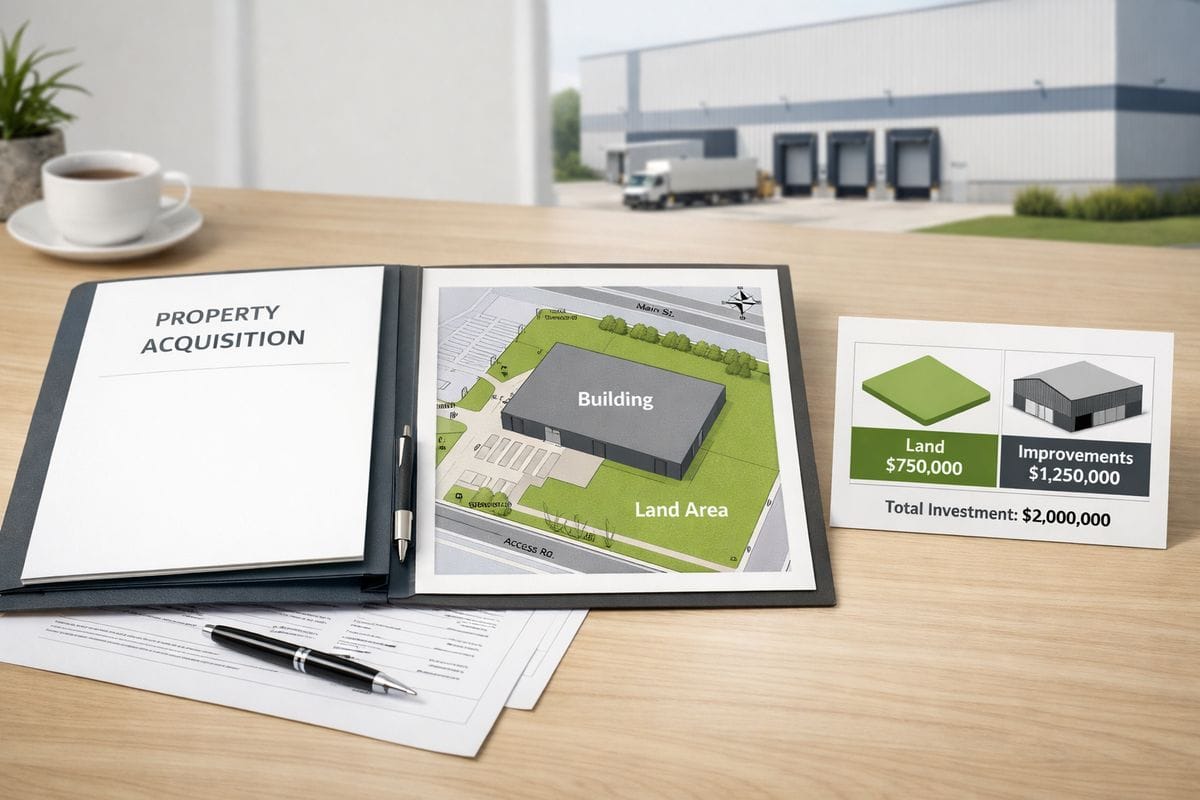
How Commercial Property Depreciation Is Calculated
The calculation itself is simple. The quality of the inputs is where deals get won or lost.
Step 1: Start with total acquisition cost
Start with the purchase price. Then add capitalized acquisition costs and initial improvements that belong in basis. Depending on the fact pattern, that can include legal and recording costs tied to acquisition, title-related costs, and certain other capitalizable amounts. It does not include routine operating costs after acquisition.
If you acquire a building for $1,000,000 and your capitalized acquisition costs bring total basis to $1,020,000, that full capitalized amount enters the allocation process. If you complete a qualifying improvement before the property is placed in service, that improvement becomes part of the starting basis for depreciation.
Step 2: Allocate value between land and building
Next, carve out land value. This is where many first-time commercial buyers get sloppy because residential deals often use rough assumptions without much consequence. In commercial, a weak allocation distorts deductions more materially because land values can be significant, especially for retail pads, urban sites, or low-improvement properties.
County assessment ratios are often the fastest starting point. If the county assessor assigns 25 percent of total assessed value to land and 75 percent to improvements, many owners use that ratio as a supportable allocation baseline. If that result looks unrealistic, an appraisal is stronger. The cost approach is also useful when the structure and site improvements can be analyzed separately from raw land value.
Here is the business outcome framing: every 5 percent swing in land allocation on a $5 million acquisition changes the depreciable basis by $250,000. On a standard 39-year schedule, that is about $6,410 of annual depreciation before any acceleration. The number is not trivial.
Step 3: Divide the depreciable basis over 39 years
Once land is excluded, divide the remaining building basis over 39 years using straight-line depreciation. That gives the full-year annual deduction for the building shell and long-life structural components.
Timing still matters because commercial real estate uses a mid-month convention. If you place the property in service in the middle of the year, you do not get a full year of depreciation in year one. You get a partial-year amount based on the month placed in service, as though the asset entered service at the midpoint of that month.
That sounds technical, but the practical takeaway is easy: a property placed in service in January gets almost a full year of depreciation, while a property placed in service in December gets very little in the first year. If you close late in the year but the building is not ready and available for rent or use until later, depreciation begins only once it is placed in service.
Dollar example: $1 million office building
Use a clean example.
Assume a $1,000,000 office purchase. Land is allocated at $200,000. The building basis is $800,000. Divide $800,000 by 39 years and the annual straight-line depreciation is about $20,513 per year.
Now compare that with residential treatment on the same $800,000 building basis. If that same amount were depreciated over 27.5 years, the annual deduction would be about $29,091. The annual gap is $8,578. If you compare a full $1,000,000 building basis with no land allocation just to isolate the schedule difference, the annual deduction would be $25,641 over 39 years versus $36,364 over 27.5 years, a $10,723 gap. That is why commercial owners feel the slower write-off immediately.
What does the $20,513 deduction do to taxable income? If the building generates $90,000 of net operating income before depreciation and interest, that depreciation lowers taxable income to $69,487 before interest and other below-the-line items. If you are in a high marginal bracket, that tax shield directly improves retained cash.
Mid-month convention changes the first-year number. If that office building is placed in service in July, you do not take the full $20,513 in year one. You take roughly half a year, adjusted by the mid-month rule. The point is not the exact worksheet math. The point is that service date changes year-one deductions and should be built into underwriting.
Dollar example: $1.5 million self-storage property
Now use the self-storage example.
Assume a $1,500,000 acquisition with $500,000 allocated to land. That leaves a $1,000,000 depreciable basis. On a standard 39-year schedule, annual building depreciation is about $25,641.
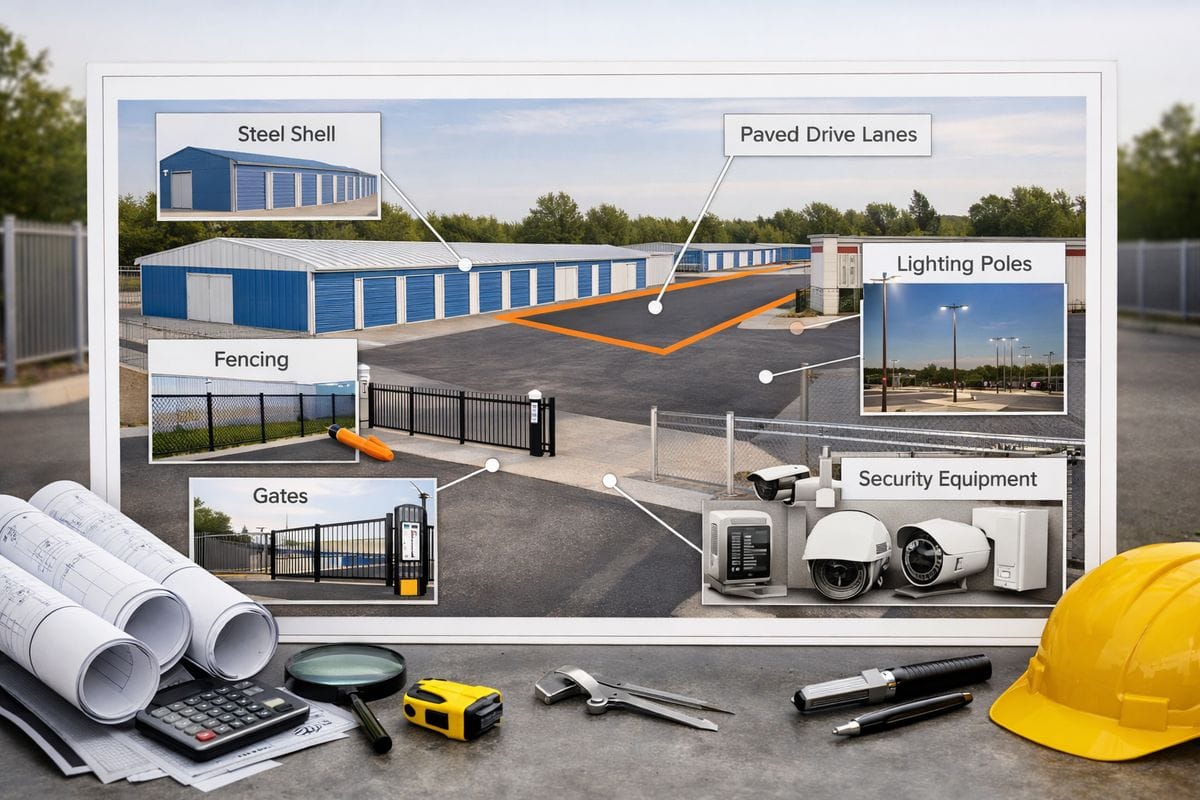
That is the baseline. It is not the likely final answer if the asset qualifies for cost segregation. Self-storage often includes site improvements, paving, fencing, lighting, drainage, security systems, and specialized components that can be assigned shorter lives. Under standard treatment, the $1,000,000 basis drips out slowly over 39 years. Under accelerated treatment, a meaningful share can move into 5-, 7-, and 15-year classes, and qualifying short-life assets can become eligible for bonus depreciation.
That difference is where cash flow moves.
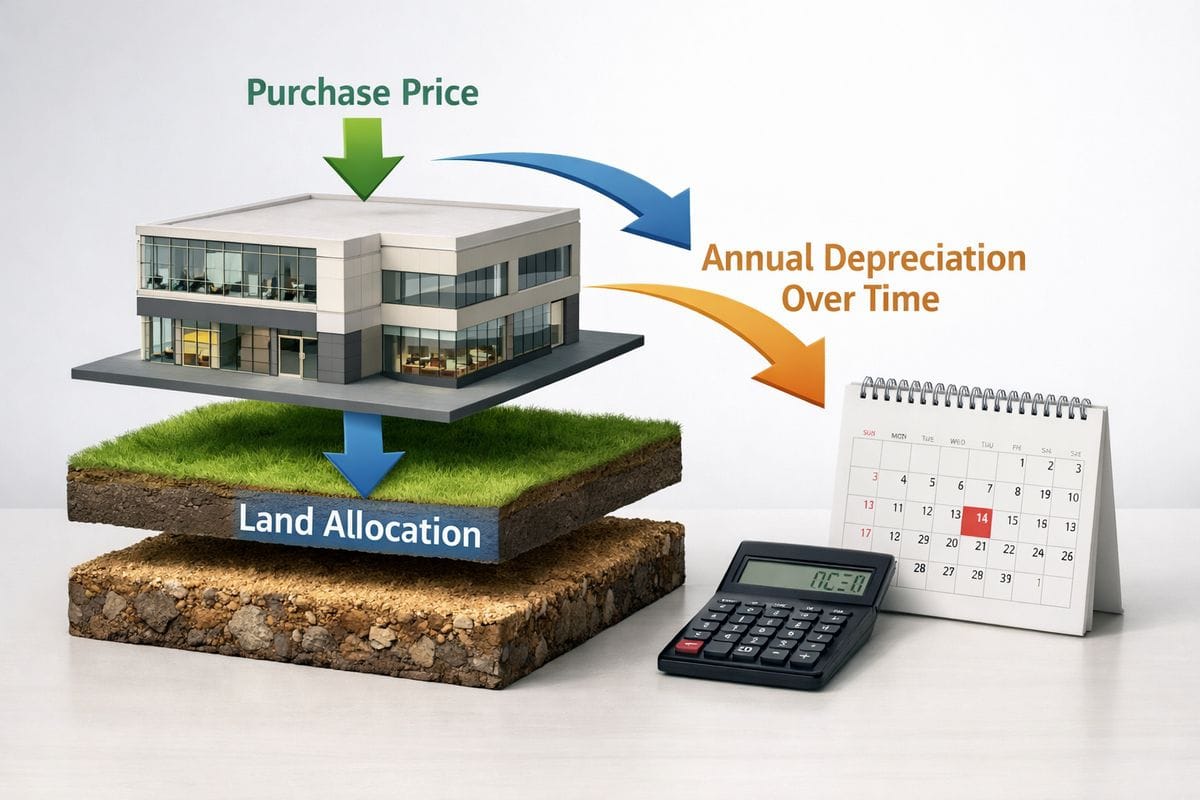
Commercial vs. Residential Depreciation: The Differences That Change the Deal
If you are scaling from residential, this is the comparison that matters most.
27.5 years vs. 39 years
Residential rental property is depreciated over 27.5 years using straight-line MACRS. Commercial nonresidential property is generally depreciated over 39 years. That single rule lowers annual deductions on comparable building basis by about 29.5 percent.
On an $800,000 building basis, residential produces about $29,091 per year. Commercial produces about $20,513. That is a meaningful reduction in annual tax shelter. It also means that a commercial deal with the same debt service and NOI as an apartment deal can leave you with more taxable income in early years.
Multifamily vs. office, retail, industrial, and NNN property
Multifamily is often grouped with commercial real estate in the investment world, but for depreciation it generally follows residential rental rules. Apartment buildings, subject to residential rental use, usually fall under the 27.5-year schedule. Office, retail, industrial, warehouses, and many NNN assets follow the 39-year nonresidential schedule.
Mixed-use properties require a use-based analysis. If the property contains both residential and commercial space, classification depends on how much of the rentable area or use falls into each category. You do not assign one label because the broker package called it “mixed-use commercial.” You classify based on tax rules.
Why the shorter residential schedule often creates stronger early tax shelter
Shorter recovery means bigger annual deductions. Bigger annual deductions mean lower taxable income sooner. That is why residential rentals often produce stronger baseline tax shelter than commercial buildings before any acceleration strategy is applied.
Commercial owners compensate by leaning harder on cost segregation, repair studies, improvement classification, and timing strategy. That is not optional planning. It is a response to the slower 39-year baseline.
What Actually Qualifies for Depreciation in a Commercial Property
A commercial property is not one asset in practice. It is a stack of asset categories with different recovery periods. That distinction is where planning value comes from.
Building structure
The building structure includes the shell and long-life structural systems: walls, roof structure, load-bearing framework, floors, permanent interior construction, and core building components. Those assets generally remain in 39-year property for nonresidential real estate.
This is the part that most investors think of when hearing “building depreciation.” It is also the part that moves the slowest.
Land improvements
Land improvements are separate from land itself. Parking lots, sidewalks, curbs, landscaping features, fencing, retaining walls, site lighting, drainage features, irrigation, and similar exterior improvements often qualify for shorter recovery periods, commonly 15 years rather than 39.
That distinction matters because many owners mistakenly leave site work trapped inside building basis. According to NAR guidance, bonus-depreciable property often includes parking lots and sidewalks along with other site improvements when classification support exists.
Personal property and removable components
Certain interior and specialized assets do not belong in the 39-year building shell. Carpeting, removable finishes, decorative millwork, certain cabinetry, specialty electrical serving particular equipment, appliances, signs, some communication systems, and tenant-specific components are common examples reviewed in cost segregation studies.
The rule is not “anything removable is short-life property.” The rule is functional and fact-specific. But the planning opportunity is real. Many buildings have 20 to 40 percent of total basis sitting in components that do not belong in a 39-year bucket.
Improvements placed in service after purchase
Post-acquisition improvements create new depreciation schedules. A new roof installed three years after purchase does not merge into the original building’s placed-in-service date. Neither does a parking lot replacement, HVAC upgrade, lobby renovation, or new fencing package.
This matters for two reasons. First, each improvement needs its own date, cost, and classification. Second, improvement-heavy properties often generate fresh acceleration opportunities long after acquisition. Owners who track only the original asset miss major deductions later.
The Four Phases of Depreciation Over a Property’s Life Cycle
The best way to understand depreciation is to follow the ownership cycle.
Acquisition phase
At acquisition, you establish basis, allocate land, identify placed-in-service timing, and set up depreciation schedules. This is where the highest ROI planning happens because initial classifications shape deductions for years.
You also collect the documents that make the tax position defensible: settlement statements, invoices, appraisal support, entity records, and renovation scopes. If you intend to order a cost segregation study, acquisition is the cleanest time to do it.
Operations phase
During operations, annual depreciation runs through the tax return. In pass-through structures, those deductions flow through to owners on K-1s. Passive activity rules still apply, so the value of depreciation depends on how your real estate income, losses, and status interact across the portfolio.
Operations is also where recordkeeping either protects deductions or destroys them. New HVAC units, resurfaced parking, interior build-outs, and common area upgrades need to be tracked separately. If a component is replaced, a partial asset disposition analysis may support writing off the retired portion instead of keeping it on the books.
Repositioning or renovation phase
Renovation is where classification decisions become especially valuable. Tenant improvements, HVAC systems, roof replacements, lighting upgrades, façade work, and interior redesign can create immediate deductions, shorter-life assets, or long-life capitalized basis depending on the facts.
The recommendation is to evaluate tax treatment before work begins, not after invoices are paid. That is how you distinguish repairs from improvements properly, identify study opportunities, and improve time-to-value from renovation capital.
Exit phase
At exit, depreciation comes back into the conversation through basis reduction, gain calculation, and recapture. If you claimed large deductions during ownership, your adjusted basis is lower, which increases gain on sale. Some of that gain is taxed under special recapture rules.
That does not make depreciation a bad strategy. It makes exit modeling mandatory.
Cost Segregation: The Highest-Impact Acceleration Strategy
If there is one strategy that closes the 39-year deduction gap, it is cost segregation.
What a cost segregation study does
A cost segregation study is an engineering-based analysis that reclassifies portions of a building into shorter-life asset classes where support exists. Instead of treating the entire acquisition as one 39-year asset, the study separates qualifying components into 5-, 7-, and 15-year property.
Done correctly, this changes the timing of deductions, not the total cost recovered over the property’s life. The benefit is front-loading. You recover more sooner, which improves cash flow and ROI today. NAR specifically describes cost segregation studies as the tool that allocates costs among long-life real property, personal property, and bonus-depreciable classes.
Which properties see the strongest ROI
Based on analysis of common implementation patterns, the strongest candidates are multifamily, self-storage, medical office, retail, hospitality, industrial, and recently renovated assets. Properties with larger purchase prices, meaningful site work, specialized interiors, or tenant-specific build-outs usually produce stronger acceleration.
Small properties can still justify a study, especially with newer digital delivery models. But the economics get stronger as purchase price and improvement depth rise. A plain older warehouse with limited site work usually yields less acceleration than a self-storage facility with extensive paving, security systems, gates, and specialized components.
What the field data shows about first-year cash flow impact
The field data shows that accelerated depreciation changes first-year retained cash more than most line-item expense reductions. When a study moves 25 percent of a $1,000,000 depreciable basis into shorter-life classes, that is $250,000 no longer trapped on a 39-year schedule. If bonus depreciation applies, a large share of that amount can hit in year one.
Take the $1.5 million self-storage example with $1,000,000 of depreciable basis. Under standard treatment, annual building depreciation is about $25,641. If a study reclassifies 30 percent, or $300,000, into shorter-life assets, the first-year deduction can jump dramatically, especially when bonus depreciation is available. That changes debt coverage after tax, investor distributions, and portfolio reinvestment capacity.
When the recommendation is to order a study
The recommendation is to order a study when you acquire a new property with meaningful depreciable basis, complete major improvements, place a newly constructed property in service, or expect a high-income year where acceleration has clear absorption value.
It also makes sense when the property type routinely contains shorter-life components, such as multifamily, self-storage, retail, medical office, and hospitality. Waiting until a later year is still possible through catch-up adjustments, but the highest planning value comes from acting early.
Bonus Depreciation After Recent Tax Changes
Commercial depreciation planning changed materially after the 2025 federal tax updates. Older articles are often outdated on this point.
How bonus depreciation works
Bonus depreciation applies to qualifying property with a useful life of 20 years or less that is new to you as the taxpayer. It does not apply to the 39-year building shell itself. It applies to shorter-life assets, often the exact assets carved out by cost segregation.
That is why cost segregation and bonus depreciation are tied together so often. One identifies short-life property. The other accelerates the deduction into year one.
Current federal bonus depreciation rates
Current federal law restored 100% bonus depreciation for qualifying property placed in service after Jan. 19, 2025 and before Jan. 1, 2031. For certain property placed in service between Jan. 1 and Jan. 19, 2025, the 40 percent rate applies instead.
That timing split matters. Acquisition date is not enough by itself. Placed-in-service timing and construction rules also matter for certain categories. If your project spans that January window, model it carefully.
Why cost segregation and bonus depreciation are usually paired
Cost segregation creates the 5-, 7-, and 15-year buckets. Bonus depreciation then allows qualifying property in those buckets to be deducted immediately, subject to current law and elections. Without cost segregation, much of that basis remains buried in a 39-year schedule and does not qualify for year-one acceleration.
This pairing is usually the highest-impact move available to commercial owners who want to improve near-term cash flow. It is especially powerful for owners with active taxable income, large passive income from real estate, or a portfolio strategy that values faster capital recovery.
When electing out is the better tax move
Bonus depreciation is not automatically the right move every time. Electing out is often the better move when state conformity creates a large addback, when federal absorption is weak and a large NOL adds little value, or when smoothing deductions over future years creates better long-term tax efficiency.
Many states do not fully conform to federal bonus rules. Bloomberg Tax specifically notes friction in California, New York, New Jersey, and Pennsylvania. In those states, the federal deduction can create state addbacks, separate schedules, and compliance drag. The recommendation is to model federal and state outcomes before making the election.
Section 179, Section 179D, and Other Commercial Real Estate Write-Offs
These provisions get confused constantly. They are not interchangeable.
Section 179 expensing
Section 179 allows immediate expensing of certain qualifying property, but it is narrower than many real estate owners assume. For 2025, the limit is $2.5 million, with phaseout beginning at $4 million of qualifying property placed in service.
Unlike bonus depreciation, Section 179 is capped and limited by taxable business income. Bonus depreciation has no annual dollar cap and can create a federal NOL. For real estate, Section 179 can apply to certain tangible personal property and some qualified improvement categories, but not to the commercial building shell.
Section 179D for energy-efficient buildings
Section 179D is the energy-efficient commercial building deduction. For qualifying buildings placed in service after Dec. 31, 2022, the deduction can be worth up to $5.80 per square foot. That is substantial on large buildings.
Timing matters. Projects beginning after June 30, 2026 face phaseout pressure under current law. If you are upgrading lighting, HVAC, envelope performance, or designing new qualifying space, 179D belongs in the conversation early, not after the building is complete.
Repairs vs. capital improvements
Repairs are generally deducted now. Capital improvements are capitalized and depreciated over time. That distinction changes current-year tax shelter more than many owners expect.
Fixing a broken component to keep the property operating as intended often points toward a repair. Betterment, restoration, adaptation, additions, major system replacements, and structural upgrades usually point toward capitalization. New roofs, additions, and major systems work commonly create new depreciable assets. The recommendation is to document work scope carefully because categorization drives cash flow.
Depreciation Recapture: Why a Big Deduction Today Can Create Tax Later
Depreciation helps on the front end. Recapture shows up on the back end.
What depreciation recapture means
Depreciation recapture means prior depreciation reduces basis, and when you sell, part of the gain tied to those deductions is taxed under special rules. In plain English, the government let you recover building cost earlier, so it wants part of that tax benefit accounted for at sale.
If you bought a property for $2 million, allocated $400,000 to land and $1.6 million to depreciable property, and then claimed $300,000 of depreciation over the hold, your adjusted basis drops by that $300,000. Sell at a gain, and part of the gain is connected to those prior deductions.
How recapture changes sale proceeds
Use a simple example.
Assume a property is bought for $1,500,000, with $500,000 land and $1,000,000 building basis. Over time, you claim $250,000 of total depreciation. Your adjusted basis falls to $1,250,000. If you sell for $1,900,000 before selling costs, your total gain is $650,000, not $400,000. The extra gain exists because depreciation reduced basis.
That means after-tax sale proceeds are lower than a naive sales-price-minus-loan-balance model suggests. Owners who ignore recapture during acquisition underwriting overstate exit ROI.
Why recapture does not make depreciation a bad strategy
Recapture does not erase the benefit of depreciation. The time value of money still works in your favor. A deduction today improves current cash flow, increases reinvestment capacity, and lowers the amount of capital tied up in taxes during the hold.
On top of that, you have planning tools. Long hold periods dilute the present value of later recapture. 1031 exchanges defer recognition. Opportunity Zone planning can change gain treatment. Refinancing can pull out equity without triggering sale tax. The recommendation is not to avoid depreciation. It is to model the full life cycle.

1031 Exchanges, Opportunity Zones, and Exit Planning
Depreciation planning and exit planning belong in the same model.
Using a 1031 exchange to defer gain and recapture
A 1031 exchange defers recognition of gain and depreciation recapture by rolling proceeds into like-kind replacement property under the exchange rules. You do not erase gain. You defer it.
Basis carryover matters here. The replacement property inherits a basis framework shaped by the relinquished property, which affects future depreciation. So a 1031 is not only an exit tool. It changes the next property’s tax profile too.
Opportunity zone considerations
Opportunity Zone planning matters when you are repositioning gains and want an alternative tax strategy outside a standard exchange. Current law made the program permanent starting in 2027 with revised rolling deferral periods and basis step-ups, including enhanced treatment for certain rural funds. The core point for commercial owners is simple: if a sale is generating significant gain and an exchange is not the chosen path, OZ analysis can become relevant quickly.
Hold period strategy and refinancing
Hold period changes the economics of accelerated depreciation. If you hold longer, the value of early deductions compounds because the tax savings are retained or reinvested for more years before a taxable exit. If you refinance instead of selling, you preserve ownership and cash out equity without triggering gain recognition.
That combination, acceleration up front, long hold, refinance in the middle, deferred disposition, is one reason depreciation remains one of the strongest wealth-building tools in commercial real estate.
State Tax Conformity: The Hidden Risk in Depreciation Planning
Federal projections are not enough.
Why federal and state results often differ
States often decouple from federal bonus depreciation or maintain separate depreciation rules. That means the federal return may show a large first-year deduction while the state return adds much of it back and recovers it over time under a different schedule.
The result is simple but annoying: less immediate state tax benefit, more compliance complexity, and different cash outcomes than the federal model suggests.
States that commonly create planning friction
California, New York, New Jersey, and Pennsylvania are frequent friction points in multistate or high-tax-state planning. These states often force owners to maintain separate schedules or reverse part of the federal acceleration for state purposes.
If your underwriting assumes federal deductions flow cleanly through to state taxable income, your projected retained cash is wrong.
How to underwrite state impact before filing
Model federal and state tax separately. Project first-year federal depreciation, state addbacks, future state recovery, and the compliance cost of maintaining separate schedules. Then compare that result against electing out of bonus depreciation or adjusting the acceleration strategy.
This is not just a filing issue. It is an ROI issue. State conformity determines how much of the headline deduction actually stays in your pocket in year one.
The Five Biggest Mistakes Investors Make With Commercial Property Depreciation
Most depreciation errors are not technical. They are process failures.
Confusing depreciation with declining market value
Depreciation is not a statement that your asset is worth less. It is a tax recovery schedule. Your building can appreciate for ten straight years while you claim annual depreciation deductions every year.
Using a weak land allocation
Land allocation drives every future depreciation number. Overstating land reduces deductions and hurts ROI. Understating land creates a weak position if challenged. Use assessor ratios, appraisal support, or a documented valuation method and keep the record.
Missing cost segregation opportunities
Many owners leave five- and fifteen-year assets buried in a 39-year schedule. That means slower deductions, weaker first-year cash flow, and lower time-to-value on the same capital investment.
Failing to track post-acquisition improvements
Roofs, HVAC systems, paving, lighting, tenant build-outs, and interior renovations need separate records, dates, and classifications. If you lump everything into one vague fixed-asset bucket, you lose deductions and make future dispositions harder to support.
Ignoring recapture and state impact during acquisition underwriting
The tax plan belongs in the buy box. If you model depreciation only at filing time, you miss state drag, overstate year-one shelter, and understate exit tax. Good underwriting treats depreciation as part of acquisition analysis, not year-end cleanup.
Real-World Examples by Property Type
Different property types produce different depreciation patterns.
Office building example
An office building usually starts with heavy 39-year basis in the shell and structural systems. Shorter-life opportunities often include specialty electrical, decorative interior finishes, carpeting, dedicated communication systems, site lighting, and paving.
Recapture exposure is often moderate to high because office owners frequently hold substantial depreciable basis and may complete tenant improvement cycles during ownership.
Retail or NNN lease property example
Retail and NNN assets often look simple because the tenant handles many operating costs. The depreciation story is not simple. Landlord-owned façade work, signage, parking lots, sidewalks, curbs, landscaping, drive lanes, and build-out allowances can create meaningful shorter-life categories.
Triple-net economics do not reduce the value of depreciation. In fact, stable lease structures can make accelerated tax shelter even more attractive because operating volatility is lower and retained cash is easier to redeploy.
Multifamily apartment building example
Multifamily generally gets the better baseline schedule, 27.5 years. That already improves annual deductions relative to office or retail. Then cost segregation can accelerate appliances, flooring, cabinetry, site work, amenities, clubhouses, pools, and specialty components.
This is why apartment owners often produce stronger early tax shelter than commercial owners on comparable basis. The schedule is shorter before any planning begins.
Self-storage or industrial example
Self-storage and industrial frequently produce attractive study results because of gates, fencing, paving, lighting, drainage, security systems, loading-related improvements, and specialized site components. Even when the shell is simple, the surrounding improvements can be substantial.
That makes these assets strong candidates for acceleration, especially when acquisition cost is meaningful and taxable income can absorb front-loaded deductions.
How Commercial Depreciation Appears on Tax Returns and Financials
Depreciation is not only a tax concept. It is also an operational recordkeeping system.
Tax return treatment
Depreciation is claimed on the business or rental tax return based on entity structure and asset use. In pass-through entities, deductions flow through to owners. Passive activity rules still matter, which means not every depreciation loss automatically shelters every type of income.
The practical takeaway is that a large depreciation deduction has value only to the extent your broader tax profile can use it now or carry it forward advantageously.
Book depreciation vs. tax depreciation
Book depreciation and tax depreciation often differ materially. Financial statements may use different useful lives, methods, or capitalization thresholds. Tax depreciation follows federal rules, elections, and study-driven reclassifications.
After cost segregation and bonus depreciation, the gap can become dramatic. A property can show modest book depreciation and very large tax depreciation in the same year. That is normal.
Recordkeeping that protects deductions
Good recordkeeping is not glamorous, but it protects the tax position. Keep settlement statements, land allocation support, invoices, contracts, placed-in-service dates, improvement logs, depreciation schedules, and any engineering or energy studies. If a component is replaced, keep records of the retired asset too.
This is where many owners lose value. Not because the tax law was unclear, but because the paper trail was weak.
What the Economic Research Says About “Real” Building Depreciation
Tax law uses fixed schedules. Real buildings do not age on fixed schedules.
Why actual depreciation rates differ from IRS schedules
Economic depreciation reflects physical aging, changing tenant preferences, design obsolescence, neighborhood shifts, and location-specific demand. A suburban office building facing vacancy pressure can lose economic value faster than a well-located apartment property. A newer dense commercial property can experience a different value-loss profile than an older low-density one.
Academic work underscores that point. The Pacific-Basin Finance Journal research found depreciation is larger for commercial real estate than residential and varies meaningfully across property characteristics.
Key findings investors should know
The key findings are straightforward. Commercial structures show higher estimated economic depreciation than residential structures. Depreciation rates are higher for newer properties, denser properties, smaller-city locations, and properties farther from CBDs. In other words, real economic wear and obsolescence are not uniform.
That matters conceptually because it explains why tax schedules are only proxies. A 39-year tax life is not an opinion about your exact office building’s real-world lifespan. It is a policy choice.
Why tax law still uses standardized lives
Standardized lives exist because individualized economic depreciation for every building would be unworkable. Tax law is a cost-recovery framework. It values administrability and consistency over perfect accuracy.
That is also why cost segregation matters. It does not replace the tax system with a custom market-value model. It simply applies the tax system more precisely by identifying which components belong in shorter recovery periods under existing rules.
A Practical Decision Framework for Owners and Buyers
The recommendation is to treat depreciation planning as a four-phase business decision framework.
Phase 1: Classify the asset correctly
Start by determining whether the property is residential rental, nonresidential commercial, mixed-use, or improvement-heavy enough to require immediate component analysis. If you classify an apartment asset as commercial in your mental model, or a mixed-use asset too casually, every tax projection after that is distorted.
Phase 2: Measure acceleration opportunities
Next, quantify the acceleration levers: cost segregation, bonus depreciation, Section 179D, and repair deductions. Estimate how much basis can move into shorter-life classes, how much of that qualifies for immediate write-off, and whether current taxable income can absorb the result.
This phase is where commercial owners close the 39-year deduction gap.
Phase 3: Model federal and state outcomes
Then model federal and state tax separately. Include first-year deductions, possible NOL creation, state addbacks, future recovery, and compliance costs. A headline federal deduction is not the same thing as retained after-tax cash.
Phase 4: Match the tax plan to the exit plan
Finally, align the depreciation strategy with hold period, refinancing expectations, 1031 plans, and target disposition timing. A heavy acceleration strategy works best when it fits the broader investment plan. Tax elections should support portfolio ROI, not fight it.
Frequently Asked Questions About Commercial Property Depreciation
How many years is commercial property depreciated?
Commercial nonresidential real property is generally depreciated over 39 years using straight-line MACRS. That is the default rule for office, retail, industrial, and many NNN properties.
Is land ever depreciable?
No. Land itself is not depreciable. Land improvements such as parking lots, sidewalks, fencing, and site lighting are separate assets and often qualify for shorter recovery periods.
Can a commercial building qualify for bonus depreciation?
The 39-year building shell does not qualify for bonus depreciation. Shorter-life components identified through cost segregation often do qualify if they meet current federal rules.
What happens to depreciation when the property is sold?
Depreciation reduces adjusted basis during ownership. When you sell, that lower basis increases gain, and part of the gain tied to prior depreciation is subject to recapture rules.
Is multifamily commercial or residential for depreciation?
Multifamily is generally treated as residential rental property for depreciation, even though investors often group it with commercial real estate operationally. That usually means a 27.5-year recovery period instead of 39 years.
The Recommendation: Treat Depreciation as a Deal-Level Planning System
Commercial property depreciation is not a box to check at filing time. It is a deal-level planning system that shapes annual cash flow, first-year tax shelter, refinance flexibility, and exit economics. The highest ROI comes from getting five decisions aligned early: basis setup, land allocation, cost segregation, bonus depreciation elections, and state plus exit modeling.
If you are moving from residential into commercial, the core adjustment is simple. Do not underwrite a 39-year asset as if it were a 27.5-year one. Build the slower baseline into the deal, then use precise classification and acceleration strategies to improve time-to-value. That is how commercial depreciation stops being a compliance topic and starts driving portfolio returns.