
39 year depreciation commercial property is the default tax rule that tells you how long the IRS expects you to recover the cost of a commercial building. That single rule shapes taxable income, after-tax cash flow, debt coverage, and deal ROI, which is why residential investors moving into apartments, retail, office, industrial, or NNN assets need to understand it before underwriting the next acquisition.
What 39-Year Depreciation Means for Commercial Property
At its core, 39-year depreciation means your commercial building does not get deducted all at once. Instead, your depreciable building basis is spread over 39 years under the federal tax system. That creates a steady annual deduction, but it also means standard commercial depreciation is slow.
Why does that matter? Because slow depreciation changes the economics of the deal. A property that looks strong on a cap rate basis can feel weaker after tax if the annual depreciation deduction is modest. On the other hand, once you understand the baseline 39-year rule, you can identify where faster deductions exist and where underwriting gets more favorable.
For investors stepping up from single-family rentals, this is usually the first tax shock. Residential rental buildings generally depreciate faster. Commercial buildings generally do not. The result is lower annual depreciation per dollar of basis, which means higher taxable income unless shorter-life assets are separated out.
The formal IRS definition
The formal rule is straightforward: nonresidential real property is generally depreciated over 39 years using the straight-line method under MACRS. In plain English, nonresidential real property means commercial buildings used to produce income, and straight-line means you deduct roughly the same amount each full year.
That rule applies to the building and qualifying structural components. It does not apply to land. Land never wears out for tax purposes, so land basis is not depreciable. Only the building and qualifying improvements go on the depreciation schedule.
This point matters because many first-time commercial buyers incorrectly think the entire purchase price gets depreciated. It does not. A land-heavy site can produce a much smaller annual deduction than the headline purchase price suggests.
Why this matters when underwriting a deal
Depreciation directly affects taxable income, cash flow, and after-tax returns. If underwriting stops at NOI and debt service, the model is incomplete.
A larger depreciation deduction lowers taxable income. Lower taxable income usually improves after-tax cash retention. Better after-tax cash retention improves real investor yield. That is the business outcome. It also affects debt-service coverage in practice, because higher tax drag reduces cash available outside the property even when the pre-tax DSCR looks acceptable.
The other reason this matters is timing. A commercial building on a 39-year schedule gives a relatively modest annual write-off. If year-one tax shelter is part of the acquisition thesis, standard depreciation alone usually disappoints. That is why cost segregation, tenant improvement classification, bonus depreciation, and Section 163(j) planning matter so much in commercial underwriting.

The Three Core Rules That Drive 39-Year Depreciation
Nearly every commercial depreciation calculation follows three decision rules. Get these right and the rest becomes mechanical. Get any one of them wrong and the model breaks.
Rule 1: The property must be nonresidential real property
The 39-year rule applies to nonresidential real property. That includes offices, retail centers, warehouses, industrial facilities, self-storage properties, medical office buildings, restaurants, and many single-tenant NNN properties.
The defining concept is use, not the sales listing language. If the asset is income-producing real estate that is not residential rental property, it generally falls into the nonresidential category. A warehouse leased to a logistics operator is 39-year property. A pharmacy building on a long-term triple-net lease is generally 39-year property. A strip center is 39-year property.
This is where investors crossing over from residential often assume all buildings follow the same schedule. They do not. The building type and how the property earns income determine the recovery period.
Rule 2: Only depreciable basis counts
Depreciation is based on tax basis, not market value. If the property increases in value after purchase, annual depreciation does not rise with it. If cap rates compress and the building is worth 20 percent more next year, the depreciation schedule does not care.
Your starting point is cost basis. That usually includes purchase price plus capitalizable acquisition costs. Then land gets carved out. The remaining building-related basis is what goes onto the depreciation schedule.
Land allocation is one of the biggest drivers of annual deductions. If too much value gets assigned to land, the depreciation deduction shrinks. If the allocation is aggressive and unsupported, audit risk rises. The recommendation is to use evidence such as appraisals, tax assessments, engineering support, and transaction documentation rather than rough guesswork.
Rule 3: The default method is straight-line over 39 years
Straight-line depreciation means your building basis is recovered evenly over the 39-year recovery period. In a full year, the basic formula is simple:
Depreciable building basis ÷ 39 = annual depreciation
That simplicity hides two practical realities. First, the deduction is often smaller than expected, especially compared with residential property. Second, first-year depreciation is not usually a full year because the commercial building uses the mid-month convention.
Under the mid-month convention, property is treated as placed in service in the middle of the month it becomes ready and available for its intended use. If you place a building in service in March, your first year includes 9.5 months of depreciation, not 10 or 12. If you place it in service in December, you only get 0.5 months.
That timing difference is real money.
Commercial vs. Residential Depreciation: 39 Years vs. 27.5 Years
The easiest way to understand commercial depreciation is to compare it with a rule already familiar from residential investing. Residential rental property generally uses a 27.5-year schedule. Commercial property generally uses a 39-year schedule.
Longer recovery means smaller annual deductions. Smaller annual deductions mean more taxable income in the early years, all else equal. That changes cash-on-cash returns and affects how attractive a deal feels after tax.
What counts as residential rental property
Residential rental property generally means a building where 80 percent or more of gross rental income comes from dwelling units. Apartment buildings usually fall here. So do many traditional multifamily properties.
That 80 percent gross rental income test matters because it separates an apartment building from an office or retail property for depreciation purposes. A typical apartment complex is generally depreciated over 27.5 years. A neighborhood shopping center is generally depreciated over 39 years.
Mixed-use buildings create confusion. A four-story building with apartments above and retail below does not get classified by marketing language or curb appeal. The income mix and property facts control the tax treatment. If the property fails the residential rental test, the building shifts into nonresidential treatment.
Side-by-side example of the same basis under each schedule
Use the same depreciable basis and the difference becomes obvious fast.
Assume a building basis of $800,000.
On a 27.5-year residential schedule, annual depreciation is about $29,091.
On a 39-year commercial schedule, annual depreciation is about $20,513.
That is a difference of roughly $8,578 every full year on the same building basis. Put differently, the commercial asset produces about 29 percent less annual depreciation than the residential asset. That means more taxable income remains exposed each year unless some of the basis qualifies for shorter lives.
For a buyer comparing a 20-unit apartment building to a retail strip with the same price and similar NOI, that difference matters. The apartment building often shelters more income through baseline depreciation before any advanced planning enters the picture.
Why multifamily investors need to classify correctly
Classification errors are expensive because they affect every depreciation year, every return, and every future sale calculation. The most common mistake is assuming that anything with multiple tenants is “multifamily” for tax purposes. It is not.
An apartment building with ground-floor retail may still qualify as residential rental property if the gross rental income test is met. A mixed-use building with substantial retail rent may not. A converted hotel or short-stay asset can create separate issues. A building labeled “multifamily with commercial upside” in a broker package is not automatically 27.5-year property.
The recommendation is simple: classify from the tax facts, not the listing language. If classification is wrong, your depreciation schedule is wrong from day one.
How to Calculate 39-Year Depreciation Step by Step
Once the property is properly classified, the math is not difficult. The process follows a predictable sequence.
Step 1: Start with total purchase price
Start with the total acquisition amount, including the contract price and any capitalizable closing costs. For many investors, this means more than the number on the PSA. Certain legal fees, title-related costs, recording fees, and other acquisition expenses may increase basis rather than get deducted immediately.
The point is to begin with tax basis, not just sale price. If the model ignores capitalizable costs, the depreciation estimate comes in too low.
Step 2: Allocate land versus building
Next, split the acquisition basis between land and building. Land is nondepreciable. Building improvements are depreciable.
This step deserves more attention than it usually gets. Many buyers rely on county tax assessments because they are easy to find, but assessments are not the only evidence and are not always the strongest evidence. Appraisals, engineering allocations, broker offering materials, surveys, and lender reports can all help support a reasonable split.
The objective is not to force the lowest possible land value. The objective is to establish a defensible allocation. Accurate support matters more than aggressive assumptions.
Step 3: Determine depreciable basis
After land is removed, the remaining building-related basis becomes the starting depreciable basis. That basis then changes over time if you place capital improvements in service, remove components through partial dispositions, or build out space for tenants.
This is where fixed asset discipline matters. If you spend $400,000 on a tenant improvement package after acquisition, that amount does not just disappear into operating expenses. It becomes part of your depreciable asset base, with classification depending on the nature of the improvement.
A clean fixed asset ledger saves money later. It also makes dispositions, remodels, and cost segregation studies much easier to support.
Step 4: Apply the 39-year straight-line method
For a full year, the baseline formula is simple:
Depreciable basis ÷ 39 = annual depreciation
If your building basis is $1,170,000, the annual full-year depreciation is $30,000. If your building basis is $780,000, the annual full-year depreciation is $20,000.
That is the baseline only. First-year depreciation usually gets reduced by the mid-month convention, which means your placed-in-service month changes the actual deduction for the first year.
Step 5: Account for placed-in-service timing
Depreciation starts when the property is placed in service, meaning it is ready and available for its intended income-producing use. Contract date is not enough. Closing date alone is not always enough either. The asset has to be ready for use as a rental or business property.
For commercial real estate, the mid-month convention means you get a half month in the month the property is placed in service, plus full months for the rest of the year. That creates a powerful planning variable.
Assume a $1 million building basis with no land allocation issue left. Full-year straight-line depreciation is $25,641.03. Here is what first-year depreciation looks like by month under the mid-month convention:
| Placed in service month | First-year months | First-year percentage | First-year depreciation on $1,000,000 basis |
|---|---|---|---|
| January | 11.5 | 2.4573% | $24,572.65 |
| February | 10.5 | 2.2436% | $22,435.90 |
| March | 9.5 | 2.0299% | $20,299.15 |
| April | 8.5 | 1.8162% | $18,162.39 |
| May | 7.5 | 1.6026% | $16,025.64 |
| June | 6.5 | 1.3889% | $13,888.89 |
| July | 5.5 | 1.1752% | $11,752.14 |
| August | 4.5 | 0.9615% | $9,615.38 |
| September | 3.5 | 0.7479% | $7,478.63 |
| October | 2.5 | 0.5342% | $5,341.88 |
| November | 1.5 | 0.3205% | $3,205.13 |
| December | 0.5 | 0.1068% | $1,068.38 |
The percentages above equal monthly allowed months divided by 39 years times 12 months. The practical takeaway is obvious. A January placed-in-service date gives you more than 23 times the first-year depreciation of a December placed-in-service date on the same basis.
That timing can move thousands of dollars. Based on analysis of closing schedules and tax outcomes, year-end acquisitions without cost segregation often disappoint because the first-year deduction is so small.
Now layer in cost segregation. Assume that same $1,000,000 commercial acquisition includes $300,000 of assets reclassified into shorter-life categories that qualify for full bonus depreciation, while the remaining $700,000 stays on the 39-year schedule. The reclassified portion gets deducted immediately if eligible for 100 percent bonus depreciation, while only the remaining $700,000 shell follows the mid-month convention.
| Placed in service month | Bonus on reclassified assets | 39-year shell first-year depreciation | Total first-year depreciation |
|---|---|---|---|
| January | $300,000.00 | $17,200.85 | $317,200.85 |
| February | $300,000.00 | $15,705.13 | $315,705.13 |
| March | $300,000.00 | $14,209.40 | $314,209.40 |
| April | $300,000.00 | $12,713.68 | $312,713.68 |
| May | $300,000.00 | $11,217.95 | $311,217.95 |
| June | $300,000.00 | $9,722.22 | $309,722.22 |
| July | $300,000.00 | $8,226.50 | $308,226.50 |
| August | $300,000.00 | $6,730.77 | $306,730.77 |
| September | $300,000.00 | $5,235.04 | $305,235.04 |
| October | $300,000.00 | $3,739.32 | $303,739.32 |
| November | $300,000.00 | $2,243.59 | $302,243.59 |
| December | $300,000.00 | $747.86 | $300,747.86 |
This changes the closing-date discussion. If you are buying in November, should you delay until January? Usually no, not if a cost segregation study will produce a large bonus depreciation deduction. The difference between November and January on the remaining 39-year shell is about $14,957 on this example, but the immediate $300,000 bonus deduction dominates the decision. Without cost seg, timing matters much more. With cost seg, bonus depreciation often dwarfs the mid-month difference.
The recommendation is practical: do not let a strong commercial deal slip just to chase a modest calendar-driven depreciation gain if cost segregation will already deliver a very large year-one deduction. But if no accelerated strategy is on the table, a late-December closing produces weak first-year depreciation and should be modeled honestly.

Simple Dollar Examples That Make the Rule Concrete
The rule feels abstract until actual dollars hit the page. These examples show what 39-year depreciation does in practice.
Example: $1 million office building with $200,000 land value
Assume an office building costs $1 million and $200,000 gets allocated to land. That leaves $800,000 of depreciable basis.
Annual depreciation is about $20,513, calculated as $800,000 divided by 39. That means your taxable income gets reduced by roughly $20,513 each full year before considering timing conventions, improvements, or accelerated strategies.
For underwriting, that is the baseline tax shelter. If your property generates $80,000 of net taxable income before depreciation, this deduction drops that amount to about $59,487 before other tax items are considered. It is useful, but it is not huge. That is exactly why cost segregation gets so much attention in commercial real estate.
Example: $1.5 million self-storage property with $500,000 land value
Now assume a self-storage acquisition at $1.5 million with $500,000 allocated to land. That leaves $1 million of depreciable basis.
Spread over 39 years, annual straight-line depreciation is about $25,641. This example reinforces two points. First, larger building basis produces larger deductions. Second, land-heavy acquisitions reduce deductions fast.
A self-storage site with excess land, expansion land, or highly valuable frontage may look attractive operationally, but the tax shelter from straight-line building depreciation will be smaller than many buyers expect. That does not make the deal worse. It just means your after-tax model has to reflect reality.
Example: Comparing a residential rental and commercial property with the same basis
Assume both properties have $1 million of depreciable building basis.
A residential rental at 27.5 years produces about $36,364 annually.
A commercial property at 39 years produces about $25,641 annually.
That is an annual gap of about $10,723. Over a five-year hold, the cumulative timing difference is more than $53,000 before taking into account conventions, improvements, or accelerated deductions. For investors used to apartments, commercial depreciation often feels slow because it is slow.
What Is Included in 39-Year Property and What Is Not
The 39-year schedule covers more than the exterior shell, but it does not cover everything attached to the site. Classification matters because some assets belong in shorter recovery periods.
Assets generally included in the 39-year building basis
The 39-year building basis generally includes the structure and structural components that serve the building as a whole. Think walls, roof, floors, ceilings, permanent interior partitions, general plumbing, building-wide electrical systems, central HVAC, elevators, and permanent interior buildout tied to the structure.
These assets are part of the building, not separate personal property. In standard depreciation treatment, they stay on the long recovery schedule.
This is the default treatment many owners stop at. That is acceptable for compliance, but it is often not the best tax outcome.
Land and land improvements are not the same thing
Land itself is not depreciable. That rule is absolute. But land improvements are a different category.
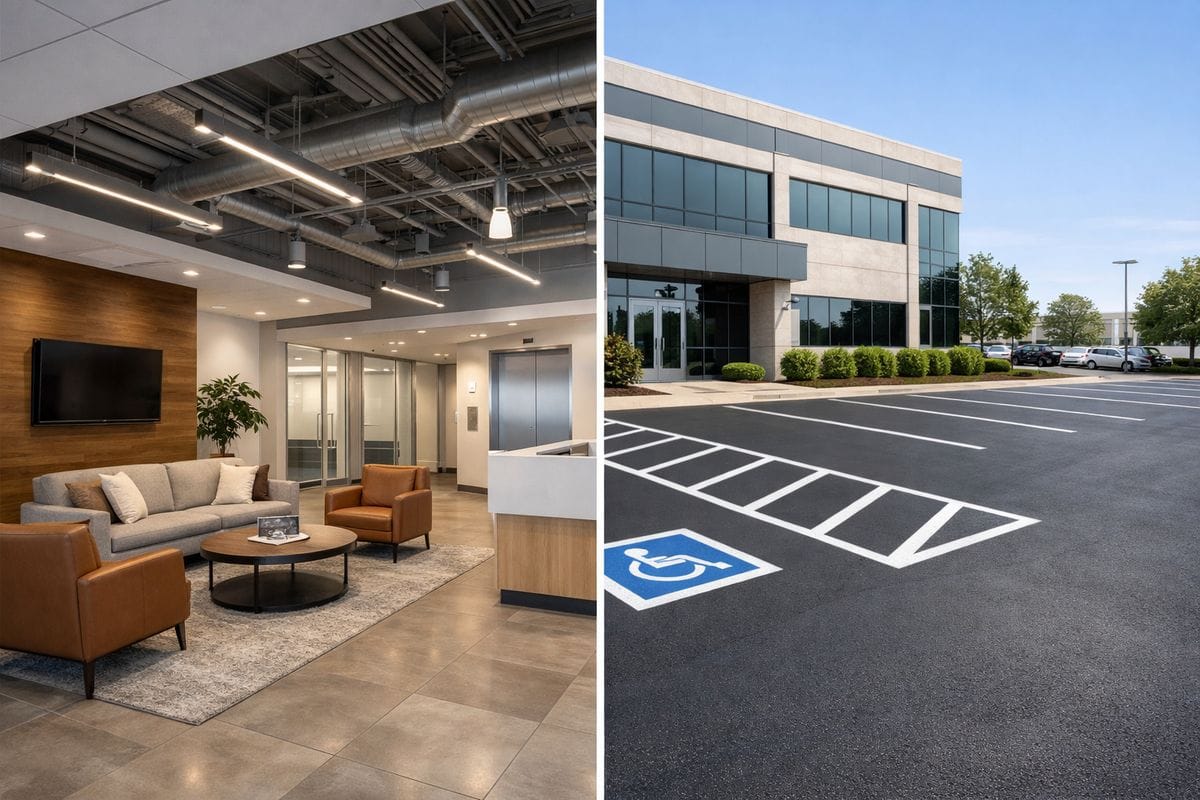
Parking lots, sidewalks, curbing, fencing, landscaping elements, site lighting, and certain exterior improvements often have shorter recovery periods than the building. That distinction is one of the highest-value clarifications for new commercial owners because these site elements are frequently embedded inside the overall acquisition cost and left on the 39-year schedule by default.
The catch is simple: “outside” does not automatically mean land, and “attached” does not automatically mean building. Classification follows tax character, not common speech.
Furniture, fixtures, and equipment do not belong on the 39-year schedule
Tangible personal property generally does not belong on the 39-year building schedule. Furniture, decorative lighting, movable partitions, dedicated equipment, specialty electrical serving equipment, carpeting in many settings, and certain tenant-specific assets can fall into shorter-lived categories if identified properly.
This is where many owners leave money on the table. If every dollar gets thrown into the building bucket, depreciation slows down unnecessarily. The recommendation is to separate personal property from structural components early, especially in retail, office, medical, restaurant, and specialty-use properties where interior buildouts are complex.
The Four Main Ways Commercial Owners Accelerate Deductions
The 39-year rule is only the baseline. Commercial owners increase year-one and early-year deductions through four main drivers.
Cost segregation
Cost segregation is the primary planning tool because it identifies parts of the acquisition that qualify for shorter recovery periods, usually 5, 7, or 15 years, instead of 39 years. A cost segregation study does not create fake deductions. It reallocates real costs into the correct tax buckets.
The business outcome is faster cost recovery. Faster cost recovery reduces current tax burden and improves early cash flow. For highly leveraged acquisitions, that timing difference materially improves time-to-value on invested capital.
Bonus depreciation
Bonus depreciation applies to eligible shorter-life property, not the 39-year building shell. This is why cost segregation and bonus depreciation are linked. The study identifies assets with shorter tax lives, and bonus rules determine how much of those assets gets deducted immediately.
Research sources conflict on the 2025 transition story. Some sources discuss phase-down rules such as 60 percent in 2024 and 40 percent in 2025. Another source states that 100% bonus depreciation was permanently restored for eligible assets placed in service after January 19, 2025. Because the legal environment changed, the recommendation is to model your exact placed-in-service date and current law position before filing.
The strategic point remains the same regardless of year-specific rates: bonus depreciation only matters if your property contains shorter-life assets that qualify.
Tenant improvements and interior buildout
Post-acquisition improvement spending can have different treatment than the original building basis. Interior work on office suites, retail spaces, restaurant interiors, and medical buildouts often includes categories that do not belong entirely on a 39-year schedule.
Qualified Improvement Property adds another layer. Interior, non-structural improvements to nonresidential real property often fall into a shorter recovery period, which changes year-one deductions materially. Renovation-heavy investment strategies often become far more tax-efficient because of this classification.
Renovation-driven reclassification
Major remodels, adaptive reuse projects, and repositioning plans create opportunities to classify more assets into shorter-lived buckets. The more design complexity, finish variation, tenant-specific infrastructure, and site work involved, the more likely it is that meaningful basis sits outside the pure 39-year shell.
That is why value-add office, mixed-use repositioning, medical conversion, self-storage retrofit, and retail redevelopment projects often generate stronger acceleration than plain stabilized assets with minimal interior detail.
Cost Segregation Explained in Plain English
If 39-year depreciation is the default rule, cost segregation is the main exception planning tool. It deserves a plain-English explanation because it drives so much of the commercial real estate tax conversation.
What a cost segregation study actually does
A cost segregation study is an engineering-based tax analysis that breaks a property into asset categories. Instead of treating the whole purchase as one 39-year building, the study identifies which components are actually personal property or land improvements with shorter tax lives.
That process usually involves reviewing settlement statements, appraisals, invoices, construction draws, plans, photos, inspections, and asset details. Strong studies are detailed because documentation is what supports the classification if the return is examined.
A good study is not a spreadsheet shortcut. It is a defensible allocation exercise supported by property-specific facts.
Typical categories: 5-year, 7-year, and 15-year assets
Shorter-life categories usually include 5-year, 7-year, and 15-year property.
Five-year property often includes decorative fixtures, certain carpeting, specialty millwork, dedicated electrical, and equipment-related components.
Seven-year property can include some furniture and fixtures.
Fifteen-year property often includes land improvements such as sidewalks, fencing, parking areas, landscaping-related site elements, and exterior improvements.
The 39-year category generally retains the structure and structural components. The building does not disappear. Cost segregation simply identifies what should never have been buried inside the shell category in the first place.
What the field data shows on reclassification ranges
What the field data shows is that cost segregation studies often reclassify about 10% to 40% of depreciable basis, depending on the property type, interior finish level, and renovation scope.
That range is wide for a reason. A tilt-wall warehouse with minimal finish may generate a modest reclassification percentage. A medical office building, mixed-use property, or interior-heavy retail project often generates a much larger one.
This matters because even a 15 percent reclassification on a multi-million-dollar asset can create a very large year-one deduction when bonus depreciation is available.
Property types that usually produce the strongest studies
Properties with stronger cost seg results usually share one trait: more components that are not pure building shell. Office space with elaborate tenant improvements, medical buildings with specialized systems, multifamily with rich amenity packages, self-storage with site work, retail with detailed interiors, and renovation-heavy repositioning deals typically produce stronger studies.
Industrial can still benefit, but plain industrial with low finish levels often yields smaller reclassification percentages than office or multifamily. Design complexity drives opportunity.
Cost Seg Example: How the Same Building Produces a Larger Year-One Deduction
The fastest way to see the value of cost segregation is to compare the same building under two methods.
Baseline 39-year result
Assume an $800,000 depreciable office building with no asset reclassification. Annual straight-line depreciation is $20,512.82. That is the control case.
At a 37 percent federal rate, that annual deduction translates into roughly $7,590 of tax value. Useful, yes. Transformational, no.
Reclassified-asset result
Now assume a cost segregation study reclassifies $300,000 of the building cost into shorter-life assets. One published example shows first-year depreciation of about $52,106.23 versus $20,512.82 without acceleration.
That is a massive timing shift. You are not creating additional total depreciation over the life of the property. You are moving deductions forward, when cash is often most valuable.
Depending on current bonus rules, first-year deductions can become even larger. One source states that shorter-life assets identified in cost segregation can qualify for full year-one deduction under 100% bonus depreciation for eligible property placed in service after January 19, 2025.
Why the difference matters to ROI and cash flow
Earlier deductions improve after-tax cash flow. That means more cash retained in the years when acquisition capital is freshest, debt service is heaviest, and repositioning plans are still being executed.
In practical terms, accelerated depreciation improves time-to-value. It strengthens investor cash retention before sale or refinance. For sponsors and active owners, that matters more than a distant deduction scheduled 25 years from now.
The recommendation is not to view cost seg as a tax side note. It is an underwriting variable.
When a Cost Segregation Study Makes Financial Sense
Not every property needs a study, but the decision should be driven by ROI, not habit.
Common acquisition threshold
Based on analysis of advisor practices and study economics, properties with cost basis of $500,000 or more are often strong candidates. Some sources view $1 million of building basis as especially attractive. Smaller properties can still justify a study if improvement spend is high or if the asset has unusual buildout detail.
The real question is simple: how much basis can be reclassified, and what is the tax value of accelerating it? If the answer materially exceeds the study cost, the economics work.
Best timing: acquisition, construction, or major renovation
The best time to perform a study is when the building is acquired, constructed, or significantly remodeled. A look-back study can still work later, but earlier is cleaner.
Why? Documentation is easier to gather. Project facts are current. Return positions are still open. And year-one planning remains available. Once time passes, records get fragmented and opportunities become harder to optimize.
Look-back studies for properties already owned
If you already own the property and never commissioned a study, the opportunity is not gone. A look-back analysis can often identify missed depreciation and claim a catch-up adjustment without amending prior returns, typically through the proper accounting method change procedure.
This matters for owners who bought commercial property years ago, accepted default 39-year treatment, and never revisited the asset. In many cases, substantial deductions remain recoverable.
The Limits: When Depreciation Deductions Do Not Create Immediate Tax Savings
A large deduction is not the same thing as a current cash tax benefit. That distinction matters.
Passive activity loss rules
Depreciation often creates passive losses in rental real estate. If your commercial ownership is passive for tax purposes, those losses generally offset passive income, not active wage or business income.
That means a cost seg study can produce a large paper loss without producing an equally large immediate tax refund. The deduction still exists, but its current-year usability depends on your tax profile.
Real estate professional status and material participation
Real estate professional status and material participation can change whether losses are currently usable against nonpassive income. This is where many investors confuse deduction size with tax value.
A $300,000 accelerated deduction sounds impressive. But if your tax posture does not allow current use of the loss, the benefit shifts into carryforward value rather than immediate cash savings. That is not bad. It is simply different.
Taxable income profile matters
A depreciation strategy has the most immediate value when you have passive income to absorb it or qualifying treatment that lets losses offset active income. If taxable income is low, suspended losses accumulate instead of reducing current tax liability.
The recommendation is to underwrite both layers: deduction amount and usability. Only then do you know the real cash outcome.
Section 163(j), ADS, and Why One Election Can Change the Entire Strategy
This is one of the most overlooked commercial real estate tax issues, and it can completely change depreciation planning.
What Section 163(j) limits
Section 163(j) limits business interest expense deductions for certain taxpayers. This becomes a real issue in larger real estate operations and highly leveraged deals where interest expense is a major part of the economics.
If interest deductions are limited, taxable income rises. For leveraged commercial investors, that is a serious modeling issue.
Electing out can force ADS depreciation
Certain real property trades or businesses can elect out of the Section 163(j) limitation. But that election comes with a tradeoff: affected real property must use ADS, the Alternative Depreciation System, for certain assets.
That matters because ADS property is not eligible for bonus depreciation. So the election that protects interest deductions can reduce depreciation flexibility and undercut the value of a cost segregation study.
This is where basic tax planning becomes strategy. You are not comparing one rule in isolation. You are comparing interest deductibility, depreciation speed, and bonus eligibility together.
Why this must be reviewed before a cost seg study
A cost segregation report is only one piece of the strategy. If you commission the study without first reviewing Section 163(j), ADS exposure, and current bonus rules, you can optimize the wrong variable.
The recommendation is decisive: model the combined tax result before filing. Review interest deductions, depreciation method, bonus eligibility, passive loss usability, and hold period together. That is how commercial depreciation planning actually drives ROI.
State Tax Treatment: Federal Savings Do Not Always Flow Through
Federal depreciation planning often looks great on paper. State tax treatment can reduce the result.
Federal versus state conformity
State conformity means whether a state follows federal tax rules. Some states conform closely to federal depreciation rules. Some do not. Some decouple from bonus depreciation or require add-backs that spread the benefit over later years.
That means the federal return and state return can produce different depreciation outcomes from the same property.
States commonly flagged in planning discussions
States frequently cited in planning conversations include New York and New Jersey, both of which are often flagged for nonconformity issues around federal bonus depreciation.
If your property, ownership entity, or investors touch those states, federal savings alone do not tell the full story.
Why multi-state owners need a separate model
A federal-first model can overstate after-tax savings if state add-backs offset part of the expected benefit. For investors with properties or filing obligations across multiple states, this is a cash-flow issue, not a technical footnote.
The recommendation is to run a separate state model whenever accelerated depreciation is material to the acquisition thesis.
Depreciation Recapture: The Future Cost of Faster Deductions
Accelerated depreciation creates real value up front. It also creates a future tax issue on sale. That tradeoff needs to be priced in, not ignored.
What recapture means
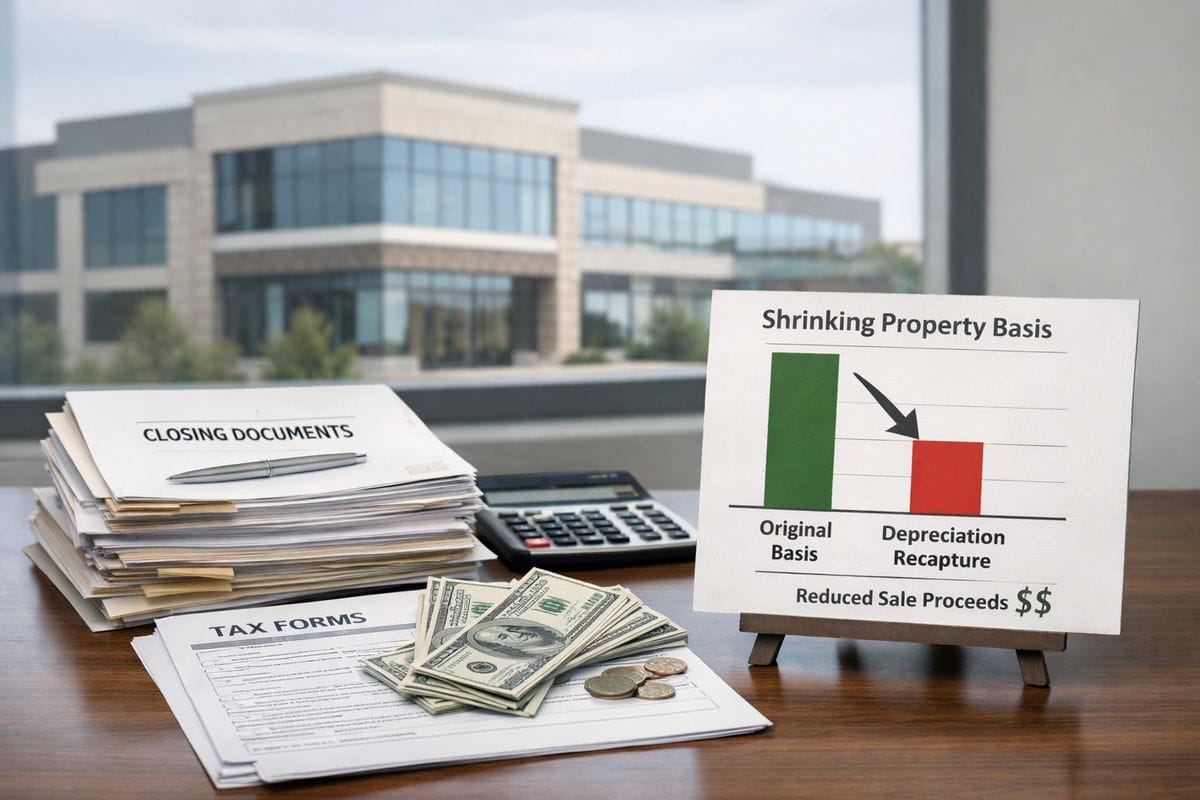
Depreciation recapture means prior depreciation deductions can convert part of your gain on sale into less favorable tax treatment. In plain English, the IRS lets you deduct basis faster, then asks for part of that benefit back when you sell.
This does not make accelerated depreciation a bad idea. It just means the tax savings are partly a timing benefit.
Why accelerated depreciation increases the future issue
The more deductions you front-load, the lower your adjusted basis becomes earlier. Lower adjusted basis increases gain on disposition. Some of that gain can be subject to recapture rather than pure capital gain treatment.
That is why depreciation recapture belongs in the model from the start. A strategy that looks excellent during acquisition can produce a surprise at exit if recapture is ignored.
How hold period changes the economics
Hold period changes everything. A short hold compresses the time between the tax benefit and the recapture cost. A long hold improves the economics because the early cash savings stay invested longer.
Refinance-driven holds, installment structures, and 1031 exchange planning can also change how the tradeoff plays out. The recommendation is simple: the shorter the hold, the more carefully accelerated depreciation needs to be modeled against exit tax consequences.
Common Errors That Reduce Depreciation or Create IRS Risk
Most depreciation mistakes are preventable. The problem is that they usually stay hidden until an audit, a refinance review, or a sale.
Using market value instead of tax basis
Depreciation is based on cost recovery, not current value. If your property appreciates from $2 million to $2.6 million, your annual depreciation does not increase.
This error shows up constantly in informal investor discussions. Market appreciation is good for wealth. It does not increase current depreciation deductions.
Failing to separate land from building
If land and building are not properly separated, the depreciation schedule is wrong from the start. An inflated land number suppresses deductions. An unsupported land number creates audit vulnerability.
The recommendation is to use credible support from appraisals, tax assessments, lender materials, engineering allocations, and transaction evidence. Guessing is expensive.
Misclassifying improvements
Tenant improvements, parking lots, landscaping, signage, dedicated electrical work, security systems, and specialty plumbing are frequent misclassification areas. If all of these items get thrown into 39-year property, deductions get delayed unnecessarily.
On the other side, aggressive reclassification without support creates risk. The right answer is documentation-backed classification.
Missing documentation
Strong depreciation support starts with records. Keep settlement statements, appraisals, construction invoices, surveys, plans, fixed asset ledgers, contractor schedules, engineering reports, and cost segregation studies.
Without documentation, even correct positions become harder to defend. With documentation, your return position becomes much stronger and future planning becomes easier.
Frequently Asked Questions About 39-Year Depreciation
Is all commercial real estate depreciated over 39 years?
No. The building and structural components are generally 39-year property, but shorter-life components, land improvements, furniture, fixtures, and certain interior improvements may use different recovery periods. That is why cost segregation exists.
Does land ever qualify for depreciation?
No. Land does not depreciate for tax purposes. Only the building and qualifying improvements do.
Can a property appreciate while being depreciated?
Yes. Tax depreciation is based on cost recovery rules, not on market decline. A property can rise sharply in market value while you continue claiming depreciation deductions based on historical basis.
When does depreciation start and stop?
Depreciation starts when the property is placed in service, meaning ready and available for its intended income-producing use. It stops when the basis is fully recovered, the property is sold, or the use changes in a way that ends depreciable treatment.
Can missed depreciation be fixed later?
Yes. A look-back study and proper accounting method procedures can often catch up missed depreciation without amending prior returns. That makes older commercial acquisitions worth revisiting.
The Recommendation: How to Evaluate 39-Year Depreciation on the Next Commercial Acquisition
The recommendation is to treat 39-year depreciation as the baseline, not the strategy. Start by establishing the correct depreciable basis. Allocate land carefully, build a clean fixed asset schedule, and model the straight-line 39-year result first. Then compare that baseline against accelerated scenarios created by cost segregation, tenant improvement classification, and current bonus depreciation rules.
After that, test whether the deductions are actually usable. Review passive loss limits, real estate professional status, material participation, and current taxable income profile. Then review Section 163(j), ADS consequences, and state conformity before locking in any filing position. Finally, price in recapture based on your expected hold period and exit structure.
That sequence changes underwriting quality. Once you understand 39 year depreciation commercial property at this level, you stop treating depreciation as a line item and start using it as a real acquisition variable.