
The 2026 tax law changes real estate owners care about are not abstract policy shifts. They change cash flow, after-tax ROI, exit timing, and how much tax value a rental loss actually creates. In plain English, 2026 keeps much of the current federal framework in place, updates key thresholds for inflation, and forces a sharper planning split between owners who can use deductions now and owners whose losses stay trapped under passive activity rules.
Before the details, focus on the decision points that actually move results:
- Marginal tax bracket in 2026
- Standard deduction versus itemizing
- SALT treatment on the personal return
- Passive loss usability under §469
- REPS and material participation status
- Depreciation timing, including bonus rules
- 1031 versus taxable sale economics
- Estate and gift transfer capacity
2026 Tax Law Changes That Matter Most to Real Estate Owners
2026 is the year the federal framework becomes operational for returns filed in 2027. Based on analysis of the enacted rules and IRS inflation adjustments, the biggest drivers are not one headline provision but five: tax brackets, the standard deduction, SALT treatment, depreciation-related rules, and estate transfer rules.
For real estate owners, those five drivers affect three business outcomes. First, how much current-year tax drag reduces portfolio cash flow. Second, how fast depreciation and losses convert into usable tax savings. Third, whether long-term wealth transfer planning gets easier or more expensive.
The short version: what changed, what stayed the same
Most of the TCJA-style individual structure continues into 2026 instead of disappearing at once. The 2026 tax brackets remain progressive, with a 37% top rate, and the standard deduction increases materially. Personal exemptions remain at zero. The old Pease itemized deduction limitation does not return.
The planning calendar matters. The IRS adjustments apply to tax year 2026, which means planning happens during 2026 and shows up on returns filed in 2027. Waiting until filing season is too late for the high-impact moves, especially cost segregation, grouping decisions, sale timing, and documentation for material participation.
Why this matters if rental losses are already suspended
If rental losses are already suspended under §469, lower brackets or a bigger standard deduction do not solve the main problem. The deduction only creates immediate value if it is usable in the current year.
That is the core mistake many landlords make. A large paper loss looks impressive on Schedule E, but if the loss is passive and there is no passive income to absorb it, the tax benefit is deferred. In that situation, 2026 planning is less about creating deductions and more about creating usable deductions.
The Three Principles That Drive Real Estate Tax Planning in 2026
Based on analysis of real-world filing outcomes, three principles drive nearly every good 2026 real estate tax decision: tax rate management, timing, and classification. Ignore any one of them and the math gets worse.
Principle 1: Tax rate management drives the value of deductions
A $50,000 deduction does not have one fixed value. Its value depends on your marginal rate, your itemized deduction posture, and for top-bracket taxpayers, the reduced value of itemized deductions. If you are in the 37% bracket, a usable ordinary deduction is worth more than if you are in the 22% bracket. If the deduction is trapped as a passive loss, its immediate value is zero.
AMT still matters for some high-income owners, though fewer than under prior law. And for taxpayers at the highest bracket, each dollar of itemized deduction no longer delivers the full top-bracket benefit. That changes the economics of personal-side deductions tied to home ownership.
Principle 2: Timing rules matter as much as deduction size
The data shows that time-to-value matters as much as total deduction amount. Suspended passive losses, depreciation timing, carryforwards, installment recognition, and gain deferral all change when tax savings arrive.
A front-loaded deduction that sits suspended for years is weaker than a smaller deduction that offsets current ordinary income now. The same logic applies on exit. A taxable sale that frees suspended losses can outperform a deferral transaction if the released losses are large enough.
Principle 3: IRS classification rules decide the outcome
Classification is where most large tax differences are created. Rental real estate is generally passive by default. REPS under §469(c)(7), material participation under the regulations, short-term rental treatment, and grouping elections decide whether a loss stays passive or becomes nonpassive.
That is not semantics. It is the difference between current-year tax savings and a carryforward.
Individual Tax Changes in 2026: Brackets, Standard Deduction, and Itemizing
This section affects every owner because real estate income, depreciation, and capital gains usually flow onto the individual return.
2026 tax brackets and why your marginal rate still matters
For 2026, the top rate remains 37%, applying above $640,600 for single filers and $768,700 for married filing jointly. The 35% bracket begins above $256,225 single and $512,450 joint. The 32% bracket begins above $201,775 single and $403,550 joint. The 24% bracket begins above $105,700 single and $211,400 joint. The 22% bracket begins above $50,400 single and $100,800 joint. The 12% bracket begins above $12,400 single and $24,800 joint.
That bracket placement drives the value of depreciation deductions, cost segregation studies, and any nonpassive rental loss. A deduction claimed at 35% or 37% produces meaningfully stronger cash tax savings than the same deduction claimed years later at a lower rate.
Higher standard deductions change the itemizing math
The 2026 standard deduction rises to $32,200 for married filing jointly, $16,100 for single and married filing separately, and $24,150 for head of household.
That changes itemizing math for owners who assumed mortgage interest and property taxes would always push them over the line. For many households, higher standard deductions reduce the practical value of personal mortgage interest, charitable giving bunching that is too small, and SALT-heavy itemizing strategies. The recommendation is simple: run the numbers each year instead of assuming real estate ownership automatically means itemizing.
AMT, personal exemptions, and deduction limits that did not return
Personal exemptions remain zero in 2026. The old broad itemized deduction limitation remains eliminated, although top-bracket taxpayers face a reduced tax benefit from itemized deductions. AMT exemptions rise to $90,100 for unmarried taxpayers and $140,200 for married filing jointly.
AMT is no longer the default concern it once was, but high-income owners with large preference items still need to test it. The point is not fear. The point is accurate modeling.

SALT, Property Taxes, and the Federal Deduction Question
This issue creates more confusion than almost any other 2026 change because owners mix up personal property taxes and rental property taxes.
The 2026 SALT cap rules real estate owners need to know
For personal itemized deductions, the SALT cap rises to $40,000 for taxpayers with income under $500,000, with a phase-down above that threshold through 2029. That change comes from 2025 legislation, not from annual IRS inflation indexing. The higher SALT cap matters most in high-tax states where state income tax and home property tax were already blowing past the old $10,000 ceiling.
That said, the SALT cap only matters if itemizing beats the standard deduction. For many owners, that is still not automatic.
Why rental property taxes are different from personal property taxes
Property taxes allocable to rental activity are generally deducted on Schedule E as business expenses. Those taxes are part of the rental activity and are not capped the same way as personal itemized SALT on Schedule A.
This is the clean dividing line. Your residence property tax is part of the personal-side SALT calculation. Your rental property tax is an operating expense of the rental activity. Mixing those categories leads to bad planning and bad expectations.
State and local pressure still affects your after-tax return
Federal relief does not remove local tax risk. Pew’s 2026 analysis shows that states continue pursuing property tax relief while local governments face revenue strain. That often leads to reassessments, service cuts, alternate taxes, or future fiscal pressure.
Portfolio planning has to be market-specific. A landlord in Texas, New Jersey, Illinois, or California is not managing the same tax drag as a landlord in a lower-tax jurisdiction. State and local friction still hits NOI even when federal rules improve.
Passive Activity Loss Rules Still Control Whether Rental Losses Help You
For many owners, this is the real article.
How §469 limits rental losses for most owners
Under IRC §469, rental real estate is generally passive by default. That remains true even if you spend meaningful time on the property. Unless an exception applies, rental losses offset passive income first. If passive income is insufficient, the excess becomes suspended.
That is why so many W-2 earners see depreciation-generated losses on paper but no current federal tax benefit. The law is not asking whether you worked hard. It is asking how the activity is classified.
The $25,000 active participation allowance and its phaseout
Section 469(i) provides a special allowance of up to $25,000 for certain taxpayers who actively participate in rental real estate. The phaseout begins at modified AGI of $100,000 and ends at $150,000.
For many W-2 owners, that benefit is gone entirely. If your modified AGI is above the phaseout range, active participation alone does not unlock the loss. That makes aggressive depreciation strategies much less attractive unless you have passive income from other sources.
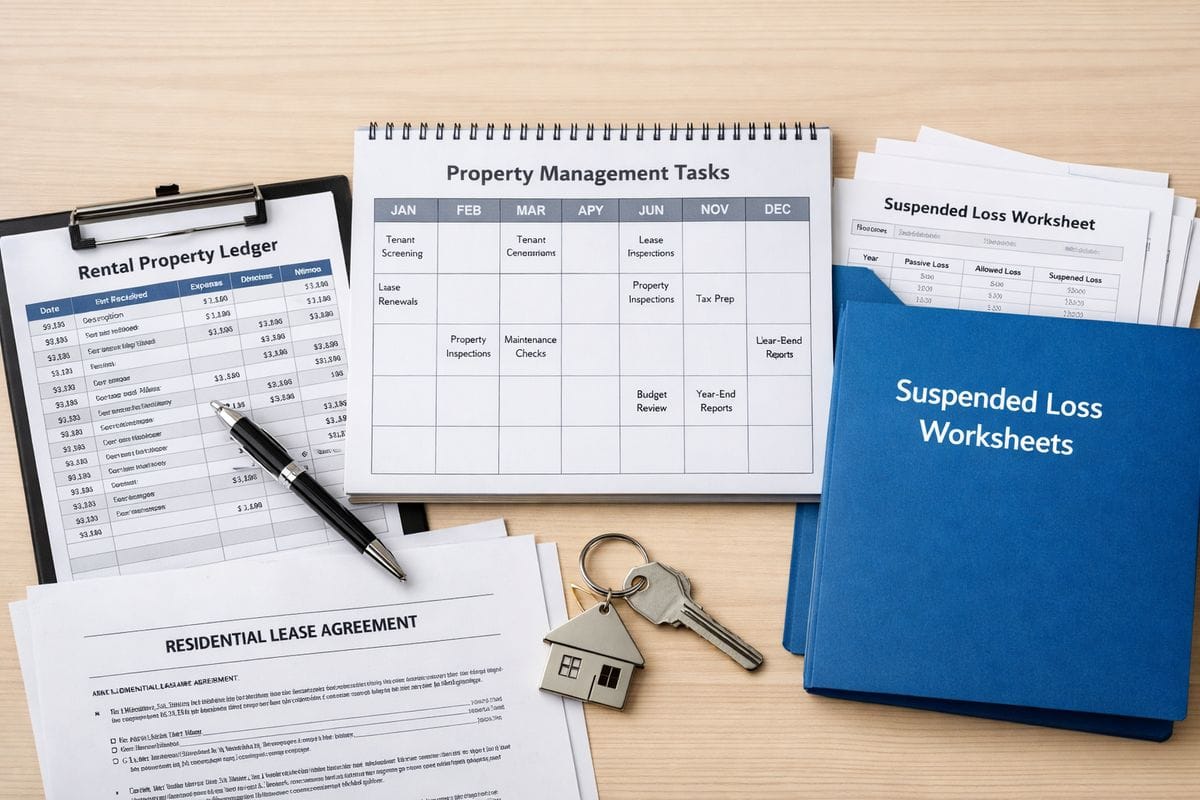
What happens to suspended passive losses
Suspended losses carry forward indefinitely. They can offset future passive income, and they are generally released upon a fully taxable disposition of the entire interest in the activity to an unrelated party.
That release rule changes exit economics. A sale is not just about gain recognition. It can also unlock years of trapped losses. In practice, that can produce a better after-tax result than owners expect.
Real Estate Professional Status: The 2026 Decision With the Highest Tax Impact
REPS is the highest-impact classification issue for real estate owners because it can convert qualifying rental losses from passive to nonpassive. But only if the record supports it.
The two tests you must satisfy under §469(c)(7)
You must satisfy both tests: more than half of your personal services during the year must be performed in real property trades or businesses in which you materially participate, and you must perform more than 750 hours of services during the year in those real property trades or businesses.
Employee hours count only in narrow circumstances, which is where many filings fail. If most working time still belongs to a full-time W-2 job, REPS usually collapses on the first test.
Material participation under the §469 regulations
REPS alone is not enough. You still need material participation in the rental activities, unless a valid grouping election changes how the activities are tested. That is where contemporaneous logs, calendars, work papers, and task records matter.
The regulations contain multiple material participation tests, but the practical point is straightforward: your file has to show real, regular, and substantial involvement. Reconstruction after an audit notice is weak evidence.
When REPS produces real tax value and when it does not
REPS creates real value when qualifying rental losses offset wages, business income, or other nonpassive income in the same year. That can materially improve cash flow and shorten time-to-value on depreciation strategies.
But if your facts do not support the hours, REPS is not planning. It is exposure. Full-time operators, spouses with sufficient hours, and owners actively managing multiple properties often have a workable path. High-income W-2 owners with limited time usually do not.
Depreciation, Bonus Depreciation, and Cost Segregation in 2026
This is where deductions get large quickly, and where many owners overestimate current benefit.
Bonus depreciation and where it stands in 2026
Based on enacted 2025 legislation, 100% bonus depreciation was restored beginning January 19, 2025, according to the Bipartisan Policy Center. That makes front-loaded depreciation highly relevant for 2026 returns.
The operational question is not whether bonus depreciation is powerful. It is whether the deduction is usable now. If losses remain passive and suspended, the deduction still exists, but the ROI is delayed.
Why cost segregation remains a high-impact strategy
A cost segregation study reclassifies portions of a building into shorter recovery periods, which increases early-year depreciation. That improves cash flow when the deductions offset current taxable income.
If your losses are suspended under §469, cost segregation still has long-term value, but not immediate value. That distinction matters. For owners with REPS, passive income, or a near-term taxable exit, cost seg is often a strong 2026 move. For owners with permanently trapped losses, it is frequently mistimed.
Section 179, improvements, and recapture risk
Section 179 expensing became more generous under recent law, but it remains a narrower tool in real estate because many building components do not qualify the same way as personal property or certain improvements. Improvement classification drives outcome.
You also need an exit view before accelerating deductions. Depreciation recapture can reduce the apparent win if the holding period is short. The recommendation is to pair every acceleration decision with a hold-period model.
Deferral and Exit Planning: 1031 Exchanges, Opportunity Zones, and Gain Management
Current-year deductions are only half the story. Exit structure often decides the final ROI.
1031 exchanges still defer gain, but basis planning matters
Like-kind exchanges remain a central gain-deferral tool for investment and business real estate. The tax is deferred, not erased, and basis carries into the replacement property.
That basis carryover affects future depreciation and future gain. A 1031 is strong when capital preservation and reinvestment velocity matter most. It is weaker when a taxable sale would free large suspended passive losses and reset the plan on better terms.
Opportunity Zone rules and why renewed interest matters
Opportunity Zones remain relevant for owners evaluating gain deferral and long-term exclusion features, especially where transaction timing aligns. Recent law also reduced the substantial improvement threshold for rural Qualified Opportunity Zones from 100% to 50% for eligible property after July 4, 2025, which the IRS confirms.
The right use case is selective. OZs fit capital gains planning tied to specific projects and timelines. They do not replace basic underwriting discipline.
Installment sales, taxable dispositions, and releasing suspended losses
A taxable disposition can outperform a deferral strategy when suspended passive losses are large. That is because the sale can unlock losses that offset other income recognized in the year of disposition.
Installment reporting adds another layer. Stretching gain across years may help bracket management, but you need to model how suspended losses are released and used. Exit planning should never be done in a vacuum.
Estate, Gift, and Succession Planning for Real Estate Portfolios
This is not only for ultra-wealthy families. Appreciating portfolios can cross planning thresholds faster than expected.
The higher 2026 estate tax exclusion
The 2026 estate exclusion rises to $15,000,000. That materially expands planning capacity for larger portfolios, family LLC structures, and succession timing.
For married couples, portability can effectively double available exclusion if handled correctly. That creates more room for long-range hold strategies without forced transfer decisions.
Annual gifting, entity interests, and family transfer strategy
The annual gift exclusion remains at $19,000 for 2026. That supports gradual transfer strategies using LLC units, tenant-in-common interests, or minority interests in family entities.
This is where mechanics matter. Entity discounts, control terms, and operating agreement structure affect the economics of gifting. Small annual transfers add up, especially in a rising asset class.
Step-up in basis and what heirs need to evaluate
A basis adjustment at death remains one of the most powerful tax features in real estate. For highly appreciated property, a hold-until-death strategy can outperform a lifetime sale because built-in capital gain and depreciation recapture exposure can be reset for heirs.
That is why succession planning and exit planning should be modeled together. Selling too early can destroy basis efficiency that a family portfolio would otherwise preserve.

A 2026 Action Plan by Owner Type
Here is the practical framework that drives outcomes before year-end.
If your income comes mainly from a W-2 job
Review modified AGI immediately. Test whether any §469(i) allowance remains available. If AGI wipes out the $25,000 special allowance, avoid front-loaded depreciation strategies that only enlarge suspended losses without current tax value.
Also separate personal residence tax planning from rental planning. Itemizing, SALT, and mortgage interest live on one side. Schedule E economics live on the other.
If you are pursuing Real Estate Professional Status
Track hours now, not later. Review grouping positions, material participation support, and employee-hour limitations before year-end. Substantiation quality determines audit durability and time-to-value.
This is the highest-return documentation work in the entire 2026 planning cycle. If the file is weak, the deduction is weak.
If you own multiple rentals or plan to sell in 2026, 2027
Model three scenarios: hold with accelerated depreciation, sell and release suspended losses, or defer through a 1031 exchange. Compare after-tax proceeds, loss usability, depreciation recapture, and future basis.
Also build a short timeline covering enacted changes from 2025 through 2028: 100% bonus depreciation restored effective January 19, 2025; Section 199A preserved on an ongoing basis under enacted law; SALT cap increased to $40,000 starting in 2026 for eligible incomes; 2026 brackets and standard deduction apply on returns filed in 2027; estate exclusion rises to $15,000,000 in 2026; Section 163(j) interest limitation remains a live modeling issue for leveraged owners and should be tested annually at the entity and investor level.
The recommendation: run a 2026 tax model before year-end
The recommendation is direct: run a full 2026 tax model before year-end. Compare standard deduction versus itemizing, passive-loss usability, depreciation timing, 1031 versus taxable sale economics, Section 199A eligibility, SALT exposure tied to your residence, and estate-transfer exposure.
Prioritize five actions now. Accelerate cost segregation only where losses are usable. Review entity structure and rental trade or business posture for Section 199A support. Separate personal SALT planning from Schedule E deductions. Test whether a taxable sale unlocks more value than a deferral strategy. Update estate and gifting models while the higher exclusion and $19,000 annual gifting rules are in effect.
Frequently Asked Questions
Do the 2026 tax law changes let rental losses offset W-2 income automatically?
No. Rental real estate remains passive by default under §469. A rental loss offsets W-2 income only if an exception applies, such as the $25,000 active participation allowance within its AGI phaseout or qualifying nonpassive treatment under REPS and material participation rules.
Is the 2026 SALT cap increase useful for rental property owners?
Yes, but only for personal itemized deductions. The increased cap helps with state income taxes and residence-related property taxes on Schedule A. Rental property taxes deducted on Schedule E are already business expenses and are not limited in the same way.
Should cost segregation be done in 2026?
Only if the deduction creates current value or near-term value. Cost segregation works best when losses offset current taxable income, passive income, or gain released on sale. If deductions will sit suspended for years, the timing is poor.
Does Real Estate Professional Status by itself make rental losses deductible?
No. REPS is only one step. You also need material participation in the rental activity, unless a valid grouping election changes the testing approach. Without both pieces, the losses stay passive.
Is a 1031 exchange always better than a taxable sale in 2026?
No. A 1031 exchange defers gain, but it does not release gain-free cash or reset basis. If suspended passive losses are large, a taxable sale can produce a stronger after-tax outcome by freeing those losses in the year of sale.
What is the most important 2026 tax move for a real estate owner?
Build a year-end model before acting. That model should test bracket position, itemizing versus standard deduction, passive loss rules, depreciation timing, exit structure, Section 199A posture, and estate exposure. Without that model, tax strategy becomes guesswork.