

Rental property record keeping IRS rules are not paperwork trivia. Your records determine how much tax you pay, which deductions survive scrutiny, and how exposed you are if the IRS questions your return. Get the system right and you protect cash flow, preserve depreciation, and keep Schedule E clean year after year.
Why IRS Rental Recordkeeping Directly Affects Tax Liability and Audit Risk
Rental property recordkeeping for IRS purposes is the system used to prove income, expenses, basis, depreciation, and every filing position tied to your rentals. In practical terms, it is the evidence behind the numbers reported on Schedule E, Form 4562, Form 1099 filings, and any related return positions involving passive losses, personal use, or short-term rental income.
That business stake is bigger than most landlords realize. If a $9,200 roof replacement is deducted as a repair instead of capitalized, tax drops in the current year, but the return is wrong. If $4,800 of Airbnb gross income never makes it into the books because only net payouts were tracked, taxable income is understated. If closing documents disappear, basis and depreciation become harder to defend years later when the property sells and depreciation recapture enters the picture.
Based on analysis of common landlord audit issues, four drivers determine the outcome: complete income reporting, documentary proof for deductions, correct capitalization and depreciation, and retention periods that match the life of the tax issue. Miss any one of those, and after-tax ROI falls fast. The IRS does not accept estimates and good intentions as a substitute for records. If a deduction is not substantiated, it can be denied.

The Four IRS Recordkeeping Rules Every Landlord Must Follow
The field data shows that most rental recordkeeping problems trace back to four simple failures. Income is incomplete. Deductions lack proof. Improvements get expensed. Records get destroyed too early. The recommendation is to build your system around the opposite four rules.
Report Income Based on What the IRS Counts as Rental Income
Most landlords think of rental income as monthly rent checks. IRS rules are broader than that. Rental income includes ordinary rent, advance rent, lease cancellation payments, tenant-paid bills that were your obligation, security deposits kept as rent or damages, and property or services received instead of cash. If money or value came in because of the rental activity, it belongs in your books.
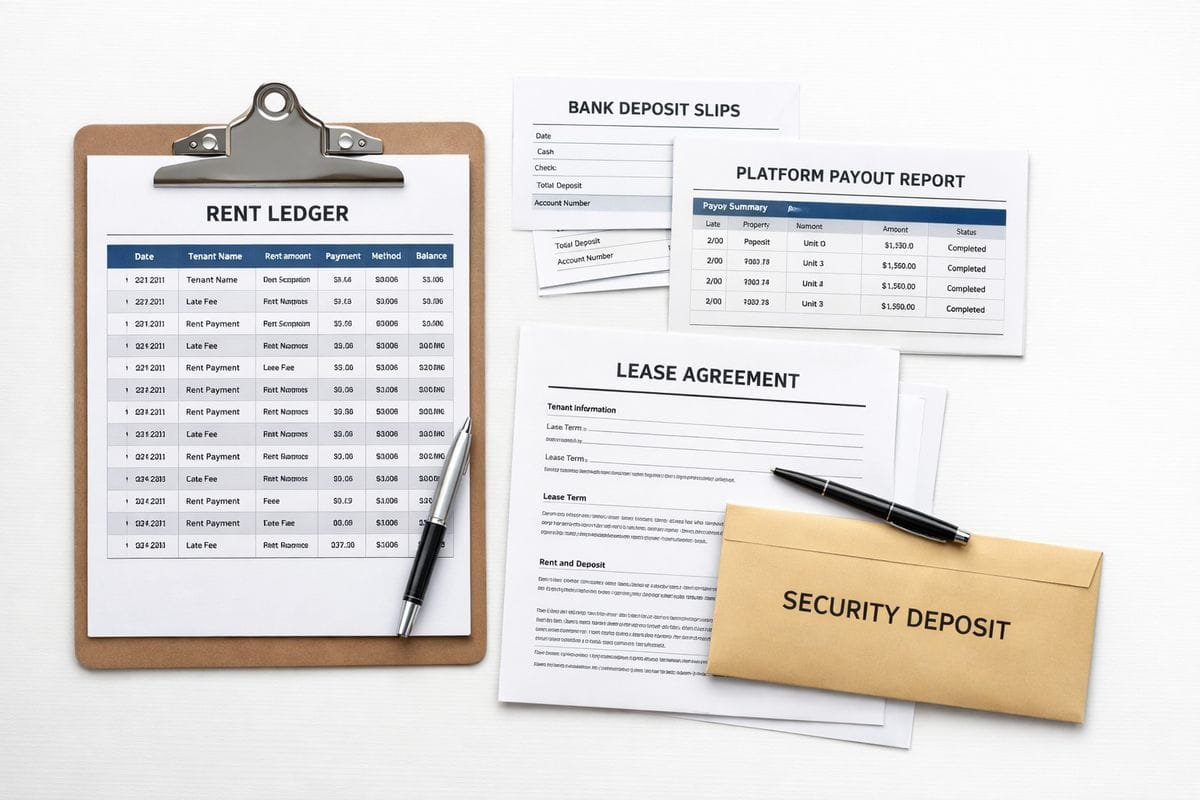
That means every receipt needs a source document. For a long-term rental, that usually means the lease, rent ledger, deposit records, and bank deposits. For a short-term rental, it means platform statements, direct booking confirmations, payout reports, refund records, and 1099-K reconciliation. Income reporting is not just about what landed in your checking account. It is about what the IRS counts.
Keep Documentary Evidence for Every Deduction
A deduction is only as strong as the paper trail behind it. The IRS expects documentary evidence such as receipts, bills, invoices, canceled checks, credit card records, bank statements, and mileage logs. Each record needs to show the amount, date, payee, property involved, and business purpose.
A bank statement alone rarely does the full job because it shows payment, not what was purchased. A contractor invoice alone is not enough either because it shows the charge, not that it was paid. Together, those records become audit-ready. That pairing matters.
Capitalize Improvements and Depreciate Them Correctly
Repairs are generally deductible in the year paid. Improvements are not. Improvements are capital costs that must be added to basis and depreciated over time. This is one of the biggest tax outcome drivers in rental real estate because expensing a $15,000 improvement instead of depreciating it changes current-year tax sharply.
The records behind this decision start on closing day. You need purchase documents, land allocation support, placed-in-service dates, itemized invoices for later work, and depreciation schedules that tie to the return. Without that support, depreciation becomes guesswork, and guesswork does not survive an audit.
Retain Records Long Enough to Support the Return
The filing date is not the end of the recordkeeping job. Annual expense support has one retention timeline. Basis and depreciation records have another, much longer timeline. That difference matters because a purchase from 2014 can still affect gain, loss, and recapture on a sale reported years later.
The recommendation is simple: keep annual expense records for at least 3 years from filing, and keep basis, improvement, and depreciation records for the full ownership period plus 3 years after sale. Destroying records after 3 years across the board is a serious error.
What Records the IRS Expects You to Keep for Rental Income
Income records should tell a complete story from the lease or booking to the deposit. If your books show $36,000 of annual rent, the source documents should prove where every dollar came from.
Monthly Rent, Late Fees, and Other Routine Tenant Payments
Start with the basics: monthly rent, prorated move-in rent, late fees, pet fees, application fees, parking fees, laundry income, and any recurring charge tied to the tenancy. Your lease should define the charge. Your rent ledger should show when it was billed and paid. Your bank deposits should match that ledger.
A practical example makes this clear. If your tenant pays $2,000 monthly rent, a $150 late fee in March, and a $300 pet fee at move-in, taxable rental income is not $24,000 for the year. It is $24,450, assuming all amounts were collected and no separate rule excludes them. Clean books catch that automatically.
Advance Rent, Lease Cancellation Payments, and Kept Deposits
Advance rent is generally taxable when received, not when the rental period arrives. If a tenant gives you first month, last month, and a prepaid extra month in December, that prepaid amount is income in December if you use the cash method, and most individual landlords do.
Lease cancellation payments are also rental income. If a tenant pays $1,800 to exit early, that is not a deposit adjustment or a miscellaneous offset. It is income.
Security deposits follow a different rule until you keep them. A refundable deposit is not income when received. But if you keep $900 of that deposit for unpaid rent or lease violations, that $900 becomes rental income. Your records need to show the original deposit, the lease terms, the move-out accounting, and the amount retained.
Tenant-Paid Expenses and Bartered Services
This is one of the easiest places to underreport income. If a tenant pays a bill that was your obligation, that payment is generally rental income to you, even if the related expense is deductible. Say a tenant pays a $240 water bill in your name and deducts it from rent under an agreement. You still have $240 of rental income and a $240 rental expense.
Barter transactions work the same way. If a tenant paints the unit in exchange for one month of $1,500 rent, you received $1,500 of value. That amount belongs in income, with a corresponding expense only if the work qualifies and is properly documented.
Short-Term Rental Platform Income, Form 1099-K, and Occupancy Taxes
Short-term rental operators face a bigger reconciliation problem because platforms report gross activity while payouts are net of fees and adjustments. If Airbnb shows $48,000 of guest charges, $4,200 of platform fees, $3,600 of cleaning fees charged to guests, and $1,100 of refunds, your books must reconcile to the gross and then separately track offsets.
That is where Form 1099-K becomes a tax risk. If your return reports only the net deposits hitting the bank, but the platform reports a higher gross amount to the IRS, the mismatch invites scrutiny. The right process is to record gross rental receipts, then record platform fees, refunds, and other adjustments in the proper categories.
Occupancy taxes need separate handling. If the platform collects and remits occupancy tax directly, that amount usually should not be reported as your rental income because you never received it. If you collect and remit it yourself, your records need a liability trail showing collection and remittance. Mixing tax collections with rent revenue creates reporting errors fast.
Which Rental Expenses You Can Deduct and What Proof You Need
Deductions reduce taxable rental income, but only when they are ordinary, necessary, tied to the rental activity, and supported by records. Schedule E categories are a useful guide because your bookkeeping should map directly to them.
Mortgage Interest, Property Taxes, Insurance, and Utilities
These are the foundation deductions for most landlords. Support them with annual lender statements, monthly mortgage statements if needed, county tax bills, proof of payment, insurance declarations, paid invoices, and utility bills tied to the property address.
If escrow is involved, do not deduct what your mortgage servicer collected into escrow during the year. Deduct what was actually paid out for interest and taxes. That distinction matters. The Form 1098 usually solves the interest side, but property taxes still need verification if escrow timing crosses tax years.
Repairs, Maintenance, Cleaning, Supplies, and Turn Costs
Routine operating costs that keep a property in ordinary working condition are generally deductible. This category includes cleaning between tenants, lawn care, trash removal, pest control, minor plumbing fixes, paint touch-ups, lock changes, smoke detector batteries, air filters, and supplies used to maintain the unit.
Turn costs deserve close review because they often mix deductible work and capital improvements in the same project. If you spend $3,400 on cleaning, patching nail holes, replacing broken blinds, and hauling trash after move-out, that is usually deductible. If the same turn includes a full kitchen rebuild for $14,000, that part belongs in improvements, not repairs.
Advertising, Management Fees, Software, Legal, and Professional Fees
Landlords often miss administrative deductions because the amounts are spread across subscriptions and one-off charges. Listing fees, photography for rental ads, property management fees, tenant screening charges, bookkeeping software, lease drafting, eviction notices, CPA fees for Schedule E preparation, and registered agent fees tied to rental entities all belong on your radar.
Documentation is straightforward here: invoices, engagement letters, bank or card payment records, and notes linking the cost to a property or entity. If the legal fee relates to acquiring title or resolving a capital issue, it may need to be capitalized instead of expensed. The invoice description usually drives the tax treatment, which is why vague vendor invoices are a problem.
Travel, Auto, and Home Office Records
Travel, auto, and home office deductions face higher scrutiny because they are easy to overstate. Your records need to be contemporaneous and specific. For mileage, record the date, destination, business purpose, and miles driven. For local rental activity, examples include driving to inspect a repair, meet a contractor, deliver notices, or show a unit.
A mileage app can work if used consistently. A reconstructed estimate at tax time is weak. The same logic applies to home office deductions. You need records showing the dedicated business-use space, the expenses claimed, and the connection to managing the rental activity. If the office doubles as a guest room, the deduction fails.
Repairs vs. Improvements: The Classification That Drives Most Tax Errors
Repairs versus improvements is where many returns break down. The tax difference is immediate, the invoices are often messy, and landlords understandably want current deductions. But the IRS standard is not based on preference. It is based on the nature of the work.
What Counts as a Repair
A repair keeps property in efficient operating condition. It does not materially add value, restore a major component, or extend useful life in a meaningful way. Think of repairs as fixing what is broken so the property continues to function as intended.
Practical examples include patching drywall after a tenant move-out, fixing a leak under the sink, replacing a broken switch, repairing a section of gutter, swapping out a damaged window pane, or replacing a small section of flooring damaged by a water spill. Those costs generally belong in current-year expense if the surrounding facts support that treatment.
What Counts as an Improvement
An improvement makes the property better, restores a major component, or adapts it to a new use. In plain English, the project is bigger than maintenance. It changes the asset in a meaningful way.
A new roof, full HVAC replacement, complete kitchen remodel, room addition, foundation stabilization, whole-house repipe, or garage conversion into living space are classic improvement examples. Those costs become capital assets and are depreciated over time. If a project replaces a major component of the building, current expensing is the wrong answer.
Side-by-Side Dollar Examples for Common Landlord Scenarios
Examples make the line easier to see.
If one bedroom wall gets patched and repainted after a tenant damages it, and the cost is $450, that is a repair. If the entire unit is gutted, retextured, fully repainted, and upgraded as part of a $9,800 turnover, the project likely includes improvements, especially if cabinets, counters, flooring, or fixtures are upgraded.
If a contractor replaces three rotted deck boards for $380, that is a repair. If the whole deck is torn out and rebuilt for $8,500, that is an improvement.
If a plumber fixes a leaking section of copper pipe for $275, that is a repair. If the property is repiped for $11,000, that is a restoration of a major component and belongs in depreciation.
The tax result is dramatic. Expensing an $11,000 repipe creates an immediate $11,000 deduction. Capitalizing it spreads deductions over time. That is exactly why the classification attracts IRS attention.
How to Document the Classification Decision
Your best defense is a file that shows what the work actually was. Keep itemized invoices, scope of work, contractor proposals, before-and-after photos, inspection notes, and property condition records. A vague invoice that says “labor and materials, $7,200” is weak evidence. An invoice that says “replace 22 feet of damaged drain line under kitchen slab, repair access point, restore existing finishes” is far better.
For larger jobs, keep the contract, change orders, photos, payment records, and any communications describing the reason for the work. If an insurance claim was involved, keep the adjuster report too. Good records do not just prove the amount paid. They prove the tax classification.

Depreciation Records: What You Need From Closing Day Forward
Depreciation is one of the strongest tax benefits in rental real estate. It lowers current taxable income without requiring a current cash outlay. But that benefit only works when basis, placed-in-service date, and asset class are documented correctly from the start.
Establish Building Basis and Separate Out Land
Your purchase price is not your depreciable basis. Land is not depreciable, so you must separate land value from building value. The file should include the settlement statement, deed, title charges, and any acquisition costs that belong in basis.
Support for the land allocation can come from county tax assessments, appraisals, or a reasonable allocation method tied to available records. The method matters less than consistency and support. If you buy a property for $300,000 and a supportable allocation assigns $60,000 to land and $240,000 to building, depreciation starts from the $240,000 building basis, subject to later adjustments.
Residential Rental Property Depreciation Basics
Residential rental buildings are generally depreciated over 27.5 years using the straight-line method. The placed-in-service date matters because depreciation begins when the property is ready and available for rent, not when you first thought about listing it and not necessarily when the first tenant pays.
That distinction affects first-year depreciation. If a property closes on June 10, requires make-ready work, and is ready for rent on July 1, July 1 is the placed-in-service date. Your records should show that timeline through invoices, listing records, photos, lease activity, or management notes.
Business-use percentage also matters for mixed-use property. If part of the property is personal use and part is rental use, the depreciation file must support the rental portion claimed.
Appliances, Flooring, and Other Depreciable Assets
Not every depreciable item belongs in the building bucket. Appliances, carpeting, certain flooring, fencing, landscaping, and other separate assets may have different recovery periods depending on the facts. Itemized invoices improve accuracy because they let you separate a $1,200 refrigerator from a $14,000 renovation invoice instead of burying everything in one line.
That matters for both timing and future disposition. If an old appliance is retired, a clean asset schedule makes it easier to stop depreciating it. If everything was lumped together, the tax record becomes muddy.
Cost Segregation and When More Detailed Records Pay Off
For larger properties or investors focused on accelerating deductions, cost segregation can change first-year tax results significantly. An engineering-based study identifies components that qualify for shorter recovery periods than the building itself. That only works if your records are detailed enough to support the allocations.
This approach pays off most when the property value is high, renovations are material, or after-tax ROI justifies the extra analysis. The file should include acquisition documents, floor plans, invoices, appraisals, construction detail, and any engineering report supporting the classification. Weak input records produce weak output.
How to Organize Rental Records So Schedule E Is Clean
Tax law tells you what must be proved. Your operating system determines whether you can prove it quickly.
Use Separate Bank Accounts and Credit Cards for Each Rental Business
Separate accounts are not optional if your goal is speed, accuracy, and defensible books. Commingling personal and rental transactions creates classification errors, wastes time at filing, and weakens substantiation. A dedicated checking account for rent deposits and rental expenses provides a clean source trail. A separate credit card for repairs, supplies, and software makes categorization far easier.
For a single-property owner, one dedicated rental account is a major upgrade. For multiple properties, an account structure by entity or operating business keeps reporting manageable. The point is consistency, not complexity for its own sake.
Track Transactions by Property, Unit, and Category
Once you own more than one or two rentals, books need to answer three questions fast: which property generated the income, which property incurred the expense, and what category belongs on the return. Property-level accounting drives better decisions because it shows actual ROI by asset instead of blending everything into one bucket.
That same structure matters for tax prep. If a repair invoice belongs to Unit 3 at Property B, your system should capture that detail immediately. It shortens year-end work and makes entity reporting cleaner if ownership structures change.
Reconcile Monthly Against Bank Accounts and Platform Statements
Monthly reconciliation is the difference between organized records and a year-end scramble. Match every rent deposit to the rent roll. Match every Airbnb payout to the platform statement. Match every expense transaction to an invoice or receipt. Match mortgage and loan entries to statements.
That process catches missing income, duplicate transactions, and miscoded expenses while the facts are still fresh. It also makes 1099-K reconciliation and contractor payment tracking much easier. A monthly close is not just bookkeeping discipline. It directly lowers filing risk.
Build a Digital Filing System That Mirrors Your Tax Return
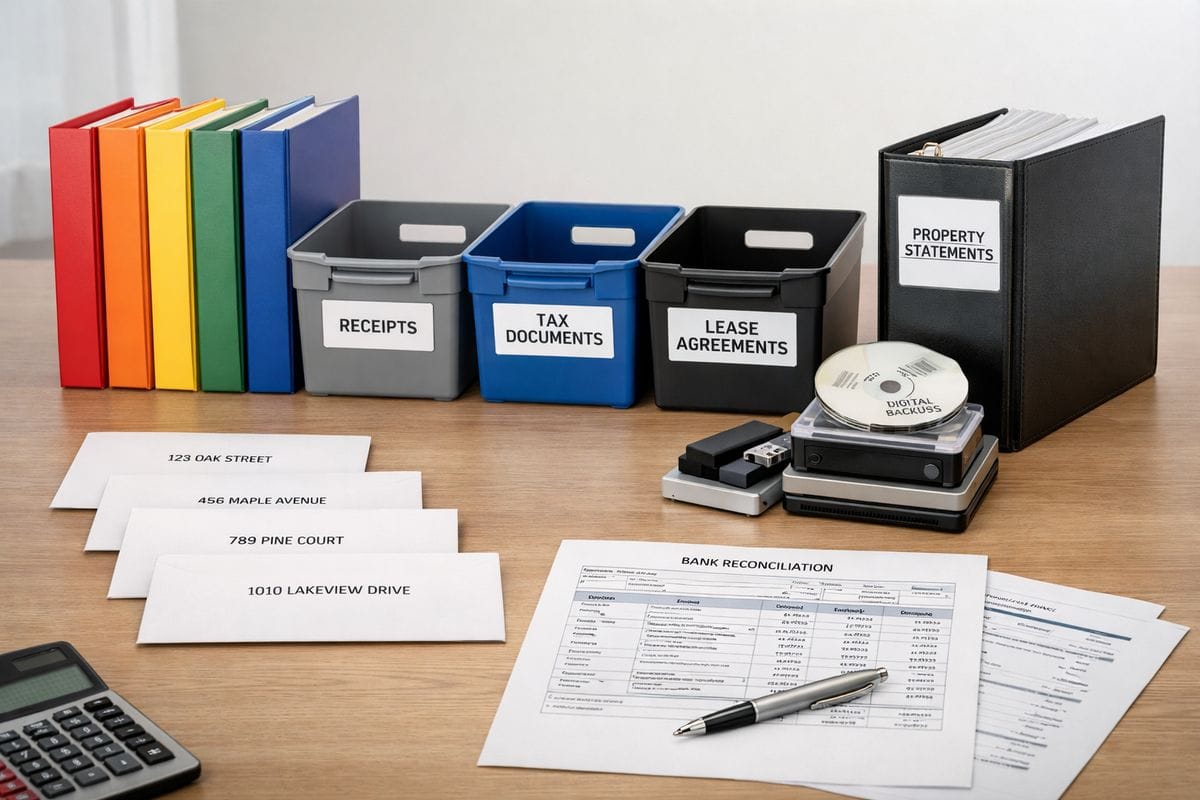
The cleanest filing systems mirror Schedule E and your depreciation files. Use folders by year and property, then subfolders for income, expenses, mortgage and tax statements, insurance, utilities, repairs, improvements, vehicle logs, 1099s, and tax returns.
Digital storage works well because it is searchable and easier to back up. The IRS accepts digital copies as long as they are legible, accurate, and available on request. That means a scanned invoice is fine if the image is readable and the file can be produced promptly. Physical originals still have value for signed closing files, entity formation records, and a few hard-copy legal documents, but daily recordkeeping belongs in a digital archive.
Contractor Payments, W-9s, and Form 1099 Rules Landlords Miss
Contractor compliance gets ignored until January, and by then the damage is usually done. Missed W-9s and bad vendor records create filing problems that are completely avoidable.
Collect Form W-9 Before Work Starts
Collect Form W-9 before the first payment goes out. That form gives you the contractor’s legal name, tax classification, taxpayer identification number, and address. Waiting until year-end is a mistake because unresponsive vendors are far harder to track down after the job is finished.
A prepayment W-9 policy solves that. No W-9, no payment. That is the cleanest process.
Track Which Vendors Cross the $600 Threshold
Contractors paid more than $600 in a year generally require Form 1099-NEC unless an exception applies. Entity type and payment method affect the filing obligation, which is why the W-9 matters. Your bookkeeping should flag cumulative payments during the year so there is no January surprise.
This is especially relevant for handymen, cleaners, lawn services, bookkeepers, and repair vendors who work across several properties. If one contractor receives $250 in March, $180 in June, and $300 in October, the total is what matters.
Keep Invoices, Proof of Payment, and Scope of Work
Contractor files serve two tax functions at once. They support 1099 compliance and they support deduction timing and classification. Keep the invoice, signed proposal, payment confirmation, and scope of work together. If the project was capital in nature, that same file belongs in your improvement records.
This is where many landlords leave money on the table or create audit risk. A complete contractor file tells you what was done, when it was done, how much was paid, and whether the work was a repair or improvement.
Special Recordkeeping Rules for Short-Term Rentals and Mixed-Use Properties
Short-term rentals and mixed-use properties create more moving parts than standard annual leases. More transactions mean more places to make mistakes.
Short-Term Rental Records Beyond Basic Rent Rolls
A short-term rental recordkeeping file needs more than bookings and payouts. Track nightly rates, cleaning fees, platform commissions, refunds, occupancy taxes, pet fees, damage claims, direct bookings, and any off-platform charges. Gross versus net reporting is the recurring issue.
If a guest pays $900 for a stay, $150 cleaning, and $90 tax, and the platform deducts a fee before remitting the balance, the books should still show the transaction clearly enough to reconcile gross guest charges, taxes handled, and platform deductions. Recording only the net bank deposit hides too much.
Personal Use vs. Rental Use Documentation
If a dwelling unit has both personal and rental use, your records need a calendar that shows exactly which days were rented, available for rent, blocked for repairs, or used personally. Personal-use days can affect expense deductibility and loss limitations, so casual memory is not enough.
Owner stays, family stays, and blocked dates should all be documented. The more mixed the use, the more valuable the log becomes. Without it, expense allocations and personal-use positions are hard to defend.
Mid-Year Conversion From Personal Residence to Rental
When a property converts from personal residence to rental mid-year, the file needs to show the conversion date, fair market value at conversion if relevant, prior use history, condition at conversion, and when the property was ready and available for rent.
This matters because the depreciation starting point and basis rules change at conversion. Keep listing records, photos, appraisals or market evidence, invoices for make-ready work, and the first lease or listing confirmation. Conversion without records leads to bad depreciation schedules.
How Long to Keep Rental Property Records for IRS Purposes
This is one of the most searched questions for a reason, and the right answer depends on the record type.
Annual Income and Expense Records
Annual receipts, bills, invoices, utility statements, bank statements tied to annual reporting, and reconciliations should be kept for 3 years from the filing date of the return they support. The same 3-year rule applies to 1099s received that tie into your rental income reporting.
If your 2026 return is filed in 2027, keep those annual support records until at least 2030. That is the minimum. Keeping them longer is fine if storage is digital and searchable.
Basis, Improvement, and Depreciation Records
Purchase documents should be kept forever while you own the property and for 3 years after the sale is reported. Improvement receipts follow the same rule because every capital improvement affects basis, depreciation, and eventual gain.
Depreciation schedules should be kept for the entire ownership period and 3 years after the last return on which depreciation was claimed. In practice, that means the full ownership period plus 3 years after sale. If you hold a rental for 12 years, keep the depreciation file for 15 years. Throwing it out after 3 years is a direct exposure on recapture and gain calculations.
Entity, Loan, and Tax Filing Records
Keep entity formation documents, operating agreements, EIN records, loan documents, insurance policies, leases, and tax returns in long-term storage. Tax returns themselves should stay with the permanent file because they show what was reported, including carryforwards such as suspended passive losses.
A practical retention schedule looks like this:
- Purchase documents: keep while owned, plus 3 years after sale
- Improvement receipts: keep while owned, plus 3 years after sale
- Depreciation schedules: keep entire ownership, plus 3 years after sale
- Annual expense receipts: 3 years from filing
- Bank statements: 3 years from filing
- 1099s received: 3 years from filing
The IRS Audit Triggers Recordkeeping Solves
Good records do more than keep the books tidy. They neutralize the issues that most often lead to adjustments.
Income Mismatches Against 1099s and Bank Deposits
If your return reports less income than a platform 1099-K or your deposit history suggests, the mismatch is easy for the IRS to spot. Missing advance rent, omitted kept deposits, and tenant-paid bills that never hit the books create the same problem.
Monthly reconciliation solves most of this. So does recording gross platform income instead of net deposits. Clean records make the income story consistent across leases, ledgers, deposits, and forms.
Unsupported Deductions and Missing Receipts
Unsupported deductions are low-hanging fruit in an audit. Repairs without invoices, travel without logs, supplies without receipts, and professional fees without engagement records are vulnerable. If records are missing, the IRS can disallow the deduction. That is the practical outcome.
If a receipt is gone, substitute evidence such as bank records, emails, photos, vendor confirmations, and contracts can help, but reconstructed files are weaker than contemporaneous proof. Some categories, especially travel and auto, demand stronger substantiation and fail quickly without it.
Depreciation, Passive Loss, and Personal Use Errors
Wrong basis, wrong land allocation, bad placed-in-service dates, excessive passive losses, and poor personal-use logs all start as recordkeeping failures. The tax adjustment may not happen until years later, but the damage starts when the file is incomplete.
That is why depreciation support belongs in the permanent file and why mixed-use property calendars matter. These are not technical extras. They are core support for the return.
A Practical Rental Recordkeeping Checklist by Property Type
Different rental models need different files. The system should match the property type and growth stage.
Buy-and-Hold Landlords
For a standard long-term rental, your baseline file should include the lease, rent ledger, bank statements, mortgage interest records, property tax bills, insurance records, utility invoices if paid by you, repair invoices, contractor W-9s where relevant, and year-end tax forms. Add closing statements, settlement papers, and depreciation schedules to the permanent file.
This is the minimum operating set. Without it, Schedule E becomes a reconstruction project.
Fix-and-Flip Investors Holding Property as a Rental Before Sale
This profile creates extra complexity because intent, holding period, renovation activity, and use can shift during ownership. Records should distinguish operating expenses from renovation costs, track the conversion into rental use if applicable, and preserve invoices that support capitalization.
If a property is rented temporarily before sale, the dates matter. So does the scope of renovation. Your file needs a timeline of acquisition, rehab, rental listing, tenant occupancy, and sale activity. That timeline drives the tax treatment.
Short-Term Rental Operators
Short-term rental operators need platform statements, direct-booking records, occupancy tax files, cleaner invoices, supply purchases, dynamic pricing reports, payout reconciliations, calendars showing rental and personal-use days, damage claim records, and 1099-K support.
This is where spreadsheets often break down. Transaction volume is higher, and the line between gross and net reporting causes errors fast. The recommendation is accounting software with channel-level reporting and monthly reconciliation.
Owners Scaling From 1-5 Properties to a Portfolio
Once you scale beyond a handful of properties, spreadsheets stop delivering reliable control. You need accounting software that tracks transactions by property, unit, and category, stores documents digitally, and produces reports that mirror the tax return. Property-level controls drive time-to-value because they cut filing cleanup, improve ROI analysis, and reduce missed deductions.
Growth also increases contractor volume, financing complexity, and the number of tax forms in play. A portfolio without standardized books becomes expensive to manage and expensive to defend.
Frequently Asked Questions About IRS Rental Property Record Keeping
Can Digital Copies Replace Paper Receipts?
Yes. Digital copies are acceptable if they are legible, accurate, and can be produced on request. A scanned invoice, PDF statement, or electronic receipt works if the record clearly shows the transaction details and is stored in a system that preserves it. Digital storage is the recommended standard for rental records because it improves search, backup, and retrieval speed.
What Happens If a Receipt Is Missing?
If a receipt is missing, the deduction is exposed. The IRS can disallow any deduction you cannot substantiate. Other evidence such as bank statements, canceled checks, emails, contracts, photos, and vendor confirmations can help support the expense, but that support is weaker than a contemporaneous receipt or invoice. Travel, auto, and home office records are especially vulnerable when documentation is incomplete.
Do Separate LLCs Need Separate Books?
Yes. Separate LLCs need separate books, separate bank accounts, and separate document files. Even if tax reporting rolls into the same broader filing structure in some cases, the accounting should stay entity-specific and property-specific. Commingling transactions across LLCs creates classification errors and weakens both tax substantiation and legal separation.
What if There Are More Than Three Rental Properties?
If you have more than three rental properties, additional Schedule E pages may be required. That filing detail is manageable only if your books already track income and expenses by property. Standardized property-level records make multi-property filing materially easier and reduce the risk of missed entries.
How long should purchase documents and improvement receipts be kept?
Keep purchase documents and improvement receipts forever while you own the property and for 3 years after the sale is reported. Those records support basis, depreciation, gain, and depreciation recapture. Destroying them too early creates tax exposure years after the original purchase or renovation.
Do bank statements and 1099s need to be saved if the amounts are already in the books?
Yes. Keep bank statements and 1099s received for 3 years from filing. The books summarize transactions, but statements and forms are source support. In an audit, source records matter because they verify that the books are accurate.
The Recommendation: Build a Year-Round Recordkeeping System Before Tax Season
The highest-ROI approach is clear: use separate accounts, categorize transactions by property, reconcile monthly, document every repair-versus-improvement decision, and follow retention rules that match the life of the tax issue, not just the filing year. That system protects deductions, lowers audit risk, and produces cleaner after-tax results.
Once your portfolio includes multiple properties, short-term rental activity, mixed-use days, significant improvements, or contractor volume that triggers 1099 compliance, basic annual filing support stops being enough. At that point, the recommendation is a proactive real estate tax advisor who can align bookkeeping, depreciation, capitalization, and filing positions before the return is due. That is where recordkeeping stops being administrative and starts driving tax outcome.