
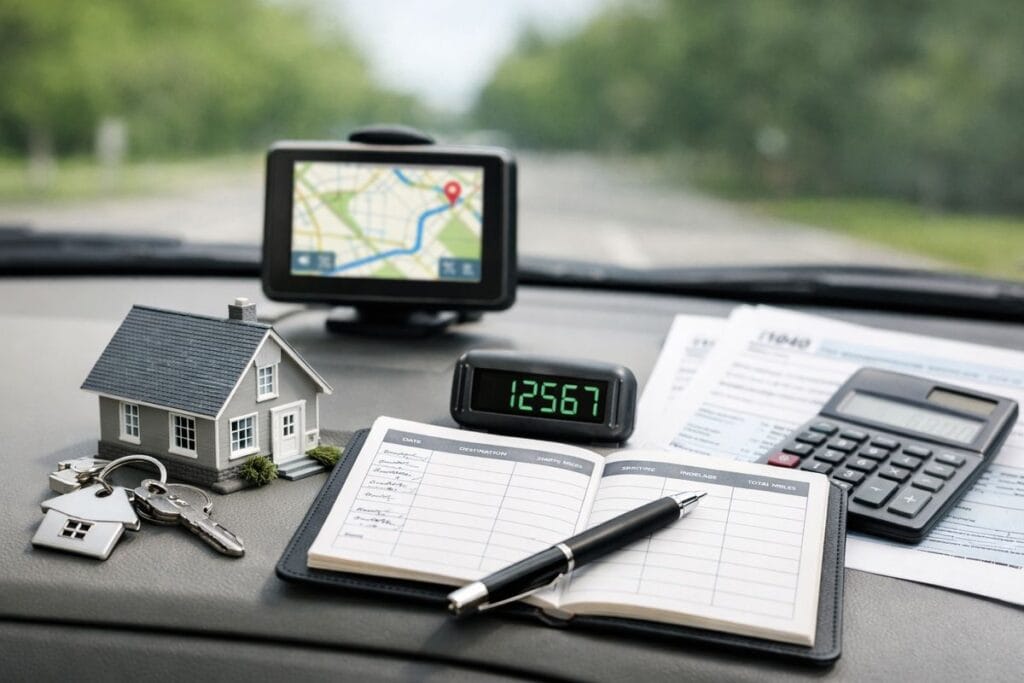
Every mile tied to a rental property has tax value, but only if rental property mileage tracking irs records are built like evidence, not guesses. Done correctly, mileage tracking turns ordinary driving into a legal deduction, protects the deduction in an audit, and gives a growing portfolio a cleaner year-end filing process.
Why Rental Property Mileage Tracking Drives Tax Savings
Mileage is not a minor bookkeeping detail. It directly affects after-tax ROI. At the 2026 IRS business mileage rate of 72.5 cents per mile, 1,000 qualifying miles produce a $725 deduction, 3,000 miles produce $2,175, and 5,000 miles produce $3,625.
That adds up fast across inspections, supply runs, lease signings, contractor meetings, and bank trips. Based on analysis of common landlord activity patterns, portfolios with 3 to 5 properties often generate enough annual driving to create a four-figure deduction without adding a single new expense. The catch is simple: no log, no defensible deduction.
Good records also reduce audit exposure. The field data shows the IRS focuses less on the fact that a deduction exists and more on whether the recordkeeping supports it. A same-day log with matching receipts and calendar entries is far stronger than a spreadsheet built from memory the following January.
What You’ll Need Before Tracking Mileage
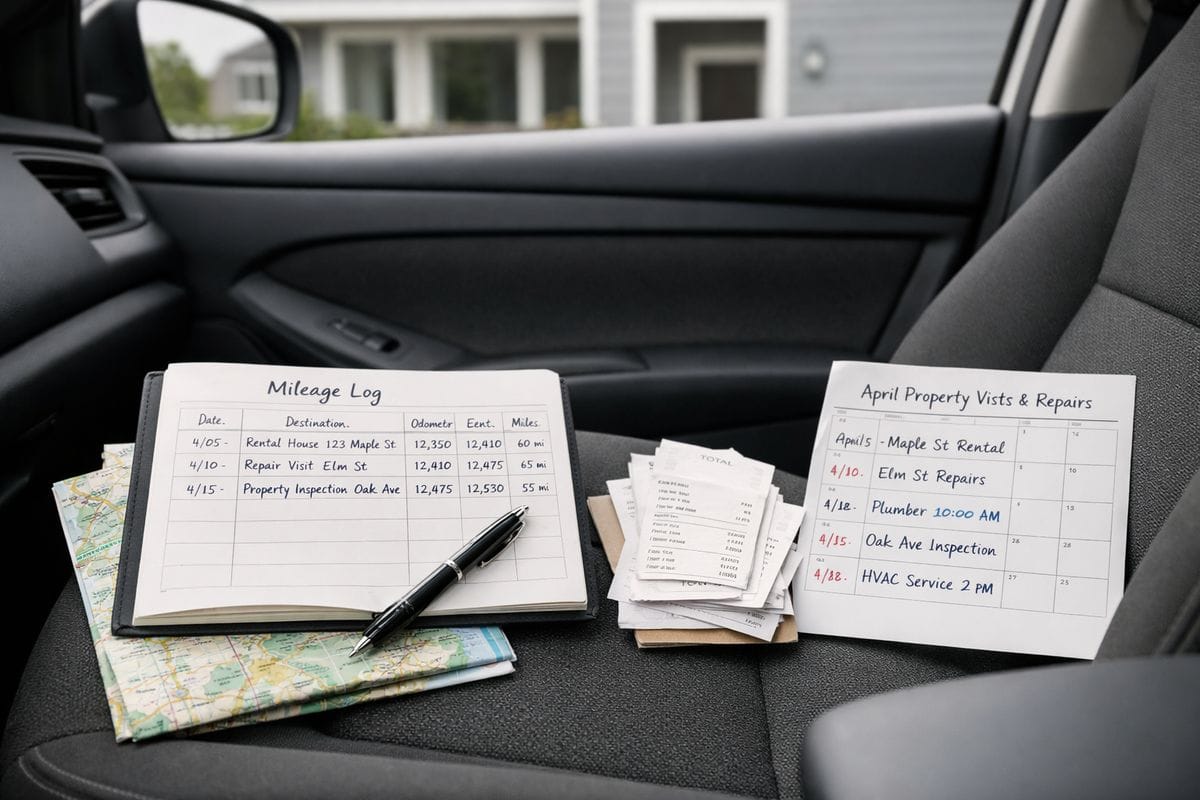
Before the first trip is logged, the system needs a clean foundation. That means vehicle facts, a tracking method, and supporting records that connect each trip to rental activity.
Vehicle details and baseline records
Start with the vehicle year, make, model, VIN, ownership or lease status, and beginning-of-year odometer reading. Add the end-of-year odometer reading when the year closes. Those numbers support total annual mileage and business-use percentage.
Without odometer baselines, the log loses credibility. If a return claims 8,000 business miles but total annual vehicle miles are not documented, the deduction is easier to challenge.
A tracking method you will actually maintain
The IRS does not require a specific format. A paper logbook, spreadsheet, or mileage app all work if the entries are accurate and contemporaneous. What the field data shows is that consistency matters more than format, though automated phone apps usually produce better compliance because they reduce missed entries.
A physical logbook works for disciplined owners. A spreadsheet works if updated the same day. A mileage app is usually the best choice for investors visiting multiple properties each week because GPS records reduce reconstruction risk.
Supporting documents for each rental activity
A mileage log is stronger when each trip has surrounding proof. Save tenant emails, contractor bids, repair invoices, showing calendars, lease-signing notes, toll receipts, bank deposit records, and hardware store receipts. Those documents corroborate the purpose behind each drive.
Step 1: Identify Which Rental Trips Qualify for an IRS Deduction
Before building the log, decide what belongs in it. Only ordinary and necessary driving tied directly to rental operations qualifies.
- Treat income-producing, management, maintenance, and leasing trips as business mileage.
- Exclude personal driving and normal commuting.
- Split mixed-purpose trips so only the rental portion enters the log.
Deductible rental-property trips
These trips generally qualify when tied to active rental operations:
- Driving to a rental house for a repair inspection.
- Driving to meet a contractor for a roofing bid.
- Driving to show a vacant unit to a prospective tenant.
- Driving to a hardware store for supplies used at a rental.
- Driving to the bank to deposit rent checks or to an accountant for rental records.
Those five examples cover the most common deductible categories for landlords. Other qualifying trips include lease signings, move-in walkthroughs, photographing a unit for listing, and checking on a short-term rental between guest stays.
Non-deductible commuting and personal trips
These trips do not qualify:
- Driving from home to a regular office that is not a qualifying home office.
- Driving to a property mainly for a personal visit or family stop.
- Driving to run personal errands and calling the trip rental-related.
- Driving on a family outing with a brief stop near a rental.
- Driving from work to home with no rental purpose.
One rule causes the most confusion: the first trip of the day from home and the last trip back home are usually commuting unless a home office qualifies as the principal place of business for rental activity.
Mixed-purpose trips and how to split them
If one outing includes both business and personal stops, allocate only the business segment. For example, if the route goes from home to a rental property, then to a grocery store for personal shopping, only the mileage up to the rental activity and between rental-related stops counts. The personal leg does not.
Document the split clearly. Separate line items in the log work best.
Step 2: Choose the Right Deduction Method Before You Build Your System
The deduction method determines what records need to be kept all year. Choose early, because a bad first-year choice limits later options.
- Review the standard mileage method.
- Review the actual expense method.
- Apply the method-selection rules before year-end.
Standard mileage rate method
For 2026, the IRS business rate is 72.5 cents per mile. That rate applies to cars, vans, pickup trucks, and panel trucks, including gasoline, diesel, hybrid, and electric vehicles. The IRS states the rate is based on an annual study of fixed and variable vehicle costs.
This method is popular because it is simple. Instead of tracking fuel, repairs, insurance, and depreciation line by line, the deduction is business miles multiplied by the IRS rate. Tolls and parking are still deductible separately.
Actual expense method
The actual expense method deducts the business-use share of real vehicle costs: gas, oil, insurance, repairs, registration, tires, lease payments, and depreciation. If business use is 40 percent, then 40 percent of eligible vehicle expenses is deductible.
This method takes more work. It often produces a larger deduction for expensive vehicles or high operating costs, but only when records are detailed enough to support every component.
Method-selection rules that affect future tax options
If a vehicle is owned, the recommendation is to decide carefully in the first year it is placed in business use. To use standard mileage later, that method must be chosen in the first business-use year for an owned vehicle, according to IRS rules. For a leased vehicle, if standard mileage is chosen, it must be used for the entire lease period, including renewals.
That rule matters because an early mistake closes off future flexibility.
Dollar example: comparing methods on a rental vehicle
Assume 5,000 qualifying rental miles in 2026.
Under standard mileage, the deduction is straightforward: 5,000 × $0.725 = $3,625.
Now assume actual annual vehicle costs are $9,200 and business use is 45 percent. The actual-expense deduction is $4,140. In that fact pattern, actual expenses produce a larger write-off.
If actual annual costs are $6,500 at 45 percent business use, the deduction drops to $2,925. In that case, standard mileage wins.
Step 3: Set Up an IRS-Compliant Mileage Log
An IRS-compliant log is not complicated, but it does require the right data every time.
- Create one log per vehicle.
- Record each rental trip separately.
- Keep annual odometer readings with the trip log.
The five core elements every trip entry should include
Each entry should contain these five required elements:
- Date
- Starting location
- Destination
- Business purpose
- Miles driven
That satisfies the custom and practical standard most examiners expect. Odometer readings can replace a simple mileage number if preferred.
Annual odometer readings and why they matter
Record the odometer on January 1 or the first day of business use, then again on December 31 or the final day of the year. Those readings support total miles driven for the year and make the business-use ratio mathematically credible.
A log showing 6,000 business miles on a vehicle that only moved 5,200 total miles is a self-inflicted problem.
Plain-English examples of acceptable trip descriptions
Strong descriptions are specific. “Drive to 123 Main St. for repair inspection and contractor bid review” works. “Drive to Oak Ave duplex for tenant move-out walkthrough” works.
Weak descriptions do not. “Rental work,” “property visit,” or “business” leave too much unexplained.
Step 4: Track Each Trip at the Time It Happens
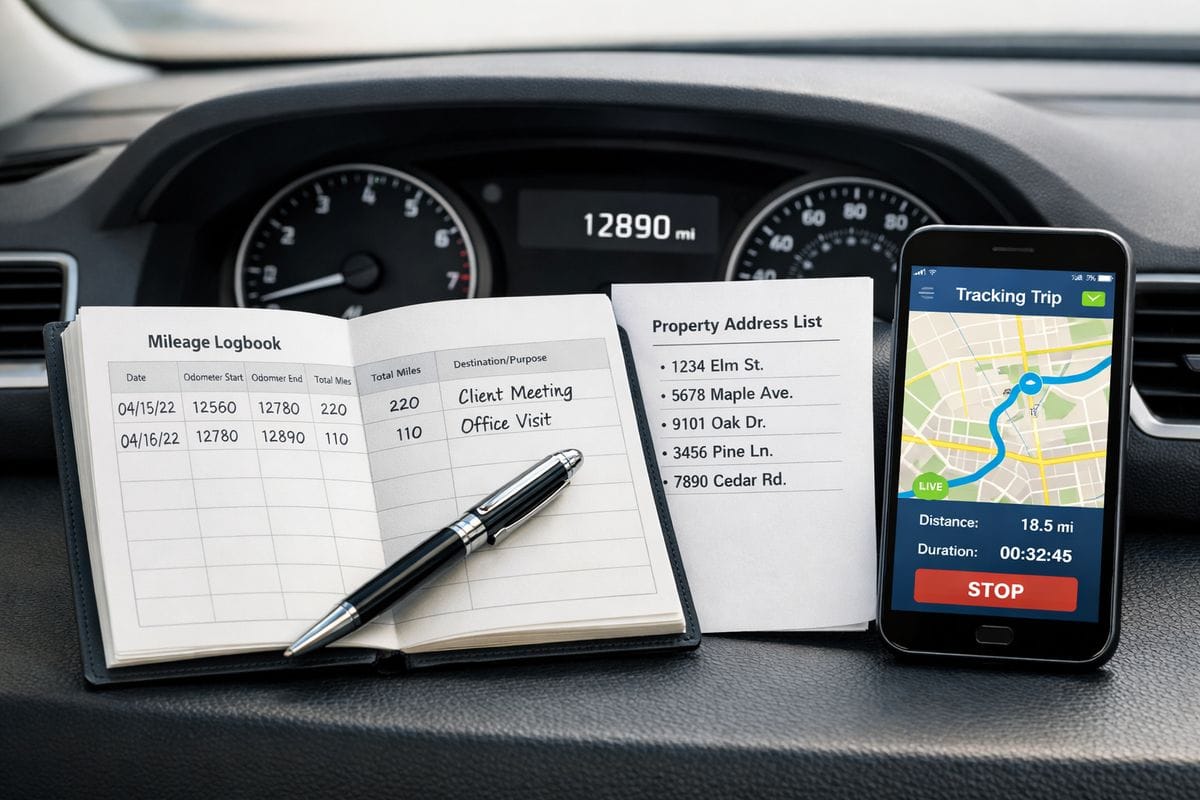
Contemporaneous logging is the dividing line between a clean deduction and a weak one. Record trips before driving or immediately after parking.
- Open the app or logbook the same day.
- Enter the route and mileage.
- Add the business purpose while details are fresh.
Log the trip before or immediately after driving
Same-day entry eliminates most errors. Addresses are remembered correctly, the purpose is obvious, and the route has not blurred into five other stops.
Reconstructed logs create problems. Tax Court cases regularly reject logs built months later, especially when entries are rounded, repetitive, or suspiciously perfect.
Record start point, stop point, and total miles
Use odometer readings, a map-based mileage calculation, or automated GPS tracking. A phone app usually gives the fastest time-to-value because each trip is captured automatically and can be classified later as business or personal.
If using a paper logbook, write the start address, destination address, and miles driven before moving to the next task.
Add the business purpose while the details are fresh
Tie the trip to a real rental activity. “Met electrician at Elm St. property to review breaker issue” is strong because it connects the trip to maintenance. “Went to property” is weak because it says nothing useful.
Step 5: Separate Business Miles From Personal and Commuting Miles
This is where many deductions fail. Mixing qualifying and nonqualifying miles inflates the claim and invites scrutiny.
- Create a rule for trips from home.
- Tag trips by property.
- Split mixed routes clearly.
Create a rule for trips from home
If home is not a qualifying principal place of business, the first trip from home and the last trip back home are usually commuting. If a home office is the principal place of business for managing rentals, then travel from that home office to properties, banks, contractors, or supply stores generally qualifies.
The home office exception matters. If rent collection, bookkeeping, scheduling, tenant communications, and management decisions are regularly handled from a dedicated home office, the first and last trip of the day can shift from nondeductible commuting to business travel.
Track multiple properties without double counting
Assign each trip to a property address or property code. That keeps trips clean when managing long-term rentals, short-term rentals, and flips at the same time.
Do not enter one long route twice just because it involved two properties. Split the actual route by stop.
Handle supply runs, bank stops, and same-day detours correctly
If the route goes from a rental to a hardware store for parts, then to the bank to deposit rent, each leg is business-related. If the route then continues to a restaurant for a personal lunch or to a grocery store, the business mileage stops where the personal detour begins.
Step 6: Save the Backup Records That Strengthen Your Log
A mileage log is stronger when the rest of the file tells the same story.
- Match entries to receipts and invoices.
- Match entries to calendars and messages.
- Track tolls and parking separately.
Match trip entries to receipts and invoices
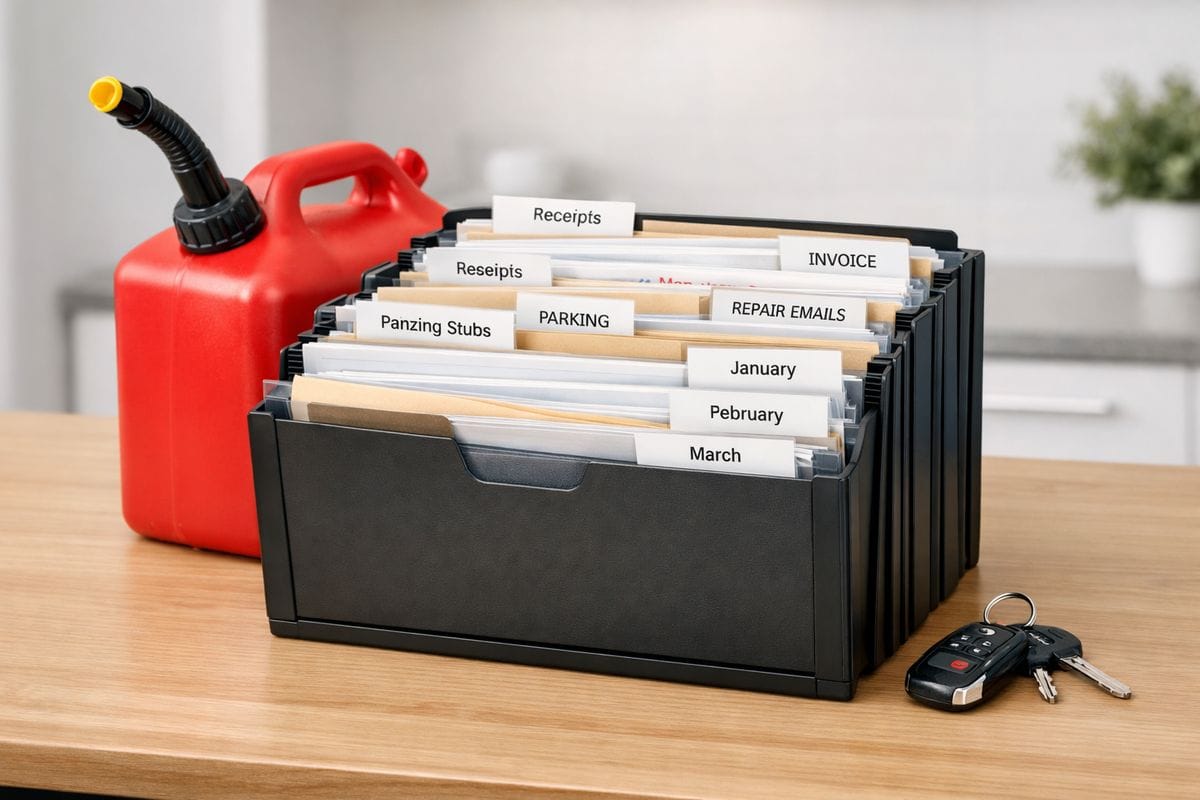
A same-day Home Depot receipt, plumber invoice, parking receipt, or toll charge helps validate the trip. Save digital copies in a folder by property and month.
Match trip entries to calendars and communications
Showing appointments, vendor texts, tenant emails, and lease-signing calendar events all support the business purpose listed in the log. If an examiner reviews the file, consistent timestamps matter.
Keep tolls and parking separate from mileage
The standard mileage rate does not include tolls and parking. Deduct those separately when they relate to rental activity. Do not bury them inside the mileage calculation.
Step 7: Review Your Mileage Log Monthly
Monthly review turns mileage tracking from a year-end scramble into an operating process.
- Compare business miles to overall vehicle use.
- Clean up incomplete entries.
- scan for audit red flags.
Reconcile mileage totals to odometer trends
Logged business miles should make sense against total vehicle miles. If total annual mileage is 12,000 and the log shows 11,900 business miles, scrutiny rises fast, especially without a separate personal vehicle.
Fix vague or incomplete entries while evidence is still available
Missing addresses and vague notes are easy to repair in the same month. Six months later, the supporting trail is weaker.
Watch for audit red flags
The IRS and Tax Court look for patterns that suggest reconstruction. Red flags include round-number estimates, identical mileage every week, blocks of entries created at once, missing personal miles, and claims of 100 percent business use without strong support. In Khan v. Commissioner, a landlord’s vehicle deduction failed because the mileage log lacked corroborating evidence.
Step 8: Calculate Your Rental Mileage Deduction
Year-end calculation is simple if the log is accurate.
- Add total qualifying miles.
- Apply the correct IRS rate.
- Add tolls and parking separately.
Add total qualifying miles for the year
Sum only eligible rental-business miles. Exclude commuting, personal use, and the personal portion of mixed-purpose trips.
Apply the correct IRS standard mileage rate
Use the rate for the tax year being filed. For 2026, that is 72.5 cents per mile. For context, the business rate was 70 cents in 2025 and 67 cents in 2024.
Add separately deductible tolls and parking
If qualifying tolls were $180 and parking was $90, add $270 to the mileage deduction. Example: 3,000 rental miles × $0.725 = $2,175, plus $270 of tolls and parking, for a total vehicle-related deduction of $2,445.
Step 9: Report the Deduction on Your Tax Return
The deduction has to flow cleanly into the return and be supported by a filing-ready summary.
- Summarize by vehicle and property.
- Provide totals and method used.
- Keep source records with the tax file.
Reporting rental vehicle expenses with Schedule E
Mileage tied to rental activity generally supports vehicle and travel-related expense reporting connected to Schedule E. The amount claimed should match the method used and the records retained.
When Form 4562 enters the picture
If the actual expense method includes depreciation, Form 4562 often enters the filing package. Method choice affects this. Standard mileage is simpler. Actual expense creates more reporting and basis tracking.
Prepare a tax-file-ready mileage summary
Prepare an annual summary listing vehicle, total miles, business miles, business-use percentage, method used, tolls, parking, and mileage by property. That makes advisory review faster and filing cleaner.
Troubleshooting Common Rental Mileage Tracking Problems
Problems are common, but the fix depends on speed and documentation quality.
“Trips were not logged during the year”
Reconstruct the record using calendars, invoices, emails, receipts, maps, and tenant communications. That is better than claiming nothing, but the audit risk is higher because reconstructed logs are weaker than contemporaneous records.
“One vehicle is used for both rental and personal driving”
Keep total annual mileage and business mileage clearly separated. That supports the business-use percentage and prevents overstating the deduction.
“Multiple vehicles or drivers are involved”
Use a separate log for each vehicle. If another driver handles rental tasks, maintain clear records showing date, vehicle, property, and purpose for each trip.
“The log lacks proof beyond mileage entries”
Add corroboration now. Match entries to invoices, texts, emails, leases, appointments, parking receipts, and bank records before filing.
“Actual expenses may save more than standard mileage”
Run both calculations before filing. Compare standard mileage against business-use share of fuel, insurance, repairs, registration, depreciation, and lease costs. Then choose the higher-value method allowed by IRS rules.
Common IRS Mistakes That Cause Mileage Deductions to Fail
Most failed mileage deductions collapse because of weak process, not because the travel was illegitimate.
Estimating miles instead of keeping contemporaneous records
A January rebuild of the entire year is exactly what examiners distrust. Same-day logging is the recommendation because it creates a stronger record and shorter audit defense time.
Using vague business purposes
“Property visit” is not enough. “Drove to 456 Cedar Ln. to inspect water damage after tenant report” is much better because it connects the trip to management and maintenance.
Claiming 100% business use without strong support
Full-use claims attract scrutiny, especially when no separate personal vehicle exists. The data shows mixed-use vehicles are normal. Report them honestly.
Ignoring court and IRS recordkeeping standards
Unsupported logs fail. Logs without dates, addresses, or corroboration fail. Records that look fabricated fail. That outcome is preventable.
Expected Outcome: What a Good Mileage System Produces
A good system produces three business outcomes: cleaner deductions, lower audit risk, and faster year-end tax prep.
A sample annual outcome for a small portfolio
Assume 4 properties with recurring inspections, tenant meetings, bank deposits, and supply runs totaling 3,000 qualifying miles in 2026. At 72.5 cents per mile, the deduction is $2,175. At 5,000 miles, it is $3,625. That is real tax value created from driving already happening in the business.
The recommendation for scaling investors
For 1 to 2 properties, a disciplined paper log or spreadsheet can work. For 3 or more active properties, short-term rentals, or a flip pipeline, an automated mileage app usually delivers better compliance and lower administrative drag. Once multiple vehicles, actual-expense comparisons, home office qualification, or larger portfolios enter the picture, a real estate tax advisor adds ROI by tightening method selection and audit-ready documentation.
Frequently Asked Questions
Can mileage be deducted for driving from home to a rental property?
Usually no, if that trip is commuting. Yes, if a qualifying home office is the principal place of business for rental management and the trip starts from that home office for a business purpose.
What is the best way to track rental mileage?
A mileage app is usually the strongest option because it captures trips automatically and reduces missed entries. A physical logbook also works if every trip is recorded the same day with date, start point, destination, purpose, and miles.
Can both mileage and gas receipts be deducted?
Not under the standard mileage method. Under standard mileage, the IRS rate already covers vehicle operating costs. Gas is part of that rate. Tolls and parking are separate and still deductible.
How long should mileage records be kept?
Keep the mileage log, odometer records, and supporting documents with the tax file for at least the standard IRS record-retention period tied to the return, and longer if basis, depreciation, or ongoing vehicle treatment is involved.
What if the mileage log was not kept during the year?
Reconstruct it using invoices, emails, calendars, receipts, and map distances. That approach is weaker than contemporaneous records, so the recommendation is to repair the file immediately and start real-time logging now.
Is rental mileage different from unreimbursed employee mileage?
Yes. Unreimbursed employee travel is generally not deductible as a miscellaneous itemized deduction under current law. Rental mileage is tied to rental business activity and is a separate tax category.
Clean mileage records convert routine property driving into a defensible deduction. The recommendation is direct: choose the deduction method early, log every trip the same day, keep backup proof, and treat mileage tracking like part of operating the portfolio, not an afterthought at filing time.