

Mixed use property tax treatment is the set of tax rules that decide how one property gets split across different uses, then taxed, depreciated, and deducted accordingly. That matters immediately because one classification choice changes annual property tax expense, depreciation timing, audit exposure, and your after-tax ROI for years after closing.
What Mixed-Use Property Tax Treatment Means for Investors
A mixed-use property contains two or more uses inside one asset. The classic example is retail on the ground floor with apartments above, but the category is wider than that. It includes owner-occupied buildings with rental space, live-work layouts, vacation properties with personal and rental use, and commercial assets with a residential manager unit.
For tax purposes, the property is not treated as one simple block. Each portion is classified by use, and that classification controls local property tax treatment and federal income tax treatment. The recommendation is to treat mixed use as a classification exercise first, not a bookkeeping exercise later.
The two tax systems you need to separate
Investors often say “property taxes” when describing the whole issue. That blends together two separate systems.
Local property tax is set by the assessor. That system determines assessed value, tax rate, exemptions, reassessment triggers, and appeal rights. Federal income tax sits on your return. That system determines depreciation life, expense deductions, passive loss treatment, and recapture.
Those systems do not have to match. A building can be one parcel for local assessment and still require separate federal depreciation allocations. In practice, that mismatch is where underwriting errors show up.
Common mixed-use property types
The most common versions are easy to spot once the label is clear. Apartments over retail is the obvious one. So is a duplex where one unit is your residence and the other is rented. A short-term rental used for part of the year personally also falls into mixed-use treatment, though under a different set of personal-use rules. Live-work space, mixed retail and office buildings, and NNN assets with a caretaker or manager apartment all belong here too.
The First Principle: Classification Drives Everything
Based on analysis of mixed-use tax outcomes, classification is the first principle because every other tax result follows from it. Residential, commercial, owner-occupied, rental, and personal-use labels decide valuation method, tax rate exposure, exemptions, reporting treatment, and depreciation period.
A good deal on paper turns into a weaker deal fast when classification is assumed instead of documented.
How assessors classify mixed-use property
Local assessors usually classify mixed-use property by actual use, square footage, income contribution, legal unit count, occupancy, or some combination of those factors. What the field data shows is sharp variation across counties and cities, which means generic rules are not enough. Parcel records, floor plans, leases, certificates of occupancy, zoning, and rent rolls need to be assembled before closing.
That same discipline helps federally. If your file already shows where the residential area ends and the commercial area begins, the depreciation work becomes defendable instead of improvised.
Why local rules create different outcomes for similar buildings
Two nearly identical buildings can produce very different tax bills because the local rules are different. California still runs under Prop. 13-style limits, so assessed value usually starts with purchase price and rises by no more than 2% annually unless reassessment is triggered. Virginia jurisdictions such as Fairfax reassess to fair market value each year, and commercial portions are commonly valued by the income approach while residential portions rely on comparable sales. New York adds another layer with special condo and co-op rules and difficult allocation questions for mixed-use units.
Reassessment triggers matter just as much as the baseline rule. Purchase, renovation, conversion, and change of use can all change the tax profile faster than rents change.

The Three Tax Buckets Investors Need to Model
The cleanest underwriting framework uses three buckets: local property tax, federal depreciation, and operating expense allocation. If a deal model does not break those out separately, the tax treatment is not really being modeled.
Local property tax assessment and tax bill
Your tax bill starts with assessed value and the applicable rate. Fairfax states the formula plainly: (Assessed Value ÷ 100) × tax rate. The simple formula hides an important distinction. Residential portions are often valued from comparable sales, while commercial portions often depend on net operating income and capitalization rates.
That means your retail rent growth can push taxes higher in a way your apartment rents may not. It also means falling office or retail demand does not reduce tax bills immediately because assessment lag delays the effect.
Federal depreciation by property use
This is the difference most investors care about first. Residential rental property generally depreciates over 27.5 years. Nonresidential real property generally depreciates over 39 years.
A mixed-use building often requires an allocation between those lives instead of one depreciation life for the entire asset. If your residential portion is 75% of the building and your commercial portion is 25%, you do not get to run the whole basis over 27.5 years by default.
Expense allocation between uses
Interest, insurance, repairs, utilities, and property taxes follow actual use and a supportable allocation method. That method usually starts with square footage for common expenses, though direct expenses should be assigned directly to the benefiting space.
Intent does not control deductions. Use does.
Depreciation Rules: Where Mixed-Use Tax Treatment Changes Deal Economics
This is where mixed-use tax treatment changes real dollars. Depreciation does not alter cash rent, but it changes taxable income, year-one tax liability, and your effective yield.
27.5-year residential vs. 39-year commercial depreciation
Use a direct example. Assume a purchase price of $1,250,000. Allocate $250,000 to land and $1,000,000 to depreciable building basis.
Now assume 6,000 square feet of apartments and 2,000 square feet of retail.
Under the square-footage method, 75% of the building basis goes to residential and 25% goes to commercial.
Residential basis: $750,000 ÷ 27.5 = $27,273 annual depreciation.
Commercial basis: $250,000 ÷ 39 = $6,410 annual depreciation.
Total annual depreciation: $33,683.
Now compare that with a 100% commercial building using the same $1,000,000 building basis. The annual depreciation is $1,000,000 ÷ 39 = $25,641.
That difference, $8,042 per year, directly affects taxable income and after-tax cash flow. On a 32% combined marginal tax rate, that is about $2,573 in annual tax savings from the mixed-use residential allocation alone.
There is a second method that investors often miss: the 80% gross rental income test. If 80% or more of the gross rental income comes from dwelling units, the entire building qualifies for 27.5-year residential rental treatment. Use the same building. Assume apartments produce $96,000 in annual rent and the retail suite produces $20,000. Residential rent is 82.8% of total gross rent. Under that test, the full $1,000,000 building basis depreciates over 27.5 years, producing $36,364 per year.
Compared with the square-footage split, that is another $2,681 of annual depreciation. The recommendation is to run both methods on every true mixed-use residential-over-retail deal and apply one consistently with your tax position.
A common question follows fast: what if the commercial tenant closes and the space is vacant? The answer is simple. Vacant commercial space still depreciates at 39 years under the commercial classification. Vacancy does not convert the space into residential property.
How land allocation affects the depreciable basis
Land never depreciates. That sounds basic, but it is where many bad models start.
Before splitting building basis between residential and commercial use, you need a defensible land and building allocation. If you overstate land, you suppress depreciation and reduce current deductions. If you understate land without support, audit risk rises. Assessment records, appraisal support, and purchase accounting all belong in the file.
Cost segregation opportunities in mixed-use buildings
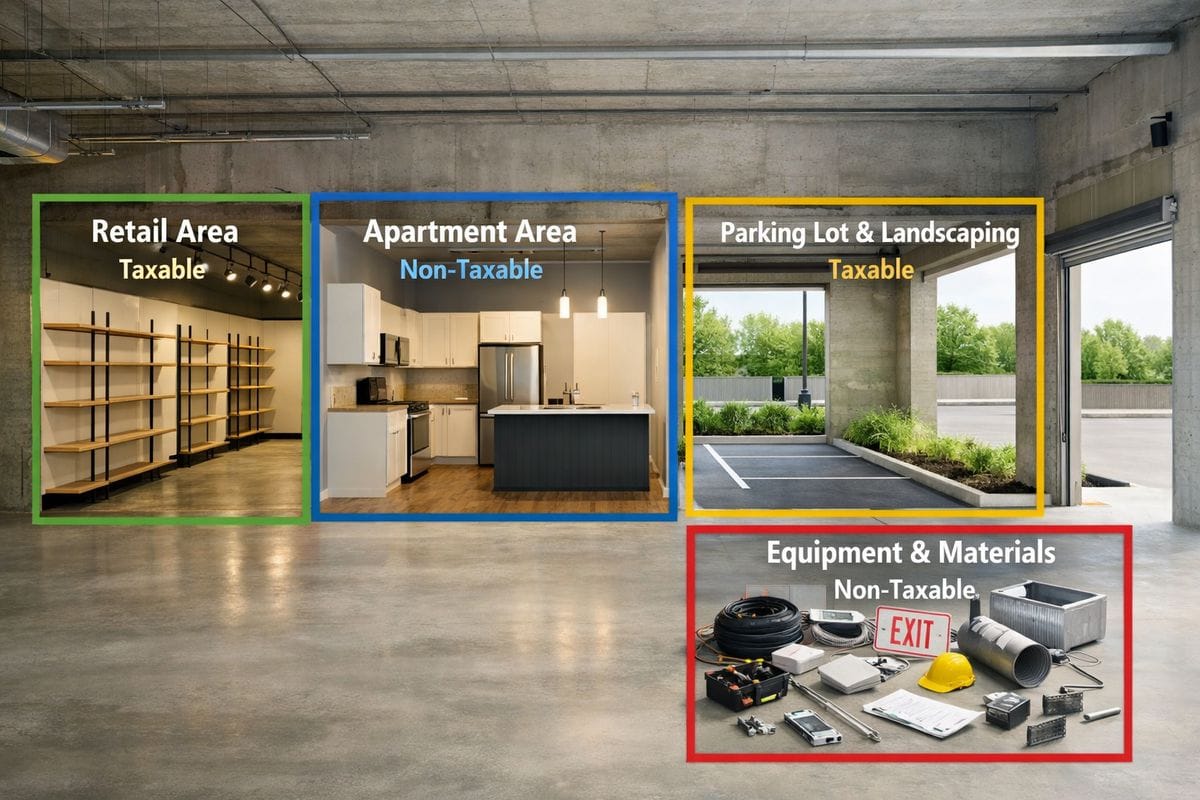
Mixed-use buildings often produce strong cost segregation results because the improvement types vary by space. Retail areas, office suites, apartments, parking, signage, paving, landscaping, security systems, and specialty electrical work often fall into different recovery periods.
The value comes from carving qualifying components out of 27.5-year or 39-year real property and moving them into shorter-life categories. According to NAR, cost segregation can split acquisition or construction cost into long-life real property, personal property, and bonus-depreciable assets. That accelerates deductions and improves time-to-value.
Bonus depreciation and recapture exposure
Accelerated deductions are good. Unplanned recapture at sale is not.
Bonus depreciation generally applies to shorter-life personal property and land improvements identified in a cost segregation study, not to the building shell itself. Current law has restored 100% bonus depreciation for qualifying property placed in service during the current statutory window. That improves early cash flow, but shorter-life assets bring recapture exposure when you sell.
The recommendation is to align acquisition, hold period, and exit planning from day one. Fast deductions without exit planning often reduce long-term ROI.
Personal Use, Rental Use, and the 14-Day Rule
Mixed-use treatment changes again when part of the property is personal rather than purely investment use. That matters for duplexes, vacation homes, and owner-occupied buildings.
When personal use changes deductibility
Personal-use days, owner occupancy, and below-market rent all change expense deductibility. If one unit is reserved for family use, that is not rental use. If space is used as your residence, that portion does not get depreciation as rental property.
Expenses must be split between personal and income-producing portions. Mortgage interest and property taxes may still have partial personal treatment, but depreciation applies only to the rental or business part.
The 14-day rule in plain English
The 14-day rule is a vacation-home rule, not a commercial-versus-residential depreciation rule. If a property is rented for fewer than 15 days during the year, the rental income is not reported and no rental expenses are deducted against it. If personal use exceeds the IRS threshold, expenses must be allocated between rental and personal days. The Illinois guidance highlights the 14-day rule as the key line.
Do not apply that rule to an apartments-over-retail building. That is the wrong test for the wrong issue.
Owner-occupied mixed-use buildings
If one portion is your primary residence and the rest is rented or used for business, every shared expense needs allocation. Insurance, utilities, common repairs, and property taxes are generally split by square footage unless a direct method is better. A repair inside the rental unit is rental. A repair inside your residence is personal. A new roof serving the whole building is shared and allocated.
Depreciation applies only to the income-producing portion.
Four Drivers of Your Actual Tax Bill
The actual tax result comes down to four drivers: use mix, lease structure, local exemptions, and reassessment events.
Driver 1: Use mix by square footage and income
A 60/40 split is not always measured the same way. Property tax assessment may focus on actual use or income potential. Federal depreciation often starts with physical allocation, while the 80% gross rent test can change the result for residential-over-retail buildings.
The recommendation is to document both square footage and revenue by unit or suite from the first day of ownership.
Driver 2: Lease structure and pass-throughs
NNN, modified gross, and full-service leases change who bears property tax economically. You remain legally liable to the taxing authority, but reimbursement clauses affect cash flow and valuation.
If taxes rise and your lease passes that cost through cleanly, your cash flow holds. If the reimbursement cap is weak, your NOI absorbs the increase.
Driver 3: Jurisdiction-specific exemptions and special assessments
Owner occupancy, homestead status, redevelopment incentives, and local abatements can change the bill materially. Philadelphia, for example, applies a single base real estate tax rate because of the uniformity clause, then uses a separate use and occupancy tax on business use within a parcel. New York and California create very different outcomes again.
This is why state-level assumptions are not enough. Parcel-level review is the standard.
Driver 4: Reassessment, renovations, and change of use
Purchase, major renovation, adding retail space, subdividing units, converting long-term rental to short-term rental, or shifting owner occupancy all trigger tax changes. In practical underwriting, post-close CapEx often alters the tax profile faster than rent growth improves NOI.
Worked Examples Investors Can Use in Deal Screening
Example 1: Apartments over retail
Assume a $1,500,000 purchase, with $300,000 land and $1,200,000 building basis. The building is 9,000 square feet: 6,750 residential and 2,250 retail. That is a 75/25 split.
Under the square-footage method, annual depreciation is $900,000 ÷ 27.5 = $32,727 for residential, plus $300,000 ÷ 39 = $7,692 for retail, for a total of $40,419.
Now test gross rents. Apartments produce $135,000 and retail produces $25,000. Residential rent is 84.4% of gross rent. The whole $1,200,000 qualifies for 27.5-year treatment, giving $43,636 annual depreciation. That is $3,217 more per year than the split method.
Common expenses such as insurance, property taxes, and water serving the whole building are allocated 75/25 by square footage. A storefront HVAC replacement is 100% commercial. Hallway lighting serving apartments only is 100% residential.
For local property tax, expect the retail component to receive income-based scrutiny in many jurisdictions, while the apartment component may be checked against sales of similar multifamily assets.
Example 2: Owner-occupied building with one rental unit
Assume a two-unit building where one 1,200-square-foot unit is your residence and one 800-square-foot unit is rented. Shared expenses are allocated 60/40 by square footage if the common areas support both equally.
If annual insurance is $3,000, property taxes are $8,000, and utilities paid by ownership are $4,000, the rental share at 40% is $1,200, $3,200, and $1,600 respectively. Depreciation applies only to the rental unit’s share of building basis, never to the residence.
If a kitchen repair is inside the rental unit, it is 100% rental. If it is inside your residence, it is personal and not a rental deduction.
Example 3: NNN commercial asset with a residential manager unit or ancillary use
Assume a small shopping center with one onsite manager apartment above a service bay. The leases are NNN, so tenants reimburse taxes, insurance, and common area costs. Economically, that protects cash flow, but the apartment still requires separate federal treatment.
If 95% of the square footage is commercial and 5% is residential, depreciation is split accordingly unless another qualifying residential rule applies. The manager apartment does not convert the center into residential property. Property tax valuation remains heavily income-driven because the asset is fundamentally commercial, and lease reimbursements support NOI.
Common Errors That Increase Taxes or Audit Risk
“The whole building gets one depreciation life”
That is usually wrong. Mixed-use property commonly requires separate depreciation lives running in parallel. The clean answer is allocation, not simplification.
“Property tax classification matches federal tax treatment”
It often does not. Local assessors and the IRS use different rule sets. One parcel on the tax roll can still require multiple federal allocations.
“Cost segregation solves everything”
It does not. Cost segregation accelerates deductions, but weak records, bad allocations, and no exit planning reduce ROI through compliance cost and recapture.
“If tenants reimburse taxes, tax treatment stops mattering”
Reimbursements help cash flow. They do not erase assessment method, appeal rights, reassessment timing, depreciation rules, or sale-price impact.
The Recommendation: Build a Mixed-Use Tax File Before Closing
Based on analysis of investor outcomes, the recommendation is simple: build the mixed-use tax file before closing, not after the first year-end scramble. That file should include a property-use map, floor plans, rent roll, parcel record, land and building value split, draft expense allocation method, reassessment assumptions, and your depreciation strategy under both the square-footage method and the 80% gross rental income test.
That work protects ROI because it improves underwriting accuracy, shortens time-to-value, and prevents avoidable tax drag. Mixed-use property rewards precision. The deal that wins is not the one with the most exciting pro forma. It is the one with the cleanest classification and the strongest support file.
Frequently Asked Questions
Does vacant commercial space switch to 27.5-year depreciation?
No. Vacancy does not change classification by itself. Commercial space that is temporarily vacant still depreciates at 39 years until the actual use and classification change.
Should common expenses be allocated by square footage or income?
For federal income tax, common operating expenses are usually allocated by square footage unless a direct tracing method is better. Income is a weaker method for shared costs such as insurance, utilities, and property taxes.
Can one mixed-use building qualify entirely as residential rental property?
Yes, if 80% or more of gross rental income comes from dwelling units, the entire building can qualify for 27.5-year residential rental treatment. That test should be run alongside the square-footage split on every qualifying deal.
Does the local assessor’s classification control federal depreciation?
No. Local assessment and federal depreciation are separate systems. Assessor records help support the facts, but IRS depreciation treatment follows federal tax rules.
Is cost segregation worth it on a smaller mixed-use building?
It is worth it when the accelerated deductions exceed the study cost and the exit plan supports the result. Buildings with varied improvements, retail build-outs, site work, and specialty systems often produce the strongest results.
What records belong in a mixed-use tax file?
Floor plans, leases, rent roll, parcel records, land and building allocation support, expense allocation workpapers, occupancy history, and any appraisal or cost segregation study belong in the file. Those records support deductions and reduce audit risk.