

If rental losses are sitting on Form 8582 year after year, the material participation tests rental property owners hear about are only part of the answer. The real decision is whether those losses stay trapped as passive, or turn into current-year tax value through the right classification, the right status, and records that survive IRS review.
What this tutorial helps you decide
This tutorial helps you decide one thing with real financial consequences: whether rental losses create current-year tax savings or remain suspended. That answer affects cash flow, tax efficiency, and portfolio ROI.
Based on analysis of common investor files, the biggest mistake is not failing a material participation test. It is applying the tests to the wrong type of rental activity. Long-term rental real estate is generally passive by default, even when involvement is heavy. That means material participation only changes the result after the rest of the framework is handled correctly.
The recommendation is simple. Start by classifying the rental, then determine whether passive loss rules are actually limiting deductions, then separate active participation from material participation, then test for real estate professional status if the property is a long-term rental. Only after that should the seven material participation tests be applied.
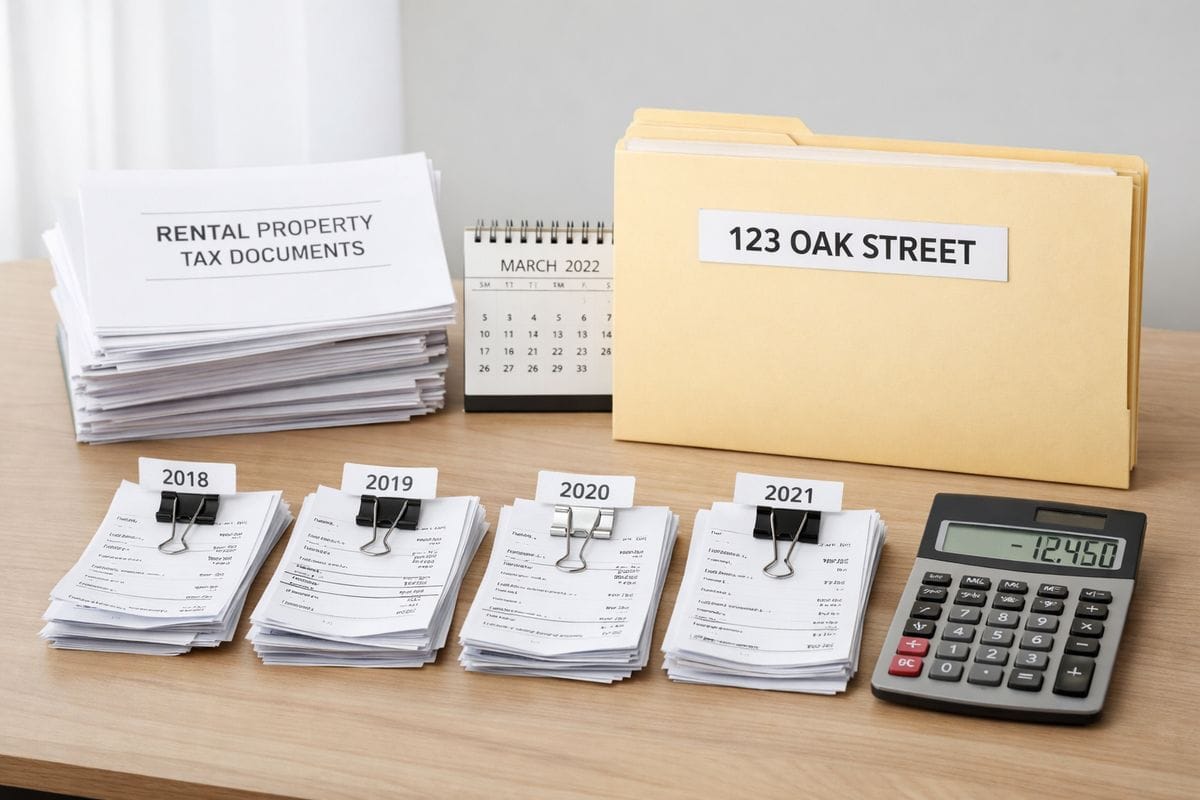
Prerequisites: What to gather before applying the material participation tests
Before running any test, gather the file that supports the analysis. Tax outcomes rise or fall on documentation, not intention. A clean file also shortens time-to-value because the conclusion becomes obvious faster.
Collect your property-by-property operating records
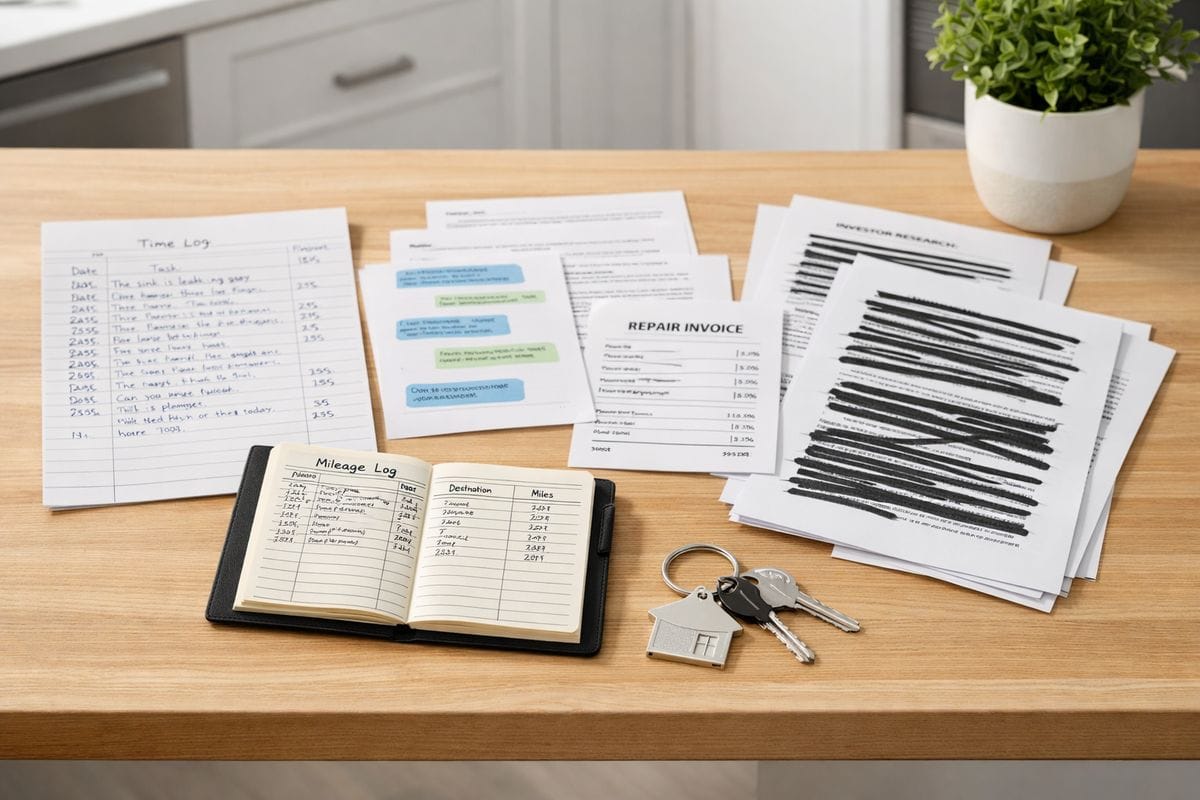
Pull leases, booking platform data, rent rolls, advertising records, management agreements, repair invoices, vendor bills, inspection notes, text threads with tenants or guests, calendars, and bookkeeping ledgers. If a property manager exists, collect monthly statements and the management contract.
These records do two jobs. First, they help classify the property as a long-term rental, short-term rental, or part of a grouped real estate activity. Second, they support hour counting by tying your work to actual operations.
Pull prior-year tax returns and passive loss carryforward schedules
Gather Schedule E, Form 8582, K-1s from partnerships or LLCs, depreciation schedules, and any workpapers showing suspended passive losses. That history shows how much tax value is at stake right now.
This step matters because many investors spend time proving nonpassive treatment when current-year passive income already absorbs the losses. In that file, the better planning question is not qualification. It is timing.
Assemble a contemporaneous time log or recreate one from source documents
A defensible log shows date, property, task, hours, and business purpose. “Rental work, 6 hours” fails. “3/14, Oak Street duplex, met plumber, inspected leak repair, updated tenant, posted bill to books, 2.1 hours” works.
If no log exists, reconstruct one from emails, invoices, phone records, platform messages, mileage logs, bank records, and calendar entries. Courts accept reasonable reconstruction, but scrutiny rises sharply when the file looks like a year-end estimate. The strongest recommendation is to treat contemporaneous time logs as part of operations, not tax cleanup.
Confirm filing status, occupation, and spouse participation
Confirm filing status, your occupation, your spouse’s occupation, and total annual work hours outside real estate. This is where many W-2 earners lose before reaching the material participation tests.
For joint filers, spouse hours count for material participation in the activity, but one spouse must separately satisfy the real estate professional tests. That distinction drives the outcome, especially when one spouse works full-time outside real estate and the other runs the rentals.
Step 1: Classify the rental activity before testing participation
Classification comes first because the same hours produce different tax results depending on the activity type. This is the strategic gate.
- Identify the average customer use period for each property.
- Separate long-term rentals from short-term rentals.
- Confirm whether any grouping election changes the activity being tested.
Checkpoint: At the end of this step, each property should be labeled as long-term rental, short-term rental, or grouped rental real estate activity.
Determine whether the property is long-term rental real estate or a short-term rental
Average stay controls the first cut. If average customer use is 7 days or less, the activity is generally not treated as a rental activity for passive loss purposes. If average stay is over 7 days, the analysis changes. Certain stays of 30 days or less with substantial services also move the activity out of rental status.
Why this matters is straightforward. A long-term rental faces the per se passive rental barrier. A short-term rental often does not. That means a short-term rental can become nonpassive through material participation alone, while a long-term rental usually needs real estate professional status first.
Separate rental classification from trade-or-business questions
Do not mix passive activity classification with Schedule C or trade-or-business analysis. A property can be a trade or business for one purpose and still be passive for Section 469. It can also be reported on Schedule E and still qualify as nonpassive under the right facts.
The point is discipline. Use the passive activity rules to answer passive versus nonpassive. Use separate analysis for QBI and NIIT.
Identify whether the activity stands alone or is part of a grouped real estate activity
Each rental interest is generally a separate activity unless a valid election treats all rental real estate interests as one activity. That election changes hour counting, documentation, and future consistency.
If each property stands alone, 140 hours at three separate rentals does not equal 420 hours for any single property. If a valid aggregation election applies, those hours can be combined across the grouped activity. That difference often decides the year.

Step 2: Decide whether the passive activity rules actually limit your losses
Not every investor needs a material participation fight. Sometimes the tax result is already acceptable.
- Review current-year passive income.
- Review suspended losses.
- Quantify the tax value of changing classification.
Checkpoint: At the end of this step, the dollar value of a successful nonpassive position should be clear.
Review whether the rental already generates passive income
If passive income from other activities already absorbs your rental losses, current-year deductibility may already exist. In that file, material participation matters less this year, though it can still matter for NIIT or future planning.
The recommendation is to quantify before optimizing. A technical win with no current-year tax value is not a priority.
Check for suspended losses from prior years
Suspended losses carry forward until passive income appears or a taxable disposition frees them. If your file shows years of trapped losses, nonpassive treatment can improve time-to-value by allowing current deductions going forward, though prior suspended passive losses keep their own rules until released or absorbed.
This is where the tax payoff becomes real. A portfolio with large carryforwards often justifies the work of better documentation and elections.
Measure the tax impact of remaining passive versus becoming nonpassive
Run the simple comparison. If losses stay passive, wages and active business income remain untouched and losses sit on Form 8582. If losses become nonpassive, they can offset ordinary income, improving current cash flow. For short-term rentals, nonpassive treatment can also change the NIIT analysis and improve after-tax ROI.
Step 3: Rule out the common trap, active participation is not material participation
This is the most common source of confusion. Active participation is easier to meet, but it is not a substitute for material participation.
- Test for the $25,000 special allowance.
- Apply the MAGI phaseout.
- Decide whether that solves the current-year problem.
Checkpoint: If active participation already gives the needed deduction, no further change is needed for that specific loss amount. If income is too high, move on.
Apply the $25,000 active participation allowance
Active participation means meaningful management involvement, such as approving tenants, approving repairs, or setting rental terms. It is a lower standard than material participation and supports a special allowance of up to $25,000 for rental real estate losses against nonpassive income.
This rule helps owners who personally manage long-term rentals but do not qualify as real estate professionals. It is especially useful for moderate-income households with one or two rentals.
Calculate the MAGI phaseout from $100,000 to $150,000
The allowance phases out by 50 cents for each dollar of modified adjusted gross income above $100,000 and disappears at $150,000. A W-2 household at $140,000 MAGI keeps only $5,000 of the allowance. A household above $150,000 gets zero.
That is why active participation is not the answer for many high-earning investors. The field data shows this is where confusion turns into bad filing positions.
Know when active participation solves the problem and when it does not
If your long-term rental losses are under the allowance and MAGI is low enough, active participation may deliver the current-year deduction you need. If MAGI is too high, or losses are much larger, active participation is not enough. For long-term rentals, the path to nonpassive treatment is real estate professional status plus material participation.
Step 4: Test for Real Estate Professional Status before applying material participation to long-term rentals
For long-term rentals, this is the gatekeeper. Without real estate professional status, long-term rental real estate remains passive regardless of hours spent.
- Apply the more-than-50 percent personal services test.
- Apply the 750-hour test.
- Evaluate spouse treatment.
- Confirm any employee-hour limitations.
Checkpoint: If real estate professional status fails, stop the nonpassive analysis for long-term rentals. Material participation alone will not convert the losses.
Apply the more-than-50% personal services test
You must perform more than half of all personal services in real property trades or businesses in which you materially participate. If a W-2 job consumes 2,000 hours and real estate activity totals 900 hours, this test fails even though 900 hours is substantial.
For many full-time employees, this test is the real blocker, not the 750-hour threshold.
Apply the 750-hour annual test
You also need more than 750 hours during the year in real property trades or businesses in which you materially participate. Estimates do not carry this test. Documented hours do.
Publication 925 states the rule directly: more than 750 hours and more than half of personal services must both be met for the year.
Include spouse hours where the rules permit joint treatment
For a joint return, spouse participation counts toward material participation in the rental activity. But spouse hours do not rescue the real estate professional tests unless the qualifying spouse independently meets them. That distinction matters. Joint treatment helps with material participation. It does not let one spouse borrow the other spouse’s 750-hour or more-than-half qualification.
Confirm that employee hours count only when ownership requirements are met
Hours worked as an employee in a real property trade or business count only if ownership requirements are met, generally a 5 percent ownership threshold. This technical limit gets missed constantly. If employee hours are being counted without qualifying ownership, the real estate professional analysis is wrong from the start.
Step 5: Define what participation hours count and what the IRS excludes
Most failed positions are not threshold failures. They are counting failures. The data shows that hour inflation through investor activity is the fastest way to lose credibility.
- Count operational work.
- Remove investor activity.
- Review borderline time categories.
- Exclude other people’s hours.
Checkpoint: At the end of this step, your hour total should shrink to what you can defend.
Count hands-on operational tasks that directly run the property
Count tenant or guest communication, advertising vacancies, showing units, screening applicants, preparing leases, scheduling repairs, inspecting work, collecting rent, bookkeeping tied to the property, vendor calls, ordering supplies, handling emergencies, coordinating turns, and making day-to-day management decisions.
Those hours directly run the asset. That is what the IRS framework recognizes as participation.
Exclude investor-type and ownership-overview activities
Do not count reviewing financial statements as an owner, studying market trends, researching neighborhoods, analyzing acquisitions, reading Zillow listings, or reviewing portfolio ROI. Those tasks belong to ownership oversight, not active operations.
The regulation-based rule is blunt: investor-type work generally does not count unless it ties directly to day-to-day management.
Handle travel time, education, and administrative work correctly
Travel counts when it is directly connected to operational work, such as driving to inspect a turnover, meet a plumber, or resolve a tenant issue. Travel to scout future acquisitions does not count. Education and conferences usually do not count. General admin only counts when tied to the specific activity, not your overall investing life.
Account for work performed by property managers, contractors, and family members
Outsourced work does not automatically ruin the position, but your contractor’s 40 hours are not your 40 hours. A property manager’s substantial involvement makes Tests 2 and 3 harder because those tests compare your work with others’ work.
Family-member help only counts if the rules allow attribution for your spouse. Other relatives’ hours do not become your participation.
Step 6: Apply the seven material participation tests to the activity
The IRS provides seven tests, and passing one is enough. For rental real estate, only a few tests have real practical value. Tests 1, 4, and 5 are the strongest in actual files. Tests 2, 3, and 7 exist, but usually require cleaner facts than most investors have. Test 6 is generally irrelevant for rentals.
Before applying them, remember the controlling rule: for long-term rental real estate, these tests matter only after real estate professional status is already established.
- Identify the activity being tested.
- Compare your documented hours and facts to each test.
- Stop once one test is passed and the proof is solid.
Checkpoint: If one test is met with credible records, the activity is materially participated in for that year.
Test 1: More than 500 hours during the year
This is the strongest and most defensible test. If you spend more than 500 hours on the activity during the year, you pass.
Real estate example: a self-managed short-term rental owner spends 11 hours per week across guest messaging, cleaner coordination, pricing updates, turnover inspections, supply runs, bookkeeping, and maintenance calls, totaling 572 hours. That owner passes Test 1.
For a long-term rental owner with real estate professional status, 520 documented hours managing a grouped set of rentals also passes Test 1.
Records that prove this test: daily or weekly time logs, emails, platform messages, invoices, calendar events, maintenance tickets, and banking entries tied to the tasks. This is realistic and often the best route.
Test 2: Substantially all participation in the activity
You pass if your participation constitutes substantially all participation in the activity by all individuals, including nonowners. This is hard to defend once paid help enters the picture.
Real estate example: a duplex owner handles all leasing, rent collection, bookkeeping, repairs, showings, inspections, and turnover work personally, with only a plumber and electrician called for isolated jobs. That fact pattern can fit Test 2.
Records that prove this test: your log plus vendor invoices showing limited outside work. This is realistic for very small self-managed properties, but theoretical once a manager, cleaner team, or frequent contractor use is involved.
Test 3: More than 100 hours and no one else participates more
You pass if you participate more than 100 hours and no other individual participates more than you.
Real estate example: a four-unit owner logs 160 hours for leasing, collections, maintenance coordination, and inspections. The handyman logs 90 hours, the cleaner logs 40, and no co-owner or manager exceeds 160. Test 3 is met.
Records that prove this test: your log, contractor invoices, management statements, and co-owner records if relevant. This can work, but it becomes fragile because it depends on proving someone else did not do more.
Test 4: Significant participation activities totaling more than 500 hours
This is one of the most practical but overlooked tests. A significant participation activity is one in which participation exceeds 100 hours, but you do not otherwise materially participate in that activity. If total time across all significant participation activities exceeds 500 hours, you pass.
Real estate example: you own three smaller short-term rentals. You spend 140 hours on Property A, 170 on Property B, and 220 on Property C. None reaches 500 alone. Each exceeds 100 hours. Total significant participation time is 530 hours. Test 4 is met.
For a real estate professional with multiple long-term rentals tested separately, this same structure can also work.
Records that prove this test: property-specific logs showing more than 100 hours per activity, plus a year-end summary totaling all significant participation activities. This is highly realistic for multi-property investors and deserves more attention than it gets.
Test 5: Material participation in any 5 of the prior 10 years
This is the sleeper test and one of the strongest planning tools in the entire framework. If you materially participated in the activity for any 5 of the previous 10 tax years, you pass this year even without current-year hours.
Real estate example: you actively managed a portfolio of rentals for 8 consecutive years and materially participated each year. Then you retired and hired a property manager in year 9. For the next 5 years, you still pass Test 5 for that same activity because 5 of the prior 10 years show material participation. No current-year hour log is needed to satisfy this specific test, though proof of the prior years is still mandatory.
This scenario gets overlooked constantly, yet it is one of the cleanest historical routes to qualification.
Records that prove this test: prior-year returns, prior grouping elections, old time logs, calendars, vendor records, emails, and any prior workpapers showing which material participation test was met in those years. This is highly realistic for long-time owners and retired investors.
Test 6: Material participation in a personal service activity for any 3 prior years
This test applies to personal service activities such as health, law, engineering, architecture, accounting, actuarial science, performing arts, or consulting. Rental property ownership is not a personal service activity.
Real estate example: none for ordinary rental ownership, because the test usually does not apply.
Records that prove this test: not relevant for standard rental real estate. This test is theoretical in the rental context and should not drive planning.
Test 7: Facts and circumstances showing regular, continuous, and substantial participation
This is the weakest test because it is subjective and carries extra restrictions. Participation of 100 hours or less fails automatically. Management time does not count if another person is paid to manage the activity or another person spends more hours managing it.
Real estate example: you spend 180 hours over the year handling regular tenant issues, approving vendors, inspecting repairs, and making continuous operational decisions for a small building without a property manager. Facts may support regular, continuous, and substantial participation.
Records that prove this test: detailed logs, calendars, communications, invoices, and proof that no paid manager displaced your management role. This is mostly theoretical as a primary strategy because cleaner hour-based tests are stronger. Use it only when the facts are unusually favorable.
Step 7: Apply special rules for short-term rentals
Short-term rentals often provide the fastest tax ROI because the per se passive rental barrier frequently does not apply. That makes material participation the main gate.
- Confirm average stay and services.
- Apply the seven tests directly.
- Review NIIT separately.
Checkpoint: If the activity is not treated as a rental activity and you materially participate, losses can be nonpassive without real estate professional status.
Use the average stay rules to determine whether the activity is still treated as a rental
If average customer use is 7 days or less, the activity usually falls outside rental activity status. If average use is 30 days or less and substantial personal services are provided, the same can happen.
Classification drives everything. A short-term rental owner who skips this step often misses the strongest nonpassive position available.
Run the material participation tests without the per se passive rental barrier
Once the activity is outside rental status, apply the seven tests directly. A host with 540 documented hours passes Test 1. An owner with three short-term rentals at 120, 170, and 230 hours can pass under Test 4. An owner who materially participated in the same operation for 5 of the prior 10 years can pass under Test 5.
That is the practical difference from long-term rentals. No real estate professional status is required to clear the passive loss barrier for a properly classified short-term rental.
Evaluate NIIT consequences for short-term rental income
Nonpassive treatment often improves the NIIT analysis because the 3.8 percent tax focuses on net investment income, not just passive loss classification. Still, do not collapse the two rules into one. Material participation helps, but NIIT needs its own review of whether income arises from a nonpassive trade or business.
Step 8: Decide whether to group properties or make a real estate election
Grouping is a strategic choice, not a paperwork footnote. It can strengthen current-year qualification and weaken future flexibility at the same time.
- Identify the activities now being tested separately.
- Model the result with and without grouping.
- Make the election only if the long-term benefit is clear.
Checkpoint: The file should show why grouping improves or hurts the tax position before the return is filed.
Understand the difference between grouping activities and the real estate professional aggregation election
General activity grouping under Section 469 and the specific election to treat all rental real estate interests as one activity are related, but not identical. The rental real estate aggregation election matters especially for real estate professionals because it avoids proving material participation separately for each property.
Identify when grouping strengthens your material participation position
Grouping helps when you own multiple smaller rentals, use centralized management, work across the portfolio, and no single property reaches a threshold alone. It is especially powerful for Test 1 and Test 4 analysis.
A scattered hour pattern often becomes defensible once the correct unit of activity is defined.
Identify when grouping weakens your tax position
Grouping can weaken your position when one property has weak facts, when you want flexibility on future dispositions, or when combining activities dilutes a clean stand-alone result. Selling one grouped property does not always produce the release effect investors expect because the entire grouped activity remains in place.
Document the election and preserve consistency year over year
The election belongs in the return with the required statement, and consistency matters afterward. An inconsistent grouping story is an audit problem waiting to happen. Keep the election, workpapers, and property list in the permanent file.
Step 9: Separate material participation from QBI and NIIT rules
One tax rule does not prove another. This is where technical sloppiness creates bad planning.
- Test QBI separately.
- Test NIIT separately.
- Keep reporting mechanics separate from legal conclusions.
Checkpoint: By the end of this step, you should have three separate answers, one for passive loss treatment, one for QBI, and one for NIIT.
Compare the 250-hour QBI rental safe harbor with the material participation tests
The QBI rental safe harbor often uses a 250-hour rental services standard. That does not establish material participation. A rental may satisfy the QBI safe harbor and still be passive. A rental may also fail the safe harbor and still be nonpassive under material participation rules.
Different code sections. Different tests. Different result.
Distinguish nonpassive treatment from NIIT trade-or-business treatment
Passing a material participation test strengthens the argument that income is not investment income for NIIT purposes, but it does not end the inquiry. NIIT analysis asks a different question and can produce a different result.
Keep Schedule E reporting questions separate from participation questions
Schedule E is a reporting form, not a legal conclusion. Do not assume Schedule E means passive, or that Schedule C means nonpassive. The substantive rules determine the answer.
Step 10: Build an audit-ready documentation system
An audit-ready file wins on speed and credibility. A weak file turns even good facts into a bad result.
- Keep a recurring log.
- Tie each entry to third-party evidence.
- Preserve old records.
- Summarize the year by test.
Checkpoint: If an IRS examiner asked for proof tomorrow, the file should already exist.
Create a daily or weekly time log tied to specific properties
Use a spreadsheet, app, or calendar-based log. Every entry should include date, property, task, hours, and purpose. “Calls with tenants, 0.8”; “turnover inspection, 1.2”; “bookkeeping for Elm Street, 0.6.” Precision matters.
Match time entries to third-party evidence
Support each category with emails, text messages, invoices, receipts, work orders, bank activity, lease drafts, and calendar invites. Independent evidence makes the log credible.
Preserve old records for the 5-of-10-year test and suspended loss support
Keep prior-year logs, returns, election statements, and activity summaries well beyond the normal instinct to purge records. Test 5 depends on historical proof. Suspended losses also depend on old schedules.
Prepare a year-end summary by test
At year-end, organize the file around the seven tests. State which test was met, total the hours, identify excluded investor time removed from the calculation, and attach supporting exhibits. That turns a pile of records into an audit defense memo.

Step 11: Calculate the result on your tax return
Once the legal conclusion is finished, the return has to reflect it cleanly.
- Determine passive or nonpassive status.
- Apply Form 8582 if needed.
- align Schedule E and statements with the conclusion.
Checkpoint: The return should tell the same story as the file.
Determine whether the activity is passive or nonpassive for the year
For a long-term rental, ask four questions in order: Is it rental real estate, is real estate professional status met, is there a grouping election, and is one material participation test met. For a short-term rental, classification and material participation usually answer the issue directly.
Apply Form 8582 and update suspended losses
If the activity remains passive, Form 8582 limits the deduction and updates the carryforward. If the activity is nonpassive, current-year losses are generally deductible against ordinary income, subject to other limits not covered here. Keep passive carryforward schedules current because old errors compound quickly.
Reflect the outcome on Schedule E and related forms
Report the activity consistently, include any election statements, and keep workpapers showing how the passive or nonpassive result was reached. The filing package should match the substantive analysis line for line.
Step 12: Adjust your strategy for 2026-2027 tax law changes
Tax rates and deduction values may shift as TCJA provisions sunset, but Section 469 remains the core gatekeeper. That makes material participation and rental classification durable control points.
- Identify what stays the same.
- Identify what changes the value of deductions.
- Act before the 2026 and 2027 filing seasons arrive.
Checkpoint: The file should end with a calendar-based plan, not just a conclusion for one year.
Identify which passive activity rules stay the same
The passive activity architecture, real estate professional framework, and material participation tests remain the key filters for rental losses. The rules that decide passive versus nonpassive treatment are not sunset-driven planning items.
Review which tax benefits around the rental may change after TCJA sunset
What changes is often the value of deductions, not the passive loss framework itself. Ordinary rates, qualified business income treatment, and depreciation-related planning can shift the ROI of pushing harder for a nonpassive result. That is why the same participation analysis can become more valuable in a higher-rate environment.
Prioritize actions before filing seasons in 2026 and 2027
Upgrade time tracking now. Review grouping elections before filing, not after. Model whether one spouse should shift work hours toward real estate. Reevaluate short-term rental classification if average stay patterns changed. The recommendation is to treat 2026 and 2027 as execution years, not learning years.
Troubleshooting: Common issues that cause rental owners to fail the tests
Most failures are predictable and fixable before filing.
Issue: Plenty of involvement, but the property is still passive
This is the long-term rental trap. You may be deeply involved and still passive because real estate professional status was not met. The fix is not a better material participation argument. The fix is either qualifying for real estate professional status, relying on active participation if income allows, or accepting passive treatment.
Issue: The hour total includes nonqualifying investor activity
Remove acquisition research, portfolio review, market study, and high-level ownership planning. Rebuild the log around operational tasks only. The total often drops sharply, but the remaining hours become defendable.
Issue: A property manager handled too much of the work
This usually weakens Tests 2 and 3. Shift the analysis to Test 1, Test 4, or Test 5 if the facts support it. Outsourcing does not end the inquiry, but it changes which test is worth pursuing.
Issue: Multiple properties each fall short on their own
Review grouping and Test 4. A scattered portfolio often fails property by property and passes once the activities are properly combined or treated as significant participation activities.
Issue: No contemporaneous log exists
Reconstruct from source records immediately. Use emails, texts, invoices, calendar entries, mileage records, and booking platform history. Expect a weaker audit posture than a true contemporaneous file, and avoid inflated estimates.
Issue: Spouse participation was ignored
For material participation, spouse hours count. That often changes the result. For real estate professional status, one spouse still must independently clear the 750-hour and more-than-half tests. Keep separate spouse work records anyway. That makes the analysis cleaner.
Expected outcome: What a completed analysis should produce
A completed analysis is not a general feeling that you were involved enough. It is a written conclusion that supports a filing position.
A property-by-property classification and participation memo
The memo should state whether each property is long-term or short-term, whether any grouping election applies, whether real estate professional status was met if relevant, and which material participation test was passed or failed.
A usable deduction plan for current and suspended losses
The file should state whether current-year losses are deductible, partially deductible under the active participation allowance, suspended under Form 8582, or released later through passive income or disposition. That turns the analysis into a cash-flow and ROI decision.
A next-step recommendation for filing, documentation, and portfolio structure
The recommendation is to leave this process with a clear action plan: maintain current treatment, improve logs, make or avoid a grouping election, shift operating involvement, or pursue real estate professional status intentionally. A tax position without an operating plan does not hold up.
Frequently Asked Questions
Do material participation tests matter for every long-term rental owner?
No. For long-term rental real estate, material participation only matters after real estate professional status is established. Without that status, the rental remains passive regardless of your hours, except for the separate active participation allowance.
Which material participation tests are most realistic for rental property?
Tests 1, 4, and 5 are the practical ones. Test 1 works when you have more than 500 documented hours. Test 4 works for multiple smaller activities above 100 hours each that total more than 500. Test 5 is powerful for long-time owners because five prior qualifying years can carry the result into the current year.
Can a retired rental owner still materially participate after hiring a property manager?
Yes, through Test 5 if the same activity was materially participated in for any 5 of the prior 10 years. An owner who actively managed rentals for 8 years and then hired a property manager after retirement can still pass for the next 5 years based on history, assuming the activity remains the same and the prior years are documented.
Does spouse participation help qualify?
Yes, spouse hours count for material participation in the activity. But spouse hours do not let you combine efforts to satisfy the 750-hour and more-than-half real estate professional tests unless one spouse independently qualifies.
Does 250 hours for the QBI rental safe harbor prove material participation?
No. QBI and material participation are separate analyses under different rules. A rental can satisfy the QBI safe harbor and still be passive, or fail the safe harbor and still be nonpassive.
What is the strongest documentation for a material participation claim?
A contemporaneous log backed by third-party records is the strongest proof. The best file includes dates, property names, tasks, hours, and matching emails, invoices, texts, calendar entries, and bank records. Year-end estimates without support are weak.