
Multifamily real estate tax benefits change the math of a deal long before rent growth or cap rate compression shows up. If you are moving from single-family rentals into apartment buildings, the tax code stops being a background detail and starts driving cash flow, refinance capacity, and after-tax ROI.
At the core, multifamily is still residential rental property for depreciation purposes, which means the building generally depreciates over 27.5 years under MACRS. But larger properties create far more room to accelerate deductions, stack operational write-offs, improve interest deductibility, and defer taxes on exit. That is where the real advantage sits.
Early in this guide, here is what matters most:
- Straight-line depreciation on a 27.5-year schedule
- Cost segregation and 100% bonus depreciation
- Passive loss rules and real estate professional status
- Interest deductions under Section 163(j)
- The 20% QBI deduction
- 1031 exchanges and exit deferral
- Energy incentives like 45L and 179D
- State and local tax drag
- A 90-day implementation plan
Why Multifamily Tax Strategy Changes Your Return Profile
Tax strategy in multifamily is not a cleanup exercise for April. It is part of underwriting. Based on analysis of actual multifamily tax outcomes, the five value drivers are consistent: depreciation, acceleration, income offsets, financing deductions, and exit deferral.
The first driver is standard depreciation. Every multifamily owner gets it. The second is acceleration through cost segregation and bonus depreciation, which pulls future deductions into year one. The third is usability, meaning whether paper losses actually offset current income under the passive loss rules. The fourth is debt, because interest deductions and loan cost treatment directly affect leveraged returns. The fifth is exit planning, where 1031 exchanges and basis management determine how much equity survives the sale.
Multifamily also scales tax planning in a way single-family rentals rarely do. One apartment building creates one cost seg study, one fixed asset schedule, one management system, and one operating platform. That makes advanced planning cheaper, easier to document, and more defensible.
Three advantages stand out.
First, cost segregation economies of scale. A 20-unit building with a study costing $400 per unit comes in around $8,000 total. By contrast, 20 single-family homes at $5,000 per study cost $100,000. Same concept, wildly different execution cost. The recommendation is obvious: multifamily makes accelerated depreciation cheaper per dollar of basis.
Second, real estate professional status becomes more credible. Logging 750 hours against a 20-unit building, including leasing, turns, vendor oversight, inspections, capital planning, and bookkeeping, reads like an operating business. Claiming the same 750 hours across a handful of scattered houses draws much harder scrutiny.
Third, Section 179D creates upside that small residential rentals usually never reach. Multifamily buildings that are four stories or more can qualify for this energy-efficient building deduction, which can reach up to $5.80 per square foot. On a 100,000-square-foot property, that is up to $580,000 of deduction from one qualifying project.
The Core Rules That Govern Multifamily Real Estate Tax Benefits
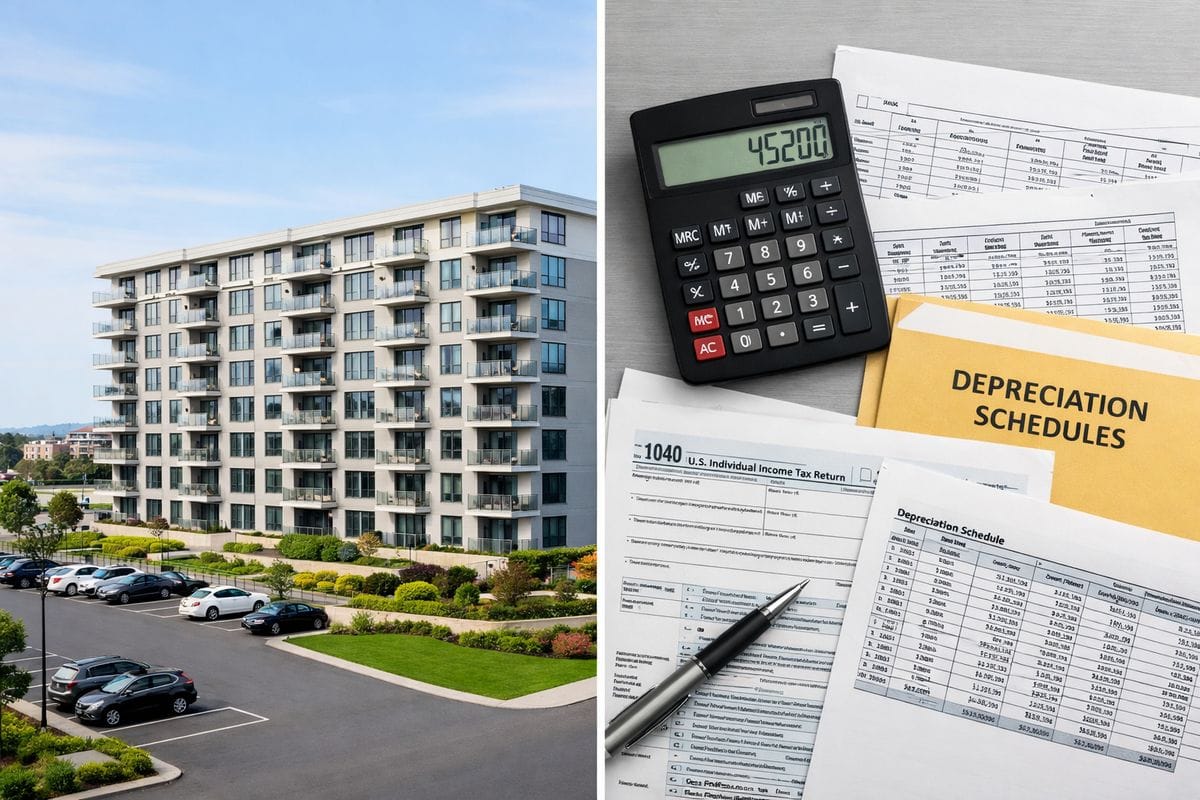
Before tactics, the baseline rules need to be clean. Rental income is taxable. Ordinary and necessary operating expenses reduce it. Capital improvements are not immediately deducted, they are capitalized and recovered over time. Your starting basis generally begins with purchase price, plus certain acquisition-related capitalized costs, then gets allocated between land and depreciable improvements.
Placed-in-service date controls timing. A property starts depreciating when it is ready and available for rent, not when you wire earnest money, not when the renovation budget is approved, and not when the first full month of collections hits. If the building is not actually placed in service during the tax year, the deduction slips.
MACRS is the default depreciation system. For multifamily residential rental property, that usually means 27.5 years. For nonresidential commercial property such as office or retail, the building life is generally 39 years. That single difference is why apartment investors often get more favorable annual depreciation than investors buying other commercial asset types.
Larger assets also create more planning room because basis is larger, components are more numerous, and common-area improvements are material. A duplex has some tax planning. A 100-unit apartment community has tax planning that can change the entire year-one return profile.
How Multifamily Is Taxed Compared With Single-Family Rentals and Other Commercial Property
From a federal depreciation standpoint, multifamily and single-family rentals are siblings. Both generally use the 27.5-year residential rental schedule when the property is used as rental housing. That gives apartment buildings a major edge over many office, retail, industrial, and NNN properties, which often depreciate over 39 years.
That distinction matters in direct underwriting. If two assets each have $10 million of building basis, a multifamily asset generates about $363,636 of annual straight-line depreciation. A 39-year commercial building generates about $256,410. Same dollars invested in building basis, very different annual shelter.
The practical difference goes further than the building life. Multifamily usually includes amenity areas, parking, sidewalks, landscaping, signage, pool areas, site lighting, and unit-level personal property that create larger cost seg opportunities. NNN properties often have simpler operating structures, fewer reclassifiable components, and lower management intensity, which can reduce both accelerated depreciation upside and the credibility of material participation.
Single-family rentals do offer the same residential depreciation schedule, but they lose on scale. Property management fees are often higher as a percentage of gross rent, insurance costs are less efficient per unit, and repairs are duplicated across multiple roofs, lawns, driveways, and utility setups. Multifamily concentrates those costs and turns them into cleaner operating deductions.
The Three Numbers That Drive Every Tax Calculation
Every multifamily tax model turns on three numbers: total purchase price, land value, and depreciable basis.
Purchase price sets the ceiling. Land value reduces the amount you can depreciate because land does not wear out for tax purposes. Depreciable basis is what remains for the building and any separately identified shorter-life assets. Get those numbers wrong and every downstream calculation breaks, including annual depreciation, cost segregation projections, gain on sale, and depreciation recapture.
Use a simple example. You buy an apartment property for $12 million. If $2.4 million is allocated to land, the remaining $9.6 million is the starting depreciable basis before any component reclassification. Annual straight-line depreciation on that building basis is about $349,091. If a cost seg study reclassifies 25 percent of that basis into shorter-life property, the year-one deduction changes dramatically.
This is why purchase price allocation is not a clerical step. It is a tax planning decision with seven-figure consequences on large assets.
Straight-Line Depreciation: The First Tax Benefit Every Multifamily Investor Uses
Straight-line depreciation is the base layer of multifamily real estate tax benefits. It is automatic, predictable, and available on every properly placed-in-service property.
In plain English, you deduct the building value over 27.5 years because the tax code treats residential rental buildings as assets that lose value over time. The deduction is non-cash. No check gets written when depreciation is claimed. That means taxable income falls without reducing current cash receipts, which is exactly why depreciation is such a powerful return driver.
This is also the easiest benefit to underwrite. If rent projections change, interest rates move, or insurance resets higher, straight-line depreciation still runs on schedule. It is the floor, not the ceiling.
Operational deductions layer on top of it. Multifamily owners also deduct common area maintenance, cleaning, landscaping, security contracts, onsite payroll, repairs, utilities for shared spaces, management fees, insurance premiums, advertising, software, and professional fees. The management fee point matters: multifamily management often runs at a lower percentage of gross rent than scattered single-family portfolios because one onsite team can support many units. Insurance also tends to be more efficient per unit because one master policy spreads fixed cost across the building. Those are not exotic tax strategies, but they improve taxable income every year.
A Simple Multifamily Depreciation Example With Real Numbers
Use the large-asset example that shows the effect clearly. On a $50 million apartment property, if 80 percent is allocated to the building, the depreciable basis is $40 million. Divide that by 27.5 and the annual straight-line depreciation deduction is about $1.45 million.
That means if the property produces $2.2 million of taxable income before depreciation, depreciation alone cuts it to roughly $750,000. If your combined federal and state marginal tax rate is 35 percent, that one deduction preserves about $507,500 of current-year cash that would otherwise go to taxes.
That is the business case. The tax code recognizes wear and tear on the building. You convert that accounting treatment into real liquidity, which improves debt coverage, reserve strength, and reinvestment capacity.
What Does Not Depreciate on the 27.5-Year Schedule
Land does not depreciate. That part is simple.
Financing costs also do not go on the 27.5-year building schedule. Loan fees, lender legal costs, and similar debt issuance costs are generally amortized over the life of the loan. If you refinance or retire the loan early, remaining unamortized costs often become deductible at that point.
Repairs are another common error area. Routine repairs are generally deducted when incurred. Capital improvements are depreciated. A unit repaint between tenants is usually a repair. A full building-wide replumb, roof replacement, or major HVAC upgrade is generally a capital improvement. Misclassify those and you either lose current deductions or create audit risk.
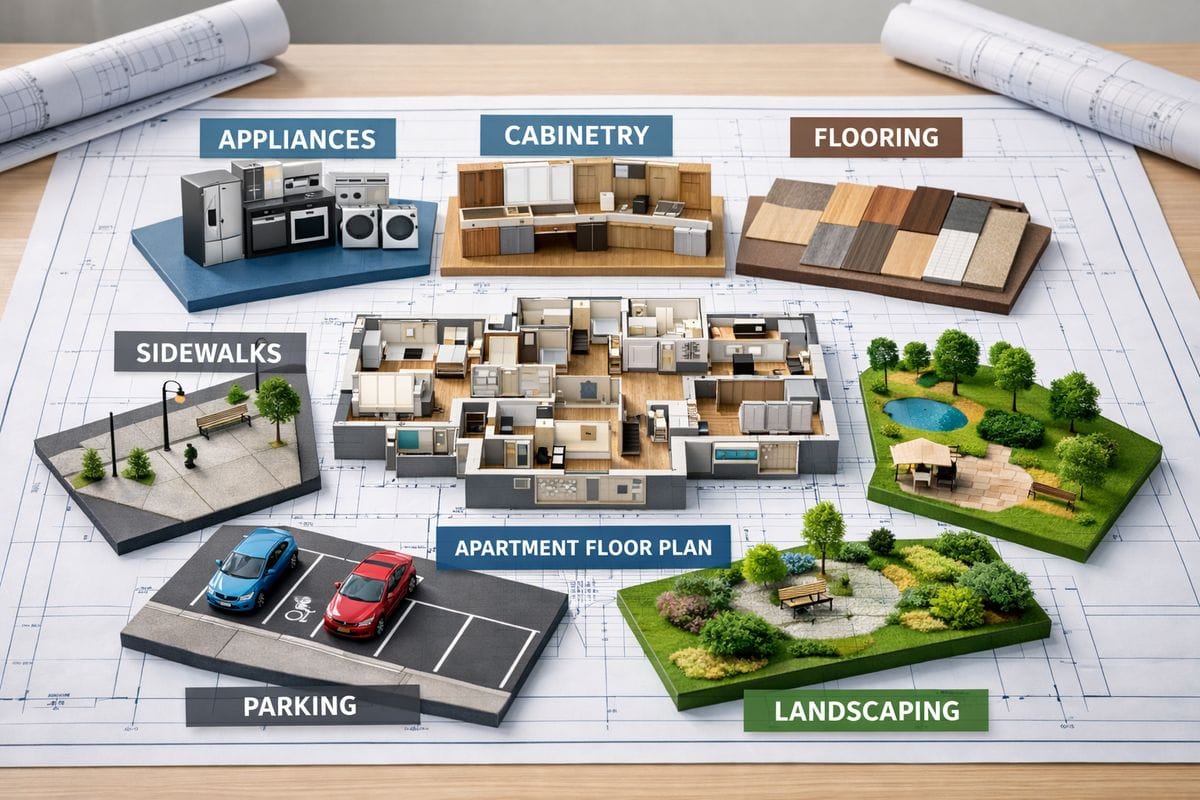
Personal property and land improvements also do not belong on the 27.5-year schedule if properly identified. Appliances, flooring, cabinetry, parking lots, sidewalks, fences, and landscaping can fall into shorter lives. That is exactly why cost segregation matters.
Cost Segregation: The Fastest Way to Pull Tax Deductions Forward
Cost segregation is the fastest way to turn a normal multifamily depreciation schedule into a front-loaded deduction strategy. An engineering-based study identifies building components that belong in 5-year, 7-year, or 15-year classes instead of 27.5-year residential real property.
The field data shows that cost seg commonly reclassifies 20 percent to 35 percent of basis into accelerated categories. On large multifamily assets, that can move millions of dollars of deductions into the first several years of ownership.
This is where multifamily outperforms single-family rentals at scale. One study on a 20-unit building at $400 per unit costs about $8,000. Running separate studies across 20 single-family homes at $5,000 each costs about $100,000. The tax concept is identical, but the multifamily platform captures the benefit at a fraction of the implementation cost.
For most acquisitions above $500,000, the recommendation is to evaluate cost seg immediately. For seven- and eight-figure multifamily deals, it belongs in underwriting before closing.
What a Cost Seg Study Actually Reclassifies
A proper study gets specific. In multifamily, short-life categories often include appliances, cabinetry, specialty flooring, decorative lighting, window treatments, certain countertops, removable casework, and selected unit-level fixtures. Exterior and site items often include parking lots, sidewalks, curbs, drainage systems, irrigation, fencing, retaining walls, signage, and landscaping.
Amenity-heavy assets create even more opportunity. Clubhouse furniture, fitness equipment infrastructure, pool-related features, playground improvements, dog park elements, package room systems, and selected electrical components tied to specialized uses often support shorter lives. Cost segregation studies work because those items are not the structural building shell.
That distinction matters. The roof, structural walls, and core building systems usually stay in long-life real property. The movable, specialized, or site-related components often do not.
When Cost Segregation Produces the Highest ROI
Acquisition year is the priority. The sooner the study is done, the sooner deductions hit the return and the sooner cash stays in the deal. Time matters because a dollar of deduction in year one is worth more than the same deduction spread across 27.5 years.
Larger-value properties usually produce stronger ROI because the fixed cost of the study is small relative to the basis being analyzed. Renovation-heavy deals also perform well because upgrades often create more personal property and land improvement categories.
Bonus depreciation timing amplifies the result. If a property is placed in service during a bonus-eligible period, short-life assets become immediate deductions instead of merely faster deductions over five, seven, or fifteen years. That is where cost seg stops being a technical optimization and becomes a material cash-flow event.
Retroactive Cost Segregation and Form 3115
If cost seg was skipped in year one, the benefit is not gone. Retroactive studies often recover missed depreciation through a current-year catch-up adjustment using Form 3115, rather than amending prior returns.
That matters for existing operators with older acquisitions. A building bought three years ago without a study can still produce a large current-year deduction if the reclassification is done properly and supported by engineering documentation. The same principle often applies to missed repair deductions under tangible property rules.
The recommendation is simple: if an owned multifamily asset never had a cost seg analysis, run the numbers now.
100% Bonus Depreciation: How to Convert Cost Seg Into Immediate Deductions
Cost segregation identifies short-life assets. Bonus depreciation determines how much of those assets you deduct immediately. The two strategies are linked.
For qualifying property placed in service after Jan. 19, 2025 and before Jan. 1, 2031, 100% bonus depreciation is restored under current law, subject to construction timing requirements where applicable. That means eligible 5-, 7-, and 15-year components identified in a cost seg study can often be fully deducted in year one.
This changes underwriting in a major way. Instead of waiting years to recover basis through depreciation, you convert a large chunk of basis into an immediate deduction. On leveraged acquisitions, that often creates one of the strongest year-one cash-flow improvements available in the tax code.
Which Multifamily Components Qualify for Bonus Depreciation
For apartment owners, qualifying items are the short-life components, not the structural building shell. Common examples include parking areas, curbs, sidewalks, drainage systems, irrigation, fences, decks, retaining walls, landscaping, site lighting in certain classifications, furniture, fixtures, flooring, window treatments, appliances, cabinetry, countertops, signage, A/V and communication systems, and selected electrical assets tied to non-structural functions.
The useful way to think about it is this: anything identified by the study as 5-, 7-, or 15-year property becomes the bonus pool. The rest stays on 27.5 years.
First-Year Deduction Example: Standard Depreciation vs. Cost Seg Plus Bonus
Go back to the $50 million apartment acquisition with 80 percent allocated to the building. Without cost seg, annual straight-line depreciation is about $1.45 million.
Now assume a cost seg study reclassifies 25 percent of the $40 million building basis into short-life assets. That is $10 million. If those assets qualify for bonus depreciation, that $10 million becomes an immediate year-one deduction, on top of the remaining straight-line depreciation on the long-life balance.
The practical difference is dramatic. Under straight-line only, year-one depreciation is about $1.45 million. Under cost seg plus bonus, year-one deductions jump by roughly another $10 million. At a 35 percent tax rate, that is about $3.5 million of current-year tax savings. On a deal with floating-rate debt or heavy capex needs, that changes liquidity, reserves, and refinance flexibility right away.
Passive Loss Rules, Real Estate Professional Status, and Material Participation
A deduction only helps if current tax rules let you use it. This is where many high-income investors get stuck.
By default, rental real estate losses are passive. Passive losses generally offset passive income, not wages, portfolio income, or active business income. If depreciation and interest push a multifamily investment into a paper loss, that loss may be suspended until passive income appears or the property is sold in a taxable disposition.
That does not make the deduction worthless. Suspended losses carry forward and preserve value. But the timing of benefit changes, and timing is everything in tax planning.
When Passive Losses Offset Only Passive Income
Under the default rule, multifamily losses offset passive income from other rental activities or passive business interests. If no passive income exists, the losses carry forward indefinitely.
Paper losses still matter because they reduce future taxable income, build a deferred tax asset, and often release on sale. If your portfolio already throws off passive income from other rentals, one cost-seg-heavy acquisition can shelter it immediately. That is why portfolio planning beats single-asset planning.
How Real Estate Professional Status Changes the Outcome
Real estate professional status changes the result because qualifying rental losses can become currently deductible against non-passive income when material participation standards are also met. The headline tests are familiar: more than 750 hours in real property trades or businesses during the year, and more than half of working time in those activities, with documentation to support it.
Here is where multifamily has a structural advantage. Managing one 20-unit or 50-unit building creates a credible operating workload. Leasing, tenant communication, unit turns, vendor coordination, bookkeeping, maintenance oversight, inspections, capex decisions, and compliance work can easily support the hours requirement. Three scattered single-family rentals usually do not tell the same story.
That is not just a tax technicality. It determines whether a seven-figure depreciation deduction reduces current tax or sits suspended on the shelf.
Interest Expense Deductions and the Section 163(j) Rules
Debt structure directly affects tax efficiency. Mortgage interest on multifamily loans is generally deductible, and on leveraged deals that deduction is often one of the largest annual expenses. Loan fees and financing costs also produce deductions through amortization.
Section 163(j) matters when borrowing levels are high. For tax years beginning after Dec. 31, 2024, the business interest limitation calculation uses EBITDA instead of EBIT, which generally allows higher deductible interest for real estate businesses. In a higher-rate environment, that is a real advantage.
Why the EBITDA Change Improves Deductibility
EBITDA adds back depreciation and amortization when calculating adjusted taxable income for the limitation test. Since multifamily owners often have large depreciation deductions, using EBITDA increases the base against which deductible interest is measured.
That means more interest gets deducted currently, especially on acquisitions with agency debt, bridge financing, or supplemental loans. If underwriting still assumes the older, tighter framework, it may understate after-tax cash flow.
The Real Property Trade or Business Election
The real property trade or business election can exempt you from the business interest limitation, but it comes with a tradeoff. The usual cost is slower depreciation under ADS for certain property. In practice, that means you need to model both paths.
If your debt load is high and interest expense is materially constrained, the election becomes part of the acquisition conversation. If cost segregation and bonus depreciation are the bigger value drivers, giving up favorable depreciation treatment is often the wrong move. The recommendation is to model this before closing, not after the return is drafted.
The 20% QBI Deduction for Multifamily Income
The qualified business income deduction is one of the cleaner federal tax benefits for multifamily owners using LLCs, partnerships, and other pass-through structures. If your rental activity rises to the level of a trade or business, qualifying net income can receive a 20 percent deduction under Section 199A.
That is a direct tax-rate reducer. In practical terms, it can lower the effective top federal rate on eligible rental profit from 37 percent to about 29.6 percent. Unlike depreciation, QBI does not depend on building basis. It depends on taxable business income and eligibility.
When Rental Activity Qualifies as a Trade or Business
The practical standard is active, organized, business-like rental operations. Professional management does not disqualify the activity. Good books, leasing activity, vendor management, maintenance decisions, separate accounts, and consistent operational records all support treatment as a trade or business.
A stabilized apartment property with regular management activity is far easier to position for QBI than a barely touched rental held like a passive side asset.
How QBI Fits With Depreciation and Passive Loss Planning
QBI stacks with other tax benefits. It does not replace depreciation, cost seg, or interest deductions. Instead, it applies after those deductions shape taxable income.
That means strong depreciation may reduce current income so much that QBI shrinks in a given year. That is not a problem. It simply means multiple tax benefits are interacting. In years with less accelerated depreciation and stronger taxable operations, QBI often becomes more visible. Over the hold period, that stacking effect improves after-tax yield.
1031 Exchanges: Deferring Capital Gains and Depreciation Recapture on Exit
If acquisition planning creates tax value on the way in, 1031 planning protects it on the way out. A properly structured 1031 exchange defers capital gains tax and depreciation recapture when you sell one investment property and acquire another like-kind investment property.
Deferral is the point. The tax is postponed so your equity keeps compounding in the next deal.
The 45-Day and 180-Day Deadlines That Control the Entire Transaction
The deadlines are absolute. You must identify replacement property within 45 days of selling the relinquished asset and complete the acquisition within 180 days. You also need a qualified intermediary to hold proceeds. Miss the sequence and the exchange fails.
This is why 1031 exchanges collapse when planning starts after the property is under contract. Exit tax strategy belongs in the listing decision, not in the closing week.
Trading Up From Smaller Rentals Into Larger Multifamily Assets
A common move is exchanging out of scattered single-family rentals into a larger apartment property. The portfolio benefit is clear: fewer roofs, fewer driveways, lower management friction, more concentrated NOI, and stronger cost segregation economics.
The tax benefit is just as strong. Instead of selling five houses, paying capital gains and recapture, then rebuilding from a smaller equity base, you roll the equity into one larger multifamily asset and keep compounding on pre-tax dollars.

Opportunity Zones, 45L, 179D, and Other Incentives Worth Evaluating
These incentives are not universal. But when the fact pattern fits, the dollars are real.
The right framing is targeted tools. Evaluate them early, then pursue only the ones your project can actually document and claim.
Opportunity Zones for Deferral and Long-Term Gain Exclusion
Opportunity Zones remain relevant for investors with eligible gains and long hold periods. Current deferred gains become taxable by sale or Dec. 31, 2026 under the existing framework, and the program is permanent starting in 2027. If gains are invested in a Qualified Opportunity Fund and held for 10 years, appreciation on the OZ investment can be excluded from federal taxable income.
Rural zones now deserve extra attention because the economics are better. Enhanced terms include a 30 percent basis step-up after five years and a reduced 50 percent substantial-improvement threshold in qualifying rural areas.
Section 45L for Energy-Efficient Residential Units
Section 45L is a per-unit tax credit for qualifying energy-efficient residential construction. The credit ranges from $500 to $5,000 per unit depending on performance and prevailing wage compliance.
This matters most for development, major rehab, and newly placed-in-service residential projects. On a 120-unit project, even a $2,500 average credit means $300,000 of value. But the project has to be designed and certified correctly. If the energy consultant is not in the conversation early, the credit often dies before the building opens.
Section 179D for Larger Multifamily Buildings
Section 179D applies to energy-efficient commercial buildings, and for this purpose that includes multifamily buildings of four stories or more. That building height threshold is the gateway. If your property is under it, 179D is off the table. If your property is at or above it, common-area and building-system upgrades deserve immediate review.
The deduction can reach up to $5.80 per square foot for eligible buildings placed in service after Dec. 31, 2022. On a 90,000-square-foot apartment asset, that means up to $522,000 of deduction. Projects beginning construction after June 30, 2026 face phaseout timing pressure, so this is a now issue, not a someday idea.
Section 179 Expensing and Where It Actually Applies
Section 179 is narrower than bonus depreciation in real estate, but ignoring it is a mistake. The current expensing limit is $2.5 million, with phaseout beginning at $4 million. It often applies to qualifying equipment and selected business-use property rather than the building itself.
For multifamily owners, Section 179 usually sits behind cost seg and bonus depreciation in priority. Still, it can add value on equipment-heavy operations, office assets tied to property management functions, or qualifying improvements where the facts fit.
State and Local Taxes: The Tax Drag That Changes Net Benefit
Federal tax benefits get attention because the deductions are visible. State and local taxes decide whether the deal still works after those benefits land.
Property taxes, transfer taxes, state income tax treatment, local assessments, and reassessment practices all affect after-tax returns. In fast-appreciating markets, the property tax line can erase a meaningful share of federal tax savings.
Why Federal Savings Do Not Cancel Poor Local Tax Economics
What the field data shows is simple: local tax burdens change behavior and value. After the SALT cap, high-tax counties saw weaker housing performance, including slower price growth and softer activity. Multifamily owners still deduct property taxes as business expenses, but that does not make bad local tax economics disappear.
Underwrite tax drag as an operating reality. If a county reassesses aggressively after sale, your federal depreciation benefit does not rescue NOI.
How to Underwrite Property Tax Risk in Multifamily Deals
Underwrite reassessment risk immediately after acquisition. Review current assessed value, recent appeals, local millage trends, exemption programs, and how multifamily is classified in that jurisdiction. Some states treat apartment assets less favorably than owner-occupied housing, which shifts tax burden onto rental property.
Use real assumptions, not seller history. In Montana, for example, long-term rental multifamily dwellings receive a flat 1.10 percent tax rate under the 2026 framework, while second homes and short-term rentals are taxed at 1.90 percent. That difference changes net yield. In other states, reassessment can move even faster in the wrong direction.
The Most Common Tax Mistakes Multifamily Investors Make
The biggest errors are not exotic. They are timing and documentation failures.
Skipping cost segregation in year one loses time-value on deductions. Missing placed-in-service timing pushes benefits into the next tax year. Treating capital improvements as repairs, or repairs as capital improvements, distorts deductions. Ignoring passive loss limits creates false expectations. Starting a 1031 exchange after the sale process begins kills the strategy.
There is another common mistake: treating tax strategy as a CPA-only issue. Acquisition teams, lenders, property managers, engineers, and legal counsel all shape the result. If those groups are not aligned before closing, time-to-value collapses.
Documentation That Protects the Deduction
Keep the records that support the position. That includes engineering reports for cost seg, fixed asset schedules, purchase price allocations, settlement statements, debt documents, interest schedules, energy certifications, placed-in-service records, contractor invoices, and participation logs for material participation or real estate professional status.
Documentation is what turns a tax idea into a deductible position.
A 90-Day Action Plan to Capture the Tax Benefits You Can Actually Use
The recommendation is to treat tax strategy as part of deal economics from day one. That means CPA, cost seg, and legal coordination are scheduled before closing, not after year-end.
Phase 1: Before Closing
Set entity structure before the acquisition closes. Model purchase price allocation, land value, and expected depreciable basis. If a sale is funding the deal, decide on 1031 treatment before the relinquished property goes under contract.
At the same time, test the asset profile. Does the property support cost segregation? Is it four stories or more, making 179D relevant? Is there development or substantial rehab that puts 45L in play? The deal team should know these answers before final underwriting is locked.
Phase 2: First 30 Days After Closing
Build the fixed asset schedule immediately. Engage the cost seg provider early enough to capture acquisition data cleanly. Confirm the actual placed-in-service date, especially if the property is in lease-up or renovation.
Organize debt documents, loan fee support, and interest schedules from day one. This avoids year-end reconstruction and protects deductions.
Phase 3: Before Filing the Return
Run the passive activity analysis, including whether real estate professional status and material participation are supportable. Review QBI eligibility. Confirm bonus depreciation treatment and any elections that affect timing.
If prior-year opportunities were missed, evaluate Form 3115 for catch-up depreciation or accounting method changes. That single filing can unlock value from older assets.
Phase 4: Before Sale or Refinance
Model depreciation recapture before the deal hits the market. Track basis changes from capital improvements and prior dispositions. If a sale is likely, prepare for a 1031 before listing.
Refinance planning matters too. Updated basis schedules, loan payoff modeling, and unamortized financing cost treatment all affect after-tax proceeds. Preserve equity by planning the exit before the market forces it.
Frequently Asked Questions
What are the main multifamily real estate tax benefits?
The main benefits are 27.5-year straight-line depreciation, cost segregation, bonus depreciation, mortgage interest deductions, operating expense deductions, the 20% QBI deduction, and tax deferral through 1031 exchanges. Larger multifamily properties also create stronger access to real estate professional status and energy incentives like 179D.
Does multifamily depreciate over 27.5 years or 39 years?
Apartment buildings generally depreciate over 27.5 years because they are residential rental property. Office, retail, and many other commercial properties generally use 39 years. That shorter schedule is one reason multifamily often produces stronger annual depreciation than other commercial assets.
Is cost segregation worth it for a multifamily property?
Yes, if the property has enough basis to justify the study. The economics usually become very attractive on larger apartment assets because one study covers many units. A 20-unit building at $400 per unit costs about $8,000, while 20 separate single-family studies at $5,000 each cost about $100,000.
Can multifamily losses offset W-2 or business income?
Not by default. Rental losses are generally passive and offset passive income first. If real estate professional status and material participation are met and documented, those losses can become currently deductible against non-passive income.
How does Section 179D apply to multifamily?
Section 179D applies to multifamily buildings that are four stories or more. If the building and its systems meet energy-efficiency standards, the deduction can reach up to $5.80 per square foot. That makes 179D especially valuable on larger apartment buildings with qualifying common-area and system upgrades.
When should a 1031 exchange plan start?
Before the sale process starts. The 45-day identification rule and 180-day closing rule are strict, and the proceeds must be handled through a qualified intermediary. Starting late is the most common reason exchanges fail.
The business case is clear: multifamily tax strategy drives cash flow, preserves equity, and improves ROI when it is built into the deal early. The recommendation is direct: underwrite depreciation, cost seg, REPS eligibility, 179D potential, and exit deferral before closing, then execute the documentation in the first 30 days. That is how multifamily real estate tax benefits become money you actually keep.