
The TCJA sunset real estate investors worried about was never just a political headline. It was a direct threat to after-tax cash flow, depreciation value, pass-through economics, and portfolio transfer planning. The picture changed again with later legislation, so the real job now is separating the rules that were expected to expire from the rules that were preserved, modified, or still declining on schedule.
In plain English, the TCJA sunset referred to a set of individual tax provisions originally scheduled to revert after December 31, 2025. For real estate owners, the biggest expected shifts were higher individual tax rates, the end of Section 199A, a lower standard deduction, the end of the $10,000 SALT cap, and continued bonus depreciation phase-down. What actually matters now is simpler: some feared changes never arrived, some were revised, and one of the biggest real estate tax benefits, bonus depreciation, is still shrinking.
Early in the analysis, focus on six moving parts:
- Bonus depreciation
- Section 199A
- SALT cap
- Estate tax exemption
- Standard deduction
- Section 163(j)
Why the TCJA Sunset Changes Real Estate Investor ROI
After December 31, 2025, the original expectation was a broad reset on January 1, 2026. That mattered because real estate returns are measured after tax, not before tax. A deal that looks attractive at a 24 percent marginal rate and a 20 percent QBI deduction looks different at a higher rate without that deduction.
What the field data shows is that investors often overfocus on one headline item and miss the interaction across the return. Higher ordinary rates increase the value of deductions. A lower standard deduction pushes more households back into itemizing. Bonus depreciation phase-down weakens first-year shelter. Passive loss rules stay in place, which means a larger deduction is still useless if it is trapped.
The recommendation is to treat this as an ROI exercise, not a tax trivia exercise. The goal is to map which provisions change annual cash flow, which ones change exit economics, and which ones only matter if income, debt, or ownership structure crosses a threshold.
The Four Buckets of Change You Need to Track
A useful framework has four buckets: rate changes, deduction changes, pass-through business changes, and depreciation or timing changes. That structure matters more than headlines because your tax return combines all four.
Rate changes hit taxable rental income, fee income, recapture, and any other ordinary income. Deduction changes determine whether you itemize and how much state tax, mortgage interest, or advisory cost gets recognized. Pass-through changes affect the spread between partnership or LLC taxation and corporate taxation. Depreciation and timing changes determine when deductions arrive, which often matters more than the deduction total.
What sunsets on January 1, 2026
Under the original sunset framework, lower individual brackets were set to revert, the standard deduction was set to drop sharply, the child tax credit was set to shrink, personal exemptions were set to return, the mortgage interest limit for qualified residence debt was set to revert from $750,000 to $1 million, the SALT cap was set to expire, and Section 199A was set to disappear. That was the expected map.
The practical point is that many of those provisions affect investors indirectly through household taxable income. A rental owner with W-2 wages, children, and high state taxes does not experience the tax code in separate silos. The return stacks all of it together.
What does not sunset
Several items were widely misreported. Like-kind exchanges under Section 1031 remained available for real property. The 21 percent C corporation rate remained permanent. Post-2017 NOL rules stayed tighter than pre-TCJA law, including the 80 percent taxable income limit and indefinite carryforward treatment. Excess business loss limits continued through 2028.
That myth-clearing matters because overreaction produces bad entity decisions. A permanent corporate rate does not make C corporations automatically better for rental holdings. A surviving 1031 rule does not erase recapture planning. Stable business rules still interact with changing individual rules.
What actually happened
Later legislation changed several of the biggest assumptions. Section 199A was preserved rather than expiring. The SALT cap was raised rather than disappearing entirely, with a $40,000 cap replacing the feared all-or-nothing shift. The higher estate tax exemption was extended and indexed, rather than dropping back near pre-TCJA levels. Bonus depreciation, however, still continues its scheduled decline.
The table below is the fastest way to see the difference between expected law and current planning reality.
| Provision | What Was Expected to Change | What Actually Happened |
|---|---|---|
| Bonus depreciation | Scheduled phase-down to 40% in 2025, 20% in 2026, 0% after Dec. 31, 2026 | Still phasing down to 0% by 2027. Action: review acquisitions and cost seg timing now because first-year deduction value keeps falling. |
| Section 199A | 20% QBI deduction expected to expire after 2025 | Preserved permanently. Action: keep modeling pass-through structures because the deduction still drives entity economics. |
| SALT cap | $10,000 cap expected to disappear entirely | Cap increased to $40,000 instead of full repeal. Action: re-run itemized deduction projections, especially in high-tax states. |
| Estate tax exemption | Expected to fall roughly in half after 2025 | Higher exemption extended and indexed. Action: keep estate planning current, but avoid panic transfers based on outdated sunset assumptions. |
| Standard deduction | Expected to drop sharply, pushing many households back to itemizing | Preserved at higher levels. Action: confirm whether itemizing still makes sense before bunching deductions. |
| Section 163(j) | Ongoing interest limitation remained a planning issue | Still a live issue. Action: analyze the election out for a real property trade or business, because unlimited interest deductions come with ADS depreciation and longer recovery periods. |

Higher Individual Tax Rates: The First Direct Hit to Rental Income
Under the original sunset model, higher individual rates were the first direct hit to real estate owners. Roughly 2 to 4 points across major brackets would have changed annual tax drag on rental income, pass-through income, and ordinary recapture.
That expected rate reset still matters as a planning lesson even though later law changed parts of the picture. Real estate tax planning fails when attention goes only to deductions. Your marginal rate determines what every deduction is worth and what every ordinary-income dollar costs.
Current brackets vs. post-sunset brackets
The expected reversion was straightforward: 10, 12, 22, 24, 32, 35, and 37 percent would have returned to 10, 15, 25, 28, 33, 35, and 39.6 percent. For many investors, the real issue was not just the nominal increase. Some brackets were also expected to apply at lower income levels.
That would have changed marginal planning decisions fast. Income acceleration into lower-rate years, Roth conversions, gain recognition, and compensation timing all become more attractive when the spread is clear.
Why ordinary income matters more than long-term gain in many real estate exits
Too many sale projections treat all gain like capital gain. That is wrong. Depreciation recapture and unrecaptured Section 1250 gain change the character of the exit. The more depreciation claimed over the holding period, the less useful a simple blended capital gain assumption becomes.
For rental owners with heavy depreciation or a cost segregation study, exit modeling should separate at least three buckets: ordinary-income recapture items, unrecaptured Section 1250 gain, and true long-term capital gain. If that analysis is missing, the projected after-tax yield is not reliable.
Itemized Deductions Return to the Center of the Strategy
The original sunset framework would have moved many households back toward itemizing because the standard deduction was expected to drop sharply. Tax Foundation projected a much smaller standard deduction, which would have changed the value of mortgage interest, SALT, and other deductions for many property owners.
Later changes altered that outcome, but the planning principle remains. You need to test filing assumptions every year instead of assuming the standard deduction wins automatically.
SALT cap repeal and why high-tax-state investors care
The expected result was full repeal of the $10,000 SALT cap. What actually happened is narrower but still meaningful: the cap was raised to $40,000, not removed entirely. That is good news for owners in high-tax states, but it is not the same as unlimited deductibility.
The catch is AMT and other phaseout pressure still matter. A larger SALT deduction does not guarantee a lower total federal tax bill if other limits offset the benefit.
Mortgage interest deduction limits revert
The expected reversion from a $750,000 residence debt cap back to $1 million mattered mostly for personal residence planning, not rental-property debt. Interest on rental property generally remains deductible under business tax rules, subject to broader limitations such as Section 163(j).
That distinction gets blurred constantly. Personal residence mortgage rules and rental-property interest rules are not the same system, and confusing them leads to bad projections.
Miscellaneous itemized deductions come back
Under the original sunset model, investment fees, certain legal fees, unreimbursed employee expenses, and some tax prep costs were set to return subject to the 2 percent of AGI floor. That mattered most for W-2 households with outside advisory costs and significant investment complexity.
If household itemizing assumptions change again in future legislation, these smaller deductions become more valuable. Not glamorous, but real money.
Personal exemptions return, but phaseouts return with them
The original sunset would also have brought back personal exemptions, along with income-based phaseouts. That was never a blanket tax cut for high earners. It was a partial offset with a built-in ceiling.
For real estate investors, this is the right lens for all household provisions: measure the net result, not the headline. A restored deduction with an aggressive phaseout often produces less benefit than expected.
Section 199A Expires: The Biggest Pass-Through Change for Many Investors
This was supposed to be the largest pass-through change for many investors. The 20 percent QBI deduction under Section 199A was expected to expire after 2025, sharply increasing the effective tax rate on qualifying pass-through income.
That is no longer the planning baseline. Section 199A was preserved, which keeps pass-through real estate much more attractive than many sunset-era projections assumed.
Who actually qualifies for 199A in real estate
Qualification still depends on facts. Rental real estate can qualify if the activity rises to a trade or business or fits the rental safe harbor. Real estate development operations generally fit more comfortably than brokerage or management businesses. For higher-income owners, wage and basis limitations still matter.
The recommendation is simple: stop asking whether 199A exists and start asking whether your operation documents eligibility properly. Entity form alone does not create qualified business income.
How the loss of 199A changes entity comparisons
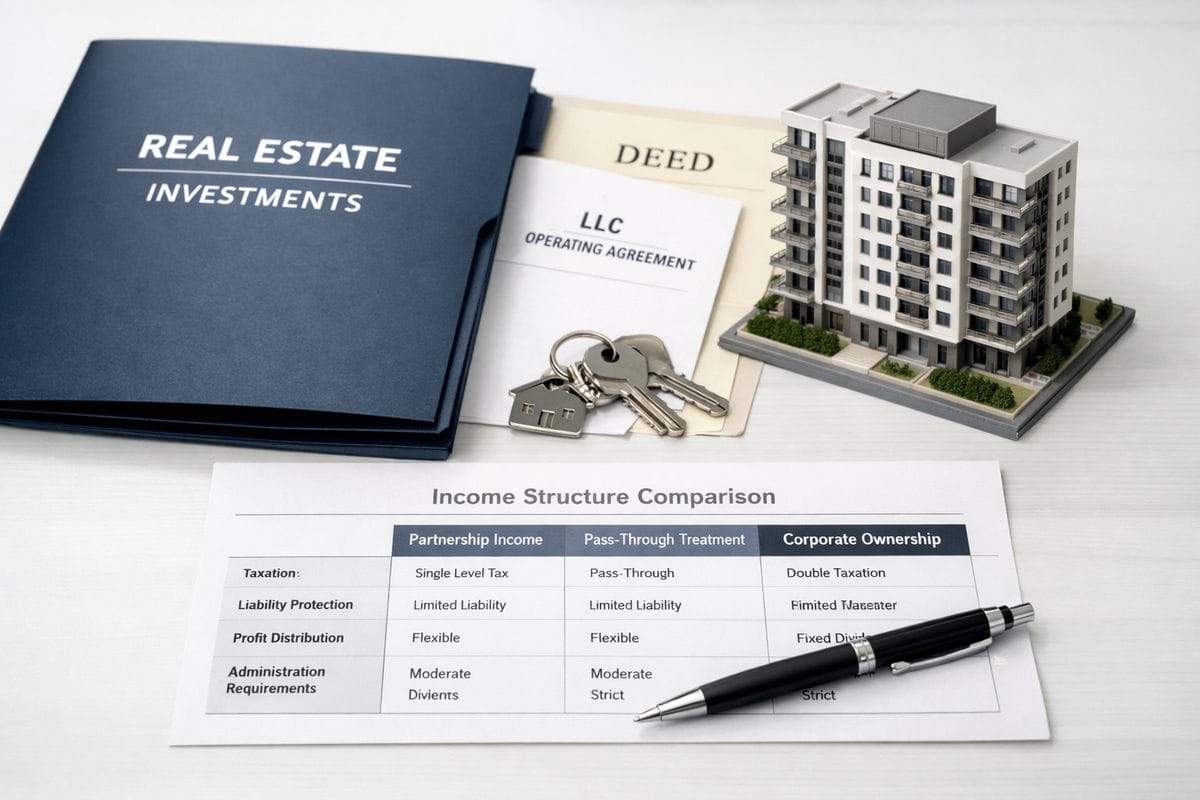
Because 199A did not expire, the spread between pass-through ownership and C corporation taxation remains wider than many forecasts assumed. That keeps partnerships and LLCs taxed as partnerships in a strong position for many holdings, especially where flexibility on allocations, refinancing, and property transfers matters.
Still, this is not a free pass. The permanent 21 percent corporate rate remains relevant for development, operating businesses, and retained earnings strategies. But pass-through status still usually wins for appreciating real estate because corporate-level tax plus shareholder-level tax remains a heavy exit drag.
Passive Loss Rules Do Not Sunset, but Their Strategic Value Changes
Section 469 never sat inside the sunset story. Rental losses remain passive by default. The $25,000 active participation allowance still phases out. Suspended losses still carry forward until passive income or a taxable disposition releases them. Passive loss limits stayed intact.
What changes is the value of those losses in a world with different rates, different depreciation timing, and different itemized deduction rules.
What stays the same under Section 469
Nothing about the sunset removed passive activity limitations. If your rental losses are trapped today, they remain trapped unless you generate passive income, dispose of the activity in a taxable transaction, or qualify for a nonpassive treatment path such as Real Estate Professional Status with material participation.
That is why suspended losses deserve active tracking. A six-figure passive loss carryforward is an asset, but only if a release event is planned.
Real Estate Professional Status after the sunset
REPS remains one of the highest-value planning paths for qualifying investors. When ordinary rates are higher, currently deductible losses are worth more. When bonus depreciation is lower, the cost of missing deduction timing is also higher.
The core tests remain the same: more than half of personal service time in real property trades or businesses, and more than 750 hours in those activities during the year. Then material participation must be established for the rental activities themselves or through a valid grouping election. Documentation is not optional. Hours, calendars, and activity records decide the outcome.
W-2 income, rental losses, and why 2026 planning starts in 2025
This is the pain point that drives most searches on this topic. If you earn W-2 income and hold rentals, losses usually stay passive. A cost segregation study can create a large paper loss that delivers no current benefit unless Section 469 allows it.
That means planning starts before the return is prepared. Grouping elections, participation logs, acquisition timing, and cost segregation only produce ROI if they match your ability to use the loss. Doing all of that after year-end is late.
Bonus Depreciation Keeps Shrinking Regardless of the Sunset
This is the cleanest part of the story because it did not depend on the individual sunset framework. Bonus depreciation phase-down continues regardless, and that directly affects acquisition underwriting.
The phase-down schedule through 2026
The schedule is simple: 60 percent in 2024, 40 percent in 2025, 20 percent in 2026, and 0 percent after December 31, 2026. That reduces the first-year deduction from shorter-life assets identified through cost segregation, including personal property, land improvements, and certain qualified improvement property.
This is one of the few areas where delay has an obvious cost. Every year of waiting lowers the immediate write-off.
Cost segregation timing before first-year benefits decline further
A cost segregation study still creates value, but the time-to-value is falling as bonus percentages drop. For investors who can use the losses, earlier placement in service improves cash flow faster. For investors trapped under Section 469, the decision becomes more nuanced because a larger paper loss without current usability may not improve ROI.
The recommendation is to model three variables together: bonus percentage, passive loss usability, and holding period. That produces a real answer. Looking at the cost seg report in isolation does not.

What Stays Intact for Real Estate Investors
The field data shows many investors still assume all major real estate tax benefits expire. That is false, and false assumptions produce bad timing decisions.
1031 exchanges remain available for real property
Section 1031 remains available for real property. The TCJA restricted like-kind exchanges to real estate, but it did not eliminate them for real estate, and the sunset did not change that.
For portfolio repositioning, this remains one of the strongest deferral tools available. It can defer both gain and depreciation recapture, preserving reinvestment capital.
The 21% C corporation rate remains permanent
The 21 percent C corporation rate stayed permanent. That matters for development companies, operating platforms, and situations where earnings are retained rather than distributed.
Still, a low corporate rate is not a blanket recommendation for holding appreciated rental real estate. Distribution tax and exit tax still matter. Structure should follow the life cycle of the asset, not the headline rate.
NOL and excess business loss rules remain tighter than pre-TCJA law
Post-2017 NOLs remain limited to 80 percent of taxable income, with indefinite carryforward and generally no carryback. Excess business loss limits also remain in effect through 2028. Those rules reduce the immediate value of large loss years and matter when cost segregation or development losses are central to the thesis.
The Three Investor Profiles Most Exposed to the Sunset
Exposure is not equal. Three profiles still deserve the closest review.
W-2 earners with suspended rental losses
This group feels the most frustration because depreciation often creates tax losses without current benefit. Higher marginal rates increase the value of a usable loss, which raises the stakes on REPS analysis, participation records, grouping, and disposition timing.
High-income investors in high-tax states
This group sits at the center of the SALT debate. A higher cap improves deductions, but AMT pressure and phaseouts still shape the result. Simple “tax cut” or “tax hike” labels miss the real interaction.
Full-time investors and developers using pass-through entities
The biggest planning issues here are bonus depreciation decline, 199A qualification, and interest deduction strategy under Section 163(j). Quarterly estimates, owner distributions, and asset-holding periods all need updated modeling.
A 2025, 2026 Action Plan for Real Estate Tax Planning
The recommendation is to run a phased tax map now, not during filing season.
Phase 1: Model 2025 vs. 2026 taxable income
Build side-by-side projections by filing status, state, and entity type. Isolate bracket changes, SALT treatment, itemized deductions, 199A, bonus depreciation, and AMT exposure. Based on analysis of real estate returns with multiple K-1s, the biggest planning errors happen when households project one line item and ignore the rest.
Phase 2: Decide what income to accelerate and what deductions to defer
If future rates are higher, income acceleration can improve ROI. That includes gains, option exercises, and Roth conversions. If itemizing becomes more favorable in a later year, delaying certain deductible payments can also improve results. Timing deductible expenses matters more than most investors assume.
Phase 3: Review entity structure and ownership stack
Re-test LLC, partnership, S corporation, trust, and C corporation structures against current rules, not outdated sunset assumptions. Include control, distribution policy, refinancing plans, and exit strategy. If Section 163(j) applies, this phase becomes more technical.
Phase 4: Coordinate depreciation, K-1 timing, and extension strategy
Partnerships and syndications create document timing issues. Cost seg studies arrive late. Passive loss tracking takes time. Filing extensions are often the right answer when K-1s are delayed or data is incomplete. Extensions can help preserve accuracy in complex returns.
Common Misreads That Distort Real Estate Planning
“All real estate tax breaks expire in 2026”
False. 1031 exchanges remain. The corporate rate remains. NOL and excess business loss rules remain. Bonus depreciation declines on its own schedule. Section 199A was preserved.
“The SALT cap repeal guarantees a lower tax bill”
False. First, the cap was raised, not fully repealed. Second, AMT, phaseouts, and rate changes still determine the final answer.
“Waiting until 2026 gives enough time to plan”
False. The highest-ROI moves depend on actions taken before the tax year closes, especially for income timing, participation records, cost segregation, and entity review.
The Recommendation: Build a Pre-2026 Tax Map Around Rates, 199A, and Depreciation
The recommendation is direct: build a tax map around three drivers, ordinary income rates, Section 199A eligibility, and bonus depreciation decline. Then test those drivers against passive loss limits, REPS eligibility, itemized deduction assumptions, and Section 163(j) exposure.
Section 163(j) deserves special attention. If your activity qualifies as a real property trade or business, electing out of the 30 percent business interest limitation can preserve full interest deductibility. But the trade-off is real: you must use ADS, which means longer depreciation lives, typically 30 years for residential rental property and 40 years for nonresidential real property, instead of standard MACRS lives. That slows deductions and changes sale-year basis. For highly leveraged property with a long hold, the election often works. For lower-leverage property, shorter expected holds, or deals built around depreciation velocity, the election can reduce ROI. This is not a boilerplate decision. It belongs in a property-level model with your real estate tax advisor.
The business outcome is clear. Protecting portfolio ROI now depends less on reacting to sunset headlines and more on quantifying the rules that actually control your cash flow.
Frequently Asked Questions
Did the TCJA sunset eliminate Section 199A for real estate investors?
No. Section 199A was preserved, so qualifying pass-through real estate income can still receive the 20 percent QBI deduction. The real question is whether your rental activity qualifies and whether wage and basis limitations reduce the benefit.
Is bonus depreciation still going away for real estate investors?
Yes. Bonus depreciation is still phasing down to zero by 2027. That directly reduces the first-year value of cost segregation studies and other accelerated depreciation strategies.
Does the SALT cap disappear for rental property owners?
No. The expected full repeal did not happen. The cap was raised to $40,000, which helps many high-income investors in high-tax states, but it does not create unlimited deductibility.
Do passive activity loss rules change after the TCJA sunset?
No. Section 469 passive loss limitations remain in place. Rental losses are still passive by default unless another rule changes the result, such as REPS plus material participation.
Should a real estate investor elect out of Section 163(j)?
Only after property-level modeling. Electing out can preserve unlimited interest deductions, but it forces ADS depreciation and longer recovery periods. The right answer depends on leverage, holding period, expected taxable income, and depreciation strategy.
Are 1031 exchanges still available after the TCJA changes?
Yes. Like-kind exchanges remain available for real property. That remains one of the strongest tools for deferring gain and recapture during portfolio repositioning.