

A QOF investment is an investment of eligible capital gains into a Qualified Opportunity Fund, a vehicle designed to place capital into Opportunity Zone property or businesses in exchange for specific federal tax benefits. For real estate investors, landlords, and property owners, this matters because the tax treatment changes after-tax ROI, hold strategy, and how sale proceeds get redeployed.
What a QOF Investment Is
A qof investment starts with a capital gain. That gain gets rolled into a Qualified Opportunity Fund, usually called a QOF, within the required time window. The fund then invests in qualified property or businesses located in designated Opportunity Zones.
In plain English, the structure works like this: you sell an appreciated asset, realize a capital gain, contribute that gain to a QOF, and the QOF puts the money into eligible Opportunity Zone real estate or an operating business. You do not invest directly into the tax incentive itself. You invest into a fund that has to follow a specific rule set.
That relationship matters. You are the investor. The QOF is the tax-advantaged investment vehicle. The underlying apartment project, mixed-use development, industrial asset, or business operating inside an Opportunity Zone is the actual economic engine. If the fund complies but the deal is weak, returns suffer. If the deal is strong but compliance fails, the tax result suffers. A successful qof investment requires both.

Why QOF Investments Matter to Real Estate Investors
For real estate investors, the strategic stake is simple: taxes change net returns, and net returns drive portfolio decisions. A large gain from selling rental property, land, a partnership interest, or appreciated securities can create a meaningful tax drag. A QOF structure delays part of that drag and, if the hold period is long enough, can eliminate federal tax on the new appreciation inside the QOF investment.
That changes behavior. Instead of forcing an immediate tax payment and shrinking the amount of capital available for reinvestment, a QOF lets you keep more gain dollars working for a period of time. Based on analysis of how these structures are used in practice, that improves capital deployment efficiency and supports long-hold strategies where the real value is created over years, not quarters.
The recommendation is to view QOFs as a capital gains planning tool wrapped around a real estate underwriting decision. The tax perks are attractive. The business outcome still comes from asset quality, sponsor execution, and your ability to stay invested long enough for the structure to work as intended.
How the Opportunity Zone Program Works
The Opportunity Zone program was created to direct private capital into designated low-income census tracts. The geographic areas are selected as Opportunity Zones, and investment into those areas can qualify for tax benefits if the money flows through the proper structure and follows the required rules. The IRS explains the framework as a program where eligible gains are invested in Qualified Opportunity Funds that hold Qualified Opportunity Zone property or businesses (IRS Opportunity Zones overview).
At a high level, the policy goal is straightforward: attract long-term investment into targeted communities by rewarding investors who commit capital for long holding periods. In practice, that means the program favors patient capital, active compliance, and assets that can hold or grow value over a decade.
The Three Core Parts of the Program
The first part is the eligible capital gain. Without a qualifying gain, there is no QOF tax election. Ordinary income does not get the same treatment.
The second part is the investment into the QOF. The gain has to be invested properly and within the timing rules. That is where the election mechanics begin.
The third part is deployment into Qualified Opportunity Zone property or businesses. Money cannot just sit in a compliant-looking shell and produce the intended result forever. The fund has to place assets into qualifying use inside the zone.
QOF vs. Opportunity Zone vs. Opportunity Zone Property
This is where confusion starts.
A QOF is the fund entity. An Opportunity Zone is the geographic area. Opportunity Zone property is the actual qualifying asset inside that area. Those are not interchangeable terms.
If a property sits in an Opportunity Zone, that alone does not make your investment a qof investment. The fund has to be structured as a Qualified Opportunity Fund, and the underlying property or business has to satisfy the applicable rules. Zone location is necessary. It is not sufficient.
The Rules That Determine Whether a QOF Investment Qualifies
Tax treatment depends on qualification. Not close enough. Not mostly compliant. Qualified.
Based on analysis of top-ranking sources and IRS guidance, three rule categories drive most outcomes: the type of gain invested, the timing of the investment, and the fund-level compliance standards. Miss any one of those, and the expected tax result can collapse.
What Gain Can Be Invested
Eligible gain generally means capital gain. Common sources for this audience include gain from the sale of rental property, raw land, appreciated securities, partnership interests, and other capital assets. The gain amount, not the entire sale proceeds, is the amount generally eligible for deferral through a QOF.
That distinction matters. If a property sale produces $1 million of proceeds and $400,000 of capital gain, the qualifying amount is generally $400,000. The rest is not what drives the Opportunity Zone tax election.
Ordinary income is different. Depreciation recapture and other non-capital components require close review because a QOF is not a universal shelter for every taxable dollar generated by a sale.
The 180-Day Investment Window
The 180-day rule is one of the most important deadlines in the program. Eligible capital gain generally must be invested in a QOF within 180 days of the triggering sale or other recognition event. The IRS specifically ties eligible gain deferral to a timely investment and election (IRS timing guidance).
Why does the clock matter so much? Because missed timing destroys the intended deferral. If the deadline passes, the gain is taxable under the normal rules. There is no late rescue through good intentions or a strong deal.
For partnership and pass-through situations, timing can become more technical because the 180-day start date may depend on entity-level or owner-level treatment. That is exactly why documentation and filing discipline matter from day one.
Self-Certification and the 90% Asset Test
A QOF generally self-certifies by filing Form 8996 with its federal tax return. No separate preapproval process gives comfort upfront. The fund declares status and then has to satisfy the program rules.
One of the main operational rules is the 90% asset test. A QOF generally must hold at least 90% of its assets in Qualified Opportunity Zone property, measured on testing dates set by the rules. The IRS outlines this directly in its filing materials for QOFs (Form 8996 instructions).
For you, this means sponsor compliance is not background noise. It is part of the investment thesis. A fund that misses testing thresholds, mishandles cash deployment, or fails to document qualification creates tax compliance risk even if the real estate itself looks attractive.
The Tax Perks: The Three Main Benefits Explained
The tax case for a qof investment comes down to three benefits: temporary deferral of eligible gain, potential exclusion of post-investment appreciation after a long hold, and basis treatment that affects how taxable gain is measured. The first benefit helps with near-term capital deployment. The second is the big prize. The third determines exit economics.
Tax Perk 1: Deferral of Eligible Capital Gains
The first benefit is deferral. Eligible capital gain invested in a QOF is not taxed immediately if the election is made properly. Under current rules, that deferred gain is generally recognized on the earlier of an inclusion event or December 31, 2026, as described by the IRS (IRS tax benefit explanation).
That means deferral is real, but temporary. It is not permanent forgiveness of the original gain.
What does this look like in practice? If you exit the QOF at year 3, you generally lose the long-hold upside and trigger tax on the deferred original gain through the inclusion rules, along with any taxable change tied to the exit structure. If you remain invested through year 7, the original deferred gain is still generally recognized by the statutory inclusion date, so you get several years of deferral but not elimination. The older 5-year and 7-year basis step-up benefits belonged to the earlier phase of the program and no longer drive most current planning because the deadlines for earning those increases have passed.
Tax Perk 2: Potential Exclusion of New QOF Appreciation After a 10-Year Hold
This is the benefit that shapes the strategy. If you hold the QOF investment for at least 10 years and meet the requirements, post-investment appreciation can be excluded from federal capital gains tax when the investment is sold. The IRS has addressed the basis adjustment available after a 10-year hold in Opportunity Zone guidance (IRS basis adjustment after 10 years).
That is powerful because it applies to the appreciation generated after your money enters the QOF, not to the original gain you rolled in. If the fund buys or develops real estate successfully and value increases materially over a decade, that growth can come out free of federal capital gains tax.
At year 10 and beyond, the structure finally delivers its signature outcome. The deferred original gain has already been recognized under the statutory schedule or earlier inclusion event rules, but the new appreciation inside the QOF can receive exclusion. That is why illiquidity is the most underestimated risk. Selling too early sacrifices the main advantage.
Tax Perk 3: Basis Rules and Why They Affect Exit Economics
Basis is your tax measuring stick. It determines how much gain is recognized when an investment is sold. In a QOF context, basis rules are not just technical detail. They directly affect taxable proceeds and your net after-tax return.
At the start, the basis in the QOF investment is generally treated differently from a regular investment because the original gain is deferred rather than taxed immediately. Over time, basis changes based on the governing rules, recognition events, and any elections available after a qualifying long hold. HUD’s investor materials also explain the long-term adjustment mechanics at a high level (HUD Opportunity Zones investor guidance).
The practical takeaway is simple. A QOF investment is not just about deferring a tax bill. It is about how basis is reset and measured at exit. That directly shapes sale economics, especially after year 10.
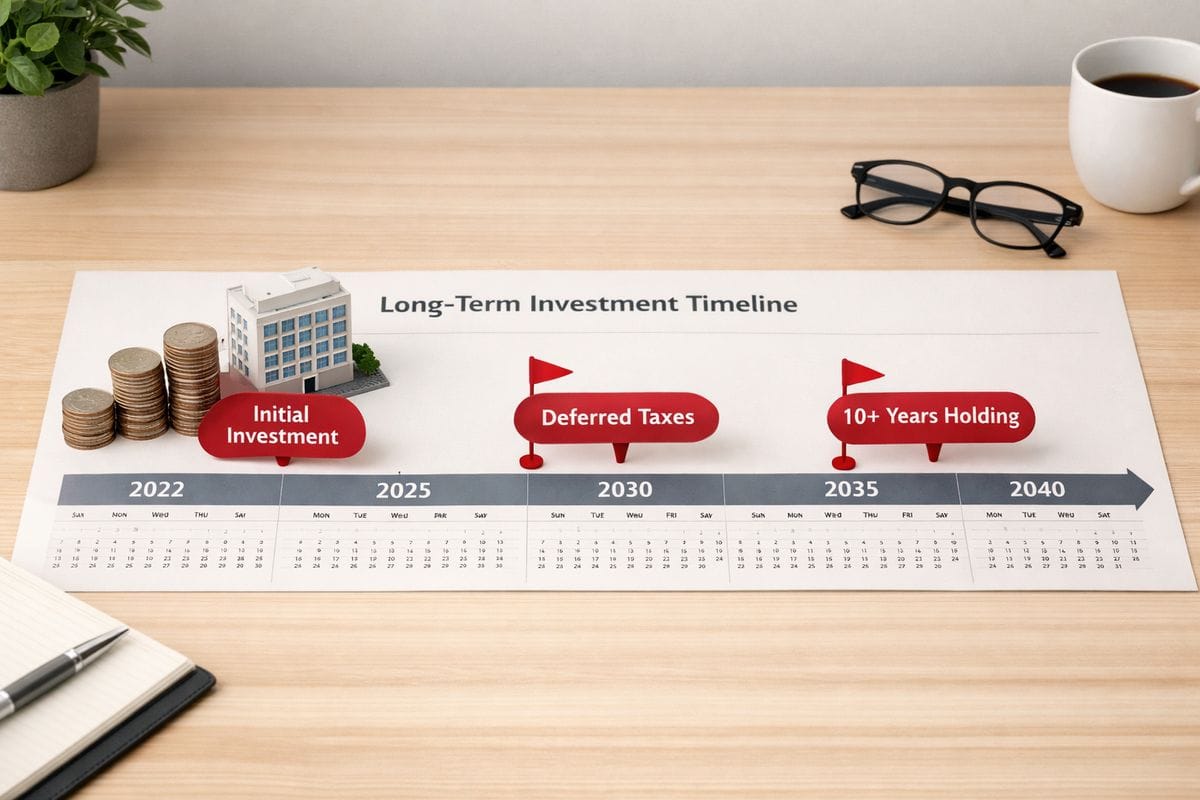
The Four Phases of a QOF Investment Timeline
A qof investment is easier to understand when broken into four phases. That sequence shows exactly where execution risk appears.
Phase 1: Triggering and Identifying the Capital Gain
Everything starts with a realization event. You sell appreciated property, securities, or another capital asset, and the gain becomes identifiable. At that point, the amount of eligible gain has to be calculated correctly and separated from sale proceeds, debt payoff, recapture, and other tax items.
This phase sounds simple. It is not. Errors here contaminate everything that follows.
Phase 2: Investing Through the Fund Election Process
Next comes contribution to the QOF within the allowed window and the proper tax election to defer the eligible gain. This phase requires subscription documents, proof of funding date, source-of-gain support, and tax reporting alignment.
If those records are sloppy, the tax position weakens. A QOF election is not a casual side note on a return. It has to be documented and filed correctly.
Phase 3: Fund Deployment and Ongoing Compliance
Once capital enters the fund, the sponsor has to put it to work in a way that keeps the fund qualified. That includes asset testing, entity structuring, qualified property treatment, and operational compliance over time.
This is where real estate reality takes over. Development delays, construction cost overruns, weak leasing, refinancing pressure, and sponsor inattention can all erode returns. At the same time, compliance failures can damage the tax outcome. You are carrying two forms of risk at once: deal risk and rule risk.
Phase 4: Exit, Inclusion Events, and 10-Year Sale Planning
The endgame splits into three paths. One path is mandatory recognition of the deferred gain under the program rules. Another is an earlier inclusion event, such as a sale or other triggering transaction involving the QOF investment. The third is the long-hold path, where a sale after 10 years is structured to claim exclusion on post-investment appreciation.
The timing differences matter. Exit at year 3 and you generally trigger the deferred original gain while losing the appreciation exclusion. Exit at year 7 and the original gain has generally already become taxable under the statutory schedule, so the value of the structure comes down to interim deferral, not exclusion of new gain. Exit at year 10 or later and the long-hold benefit can finally produce the intended after-tax payoff.
QOF Investment Structures You Will Encounter
Not every QOF looks the same, and structure changes risk, control, fees, and transparency.
Single-Asset Real Estate QOFs
A single-asset QOF is built around one project, such as one multifamily development, one adaptive reuse asset, or one industrial property in an Opportunity Zone. The appeal is focus. You can underwrite one property, one market, and one business plan.
The downside is concentration risk. If that asset misses budget, leasing, or exit targets, there is nowhere else in the fund to absorb the damage. In this structure, sponsor quality and project underwriting are decisive.
Multi-Asset or Diversified QOFs
A multi-asset QOF spreads capital across several properties, markets, or project types. That reduces single-project concentration and can smooth performance if one asset underperforms.
The tradeoff is less visibility. Oversight becomes harder, reporting can feel more abstract, and your return depends on portfolio construction discipline, not just one strong acquisition. Diversification can reduce some risk, but it never fixes weak asset selection.
Direct Sponsor Funds vs. Feeder or Platform Structures
A direct sponsor fund is controlled by the developer or operator running the actual projects. That usually gives clearer visibility into business plans, decision-making, and property-level execution.
A feeder or platform structure adds another layer. Capital is pooled by an intermediary and then allocated into underlying QOF projects or sponsor vehicles. The result can be broader access, but it often means more fees, more complexity, and less direct control over reporting and asset decisions. The recommendation is to map every entity, every fee layer, and every decision-maker before committing capital.
The Main Risks of a QOF Investment
Tax benefits do not rescue a weak investment. That is the governing principle.
Tax Compliance Risk
If timing rules are missed, elections are mishandled, or the fund fails compliance testing, the expected tax outcome weakens or disappears. A QOF that self-certifies still has to perform under the rules. Filing status alone does not protect your result.
This is why compliance diligence belongs next to real estate diligence, not behind it.
Real Estate and Execution Risk
Most QOF offerings are tied to real estate development, redevelopment, or value-add execution. That means entitlement risk, construction risk, cost inflation, lease-up risk, operating shortfalls, and refinancing pressure all sit inside the deal.
Time-to-value becomes a business issue. Delays push out stabilization, reduce cash flow, and compress exit flexibility. If the project requires everything to go right just to earn an average return, the tax incentive is not enough.
Liquidity and Hold-Period Risk
This is the risk investors underestimate most. QOF investments are usually illiquid, and the full tax exclusion on post-investment appreciation requires a 10-year hold. Most funds do not offer practical early redemption.
That creates a hard reality. If you need cash at year 3, the structure does not bend for convenience. You lose the long-hold exclusion and trigger the deferred gain under the inclusion rules tied to the exit. If you leave at year 7, you have accepted years of illiquidity without capturing the signature tax benefit. A QOF only fits capital that can stay locked up.
Legislative and Regulatory Risk
This is a long-duration strategy built on tax law. That means future statutory changes, new IRS guidance, and evolving Opportunity Zone policy matter. HUD has also framed the program in phases, including newer policy development around permanent incentives and updated structures (HUD investor materials).
Another point deserves attention: zone redesignation and policy evolution create planning noise. The fund’s qualification and the timing of investment relative to governing rules matter more than a simplistic assumption that any map label guarantees lasting certainty. Long-hold investors need to follow the law, not the marketing.
Due Diligence: Five Drivers of a Strong QOF Investment
Based on analysis of what the field data shows across sponsor offerings, due diligence determines whether tax savings translate into actual wealth creation. Five drivers separate strong QOFs from expensive tax-themed speculation.
Driver 1: Sponsor Track Record
Start with execution history. Review prior developments, realized exits, market specialization, lender relationships, and actual performance through difficult cycles. A polished deck means nothing without a pattern of delivered projects and credible reporting.
Compliance history also matters. A sponsor that treats tax administration as a back-office afterthought introduces avoidable risk.
Driver 2: Asset Quality and Business Plan
Underwrite the property as if the tax incentive did not exist. Look at location fundamentals, demand drivers, replacement cost, rent assumptions, absorption logic, and exit cap rate discipline.
A strong QOF owns a deal that makes sense on its own. If projected returns depend more on the tax pitch than on the property economics, the deal is weak.
Driver 3: Fund Compliance Controls
A serious QOF needs legal structure discipline, tax counsel involvement, accounting controls, asset-testing procedures, and documented processes around qualification. Self-certification places even more weight on internal controls because the structure relies on ongoing compliance, not one-time approval.
If the sponsor cannot explain testing, reporting, and document retention clearly, the compliance framework is not strong enough.
Driver 4: Fee Structure and Waterfall Economics
Fees change net returns. Management fees, acquisition fees, development fees, disposition fees, financing fees, and promote structures can drain more value than most investors expect.
The right analysis is not “Are the fees normal?” The right analysis is “What do fees do to net after-tax proceeds under realistic, base-case performance?” If the waterfall heavily favors the sponsor before you reach acceptable ROI, pass.
Driver 5: Exit Strategy
Every QOF should have a credible path to liquidity after the intended hold period. That can mean an asset sale, portfolio sale, refinance-supported distribution, or another defined exit route. A vague statement about optionality is not enough.
Exit planning matters even more in a structure designed around a 10-year benefit. If there is no realistic buyer profile, no refinancing logic, and no thought given to post-stabilization market conditions, the hold-period advantage loses practical value.
Common QOF Investment Misconceptions
Confusion around Opportunity Zones is constant, and most mistakes are expensive.
“A QOF Eliminates the Original Capital Gain”
No. Under the standard rules, the original eligible gain is generally deferred, not erased. The major exclusion opportunity applies to post-investment appreciation in the QOF after a qualifying 10-year hold.
“Any Property in an Opportunity Zone Qualifies”
No. Location alone does not make an investment eligible. The fund must be a QOF, and the underlying asset or business must satisfy the program rules.
“Tax Benefits Make a Bad Deal Good”
No. Tax perks improve a good deal’s after-tax outcome. They do not fix weak fundamentals, poor sponsorship, bad market selection, or flawed capital structure.
“Only Large Institutional Investors Can Use QOFs”
No. Individuals, partnerships, corporations, trusts, and estates with eligible capital gains can invest, subject to the applicable rules and the fund’s own minimum investment requirements. The program is broader than many assume.
Filing, Reporting, and Recordkeeping Basics
The administrative side matters because QOF tax treatment depends on elections, documentation, and ongoing reporting. IRS guidance places repeated emphasis on elections, timing, and forms tied to both investor and fund compliance (IRS forms and publications).
Key Tax Forms and Elections
At the fund level, self-certification is generally handled through Form 8996. At the investor level, the eligible gain deferral election and annual reporting have to be reflected properly on the federal return using the required tax forms and attachments.
This is not a form-by-form manual. The practical point is simpler: the filing package has to tell a coherent story that matches the sale date, gain amount, investment date, and ongoing basis treatment.
Records to Keep From Sale Through Exit
Keep the sale documents that created the gain, gain calculations, closing statements, subscription agreements, proof of funding date, K-1s if applicable, annual tax reporting files, basis schedules, and all documents tied to exit.
A QOF is a long-duration file. If records are not organized from the start, reconstructing the position years later becomes expensive and risky.
A Simple Example of How QOF Investment Economics Work
Assume a rental property sale creates a $500,000 long-term capital gain. That gain is invested into a QOF within 180 days. No immediate federal capital gains tax is paid on that $500,000 because the gain is deferred under the QOF rules.
Now assume the QOF uses the capital in an Opportunity Zone multifamily development. By the time the deferred gain must be recognized under the governing rules, tax is paid on the original $500,000 deferred gain. That tax bill was postponed, not canceled.
Next, assume the QOF investment grows from $500,000 to $900,000 over a 10-year hold. The $400,000 of new appreciation is where the major upside appears. If the sale is structured after the required 10-year holding period and the applicable election is made, that $400,000 of appreciation can be excluded from federal capital gains tax.
Change the timeline and the economics change fast. Sell at year 3 for $600,000, and the deferred original gain is generally triggered through the exit while the $100,000 of appreciation does not receive the 10-year exclusion. Sell at year 7 for $700,000, and you have received years of deferral on the original gain, but the new $200,000 of appreciation still lacks the long-hold exclusion. Sell at year 10+ for $900,000, and the structure finally delivers the primary tax reward on the new appreciation.
That is the real decision rule. A QOF is not a short-term tax trade. It is a long-term capital allocation strategy.
When a QOF Investment Fits Your Tax Strategy
A QOF fits when you have a meaningful recent capital gain, a long investment horizon, tolerance for illiquidity, and conviction in the underlying real estate or business plan. It also fits when after-tax ROI improves materially because the capital stays invested longer and appreciation has room to compound inside the structure.
For real estate investors, a strong fit often appears after the sale of appreciated rental property or land when there is no need for immediate liquidity and a willingness to accept development or value-add exposure. In that setup, the tax treatment supports, rather than drives, the investment case.
When a QOF Investment Does Not Fit
A QOF does not fit capital that needs flexibility. It does not fit investors who expect easy redemptions, want simple tax treatment, or have only a modest gain that does not justify the complexity.
It also does not fit when sponsor access is weak. If the available deals are opaque, fee-heavy, or poorly underwritten, the tax incentive is not enough to justify commitment. Simpler deferral or reinvestment options may produce a better business outcome when liquidity, control, or transparency matter more than long-duration tax advantages.
How to Evaluate a QOF Before Committing Capital
The recommendation is direct: underwrite the deal first, verify the tax mechanics second, and commit capital only when both are strong. A QOF should stand up as a real estate investment before the tax benefits enter the discussion. Then the compliance framework should confirm that the promised tax treatment is actually supportable.
Based on analysis of how QOF outcomes diverge in practice, the winning formula is disciplined underwriting, sponsor scrutiny, documented compliance controls, fee clarity, and a believable 10-year exit path. If any one of those elements is weak, your after-tax ROI falls, your time-to-value stretches, and your risk rises.
A QOF investment works best when the property is compelling, the sponsor is proven, the rules are followed precisely, and your capital can stay in place long enough to earn the benefit that matters.
Frequently Asked Questions
Is a QOF investment only for real estate?
No. A QOF can invest in qualified Opportunity Zone businesses as well as real estate. In the market, most offerings are real estate-focused because property development and redevelopment fit the long-hold structure well.
Does a 1031 exchange do the same thing as a QOF investment?
No. A 1031 exchange defers gain under a different rule set and is generally limited to like-kind real estate exchanges. A QOF investment can be funded with eligible capital gains from a wider range of asset sales, but it comes with its own timing, compliance, and hold-period requirements.
What happens if a QOF investment is sold before 10 years?
The deferred original gain is generally recognized under the applicable inclusion rules, and the post-investment appreciation does not receive the 10-year exclusion. In plain terms, an early sale gives up the main long-term tax benefit.
Can a self-directed investor create a QOF?
Yes, a fund can generally self-certify rather than seek advance approval, using the required IRS filing process. That said, forming a compliant QOF and keeping it qualified is technical work. Entity structure, testing, reporting, and operational compliance all have to be right.
Are Opportunity Zone investments automatically good because of the tax break?
No. The tax break improves net returns on a strong project. It does not repair poor location selection, weak sponsorship, unrealistic rents, or bad financing assumptions.
What is the biggest practical mistake in a QOF investment?
Underestimating illiquidity. If capital may be needed before year 10, the structure is misaligned from the start. That mistake damages both tax results and portfolio flexibility.