

Property management bookkeeping decides how much profit stays in a rental portfolio and how much gets lost to tax overpayment, bad reporting, and preventable errors. In plain English, property management bookkeeping is the system for recording every dollar of rent, deposit, expense, liability, and owner movement by property and entity so financial statements, Schedule E, and portfolio decisions all match reality.
What Property Management Bookkeeping Controls in a Rental Portfolio
Bookkeeping is not clerical cleanup. It is the control system for cash flow, tax compliance, financing support, and property-level decision making. That matters more now because the underlying business is getting tighter. Based on industry data, the U.S. property management industry exceeds $130 billion in annual revenue, while real estate and rental activity represented 13.9% of U.S. GDP in Q2 2025. At the same time, rents rose roughly 32% over five years, but insurance climbed 26% and maintenance 12%. Margin pressure changed the job.
For a long-term rental, bad books hide delinquency, understate repairs, and produce a false sense of cash available for distributions. For a flip, bad books distort basis, holding costs, and project profitability. For a short-term rental, bad books create a mess fast because booking volume, platform fees, cleaning turns, and occupancy taxes multiply transaction count.
The three business outcomes bookkeeping drives
First, bookkeeping protects cash flow. If rent is posted late, duplicate vendor bills sit unpaid, or security deposits are mixed into operating cash, cash visibility becomes fiction.
Second, bookkeeping reduces tax overpayment. Based on analysis of rental-owner files, one recurring problem stands out: property manager year-end statements are incomplete for tax filing. Those statements usually show gross rent collected, management fees, and repairs coordinated by the manager. Schedule E requires far more. If mortgage interest, escrowed property taxes, insurance premiums, HOA fees, and directly paid capital items are missing, deductions disappear.
Third, bookkeeping improves decision quality. Net operating income, cash-on-cash return, and hold versus sell decisions all depend on clean expense allocation and timely reconciliations. If one property carries $4,800 in annual maintenance and another carries $11,900, that should drive action, not get buried inside one combined repairs account.
The Four Foundations of a Clean Bookkeeping System
The setup determines reporting accuracy later. A sloppy foundation guarantees expensive cleanup at year-end. A clean foundation shortens close time, supports tax prep, and gives per-property reporting that actually means something.
Separate bank accounts, entities, and property-level records
Use dedicated accounts for each operating entity and keep security deposits separate from operating cash. In Texas especially, mixed funds create legal, tax, and liability problems fast. If one LLC owns three rentals and another LLC owns two flips, each entity needs distinct books, bank activity, and balance sheet reporting.
Property-level records matter just as much. If five rentals share one repairs account with no property tags, underperformers disappear. For portfolios with 5+ properties, per-property P&L tracking is the recommendation because it exposes units with chronic turnover, rising maintenance, or weak collections and supports accurate Schedule E preparation.
Build a chart of accounts that matches real estate activity
A generic small-business chart of accounts is the wrong tool. Rental books need income accounts for rent, late fees, lease-cancellation income, application fees where relevant, and owner contributions. Expense accounts should separate repairs, maintenance, utilities, insurance, property taxes, mortgage interest, management fees, advertising, legal and professional fees, and cleaning for short-term rentals.
Capital expenditures need separate fixed asset accounts, not a catch-all repairs bucket. That distinction drives depreciation and current-year deductions. The account structure should support Schedule E categories, entity returns, and portfolio roll-up reporting without recoding everything in March.
Choose the right accounting method and bookkeeping cadence
Most rental owners use cash basis because it aligns with actual cash movement and tax reporting. Accrual becomes more useful when receivables, payables, or higher transaction volume start distorting monthly operations. The recommendation is simple: choose one method intentionally, then stay consistent.
Cadence matters more than software branding. Record transactions weekly. Reconcile monthly. Close each month with bank accounts, credit cards, loan balances, security-deposit liabilities, and uncategorized items cleared. Year-end cleanup is not a process. It is a symptom.

What You Must Track for Every Property, Unit, and Entity
This is where tax opportunity and risk show up in real numbers.
Income tracking under IRS rules
The IRS requires reporting all rental income, not just monthly rent. That includes advance rent, lease-cancellation payments, tenant-paid owner expenses, and non-cash payments at fair market value. Income has to be posted to the correct property and period so rent rolls, P&Ls, and Schedule E tie out.
A common failure is relying on the property manager’s 1099 and year-end statement without reconciliation. The manager generally reports gross rent collected, not net rent after fees. If gross rents reported on Form 1099 are $84,000 and management fees were $7,560 at 9%, income still gets reported at $84,000. The management fee is deducted separately as an expense. Netting the fee against rent creates mismatches and invites notices.
Security deposits, owner funds, and trust-account discipline
Security deposits are not rent when received if there is an obligation to return them. Under IRS rules, they become income when retained, applied to rent, or kept for damages in a way that ends the refund obligation. That means deposit liabilities belong on the balance sheet, not the income statement, until status changes.
Owner contributions, reserve funding, and loan proceeds also stay out of operating income. Mixing those items into rent inflates revenue and distorts NOI. The same problem hits cash flow statements when reserve transfers are booked as profit instead of balance sheet movement.
Expenses, reimbursements, and vendor payments
Ordinary rental expenses generally include mortgage interest, property taxes, insurance, advertising, utilities, maintenance, and professional fees. But bookkeeping has to separate operating expenses from reimbursements and billable repairs. If a tenant causes $1,200 in damage and reimburses that amount, posting the repair without the reimbursement overstates cost. Posting both correctly preserves margin analysis.
Here is the comparison that matters most at tax time:
| Typical PM year-end statement includes | Schedule E and tax books require |
|---|---|
| Gross rent collected | Gross rent plus all other rental income |
| Management fees | Management fees as separate expense |
| Repairs coordinated by PM | All repairs, including owner-paid items |
| Sometimes leasing fees | Advertising, commissions, leasing costs |
| Tenant charges collected | Proper classification of reimbursements |
| Owner draws | Not deductible, balance sheet only |
| Rarely mortgage data | Mortgage interest |
| Rarely escrow detail | Property taxes paid from escrow |
| Rarely direct-billed insurance | Insurance premiums |
| Rarely HOA dues | HOA and association fees |
| Usually no fixed assets | Improvements and depreciation support |
Reconciliation checklist for what PM statements often miss: mortgage interest, property taxes from escrow, insurance paid directly, HOA dues, utilities paid outside management, owner-paid repairs, travel and mileage if applicable, legal and accounting fees, software subscriptions, loan fees, and capital improvements.
The Biggest Bookkeeping Errors That Distort Profit and Tax Strategy
The field data shows the same breakdowns over and over once portfolios move beyond a few units: spreadsheets, stale reconciliations, missing receipts, and account balances nobody trusts.
Misclassifying repairs vs. improvements
A repair keeps property in ordinary operating condition. An improvement adds value, extends useful life, or adapts property to a new use. Patching drywall after a tenant move-out is generally a repair. Replacing the full roof is a capital improvement. Swapping one broken appliance is usually a repair. A full kitchen renovation is not.
The tax impact is direct. Repairs are deducted now. Improvements are capitalized and depreciated over time. If a $14,000 roof replacement gets buried in repairs, deductions are overstated this year and depreciation schedules are wrong for years after.
Mixing personal, property, and portfolio transactions
Co-mingled spending destroys the audit trail. It also makes owner distributions unclear, partner reporting harder, and lender financial packages less credible. Paying a plumbing invoice from a personal credit card once is fixable. Doing it repeatedly across multiple properties guarantees messy books and higher tax-prep cost.
Failing to reconcile rent, bank activity, and liabilities
Monthly reconciliation is the control point. Unposted rent creates false receivables. Duplicate vendor bills inflate expenses. Stale security-deposit balances overstate liabilities. Unreconciled bank accounts make cash flow reporting unreliable. Operating accounts, credit cards, loans, and deposit liabilities all need monthly reconciliation, every month, no exceptions.
Reporting That Turns Bookkeeping Into Portfolio Decisions
Clean books matter because they produce decisions, not because they look organized.
Monthly reports every rental owner should review
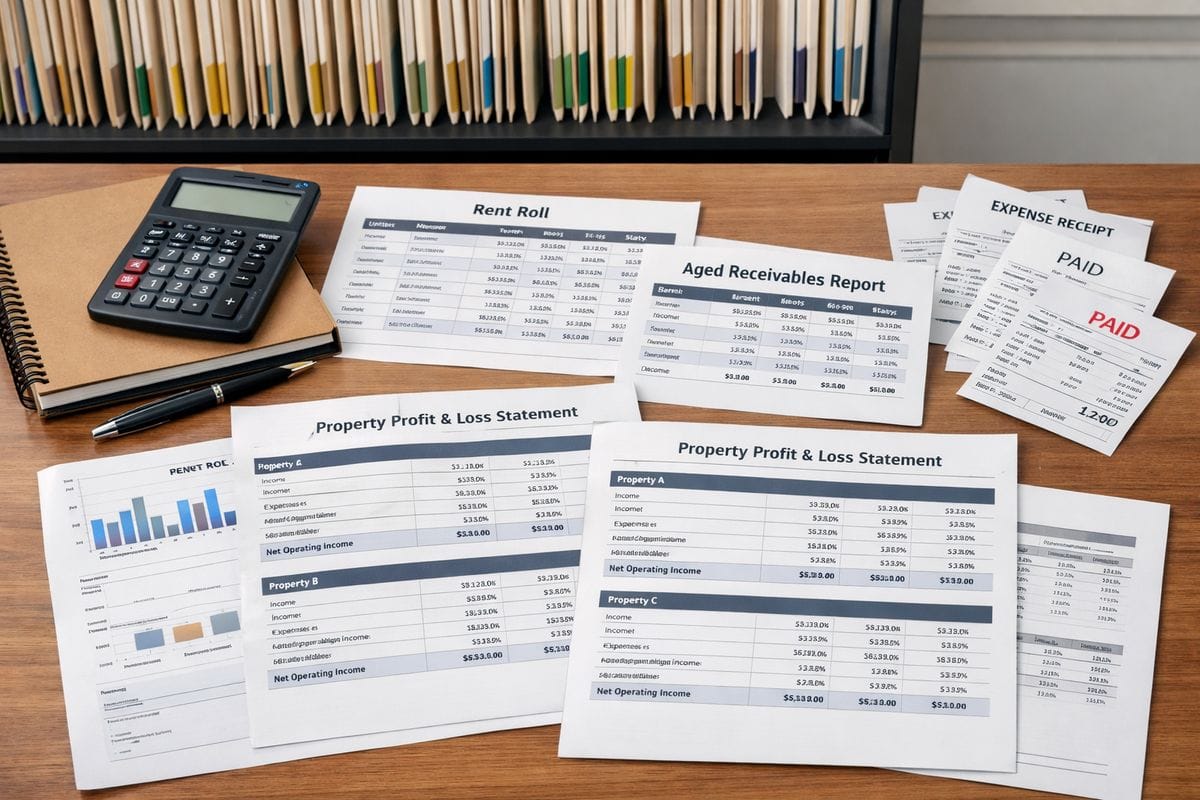
Review the income statement, balance sheet, cash flow statement, rent roll, aged receivables, and property-by-property P&L every month. The income statement shows margin. The balance sheet shows liabilities, loans, deposits, and owner equity movement. Cash flow exposes whether reported profit actually converted to cash.
The rent roll and aged receivables show collection risk fast. For portfolios above five properties, the property-by-property P&L is the report that exposes underperformers and supports accurate property-level tax reporting.
Metrics that expose margin loss across the portfolio
Track NOI, gross rent collected, delinquency rate, maintenance cost per unit, turnover cost, and cash reserve coverage. With insurance and maintenance costs rising, those metrics reveal where pricing, vendor control, or disposition decisions need attention. If one property produces $18,000 in annual gross rent but only $2,400 in NOI after repeated turnover and repairs, the bookkeeping already answered the hold versus sell question.
Software, Automation, and When to Bring in a Real Estate Tax Advisor
Software should reduce error rates and close time. It should not create a second set of books.
What software should automate first
Automate rent collection, bank feeds, receipt capture, bill pay, maintenance tracking, owner statements, and sync with QuickBooks or a similar accounting platform. Based on analysis of current software use, a single source of truth reduces double entry, speeds month-end close, and improves accuracy across reporting and tax prep.
When DIY bookkeeping stops paying for itself
DIY stops paying when multiple entities exist, short-term rental volume adds hundreds of monthly transactions, flips sit beside holds, reconciliations run late, and tax-time cleanup becomes a project. Another warning sign is uncertainty around depreciation, improvements, or entity-level filings.
The recommendation is to move from annual tax prep to proactive advisory support as soon as bookkeeping errors start affecting deductions, cash visibility, or acquisition decisions. That shift protects ROI.
The operating recommendation for scaling from 1, 5 properties to a larger portfolio
Use four phases. Phase one: basic setup with separate accounts, a real estate chart of accounts, and property-level tracking. Phase two: monthly discipline with weekly posting and monthly reconciliations. Phase three: portfolio reporting with per-property P&Ls, rent rolls, and margin metrics. Phase four: proactive tax planning with year-round bookkeeping tied to depreciation, entity structure, and acquisition strategy.
Clean bookkeeping is the operating system for a growing portfolio. Put it in place before scale exposes every weak assumption.
Frequently Asked Questions
How often should property management bookkeeping be updated?
Transactions should be recorded weekly and reconciled monthly. Waiting until quarter-end or tax season produces coding errors, missed deductions, and unreliable cash flow reporting.
Can a property manager’s year-end statement replace bookkeeping?
No. A typical PM statement does not capture everything needed for Schedule E. Mortgage interest, escrowed taxes, insurance, HOA dues, and owner-paid expenses are often missing.
Why does per-property P&L tracking matter after five properties?
Because combined reporting hides weak assets. Per-property P&Ls show which rentals have poor collections, high maintenance, repeated turnover, or shrinking NOI, and that supports both tax accuracy and hold/sell decisions.
Should management fees be netted against rent income?
No. If the property manager reports gross rent on Form 1099, gross rent should stay in income and management fees should be deducted separately as an expense.
What is the biggest tax mistake in rental bookkeeping?
Misclassifying improvements as repairs. That error distorts current deductions, fixed asset schedules, depreciation, and gain calculations later.
When is a real estate tax advisor worth the cost?
A tax advisor is worth the cost when bookkeeping errors start reducing deductions, delaying close, creating filing uncertainty, or affecting acquisition and portfolio strategy. At that point, advisory support drives a measurable return.