

Material participation real estate rules determine whether your rental losses stay trapped as passive losses or become usable against other income, and that distinction drives real cash flow, ROI, and filing risk. Heading into 2026 and 2027, that classification matters even more because broader tax changes increase the value of every deductible dollar while leaving the passive activity framework largely intact.
Why Material Participation in Real Estate Drives Tax Outcomes
Material participation is not a technical side issue. It is the gatekeeper that determines whether rental losses remain suspended under the passive loss rules or support a more efficient tax position. If your depreciation, repairs, interest, and operating costs produce losses on paper, the question is simple: can those losses offset salary, business income, or other active earnings now, or do they sit on the shelf?
For many rental owners, especially W-2 earners, the answer is frustrating. A property can produce real tax losses and still provide no current-year benefit because rental real estate is generally passive by default. That affects after-tax cash flow, investment pacing, refinancing decisions, and even whether a new acquisition improves portfolio returns this year or only in some later year.
The stakes rise as 2026 approaches. If current individual rate structures and the present QBI framework change after 2025, timing becomes more valuable. A deductible loss is worth more when used in the right year, against the right kind of income, under the right rate structure. Material participation rules sit at the center of that planning.
What Material Participation Means Under IRS Rules
Material participation means your involvement in an activity is regular, continuous, and substantial for the year. The governing framework comes from IRC §469 and the temporary Treasury regulations under that section, especially the seven tests in Temp. Reg. §1.469-5T. The rule is annual. You qualify for one year at a time, not forever.
That annual point matters more than most investors expect. A year with turnovers, renovations, leasing problems, or self-management can produce enough hours. The next year, after stabilization or after hiring management, the same portfolio can fail the test. Your tax result changes with your operating model.
The Core Rule for Rental Real Estate
The starting point for rental real estate is blunt: it is generally passive. The IRS states in Publication 925 that rental real estate activities are generally passive even when you materially participate, unless you also qualify as a real estate professional and materially participate in the rental activity.
That is the most common investor error in this area. You can spend 600 hours managing rentals and still have passive losses if you do not separately qualify under the real estate professional rules. Material participation by itself is not enough for most long-term rental owners.
Why This Standard Exists
Congress enacted these rules to stop passive losses from sheltering wages and other non-passive income. In plain English, the system is designed to prevent an investor from buying into losses and using those losses freely without genuine operational involvement.
That policy objective drives how the IRS examines these cases. Informal involvement, occasional oversight, and owner-level decision making are not enough. Technical compliance matters because the agency is looking for a provable operational role, not a general sense that you were engaged. If your position depends on vague logs and memory, your deduction is already in trouble.

The Three Terms That Get Confused Most Often
Three terms control this area: active participation, material participation, and real estate professional status. They are related, but they are not interchangeable. Confusing them produces denied deductions, suspended losses, and avoidable audit exposure.
Active Participation
Active participation is the lowest threshold. It usually means you make meaningful management decisions, such as approving tenants, authorizing repairs, setting rental terms, or deciding on capital improvements. You do not need to be involved every day.
Its main tax benefit is the special rental loss allowance. If you actively participate in rental real estate, you may deduct up to $25,000 of losses against non-passive income, subject to income limits. But active participation does not turn the activity into non-passive. It is a limited exception, not a full escape from the passive activity regime.
Material Participation
Material participation is the higher standard. It asks whether your work in the activity is substantial enough under one of the seven IRS tests to treat the activity as non-passive, assuming the activity is not passive by default under some separate rule.
For real estate investors, that phrase “assuming the activity is not passive by default” is the catch. Material participation is the operating test. It matters enormously. But with long-term rentals, it only gets you to the finish line when paired with the real estate professional rules.
Real Estate Professional Status
Real estate professional status under IRC §469(c)(7) is a separate gatekeeper for rental real estate. To qualify, more than 50% of your personal services during the year must be in real property trades or businesses in which you materially participate, and you must perform more than 750 hours of services in those businesses during the year.
Real property trades or businesses include acquiring, renting, leasing, operating, managing, developing, constructing, and brokering real property. This is why the rule is so difficult for full-time W-2 earners. If your main working time is spent in a non-real-estate job, the more-than-50% test usually blocks the result even if your rental hours are substantial.
A Side-by-Side Comparison
Active participation gives you access to the limited $25,000 rental loss allowance, subject to MAGI phaseouts. Material participation is the general test for deciding whether an activity is passive or non-passive. Real estate professional status is the special rule that removes rental real estate from its default passive classification when paired with material participation.
Here is the practical difference. Active participation can help a moderate-income rental owner use some losses. Material participation can make a business non-passive. Real estate professional status plus material participation is what usually makes long-term rental losses non-passive. Documentation demands rise at each level. So does audit sensitivity.
When Rental Losses Stay Passive and When They Do Not
Classification controls deduction timing. If your losses are passive, they generally offset passive income only. If your losses are non-passive, they can offset wages, business income, and other non-passive income, subject to other limits.
The Default Passive Loss Limitation
Under §469, passive losses generally offset passive income and nothing else. If losses exceed passive income, the unused amount is suspended and carried forward. Those suspended losses stay with the activity until you either generate passive income or dispose of the activity in a fully taxable transaction.
This matters most when depreciation is large and taxable rental income is low or negative. Your properties can look highly tax efficient on paper, but the benefit does not improve current-year cash taxes if the losses are trapped. That is why so many high-income W-2 investors feel disappointed after buying rentals for tax reasons.
The $25,000 Active Participation Exception
There is one limited release valve. If you actively participate in rental real estate, the IRS allows up to a $25,000 special allowance against non-passive income. That benefit starts phasing out at MAGI of $100,000 and is generally gone at $150,000.
This exception helps small and mid-income landlords. It does not help many higher earners, and it does not convert the rental activity into non-passive status. That distinction matters. The allowance is a narrow exception layered on top of passive treatment, not a substitute for material participation or real estate professional status.
What Changes After You Meet the Right Tests
For most long-term rental owners, losses become non-passive only when the rental activity is no longer treated as passive under the rental real estate rules. In practice, that usually means qualifying as a real estate professional and materially participating in the rental activity, or in the grouped rental activity if a valid election applies.
This is where strategy becomes operational. If your target outcome is current-year use of rental losses against salary or business income, your management structure, time allocation, grouping position, and documentation system all need to support that result before filing.
The Seven IRS Material Participation Tests
The IRS gives you seven alternative tests. Passing any one test for the year is enough. Failing all seven means the activity is passive unless another exception applies. The legal framework is clear. The practical challenge is proof.
Test 1: More Than 500 Hours
This is the cleanest and strongest test. If you spend more than 500 hours participating in the activity during the year, you materially participate.
It is the best test because it leaves the least room for argument. Hours spent on leasing, tenant communications, maintenance coordination, bookkeeping tied to the property, inspections, collecting rent, supervising vendors, and direct management decisions usually support this position. If your records are credible and exceed 500 hours, audit defense is materially stronger.
Test 2: Substantially All Participation
You qualify if your participation constitutes substantially all of the participation in the activity by all individuals for the year. In effect, you and your spouse perform nearly all the work.
This test works for self-managing owners with limited outside help. It breaks down fast when contractors, handymen, cleaners, leasing agents, or property managers perform substantial work. Once daily operations are outsourced, “substantially all” becomes hard to prove.
Test 3: More Than 100 Hours and More Than Anyone Else
You qualify if you participate for more than 100 hours during the year and no other individual participates more than you. That means no property manager, contractor, assistant, or co-owner can exceed your hours.
This is one of the most commonly attempted tests because 100 hours sounds manageable. But the second half is where filings fail. If a third-party manager logs 130 hours and you log 120, the test fails. If you rely on this test, your records must cover not only your time but also enough operational facts to show no one else exceeded it.
Test 4: Significant Participation Activities Totaling More Than 500 Hours
This test allows you to combine hours from significant participation activities, where each activity exceeds 100 hours, and the total across those activities exceeds 500 hours. It is technical and narrower than it sounds.
For rental real estate investors, this test is often less useful than expected because rental or leasing activities have their own passive framework, and grouping rules matter. Treat it as a specialized rule, not a default planning tool.
Test 5: Material Participation in 5 of the Prior 10 Years
You qualify if you materially participated in the activity for any 5 of the preceding 10 taxable years. This helps long-time operators whose current-year hours dropped after systems matured.
It is a powerful lookback rule, but only if you can support the earlier years. If prior returns were filed without clear documentation or if the history is inconsistent, this test is weaker than it first appears.
Test 6: Personal Service Activity in 3 Prior Years
You qualify if the activity is a personal service activity and you materially participated in it for any 3 prior taxable years. Rental real estate usually does not fit this category.
For most rental owners, this test is not the answer. It exists in the regulations, but it rarely drives a real estate result.
Test 7: Facts-and-Circumstances Test
You qualify if, based on all the facts and circumstances, you participate in the activity on a regular, continuous, and substantial basis. On paper, this sounds flexible. In practice, it is the weakest position.
The regulation imposes constraints, and compensated management by others can ruin the argument. Without exceptional records and strong day-to-day operational control, this test invites scrutiny and underperforms in examination.
How the Seven Tests Apply to Real Estate Investors in Practice
Based on analysis of common investor operating models, only three tests are realistic planning tools for most rental owners: the 500-hour test, the substantially all test, and the 100-hours-and-more-than-anyone-else test. The rest matter legally, but they are not where most supportable filings are built.
The Tests Most Investors Actually Use
The 500-hour test appears most often because it is direct and easier to defend. The 100-hour and no-one-else-has-more test also appears frequently, especially for small portfolios with self-management. Grouped-hour strategies become relevant for owners with multiple properties who are otherwise short on a property-by-property basis.
This practical hierarchy matters. Planning around a test you can actually prove produces better time-to-value than reaching for clever theories that collapse under audit.
Why Property Managers Change the Analysis
A property manager changes the tax analysis because direct operational work moves away from you. That reduces your countable hours and often causes Test 2 and Test 3 to fail. If the manager handles leasing, tenant calls, maintenance coordination, and vendor oversight, your role often shrinks to owner oversight.
That tradeoff is real. Outsourced management saves time and can improve operational consistency, but it weakens your material participation position. If current-year loss usage is the objective, management structure has to be evaluated as a tax driver, not just a convenience decision.
Why the Facts-and-Circumstances Test Usually Performs Poorly
This test performs poorly because it is vague, argument-heavy, and easy for the IRS to attack. Hour-based tests create cleaner records and a clearer standard. Facts-and-circumstances positions depend too much on interpretation.
The recommendation is direct: use this test only as a last resort. It is not a planning model. It is a fallback for unusually strong fact patterns with unusually strong documentation.
What Counts as Participation Hours and What Does Not
Material participation cases are won or lost on what your hours actually consist of. Not all time connected to a property counts.
Hours That Usually Count
Operational work usually counts. That includes tenant screening, leasing activity, rent collection, coordinating repairs, bookkeeping tied to a specific property, vendor oversight, property inspections, handling tenant issues, emergency response, and day-to-day management decisions. The common thread is simple: the task affects actual operations.
Hours spent doing the work yourself are strongest. Hours spent directing and controlling the work are also useful if your role is active and specific. Vague oversight is not.
Hours the IRS Commonly Rejects
Investor-type activities are frequently excluded. Reviewing financial statements, monitoring dashboards, studying market conditions, reading articles, attending seminars, analyzing acquisition opportunities, or arranging financing for a future purchase usually do not count toward material participation in an existing rental activity.
Ownership oversight is not material participation. Watching the business is not the same as running it.
Gray Areas: Travel Time, Mixed Tasks, and Administrative Work
Travel time sits in a gray zone. If travel is directly tied to operational work, such as driving to a property for an inspection, repair meeting, tenant turnover, or emergency response, it is more defensible. But travel claimed in broad blocks without a linked operational task draws scrutiny fast.
Mixed-purpose time is another problem. If one trip covers property work, a financing meeting, and market research, only the property-specific operational portion is defensible. Administrative work also needs support. General bookkeeping and planning are weak. Property-specific entries connected to real activity are stronger.
Whose Hours Count
Spouse hours generally count for material participation, which creates a major planning advantage for married filers. A spouse does not need an ownership interest for participation time to count toward the activity.
Employee, child, and contractor hours do not count toward your own hours. That matters for family-run operations. If your child answers tenant calls or your contractor handles turnovers, those hours help the business run, but they do not help you satisfy the test.

Real Estate Professional Status: The Separate Gatekeeper
This is the section many investors need most. Material participation alone does not usually convert long-term rental real estate into non-passive activity. Rental activity remains passive unless the real estate professional rules are satisfied. That is the separate gatekeeper.
The 750-Hour Test
You must perform more than 750 hours of services during the year in real property trades or businesses in which you materially participate. The IRS includes acquiring, renting, leasing, operating, managing, developing, constructing, reconstructing, converting, and brokering real property in this category.
Not every real-estate-adjacent hour counts. Investor research does not. Passive ownership does not. Actual services in real property trades or businesses do.
The More-Than-50% Personal Services Test
More than half of all personal services you perform in all trades or businesses during the year must be in real property trades or businesses in which you materially participate. This is the barrier that defeats many full-time employees.
If your W-2 job consumes 2,000 hours, clearing 750 real estate hours is still not enough. Your real estate time also has to exceed half of your total personal service time. For many high-income professionals, that is the rule that blocks non-passive treatment.
Why Both Standards Must Work Together
For most rental owners, the winning position requires both real estate professional status and material participation in the rental activity or properly grouped rental activity. One without the other does not deliver the result.
A simple example shows the mistake. If you spend 600 hours directly managing long-term rentals, you likely satisfy the 500-hour material participation test. But if you work full time in a separate profession and fail the more-than-50% personal services test, your rental losses remain passive. The hours are real. The losses are still trapped.

Grouping Elections and Why They Matter
Unless activities are grouped, material participation generally must be established activity by activity. For multi-property owners, that is one of the highest-impact tax decisions in this area.
How Grouping Changes the Hour Calculation
A valid grouping election can allow hours across multiple rentals to be combined for material participation analysis. That can transform several weak positions into one strong position. Instead of proving 500 hours at Property A, Property B, and Property C separately, you test participation across the grouped activity.
That changes outcomes dramatically for small portfolio operators. If your time is spread across four rentals, separate treatment can sink the position. Grouping can create a supportable whole.
Grouping for Real Estate Professional Purposes
For qualifying real estate professionals, the IRS generally treats each rental interest as a separate activity unless you elect to treat all rental real estate interests as one activity, as noted in Publication 925. Consistency and disclosure matter.
This is not a casual election. It affects how participation is tested in future years and how gains and suspended losses interact when properties are sold.
Risks of Grouping the Wrong Way
Grouping reduces flexibility. A future disposition of one property may not free suspended losses in the way you expected if all rentals are treated as one activity. Your operating model can also change. A grouping decision that works today can become awkward after portfolio growth, a shift to third-party management, or a move into short-term rentals.
The recommendation is clear: evaluate grouping as a long-term tax decision. It is not a one-year patch.
Special Situations That Change the Passive Activity Analysis
Not every real estate activity follows the standard long-term rental script. A few categories change the analysis materially.
Short-Term Rentals
Short-term rentals can fall outside the definition of a rental activity for passive loss purposes if average guest stays are short enough or if significant services are provided. When that happens, the activity can be tested under the material participation rules without first clearing the real estate professional barrier.
That creates planning opportunities. It also creates classification risk. The stay-length and service rules must be analyzed carefully because the tax result turns on details of operations, not labels on a booking platform.
Self-Rentals
If you rent property to a business in which you materially participate, self-rental rules can recharacterize net rental income as non-passive. That sounds favorable, and for income it often is.
But the symmetry is not perfect. Net losses from self-rentals do not automatically receive the same favorable treatment. This is an area where simplistic assumptions create bad returns.
Limited Partnerships and Similar Interests
Limited partners face stricter standards under the passive activity rules and generally cannot rely on every material participation test. For most real estate syndication investors, passive treatment is the default outcome.
That is why syndication offerings are usually discussed as passive investments from a tax perspective. Ownership interest does not equal operating participation.
Documentation Standards That Survive IRS Scrutiny
The law gives flexibility in how you prove hours. Examinations do not. Good positions fail because records are vague, reconstructed late, or disconnected from actual operations.
What a Strong Time Log Looks Like
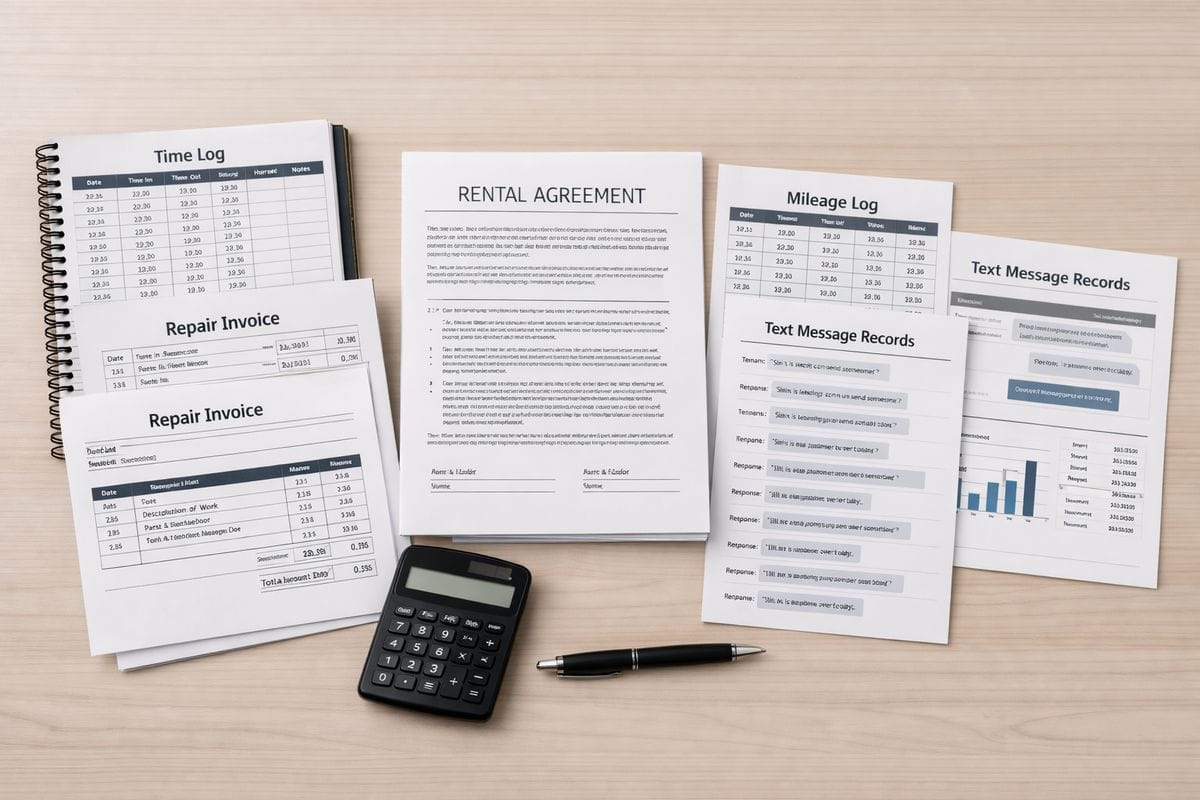
A strong log includes the date, property, task, duration, and business purpose. The entry should show what was done, where it was done, and why it mattered to operations.
Contemporaneous records outperform reconstructed records by a wide margin. A log entered weekly from calendars, texts, and work orders is far more credible than a year-end spreadsheet built from memory.
Records That Support the Log
Good support includes calendars, emails, text messages, work orders, leases, invoices, mileage records, call logs, accounting entries, and exports from property management software. The goal is not volume. The goal is alignment.
If your log says you coordinated a turnover on June 14 for 2.3 hours, there should be surrounding evidence that the turnover existed and that you handled it. That consistency reduces audit friction.
Common Recordkeeping Failures
Broad estimates fail. Repetitive entries fail. Logs that say “property management” for three hours every Tuesday fail. Spreadsheets built after receiving an audit notice fail. Courts have repeatedly rejected rough estimates and “ballpark” reconstructions in real estate participation cases.
The recommendation is operational, not clerical: build a system that creates evidence as the work happens. That is how a tax position becomes defensible.
How Material Participation Interacts With NIIT, QBI, and At-Risk Rules
Material participation does not operate alone. Your actual after-tax ROI depends on several overlapping rule sets.
Net Investment Income Tax (NIIT)
The NIIT imposes a 3.8% tax on certain net investment income above applicable income thresholds. Passive rental income often falls within that regime. If an activity is properly treated as non-passive, the NIIT analysis can change in your favor.
That makes classification more valuable than the ordinary income tax result alone suggests. A non-passive position can affect both loss usage and surtax exposure.
Qualified Business Income (QBI) Considerations
QBI is a different framework. Material participation does not automatically create a QBI deduction, and failing material participation does not automatically destroy it. Rental enterprise standards, trade-or-business analysis, and separate limitations all matter.
This is where many articles go off track. Passive activity rules answer one question. QBI answers another. The overlap is real, but the tests are not the same.
At-Risk Rules Before Passive Loss Rules
The at-risk rules under IRC §465 apply before the passive loss rules. If you are not at risk for the full amount claimed, your deduction can be limited before §469 even enters the picture.
That ordering matters. Material participation is not the only gatekeeper. It is one gate in a stack of gates.
2026-2027 Tax Planning Pressure: What Changes and What Stays the Same
Tax planning around material participation matters more when the broader rate environment is in motion. That is exactly the current setup.
What TCJA Sunset Changes for Real Estate Owners
After 2025, major individual TCJA provisions are scheduled to expire unless Congress acts. That means current tax rates are scheduled to change, and the present QBI regime is also scheduled to change. For real estate owners, this raises the value of timing. A deductible loss used in one year can produce materially different tax savings than the same loss used later.
This is not a theory exercise. It affects ROI, entity decisions, renovation timing, disposition timing, and whether current-year losses should be positioned for immediate use.
What Does Not Change: The Material Participation Framework
The passive activity architecture under §469 remains the core analysis unless Congress specifically changes it. The seven tests still govern material participation. The separation between real estate professional status and material participation still controls rental loss treatment.
That stability is useful. Rate law can shift. The participation framework remains the operating standard you plan around.
The Recommendation Before 2026
The recommendation is to review grouping elections, time-tracking systems, management structure, and real estate professional status eligibility before the sunset window closes. This is a time-to-value decision. Waiting until return preparation is too late.
If your target is current-year use of rental losses, your operation has to be built to support that result. If your operation cannot support it, your filing should not pretend otherwise.
Common Mistakes That Cause Deduction Denials
Based on analysis of common disputes, most deduction denials come from basic classification errors and weak records, not obscure legal issues.
Confusing Active Participation With Material Participation
The $25,000 exception is not material participation, and it does not create non-passive losses. It is a limited allowance with income phaseouts. Treating it as a full escape hatch is one of the most expensive mistakes in this area.
Assuming Ownership Equals Participation
Owning the property, approving major repairs, reading monthly reports, and checking occupancy numbers do not satisfy the tests by themselves. The IRS looks for actual participation time and actual task type.
A landlord is not automatically a material participant. An owner is not automatically an operator.
Ignoring the Annual Nature of the Test
Material participation is tested every year. A qualifying year does not carry forward automatically. Staffing changes, management changes, tenant stability, or a busier outside job can change the result.
That means your records and your analysis need to be annual as well.
Filing Without a Defensible Record
Unsupported hours create audit risk and often erase the intended benefit. Examinations strongly favor specific, contemporaneous records over reconstructed estimates, and courts do the same.
The recommendation is simple: treat documentation as part of operations, not tax cleanup.
FAQ: Direct Answers to the Questions Investors Ask Most
Does Material Participation Alone Make Rental Losses Non-Passive?
No, not for most long-term rental real estate. Rental activities are generally passive by default, so material participation alone does not change the result. To treat long-term rental losses as non-passive, you usually need both real estate professional status and material participation.
Can a Spouse’s Time Help Meet the Tests?
Yes. Spouse participation generally counts for material participation, which can materially improve your position on a joint return. But for real estate professional status, one spouse must separately satisfy the statutory requirements.
Can Time Spent Looking for New Deals Count?
Generally no, not for material participation in an existing rental activity. Acquisition analysis, market research, and financing discussions are usually investor or expansion activities, not day-to-day operational participation in the current rental activity.
Does Using a Property Manager Eliminate Material Participation?
No, but it makes several tests much harder to satisfy. A property manager often performs more hours than you do and takes over the direct operational work that creates countable participation time.
Is Contemporaneous Tracking Required by Statute?
A specific log format is not always required by statute. But examinations strongly favor contemporaneous, specific records over after-the-fact reconstructions. In practice, contemporaneous tracking is the standard that survives scrutiny.
Frequently Asked Questions
If 600 hours are spent managing rentals, are the losses automatically non-passive?
No. Six hundred hours usually satisfies the 500-hour material participation test, but long-term rental real estate is still passive by default. Without real estate professional status, the losses generally remain passive.
Can rental properties be grouped to reach 500 hours?
Yes, if a valid grouping election applies. Grouping can allow hours across multiple rentals to be combined for material participation analysis, which is often decisive for small portfolio owners. The election has long-term consequences, so it should be evaluated carefully.
Do bookkeeping hours count toward material participation?
Property-specific bookkeeping tied to actual rental operations usually counts. General financial review, portfolio monitoring, and investor-level analysis usually do not. The closer the work is to day-to-day operations, the stronger the position.
Does travel time to a property count?
Sometimes, but it is a gray area. Travel tied directly to operational work is more defensible than broad commuting-style claims. If travel time is included, the underlying business purpose should be documented with precision.
Can a full-time W-2 employee qualify as a real estate professional?
Yes, but the more-than-50% personal services test makes it difficult. You need more than 750 hours in real property trades or businesses, and that real estate time must exceed half of all personal service time for the year.
What is the safest material participation test for most investors?
The 500-hour test is the safest and strongest. It is the most objective, the easiest to document, and the least dependent on what other people did.
The Recommendation: Build a Defensible Position Before Filing
The recommendation is to choose the target tax outcome first, then align management structure, grouping elections, time tracking, and filing positions to that outcome. If the objective is current-year loss usage, build an operating model that supports real estate professional status where available and a clear material participation test, preferably the 500-hour test. If the operation uses third-party managers and owner-level oversight, accept passive treatment and plan around suspended losses honestly. Material participation is not a box to check. It is an operating standard that determines whether your rental tax strategy produces real ROI.