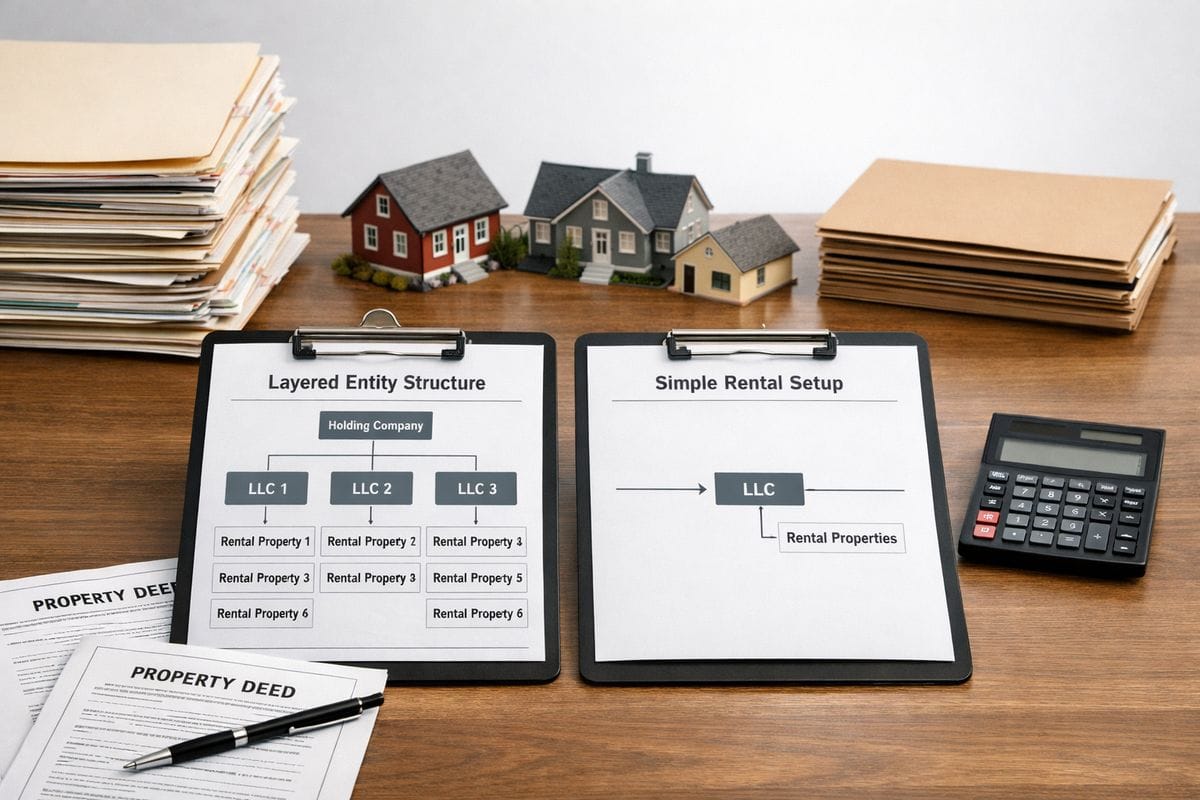
A holding company for rental properties is a parent entity that owns the entities holding your rentals, instead of putting every property in your personal name or dropping every door into one LLC. That matters because the structure changes risk, control, bookkeeping, financing, and succession planning far more than it changes taxes, and getting that distinction right saves money and prevents a lot of bad entity decisions.
What a Holding Company for Rental Properties Actually Is
A holding company for rental properties is not a magic tax shelter. It is an ownership structure. In plain English, you set up one parent company, usually an LLC, and that parent owns membership interests in one or more subsidiary LLCs that actually own the real estate.
Think of it like a breaker panel in a house. The power is centralized, but each circuit is separated so one problem does not shut down everything else. That is the real appeal here. You keep ownership organized at the top while limiting the spread of property-level risk below.
The business value comes from three places: risk separation, cleaner ownership, and easier portfolio management. Automatic tax savings do not belong on that list. Rental tax benefits such as depreciation, expense deductions, and gain deferral exist with or without a holding company. The structure simply makes those benefits easier to track, defend, and plan around.
How the Structure Usually Works
The standard version looks like this: a parent LLC sits at the top, and each child LLC owns one property or a small group of similar properties. Rent is collected at the property entity level or through a management setup, expenses are booked to the correct entity, and the parent owns the membership interests rather than holding title directly.
Some investors add a separate management company. That company handles leasing, maintenance coordination, and vendor contracts, then charges management fees where appropriate. That setup can make sense once a portfolio is large enough to justify true operating separation.
This differs sharply from owning rentals personally, where your name is on title and liability exposure runs straight to you. It also differs from putting every property into one LLC, where administration is easy but a lawsuit tied to one property can expose the equity of every asset inside that single entity. If putting one rental into an LLC already feels like a major step, a holding company is the next level up in complexity.

Why Investors Use a Holding Company
Based on analysis of common investor setups, the decision is really about ROI on complexity. A holding company adds cost, paperwork, banking, compliance, and planning work. In return, it gives cleaner boundaries between assets, more control over portfolio ownership, and a better framework for long-term wealth transfer.
For a small portfolio, that tradeoff often fails. For a larger one, it usually wins.
Liability Separation and Asset Protection
Liability separation is the headline reason to use this structure. If one property has a serious claim, a properly maintained entity structure helps contain that claim to the property-owning LLC instead of exposing the full portfolio.
That protection only works when entity formalities are real. Separate books, separate bank accounts, correctly titled contracts, and clean records matter. Ignore those basics and the structure starts looking cosmetic, which is exactly what courts punish.
Insurance still matters just as much. An LLC is one layer, not the whole plan. The recommendation is to treat entity structure and coverage as complementary tools, not substitutes. A deeper review of what actually protects rental assets makes the point clearly: structure without operational discipline is weak protection.
Centralized Control Without Mixing Risk
A holding company keeps ownership centralized. That gets more valuable as the portfolio grows from one or two rentals to several doors, especially when acquisitions happen over multiple years.
Instead of tracking direct ownership across a scattered set of properties, you control the parent and the parent controls the portfolio. That simplifies membership changes, partner buy-ins, and internal reorganizations. You can add or remove property LLCs without rewriting the entire ownership story every time.
The catch is operational friction. Each entity usually needs its own bank account, its own bookkeeping, and often its own annual filings. Field data from actual investor setups shows annual compliance costs often exceed $1,000 per entity. A five-property structure can easily cost $5,000 or more per year before legal review, CPA work, registered agent fees, and extra insurance endorsements. That cost is justified only when the equity being protected is materially larger than the carrying cost of the structure.
Better Fit for Multi-Owner and Family Portfolios
This is where holding companies become more than a liability tool. A top-level entity gives you a cleaner way to handle uneven ownership percentages, different capital contributions, inherited interests, and family investment arrangements.
If one property has one investor group and another has a different group, the structure can reflect that with separate child LLCs. If a family wants centralized voting control while gradually transferring economics to children, a family holding company makes that easier.
That is a real advantage, not theory. Ownership stops being tied to individual deeds and starts being tied to membership interests. That makes transfers more flexible and estate planning more manageable.

The Three Most Common Structures Compared
Most investors are not choosing between fifty entity models. The real-world decision usually comes down to three.
Single LLC for All Rentals
A single LLC for all rentals wins on simplicity and cost. One entity, one bank account, one operating agreement, fewer filings, and less admin drag. For a first-time landlord or a small local portfolio, that speed matters.
The weakness is concentration risk. If every property sits inside one LLC, every property equity dollar is inside the same liability bucket. One bad claim can reach all assets owned by that entity.
Separate LLC for Each Property
A separate LLC for each property gives the strongest liability separation. Accounting is cleaner by property, ownership can differ by asset, and exits are often easier to document.
It also creates the most overhead. More filings. More bank accounts. More bookkeeping. More annual fees. More chances to make mistakes. If all properties are in the same state and the portfolio is modest, this setup often produces more admin than value. A closer look at the hidden costs of entity layering usually changes how attractive this looks on paper.
Holding Company With Property-Level LLCs
This is the middle path for a growing portfolio. You keep property-level separation while centralizing ownership through the parent. For investors with several properties, material equity, outside partners, or estate-planning goals, this is often the cleanest long-term structure.
It becomes worth the complexity when four conditions are present: several properties, meaningful equity, long holding periods, and enough administrative discipline to keep the structure clean. Without those four, the model tends to underperform a simpler setup.
When a Holding Company Makes Sense , and When It Does Not
A holding company is not the default answer. It is a business tool that earns its keep only when the numbers and operational demands line up.
Good Fit: Growing Portfolios, Equity Protection, and Long-Term Ownership
The recommendation is strongest when you own multiple rentals, hold significant equity, plan to keep properties long term, and want clean succession planning. It also fits well when properties sit in different states, when specific properties have different investor groups, or when family wealth transfer is part of the plan.
This is especially true in Texas, where entity law is favorable and state income tax is not part of the equation. If a portfolio has six or seven figures of exposed equity, paying several thousand dollars per year to reduce spread risk and improve control is rational.
Poor Fit: One Low-Equity Rental and No Appetite for Compliance
If you own one low-equity rental, all assets are in one state, cash flow is tight, and bookkeeping already feels like a chore, a holding company is overkill. The same is true if frequent refinancing is part of your strategy and lender-friendly simplicity matters more than top-tier entity segmentation.
Small portfolios under five units often fall into this bucket. The math is hard to ignore. A structure costing $3,000 to $5,000 annually needs to produce clear protection or planning value. If the portfolio does not justify that, the better move is often a simpler entity and stronger insurance. For many investors, the right time to add complexity arrives later than expected.
Tax Reality: What a Holding Company Changes and What It Does Not
Here is the misconception to kill early: a holding company does not lower taxes by itself. Entity structure changes administration and planning. Tax results come from rental real estate rules already available under federal law.
Pass-Through Tax Treatment and Schedule E Basics
Most rental LLCs remain pass-through entities by default. Income and deductions flow through to the owner, and many landlords report rental activity on Schedule E. If substantial services are provided primarily for tenant convenience, reporting can shift toward Schedule C instead.
Rental income is taxable whether received as cash, services, or property value, and ordinary rental expenses are generally deductible against that income under IRS rental rules. In practice, the holding company does not rewrite those basics. It just gives cleaner lanes for capturing them correctly.
Deductions, Depreciation, and Cost Segregation
The recurring tax drivers are straightforward: operating expenses, repairs, management fees, mortgage interest where allowed, property taxes, and depreciation. Residential rental property is typically depreciated over 27.5 years and commercial property over 39 years.
That baseline matters, but the bigger planning opportunity is acceleration. Cost segregation can break out shorter-life assets such as appliances, flooring, certain land improvements, cabinetry, and fixtures so deductions arrive faster. For qualifying property placed in service after Jan. 19, 2025 and before Jan. 1, 2031, 100% bonus depreciation is restored, which makes timing and classification far more valuable.
A holding company does not create those deductions. It makes the ownership map cleaner so those deductions can be assigned, tracked, and defended with less confusion.
QBI, Interest Deductions, and Business Classification
Some rental operations qualify for up to a 20% qualified business income deduction if safe harbor and business standards are met. The line here is not entity name, it is substance. Records, hours, management activity, and business-like operations drive the result.
Interest deduction rules also improved because business interest is now measured using EBITDA rather than EBIT for relevant tax years, which generally expands deductible interest for real estate businesses.
One warning matters. If operations start looking like high-service hospitality rather than standard rentals, tax reporting changes. That is another reason clean entity design and clean records matter.
Texas-Specific Advantages and the Series LLC Question
Texas gets special attention for good reason. No state income tax helps portfolio efficiency, and Texas law has long made LLC planning attractive for real estate owners.
Why Texas Investors Look at Series LLCs
A series LLC is one umbrella entity with separate internal series, each intended to hold different assets and liabilities. For Texas investors, the appeal is obvious: lower filing volume, lower maintenance cost, and a version of asset separation without forming a full stack of traditional LLCs.
If the goal is cost control while segmenting properties, the structure deserves review. For an all-Texas portfolio with straightforward ownership and cash purchases, it can be efficient.
Where Series LLCs Help , and Where Traditional LLC Stacks Still Win
The problem is practical, not theoretical. Lenders often hesitate. Title companies sometimes slow down. Cross-state recognition remains less predictable. Even routine transactions can get harder because not every counterparty is comfortable with series structures.
That is why the recommendation stays decisive: when financing clarity, title certainty, and operational predictability matter most, a traditional holding company plus property-level LLCs usually wins. A series LLC is attractive on filing cost, but less attractive when real transactions hit real friction.
How to Set Up a Holding Company for Rental Properties
Setup matters, but the highest-value decisions happen before any filing.
Choose the Entity Type and Ownership Map
Start with the ownership design. Decide whether the parent should be a standard LLC, a family LLC, a partnership-style structure for multiple investors, or an entity coordinated with a trust. Map voting control separately from economics if family transfers are part of the plan.
This is also where spouse ownership, inherited interests, and management rights need to be handled intentionally. The point is not just who owns what today. The point is who controls decisions, who receives income, and how interests transfer later.
Form the Entities and Open Separate Banking
After the ownership map is clear, form the parent and child entities, obtain EINs, sign operating agreements, and open separate bank accounts. Then keep accounting by entity from day one.
Commingling defeats the purpose. If one account pays every mortgage, every contractor, and every personal expense, the structure stops acting like separate businesses and starts acting like paper theater.
Transfer or Acquire Properties the Right Way
Buying new properties directly in the right entity is usually cleaner than transferring properties later. Transfers of already-owned rentals trigger lender review, title work, insurance revisions, and due-on-sale concerns.
That review is not optional. Deeds, loan documents, and carrier policies need to align before a transfer happens. Some investors also use trusts in the chain for privacy or estate planning, but that works only when the structure is coordinated carefully. If title privacy is part of the goal, using trusts alongside LLCs deserves separate analysis before any deed is moved.
The Compliance Rules That Determine Whether the Structure Actually Works
This is the section that decides success or failure. Fancy entity charts do not protect anything by themselves.
Keep Entity Formalities and Records Clean
Keep separate books, lease files, repair receipts, capital improvement records, and documentation for tenant-paid expenses. Track which entity signed which contract and which entity paid which invoice. Keep digital backups and maintain records long enough to support deductions and audit defense.
That discipline improves more than liability protection. It speeds reporting, reduces tax prep friction, and makes property performance measurable. Time-to-value improves because decisions are based on clean numbers instead of reconstruction work every March.
Match Insurance, Management, and Contracts to the Entity Structure
The named insured on the policy should match the owner. The lease should match the owner or authorized manager. Vendor contracts should reflect the entity actually hiring the vendor. If a management company exists, management agreements should say so clearly.
This sounds basic because it is. But this is where many structures fail. The deed says one thing, insurance says another, leases use an old name, and the bank account belongs to a different entity. That kind of mismatch destroys the clean separation the model depends on.
Estate Planning and Generational Wealth Transfer
For higher-value portfolios, the bigger question is not only how to hold rentals during life. It is how to transfer them without blowing up control or tax efficiency.
Family LLCs, Trusts, and Control During Lifetime
A family holding company can centralize decision-making while allowing gradual transfers of membership interests over time. That gives you one governance system instead of multiple deed changes across multiple properties.
Revocable trusts often fit above or beside the entity structure, depending on the plan. The key is coordination. The entity should support lifetime control while making future transfers cleaner, not harder.
Step-Up in Basis and Heir-Friendly Transfers
The most important tax concept in long-term real estate succession is step-up in basis. At death, appreciated property generally receives a new tax basis based on date-of-death value, which can erase a large built-in capital gain for heirs. That is why buy-and-hold investors care so much about transfer design.
Beginning in 2026, the federal estate tax exemption rises to $15 million per person and $30 million per couple, which changes planning for larger estates but does not remove the need for coordination. A holding company should support those transfer goals, not interfere with them. If heirs will eventually inherit the portfolio, understanding how basis resets at death and what inherited property basis actually means becomes part of the entity conversation, not a separate topic.
Common Mistakes and Frequently Asked Questions
“Will a Holding Company Lower Taxes?”
No automatic tax reduction comes from the holding company itself. The structure improves organization and planning, which makes it easier to capture depreciation, deductions, interest treatment, and exit strategy correctly.
“Can Existing Rentals Be Moved Into an LLC or Holding Company?”
Yes, but only after legal, lender, title, and insurance review. Free-and-clear properties are easier. Financed properties demand tighter review because loan documents and due-on-sale language matter.
“Is One LLC Enough?”
One LLC is enough when risk concentration is low, equity is limited, and the portfolio is small. Once multiple doors and meaningful equity sit in one bucket, the case for segregation gets much stronger.
Frequently Asked Questions
Does a holding company need its own bank account?
Yes. Every entity in the structure should have separate banking. Shared accounts create commingling problems and weaken both liability protection and accounting accuracy.
How many properties justify a holding company?
The count alone does not decide it. Equity at risk, property value, partner structure, and long-term ownership plans matter more. In practice, the structure starts making economic sense once multiple properties carry meaningful combined equity or different ownership groups.
Is a holding company better than a series LLC in Texas?
For financing clarity and transaction predictability, yes. A series LLC can reduce filing burden, but traditional parent-and-child LLC structures are easier for lenders, title companies, insurers, and out-of-state transactions.
Will lenders allow a financed rental to be transferred into an LLC?
Sometimes, but lender consent needs review before any transfer. Ignoring loan terms is a direct path to avoidable problems.
Can a holding company help with estate planning?
Yes. It can simplify transfers by moving membership interests instead of retitling each property individually, and it works especially well when family control and staged ownership transfers are part of the plan.
Does each child LLC need a separate tax return?
Not always. Single-member LLCs are often disregarded for federal tax purposes, while multi-member LLCs usually file partnership returns. The administrative burden still rises because bookkeeping, banking, and compliance remain separate even when federal filing treatment is simpler.
The Recommendation: Use a Holding Company Only When the Structure Produces Clear Business Value
Based on analysis of common investor setups, the recommendation is direct: use a holding company for rental properties when you own multiple rentals, hold material equity, expect long holding periods, have partner or family ownership complexity, or want a cleaner path for generational transfer. In that setting, the extra cost produces real ROI through risk containment, cleaner control, and better succession design.
For one small rental, or a small same-state portfolio under five units, the better answer is usually a simpler LLC setup with strong insurance and disciplined bookkeeping. The winning outcome is not the most complex chart. It is the structure that matches your portfolio size, financing needs, tax planning, and transfer goals without creating admin drag that the business cannot justify.