
Cost segregation commercial property is an IRS-accepted tax strategy that breaks one building into multiple depreciation buckets, so more of the cost gets written off sooner. That matters because faster depreciation improves near-term cash flow, lifts after-tax ROI, and frees capital for debt paydown, renovations, or the next acquisition.
What Cost Segregation for Commercial Property Means
A commercial building is not one tax asset in any practical sense. For tax purposes, the structure itself usually depreciates over 39 years, but many parts inside and outside that property do not belong in the same bucket. Cost segregation identifies those parts and assigns them to shorter lives such as 5, 7, or 15 years.
The business outcome is simple: deductions move forward in time. You do not create depreciation out of thin air. You accelerate it. That timing difference is what drives the value, because tax savings in year one and year two are worth more than the same deductions spread thinly across nearly four decades.
How Commercial Depreciation Differs From Residential Rentals
If your background is single-family rentals or small multifamily, your mental model is 27.5-year residential depreciation. Commercial property uses a different schedule, and that alone changes the tax playbook.
Office, retail, industrial, NNN properties, and larger apartment assets often contain more site work, more specialized systems, and more tenant-specific buildout than a basic residential rental. Based on analysis of commercial studies, that wider mix of components is exactly why commercial assets often produce stronger front-loaded deductions than smaller residential properties.
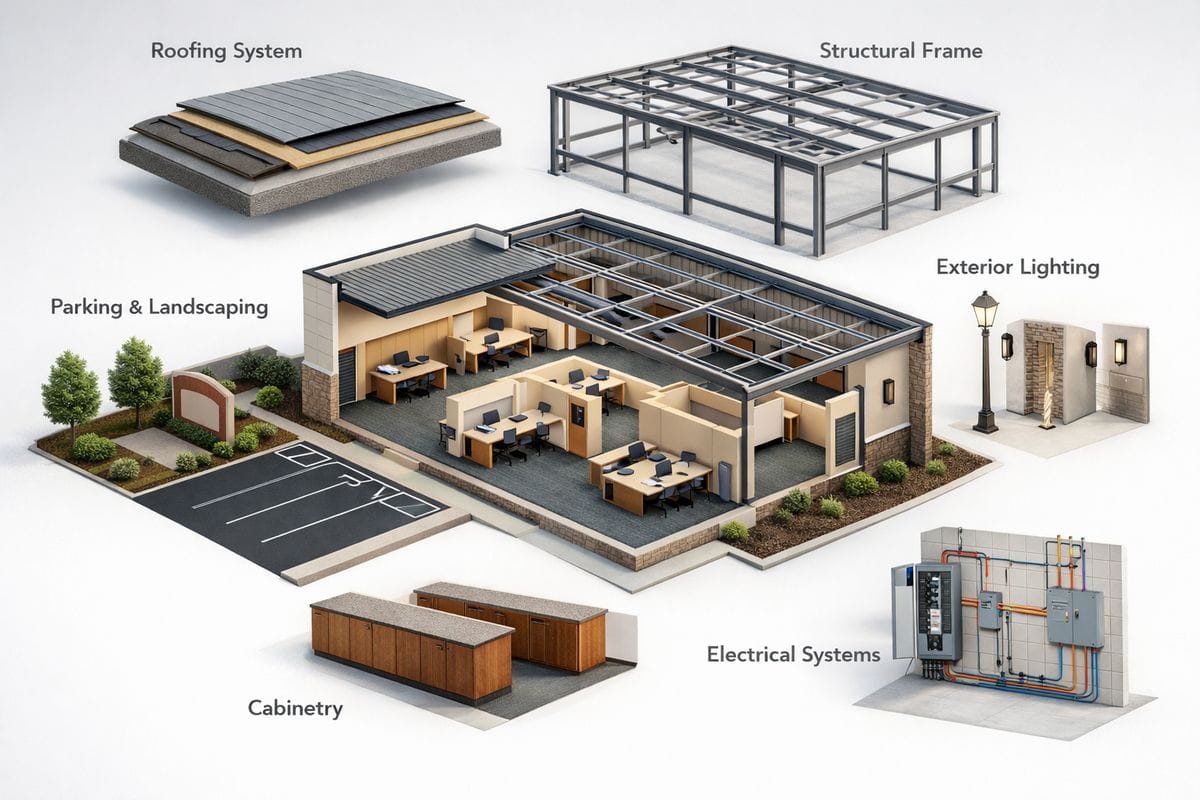
The Core Idea: A Building Is Not One Asset
Parking lots, landscaping, signage, decorative lighting, specialty electrical, certain plumbing fixtures, carpet, cabinetry, and interior finishes often qualify for shorter treatment. A parking lot is commonly 15-year land improvement. Decorative lighting often falls into 5-year property. Carpet is typically 5-year. Cabinetry often lands in 7-year treatment. Electrical that serves specific equipment, rather than the whole building, often falls into 5- or 7-year property.
What the field data shows is that standard properties commonly reclassify about 20% to 30% of depreciable basis. In a benchmark set of 8,000+ studies, the median accelerated allocation was 24.0%, with a normal range of 22% to 28% for standard assets. That is the right anchor for an ordinary office or apartment building.
How a Cost Segregation Study Works
A cost segregation study is an engineering-based tax analysis, not a bookkeeping exercise. The report identifies building components, assigns costs, ties those costs to IRS class lives, and produces support that belongs in your tax file for as long as you own the property.
A defensible study also answers the practical question investors care about: how much basis shifts into shorter-life categories, and what does that do to current-year deductions?
The Four Phases of a Defensible Study
Phase one is the feasibility review. This is where the property, purchase price, land allocation, improvements, tax profile, and likely ROI get screened. If the depreciable basis is too small, the study is not worth ordering.
Phase two is document collection. The standard file includes the settlement statement, depreciation schedule, blueprints, invoices, site maps, surveys, appraisal support, and details on remodels or tenant improvements.
Phase three is the site inspection. An engineer walks the property, photographs components, measures finishes, reviews site work, and confirms what was actually built. That physical inspection matters because depreciation categories depend on function, not just labels in a closing statement.
Phase four is the final allocation report. That report assigns costs to 5-year, 7-year, 15-year, and 39-year property and provides the tax-law support behind each classification.
Why Engineers and Tax Advisors Both Matter
A proper study requires engineers and tax advisors. The engineer identifies and quantifies components. The tax specialist maps those components to the right recovery periods and reporting rules. Without both pieces, the result is either technically weak or tax-law weak. Neither holds up well if the IRS asks for support.

Where the Tax Savings Come From
The savings come from front-loading deductions. That is the whole strategy. Shorter recovery periods push more depreciation into the early years of ownership, where the cash flow impact is strongest.
The Three Drivers of Year-One Savings
The first driver is shorter class lives. Moving part of the basis from 39 years to 5, 7, or 15 years sharply increases annual depreciation.
The second driver is bonus depreciation on eligible assets. For applicable property categories, bonus depreciation was 60% in 2024 and 40% in 2025. That phase-down matters because the same study produces different year-one savings depending on when assets are placed in service.
The third driver is the immediate taxable income effect. If your tax profile can absorb the deductions, lower taxable income means lower current taxes and more capital retained inside the portfolio.
A Simple Dollar Example for a Commercial Building
Use a $1,000,000 office building purchase with $200,000 allocated to land and $800,000 to building. Without cost segregation, annual depreciation on the building basis is about 20,512.82 over 39 years.
Now assume the engineering study inspects the property and identifies these components: parking lot and landscaping as 15-year property, decorative lighting and carpet as 5-year property, cabinetry as 7-year property, and dedicated electrical serving office equipment as 5- or 7-year property. The report then allocates those costs into shorter-life classes and leaves the structural shell, roof, load-bearing walls, and general building systems in 39-year property.
In this example, first-year depreciation rises to about 52,106.23 before bonus depreciation. At a 37% federal rate, that is about $11,689.56 in first-year tax savings from accelerated depreciation alone, versus roughly $7,500 without cost segregation. If $300,000 of reclassified assets also qualifies for 60% bonus depreciation, first-year tax savings jump dramatically, with an estimated benefit of about $72,634.
What Real-World Benchmark Data Shows
Benchmarking keeps expectations grounded. Based on analysis of 8,000+ studies, average accelerated allocation was 16.3% for 5-year property and 11.4% for 15-year property, with total reclassification commonly landing in the 20% to 30% range. For standard office and apartment assets, 24% is a reasonable anchor. Claims far above that on ordinary properties deserve scrutiny, not applause.
Which Commercial Properties Benefit the Most
Property type drives results. More specialty buildout and more site improvements usually mean more accelerated basis.
Typical Winners: Multifamily, Retail, Medical, and NNN Properties
Apartment buildings, shopping centers, medical offices, and many NNN properties regularly produce meaningful savings because those assets often include parking areas, walkways, landscaping, upgraded interiors, tenant-specific electrical, and other short-life components. For investors moving up from residential portfolios, this is where commercial tax treatment starts to separate itself in a meaningful way.
High-Yield Property Types and Lower-Yield Property Types
Standard properties usually land in the 20% to 30% range. Specialty properties with extensive site work or equipment can reach 30% to 50% or higher. Hospitality, car washes, gas stations, and specialty retail sit near the high end. Basic warehouses and high-rise offices sit lower. In fact, high-rise office buildings were among the weakest categories in the benchmark data.
When Cost Segregation Pays Most
Timing changes ROI. The earlier the study is done, the more of the hold period benefits from accelerated deductions.
Best Timing: Acquisition, Construction, or Major Renovation
The recommendation is to complete the study in the year of acquisition, construction, or major remodel. That captures the maximum time-to-value and gets the deductions working early, when cash flow pressure is highest.
Look-Back Studies and Catch-Up Depreciation
A missed study is not a lost opportunity. A look-back study can be performed years later, and the missed depreciation is often claimed through a Form 3115 accounting method change instead of amending prior returns. That makes retroactive planning very practical for investors who bought commercial property before understanding cost segregation.
Minimum Property Size and ROI Thresholds
The practical starting point is about $300,000 of depreciable basis. At that level, first-year tax savings can exceed study cost. For a $1 million property, year-one tax savings often land around $40,000 to $60,000, while study costs are often around $10,000. That is a strong ROI by any investment standard.
The Tradeoffs, Limits, and Tax Rules to Watch
Cost segregation is powerful, but it is not magic. The value depends on timing, tax capacity, and exit strategy.
Depreciation Recapture at Sale
Accelerating deductions now increases recapture exposure later. That is the tradeoff. You get stronger current cash flow, and part of that benefit reverses on sale. For owners focused on hold-period cash flow and reinvestment, that trade usually works. For very short-term holds, the edge narrows.
Passive Activity Limits, Taxable Income, and Bonus Depreciation Rules
Accelerated depreciation only creates immediate value if your tax profile can use it now. Existing losses, passive loss limits, or low taxable income can delay the benefit. Bonus depreciation rules also change by year, so year-one projections must match the actual placed-in-service date.
Aggressive Reports vs. Defensible Results
A report that promises 45% or more accelerated allocation on a plain apartment or office building is a review point, not a selling point. Based on analysis of 8,000+ studies, 24% is the right anchor for standard properties. Defensible results beat inflated results every time.
How to Evaluate Whether a Study Makes Sense for Your Deal
A good decision starts with five variables: basis, hold period, property type, taxable income, and renovation plans. Those five drivers determine the size and timing of the benefit.
The Five Questions to Ask Before Ordering a Study
Start with depreciable basis. Below roughly $300,000, the math usually gets thin. Then look at hold period, because longer holds improve the tradeoff against recapture. Next, evaluate property type and site improvements, since those control the likely allocation range. Then confirm taxable income, because unused deductions do less for current cash flow. Finally, account for planned renovations, because replacements and remodels increase the value of a detailed asset breakdown.
What to Ask the Provider
Ask if the study includes an engineering site visit. Ask how many similar properties have been analyzed. Ask for a sample report. Ask for the expected allocation range and how it compares to benchmark data. Ask what audit support is included. Ask how pricing works. The report should show clear asset classifications, cost methodology, and tax-law support.
Clear Recommendation
For commercial and larger multifamily owners with meaningful depreciable basis, taxable income to offset, and a hold strategy that values current cash flow, cost segregation is a high-ROI tax acceleration tool. The recommendation is strongest when the study is completed near acquisition and benchmarked against realistic allocation ranges.
Frequently Asked Questions
Is cost segregation only for large commercial deals?
No. It generally starts to make sense at about $300,000 of depreciable basis, and it becomes especially attractive above $1 million. Larger properties usually deliver stronger ROI because study cost rises far more slowly than potential tax savings.
Can an apartment building use cost segregation?
Yes. Larger multifamily properties are often strong candidates because they include site improvements, interior finishes, dedicated systems, and common-area components that qualify for shorter lives.
What happens if the property was purchased years ago?
A retroactive, or look-back, study can still work. Missed depreciation is usually claimed through Form 3115 as a catch-up adjustment in the current year, without amending prior returns.
How long does a commercial cost segregation study take?
Many studies take roughly four to eight weeks once documents are collected. Complexity, property size, and the quality of records all affect the timeline.
Does cost segregation always reduce taxes right away?
No. The deduction is immediate, but the tax benefit depends on your ability to use it. Passive loss limits, existing losses, or low taxable income can delay the cash impact.
Is cost segregation aggressive?
No, not when it is done correctly. It is an IRS-accepted method, but the report must be engineering-based, properly documented, and grounded in realistic allocation benchmarks.