
If you want to know how to track rental property expenses the right way, start with one fact: bad records cost real money. In a 2026 survey of 835 landlords, 59% said expense categorization was their biggest tax prep challenge, and 31% said incomplete records caused missed deductions. Clean tracking protects deductions, shows true cash flow, and gives faster answers when a CPA, lender, or IRS agent asks for proof.
Why Tracking Rental Property Expenses the Right Way Matters
Rental expense tracking is not bookkeeping busywork. It is the control system behind tax deductions, property-level profitability, and year-end reporting. The IRS allows deductions for operating expenses, repairs, and depreciation, but only when the amounts are properly tracked, classified, and supported.
The business case is stronger now because costs keep rising. Based on landlord survey data, 82% of landlords saw ownership costs increase in 2024, and 26% saw increases above 20%. Separate research found 74.4% of landlords reported rising ownership costs driven heavily by taxes and insurance. If costs are climbing and records are weak, NOI gets squeezed twice, once by higher expenses and again by missed deductions.
What the field data shows is simple: portfolios with current books make better decisions. Monthly reports reveal when insurance renewals jump, turnover costs spike, or maintenance starts eating margin. That matters because tenant turnover averages $1,795 per month, per unit, and single-family maintenance can exceed $10,000 per year. Tracking expenses as an operating system, not a tax-season cleanup project, is the recommendation.
What You’ll Need Before You Start
Before entering a single transaction, build the structure. A one-property landlord needs fewer moving parts than a portfolio owner with multiple entities, but the underlying standard is the same: every expense needs a source, a category, a property assignment, and a paper trail.
Dedicated financial accounts
Open a separate bank account for rental activity. Add a dedicated credit card used only for rental purchases. That single move removes the biggest bookkeeping failure point, mixed personal and rental spending.
For one property held personally, one rental bank account and one rental card is enough. For a growing portfolio, label accounts by entity or activity type. A short-term rental business, a flip entity, and a long-term hold portfolio should not share transaction flow if the reporting needs are different.
Core source documents
Gather the documents that define both current deductions and long-term basis:
- Closing disclosure or settlement statement
- Mortgage statements and Form 1098
- Property tax bills or assessments
- Insurance invoices
- Leases
- Utility bills
- Vendor invoices and receipts
- Property management statements
- Prior-year tax returns
- Loan closing documents
- Escrow statements
Without these documents, the books become guesswork. Guesswork does not survive an audit.
Tracking method
Three options work.
A spreadsheet fits one property with low transaction volume and a disciplined owner. Accounting software fits portfolios where bank feeds, receipt capture, and property-level reporting save time. A bookkeeper or tax advisor fits higher complexity, including short-term rentals, flips, multiple entities, depreciation strategy, cost segregation, or real estate professional status planning.
Based on analysis of common landlord setups, software becomes the recommendation as soon as manual entry starts costing time, delaying categorization, or creating missed documentation.
IRS forms and tax references to keep in mind
Build the system around the forms that matter. Schedule E is where most rental income and expense reporting lands. Form 4562 handles depreciation and amortization. IRS Publication 527 covers residential rental property. IRS Publication 946 covers depreciation.
If the chart of accounts does not map cleanly to those rules, year-end cleanup gets expensive.

Step 1: Separate Rental Finances From Personal Spending
- Open a rental-only checking account.
- Open a rental-only credit card.
- Stop paying rental bills from personal accounts.
- Move all rent deposits into the rental account.
- Document any owner-paid items as contributions.
This step is non-negotiable. Commingling creates missing deductions, duplicate entries, and ugly reconciliations.
Open and label dedicated accounts
Name accounts clearly. Use the entity name, property group, or portfolio label that matches the tax return. If one LLC owns three long-term rentals, use one account structure for that LLC. If separate entities exist, separate the accounts.
Checkpoint: every incoming rent payment and every outgoing rental bill has an obvious account home.
Move recurring rental payments into the new system
Change the payment method for insurance, utilities, software subscriptions, management fees, lawn care, pest control, and recurring vendors. Update ACH drafts and autopay settings immediately.
This matters because recurring charges are the easiest expenses to miss when accounts are split across personal and rental banking.
Clean up mixed transactions from the start
Review the last 60 to 90 days of activity. Reimburse personal charges that were actually business costs, book owner contributions for out-of-pocket rental purchases, and remove personal purchases accidentally charged to the rental card.
Checkpoint: by the end of month one, the rental account contains rental activity only, plus clearly labeled owner contributions and draws.
Step 2: Choose a Tracking System That Fits Your Portfolio Size
- Count the number of properties.
- Count average monthly transactions.
- Decide how much time gets spent on coding and receipts.
- Choose the system that matches the workload, not the current habit.
Use a spreadsheet if you have 1 property and low transaction volume
A basic spreadsheet works when the transaction count is low and discipline is high. Include these columns: date, vendor, property, category, amount, payment method, and notes. Add a receipt file path or link if the file is stored digitally.
That is the minimum viable structure. Anything less turns into a tax-season scavenger hunt.
Use rental accounting software for automation and scale
Software earns its cost fast once bank feeds, receipt capture, and property-level reports eliminate manual drag. The features that matter are simple: imported transactions, digital receipts, custom categories, Schedule E summaries, and an audit trail.
The data shows adoption is moving this direction. In a landlord survey, 21% had already switched to real-time receipt capture. That number will rise because speed and documentation quality improve together.
Use a bookkeeper or tax advisor when complexity rises
Bring in professional help when the portfolio includes multiple entities, flips, short-term rentals, cost segregation studies, heavy renovation cycles, or advanced tax planning. The goal is not just data entry. The goal is correct treatment of basis, depreciation, repairs, and owner transactions.
That said, outsourcing does not remove the need for a system. It only raises the standard for source documents and communication.
Step 3: Build Your Expense Categories Before Entering Transactions
- Create the categories first.
- Match them to tax treatment.
- Keep operating costs separate from capital items.
- Use the same categories every month.
Bad categorization is where deductions go to die.
Operating expenses
Track routine costs in clear buckets: management fees, utilities, insurance, advertising, software, cleaning, lawn care, pest control, office expenses, supplies, internet, HOA dues, and payment processing fees.
These are current-period operating costs. They belong in current books, not buried in vague labels like “miscellaneous.”
Repairs and maintenance
Track ordinary repairs separately from operations. Patching drywall, fixing a leak, replacing a lock, servicing HVAC equipment, snaking a drain, or replacing a faucet are repair and maintenance items when they keep the property in ordinary working condition.
This category gets special attention because it is the most audit-prone area for landlords.
Taxes, interest, and insurance
Create separate lines for mortgage interest, property taxes, lender fees, and insurance. Do not combine them. Form 1098 supports mortgage interest, tax bills support property tax, and policy invoices support insurance.
When escrow is involved, the actual tax and insurance expense still needs separate tracking.
Capital improvements and fixed assets
Create separate asset categories for roofs, HVAC systems, flooring, appliances, remodels, new water heaters, windows, fencing, cabinets, and furniture for short-term rentals. These costs are not routine operating expenses. Many must be capitalized and depreciated.
Travel, mileage, and home office
Keep travel, local mileage, and home office in separate categories with stronger documentation. These areas require a higher level of substantiation and should never be dumped into general admin.
Property-specific vs. portfolio-wide expenses
Some costs apply to one property. Others support the whole portfolio, such as umbrella insurance, software, legal work, or admin support. Set those up in distinct categories so allocation stays consistent and NOI stays meaningful.
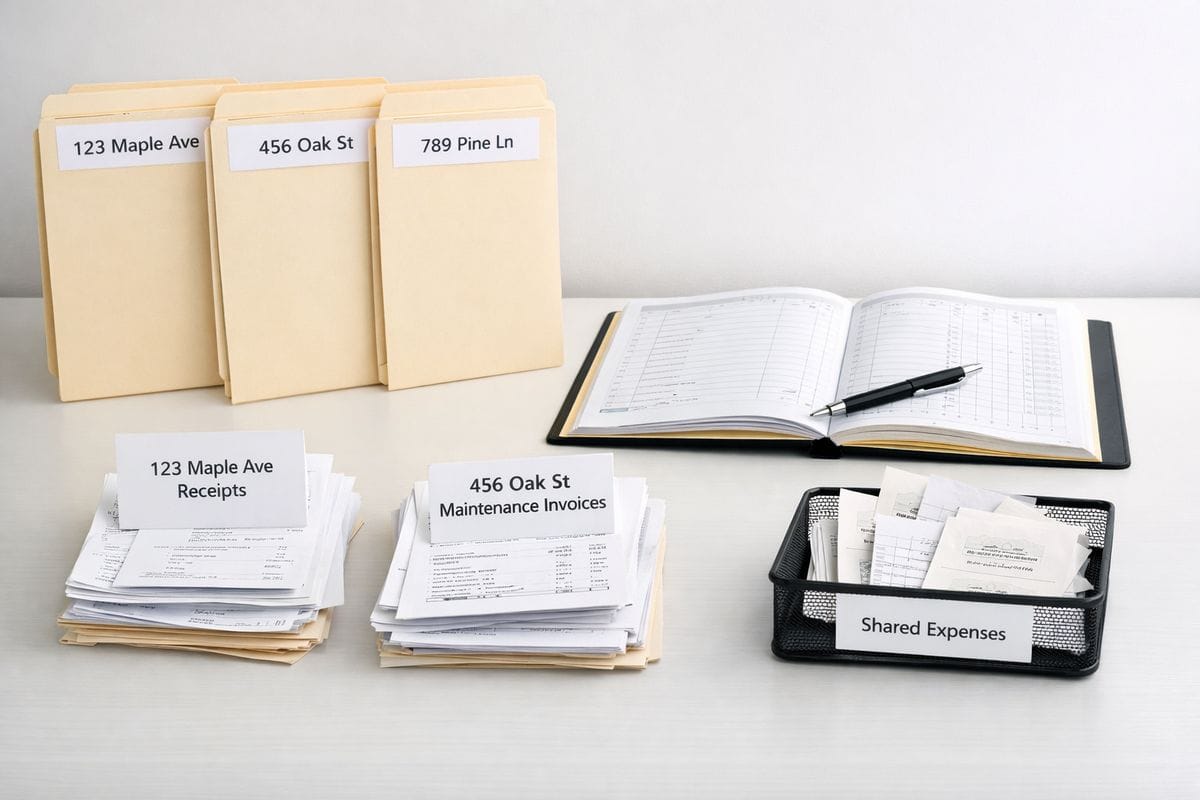
Step 4: Set Up Each Property as Its Own Profit Center
- Create one ledger per property.
- Assign every transaction to a specific address or unit.
- Keep shared costs in separate accounts.
- Allocate shared costs using a fixed method.
A portfolio-level lump sum hides underperformance.
Create a separate ledger for each property
Every address needs its own income and expense trail. That means one property code, one ledger, and one report. If one duplex has two units, unit-level tracking can add value for turnover and rent analysis, but property-level tracking is the minimum standard.
Track common-area or portfolio expenses separately
Admin software, umbrella insurance, office supplies, bookkeeping fees, and shared maintenance should sit in portfolio-wide accounts until allocated. Do not force them into one random property.
Use a simple allocation method and document it
Use unit count, square footage, or revenue share. Pick one method that matches the expense and stick to it. Document the rule in a short written policy.
Checkpoint: a month-end P&L should show direct costs by property and clearly assigned shared costs.
Step 5: Record Every Expense in Real Time
- Enter the expense the day it happens.
- Assign the property.
- Assign the category.
- attach the support.
- Add notes for anything unusual.
Real-time entry reduces forgotten details. It also catches duplicate vendor charges before months pass.
Capture the transaction on the day it happens
For each expense, record the date, payee, amount, property, category, tax treatment, and business purpose. Tax treatment means current expense, capital improvement, loan cost, mileage, or reimbursable item.
Upload or attach the receipt immediately
Attach the invoice, receipt, work order, or statement while the details are fresh. Do not rely on memory later. A bank line that says “Home Depot $486.22” does not explain what was purchased or how it should be treated.
Add notes that explain unusual charges
Use notes for tenant damage, insurance claims, emergency repairs, owner-paid items, and partial reimbursements. Those notes save hours during tax prep and audit review.
Step 6: Document Receipts and Proof the Way the IRS Expects
- Keep payment proof.
- Keep business-purpose proof.
- Keep contemporaneous logs where required.
- Retain long-term records for basis.
Keep both payment proof and business-purpose proof
A credit card statement proves payment. It does not prove what was bought or why it was ordinary and necessary. Pair statements with invoices, signed contracts, work descriptions, receipts, and email confirmations.
Organize digital files by property and tax year
Use a folder structure that matches the books:
Property Address > Tax Year > Expense Category > Receipt or Invoice
Use consistent file names such as 2026-03-14_123Main_Plumbing_LeakRepair_425.00.pdf. Searchability matters during tax prep, refinancing, and sale due diligence.
Retain records for current deductions and long-term basis tracking
Routine expense support should be retained with the annual tax file. Improvement records, depreciation schedules, and closing documents should be retained for as long as the property is owned, plus the full statute period after sale, because they affect basis and gain calculation.
Expense tracking reference card
Use this standard:
- No receipt needed, but written record required: cash expenses under $75 still need the date, amount, property, vendor, and business purpose recorded.
- Receipt required: expenses over $75 need a receipt or equivalent source document plus payment proof.
- Contemporaneous log required: mileage and travel need a current log showing date, destination, business purpose, and miles or travel details. A year-end reconstruction is weak support and often rejected.
- Special documentation required: home office and listed property need tighter records showing exclusive business use, square footage or usage method, and supporting calculations.
Entertainment is not deductible. Keep it out of the books.

Step 7: Classify Repairs vs. Improvements Correctly
- Ask whether the work restores a major component.
- Ask whether it makes the property better.
- Ask whether it adapts the property to a new use.
- If yes, treat it as an improvement.
Apply the restore-better-adapt framework
Use a plain-English test. If the cost restores a major component, makes the property materially better, or adapts it to a new use, capitalize it. If it keeps the property in ordinary operating condition, deduct it as a repair.
Use side-by-side examples
Here are 10 specific examples:
- New paint after normal wear: repair.
- Patching drywall holes: repair.
- Replacing a faucet: repair.
- Replacing a few broken shingles: repair.
- Servicing an HVAC unit: repair.
- New water heater: improvement.
- Full roof replacement: improvement.
- Full HVAC replacement: improvement.
- Kitchen remodel with new cabinets and layout changes: improvement.
- New flooring throughout the property as part of a broader upgrade: improvement.
A new water heater is an improvement because it replaces a major building component. New paint is routine maintenance. A new roof is an improvement because it restores a major component and extends useful life.
Handle materials, labor, permits, and related costs together
If a project is capitalized, capitalize the labor, materials, permits, delivery, haul-off, and related contractor costs too. Do not expense labor while capitalizing materials for the same job. One project gets one treatment.
Flag gray-area projects for advisor review
Get review when dealing with casualty work, phased renovations, partial asset dispositions, or projects that combine repairs with upgrades. Also pay attention to safe harbors. The de minimis safe harbor election generally allows expensing certain items costing up to $2,500 per invoice or item when a proper election is made with the tax return and a written capitalization policy exists at the start of the year. Track those items separately so the election can be applied cleanly.
Step 8: Track Depreciation Inputs, Not Just Cash Expenses
- Pull basis data from closing documents.
- Separate land from building value.
- Add placed-in-service dates.
- Track every new asset addition.
Start with the purchase closing statement
Use the settlement statement to identify purchase price, acquisition fees, lender charges, and items that belong in basis. This is where depreciation starts.
Separate land from building value
Land is not depreciable. Split land from building value using assessment data, appraisal support, or another defendable method. Document the method used and keep it with the tax file.
Add new assets as they are placed in service
Track appliances, flooring, roofs, HVAC systems, windows, cabinets, furniture, and fixtures with date placed in service, cost, description, and property address. That information feeds Form 4562.
Track loan costs and amortizable fees
Points, certain financing fees, and refinance costs belong in their own category. They are not repairs, not maintenance, and not building basis in every case. Separate tracking prevents bad treatment later.
Step 9: Reconcile Bank, Credit Card, and Loan Statements Every Month
- Match each book entry to a statement line.
- Investigate differences.
- Clear duplicates and uncategorized items.
- Record owner transactions correctly.
Match every transaction to a statement line
Reconcile bank accounts, credit cards, and loan activity monthly. If a transaction exists in the bank but not the books, enter it. If it exists in the books but not the statement, investigate it. Reconciliation turns imported data into reliable books.
Clear uncategorized and duplicate entries
Bank feeds save time, but imported data is not finished bookkeeping. Review and clear uncategorized items before month-end. Remove duplicate imports, duplicate manual entries, and split errors.
Record owner contributions and reimbursements correctly
When a personal card pays a rental bill, book it as an owner contribution, not as if the rental account paid it directly. When the business reimburses that cost, record the reimbursement against owner equity or due-to-owner, not as a second expense.
Step 10: Review Monthly Reports That Drive Better Decisions
- Run a P&L by property.
- Compare actuals to budget.
- Watch trend lines in key expenses.
- Investigate outliers immediately.
Run a monthly profit and loss by property
A property-level P&L shows margin compression fast. If one house has recurring plumbing calls, rising vacancy costs, or a vendor problem, the report will show it before year-end.
Compare actual expenses against budget
Set annual budgets for taxes, insurance, repairs, capex reserves, and turnover. Then compare actuals monthly. This is where rising insurance or maintenance becomes visible before cash flow gets hit.
Watch the key landlord metrics
Watch NOI, cash flow, operating expense ratio, maintenance per unit, and turnover cost per vacancy. In 2024, landlords collected $428 billion in rent but average profit margins were far thinner than gross rent suggests. Research shows average gross profit was $8,552 and average income was $16,166, roughly a 36% retained profit margin. Expense control is what protects that spread.
Step 11: Prepare Tax-Ready Reports Before Year-End
- Map categories to Schedule E.
- Pull asset additions.
- Package source documents.
- Deliver a clean file set before filing season.
Export a Schedule E-friendly expense summary
Map internal categories to tax reporting lines. Advertising, cleaning, insurance, legal and professional fees, management fees, mortgage interest, repairs, supplies, taxes, utilities, and other expenses should roll cleanly into a year-end summary.
Pull depreciation additions and asset changes
Prepare a list of assets placed in service, disposed items, major improvements, refinance costs, and basis adjustments. That list drives Form 4562 accuracy.
Package supporting documents for handoff
Include P&L by property, general ledger, balance sheet if applicable, mortgage interest support, tax bills, insurance totals, major repair receipts, mileage logs, and closing or refinance documents. Clean handoff reduces CPA cleanup fees and reduces filing friction.
Step 12: Create a Repeatable Workflow for the Next 12 Months
- Set a weekly bookkeeping block.
- Set a monthly close date.
- Schedule quarterly tax review.
- Use the same workflow every cycle.
Weekly bookkeeping checklist
Each week, import transactions, code expenses, attach receipts, and clear open questions. That takes less time than reconstructing a quarter from scratch.
Monthly close checklist
Each month, reconcile all accounts, review the P&L by property, clean up categories, record reserve transfers, and document unusual items.
Quarterly tax-planning review
Each quarter, review taxable income, major repairs, planned improvements, depreciation additions, and advisor questions. Timing matters. Once the year closes, many tax moves are gone.
Common Rental Property Expenses to Track
Missed recurring expenses are common once portfolios grow. Use this as a working checklist.
Property operations
Track utilities, HOA dues, cleaning, landscaping, pest control, supplies, trash, internet, and security monitoring.
Maintenance and vendor services
Track handyman work, plumbing, electrical, HVAC service, appliance repair, locksmith charges, and turnover-ready labor.
Financing and compliance
Track mortgage interest, loan fees, property taxes, licenses, permits, inspection fees, and legal or accounting services.
Management and leasing
Track property management fees, tenant screening, advertising, leasing commissions, software, and payment processing fees.
Short-term rental and flip-specific costs
Track platform fees, furnishing, consumables, cleaning between stays, staging, and project-specific holding costs. For flips especially, tax treatment can differ from long-term rentals, so separate books by activity.
Common Mistakes That Cost Deductions
Mixing personal and rental spending
This destroys clarity. Commingling creates missed expenses, unsupported deductions, and longer reconciliation time.
Expensing capital improvements
Roofs, remodels, and major replacements do not belong in repairs just because cash left the account this year.
Failing to track by property
One combined portfolio report hides weak assets and makes Schedule E preparation slower.
Waiting until tax season
Delayed entry leads to lost receipts, thin documentation, and lower deduction capture. That is exactly why real-time systems outperform cleanup systems.
Ignoring owner-paid and reimbursed expenses
Out-of-pocket purchases, tenant reimbursements, and insurance claim proceeds all affect the books. If they are not recorded, the numbers are wrong.
Troubleshooting Common Issues
Missing receipts for older transactions
Rebuild support using bank records, vendor invoices, email confirmations, work orders, and signed written explanations. Strong reconstruction is better than silence, but build a real-time system so this stops happening.
One payment covers multiple categories
Split the transaction by line item. If one invoice includes supplies, repairs, and a capital item, book each portion to the proper category.
A contractor invoice mixes repair work and an improvement
Request a line-item invoice. If needed, have the contractor separate repair labor from improvement labor and materials. One lump invoice creates tax treatment problems.
Personal card used for a rental expense
Record the expense in the rental books and offset it to owner contribution. Attach the receipt to the rental transaction, not just the personal card statement.
Escrow accounts make taxes and insurance hard to track
Separate escrow deposits from actual tax and insurance expense. Record the escrow activity on the balance sheet, then record property tax and insurance when paid on your behalf based on escrow analysis and lender statements.
What the Finished System Should Produce
A working system produces clean books, not just stored receipts.
Audit-ready documentation
You should have payment proof, business-purpose proof, mileage logs where required, and asset support for capital improvements. For expenses under $75 paid in cash, you still need a written record.
Property-level financial visibility
You should be able to pull a monthly P&L by property, see NOI trends, identify expense spikes, and support pricing, refinance, reserve, and hold-versus-sell decisions.
Faster tax prep with fewer missed deductions
A clean system reduces CPA cleanup time, improves deduction capture, and shortens the path from year-end close to filed return.
Next Steps: Upgrade From Basic Tracking to Tax Strategy
Once expense tracking is under control, the next move is tax planning. Accurate books support decisions around depreciation, cost segregation, repair timing, entity structure, and year-end elections. The recommendation is direct: build the tracking system first, then use those numbers to drive advisor-led tax reduction strategy.
Frequently Asked Questions
How often should rental property expenses be updated?
Weekly is the standard. Monthly is the bare minimum. Real-time entry produces better documentation, fewer duplicates, and fewer missed deductions.
Can a single credit card statement prove a rental expense?
No. A statement proves payment, not business purpose. Keep the invoice, receipt, or work description with the statement.
Is a new water heater a repair or an improvement?
It is an improvement. It replaces a major component and should be tracked as a capital asset for depreciation.
What is the $2,500 de minimis safe harbor for landlords?
It is an annual tax election that generally allows expensing certain items costing up to $2,500 per invoice or item instead of capitalizing them. Keep a written capitalization policy at the start of the year, track eligible items separately, and include the election with the timely filed return.
How long should improvement records be kept?
Keep them for as long as the property is owned, plus the full statute period after sale. Improvement records affect depreciation, adjusted basis, and gain calculation.
Should each rental property have its own ledger?
Yes. Each property should function as its own profit center. That structure supports Schedule E reporting, cleaner budgeting, and better hold-versus-sell decisions.