

Accurate schedule e preparation rental property work does more than finish a tax return. It protects deductions, preserves suspended losses, and gives a clean record that holds up when the IRS asks how the numbers were built.
Why accurate Schedule E preparation drives tax savings and audit defense
Schedule E is where rental real estate income or loss lands on an individual return, and small mistakes create expensive consequences. Based on analysis of landlord filings, the biggest savings come from three drivers: correct classification of the activity, full depreciation, and property-level records that tie back to actual books.
That matters because rental income reported on Schedule E is generally not subject to self-employment tax, unlike Schedule C treatment for an active business (IRS Schedule E instructions). A classification error can raise tax, distort passive loss treatment, and trigger amended returns later.
The field data shows the highest-cost mistakes are predictable: claiming land depreciation, deducting improvements as repairs, and losing track of passive loss carryforwards after switching preparers. The recommendation is simple: prepare Schedule E one property at a time, with your own depreciation and suspended loss file kept outside tax software.
What you need before starting Schedule E preparation
Good filing starts before any number goes into Part I. If records are incomplete, error rates rise fast.
Tax forms and reports to gather
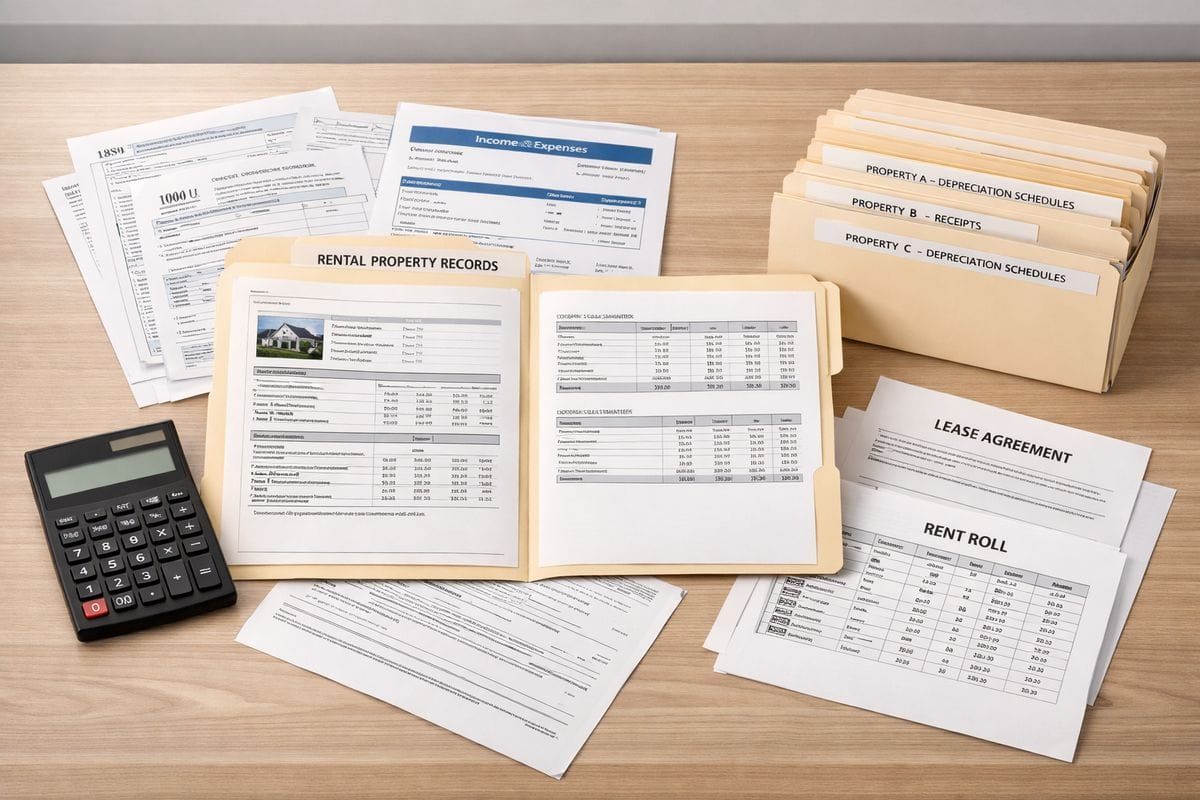
Pull the current-year Form 1040 draft, the prior-year tax return, prior depreciation schedules, and any prior Form 4562. Add mortgage interest statements, property tax records, insurance statements, year-end bookkeeping reports, bank statements, and a property-level profit and loss statement.
The prior-year return matters for one reason above all others: suspended passive losses. If last year’s Schedule E or Form 8582 showed disallowed losses, those amounts carry forward. Lose that history, and taxable income gets overstated.
Property-level documents to organize
Keep each rental in its own file. That file should include the closing disclosure, settlement statement, purchase documents, lease agreements, rent roll, repair invoices, mileage log, and records showing security deposits and owner contributions.
That separation is not just tidy bookkeeping. It is the fastest way to prove income, basis, and deductions if a notice arrives.
Information that changes the filing approach
Before filing, identify facts that change reporting: personal-use days, average guest stay, substantial guest services, co-ownership, refinancing, placed-in-service date, and prior suspended losses.
Short-term rental operators need special attention. If the average rental period is 7 days or less and substantial services are provided, the activity can shift away from Schedule E and into Schedule C treatment (IRS Schedule E instructions).
Step 1: Confirm the rental belongs on Schedule E instead of Schedule C
This decision comes first because the wrong form changes tax treatment from the ground up.
- Identify how income is earned.
- Determine average rental period.
- Review services provided to guests or tenants.
- Confirm whether the activity is passive rental use or an active operating business.
Use Schedule E for most long-term rental real estate
Most long-term residential and commercial rentals belong on Schedule E. If tenants are paying for the use of space and not for hotel-style services, Schedule E is the default rule.
That treatment usually works in your favor because net income is generally not exposed to self-employment tax. It also places the activity inside the passive activity framework, which matters for losses.
Identify when short-term rentals shift away from Schedule E
Short-term rentals are where mistakes multiply. If the average customer stay is 7 days or less, and you provide substantial services such as daily cleaning, meals, concierge support, or similar hospitality services, the activity is no longer simple rental real estate.
In that setup, Schedule C often becomes the right reporting form. Filing it on Schedule E anyway is one of the most expensive classification errors in this area.
Account for special situations that need extra review
Mixed-use properties, part-year rentals, vacation homes, room rentals, and ownership through partnerships or S corporations need extra review. Partnership and S corporation activity does not go into Schedule E Part I as direct rental entries. It usually flows from a K-1 into a different part of Schedule E.
Checkpoint: before moving on, confirm the property is directly owned and reported as rental real estate in Part I.
Step 2: Build a property-by-property income summary
Schedule E works best when each property stands on its own books.
- Create a separate income tab or report for each property.
- Pull rent actually received during the year.
- Separate deposits from income.
- Add other taxable rental income items.
- Tie the total to bank deposits and manager statements.
Total gross rents received during the tax year
Use actual collections, not lease totals. Pull rent from bank records, rent rolls, accounting software, and management statements. If a tenant owed December rent but paid in January, cash-basis filers report it in January.
For the completed example in this guide, gross rents received equal $24,000.
Separate security deposits from taxable rental income
Security deposits stay off Schedule E if you expect to return them. Once a deposit is kept for unpaid rent, damages, or lease-break charges, it becomes taxable rental income.
This is where sloppy books create duplicate reporting. If a retained deposit already sits in an income account, do not count it again.
Include other rental income items correctly
Late fees, pet fees, parking income, laundry income, lease cancellation payments, and tenant reimbursements belong in rental income totals if you keep them. Add them to gross rents for reporting purposes.
Checkpoint: the income total should match your books and your deposit trail.
Step 3: Classify deductible expenses into the right Schedule E categories
This step prevents most avoidable notices.
- Export the year-end expense detail.
- Map each expense to a Schedule E line.
- remove personal and non-deductible items.
- Allocate mixed-use costs where required.
- Confirm totals tie to books.
Match bookkeeping categories to Schedule E lines
Schedule E includes standard lines for advertising, auto and travel, cleaning and maintenance, commissions, insurance, legal and professional fees, management fees, mortgage interest, other interest, repairs, supplies, taxes, utilities, and depreciation.
If your chart of accounts mirrors these categories, filing moves faster and tie-out errors drop. If not, map them once and save the mapping for next year.
Separate current expenses from owner draws and personal spending
Loan principal is not deductible. Owner contributions are not expenses. Personal spending is not a rental deduction. If a mortgage payment was $1,800 and only $1,250 was interest, only the interest portion belongs on Schedule E.
This sounds obvious, but commingled accounts cause repeated overstatements.
Handle mixed-use expenses with a defensible allocation
For duplexes, part-year rentals, and properties with personal use, allocate shared costs by square footage, rental days, or another reasonable method. Keep the method consistent and document it in your workpapers.
Step 4: Distinguish repairs from improvements before claiming deductions
This one decision changes current-year tax savings and future depreciation.
- Review each larger invoice.
- Ask whether the work kept the property in ordinary condition or materially bettered, restored, or adapted it.
- Deduct repairs currently.
- Capitalize improvements and add them to basis.
- Save support with the invoice.
Deduct repairs that keep the property in ordinary operating condition
Patching drywall, repairing a leak, replacing a broken fixture, repainting a room, or fixing an appliance are usually repairs. These costs keep the property operating, but do not create a new asset or extend useful life in a major way.
Capitalize improvements that better, restore, or adapt the property
A new roof, full HVAC replacement, room addition, major remodel, full-house flooring replacement, or major system upgrade belongs in basis. Those amounts are depreciated, not deducted all at once.
Deducting improvements as repairs overstates current expenses and creates a correction problem later.
Keep invoices and job descriptions that support the treatment
Keep contractor scope of work, itemized invoices, before-and-after notes, and payment records. If an invoice says “full HVAC system replacement,” the treatment is clear. If it says “HVAC work,” the support is weak.

Step 5: Calculate basis and depreciation for the rental property
Depreciation is one of the most valuable deductions on Schedule E, and it is not optional. If it should have been claimed, the IRS generally treats it as allowed or allowable.
- Start with purchase price and acquisition costs.
- Separate land from building.
- Apply the correct recovery period.
- Add improvements and amortizable loan costs.
- Calculate the annual deduction.
Start with purchase price and acquisition costs
Use the closing statement to identify purchase price and capitalizable costs. Costs tied to buying the property generally increase basis. Loan fees usually do not increase building basis and are often amortized separately.
Separate land value from building value
Land is never depreciated. Assign value between land and building using the county assessment, appraisal support, or another reasonable method.
Apply the 27.5-year recovery period for residential rentals
Residential rental buildings use a 27.5-year recovery period (IRS Publication 946). The placed-in-service date determines the first-year amount under the mid-month convention.
Add depreciable improvements and amortizable loan costs
Improvements made after purchase, such as appliances, flooring, and remodel work, are recovered over the proper life. Refinancing costs are generally amortized over the life of the new loan, not deducted immediately.
Use a clear dollar example
Assume purchase records show a $250,000 building basis after land is removed. Annual depreciation is $250,000 ÷ 27.5 = $9,091.
Now compare that to operating results. If gross rental income is $28,800 and operating expenses before depreciation are $28,000, operating income is $800. Subtract $9,091 depreciation and Schedule E shows a $8,291 loss.
For the required filing example in this article, use a simpler completed return example: $24,000 rent, $28,000 total expenses including depreciation, $4,000 net loss.
Step 6: Complete Schedule E Part I line by line
This is the operational core.
- Enter property details at the top of Part I.
- Enter gross rents on line 3.
- Enter each expense on its matching line.
- Total expenses.
- Calculate net income or loss.
- Reconcile to books before filing.
Fill in the property information section
Enter the property address, property type, fair rental days, personal-use days, and ownership percentage. If the property was available and rented all year, fair rental days would usually be 365, less vacancy days if not available for rent.
Enter income on the correct line
For a single rental property, put $24,000 of rents on line 3. Leave royalty lines alone unless the property generates royalty income, which most rentals do not.
Enter each expense on its matching line
Use a clean example that totals $28,000:
- Advertising: $500
- Cleaning and maintenance: $1,200
- Insurance: $1,800
- Legal and professional fees: $700
- Management fees: $2,400
- Mortgage interest: $10,500
- Repairs: $1,900
- Taxes: $3,000
- Utilities: $2,000
- Depreciation expense or depletion: $4,000
That produces total expenses of $28,000 and a $4,000 loss on line 21 for that property.
Reconcile totals to property books before filing
Compare Schedule E totals to the year-end P&L, mortgage statements, tax bills, and depreciation report. If mortgage interest on Form 1098 says $10,500 and Schedule E shows $12,300, stop and fix it before filing.
Checkpoint: your completed Part I should produce a property-level loss of $4,000 that ties exactly to the books.
Step 7: Apply passive activity, at-risk, and loss limitation rules
A Schedule E loss does not automatically reduce current-year tax by the same amount.
- Determine whether the rental loss is passive.
- Check eligibility for the $25,000 special allowance.
- Review real estate professional status and material participation.
- Apply at-risk and passive loss forms if required.
- Track suspended losses forward.
Determine whether the rental loss is passive
Rental real estate is generally passive. That means your $4,000 loss is not automatically deductible against W-2 income unless an exception applies.
Apply the $25,000 special allowance for active participation
If you actively participate and own at least 10%, up to $25,000 of rental losses can offset nonpassive income. This allowance phases out between $100,000 and $150,000 of modified adjusted gross income.
Here is how the $4,000 loss works:
- AGI $90,000: full $4,000 deductible currently
- AGI $120,000: allowance reduced by 50% of the $20,000 excess over $100,000, leaving a $15,000 allowance, full $4,000 still deductible
- AGI $149,000: allowance reduced to $500, so only $500 of the $4,000 loss is currently deductible, $3,500 is suspended
- AGI $155,000: allowance eliminated, full $4,000 is suspended
Review real estate professional status and material participation
If you qualify as a real estate professional and materially participate, rental losses can become nonpassive and currently deductible. That requires documented time and activity records, not estimates created later.
Account for at-risk limits and suspended losses
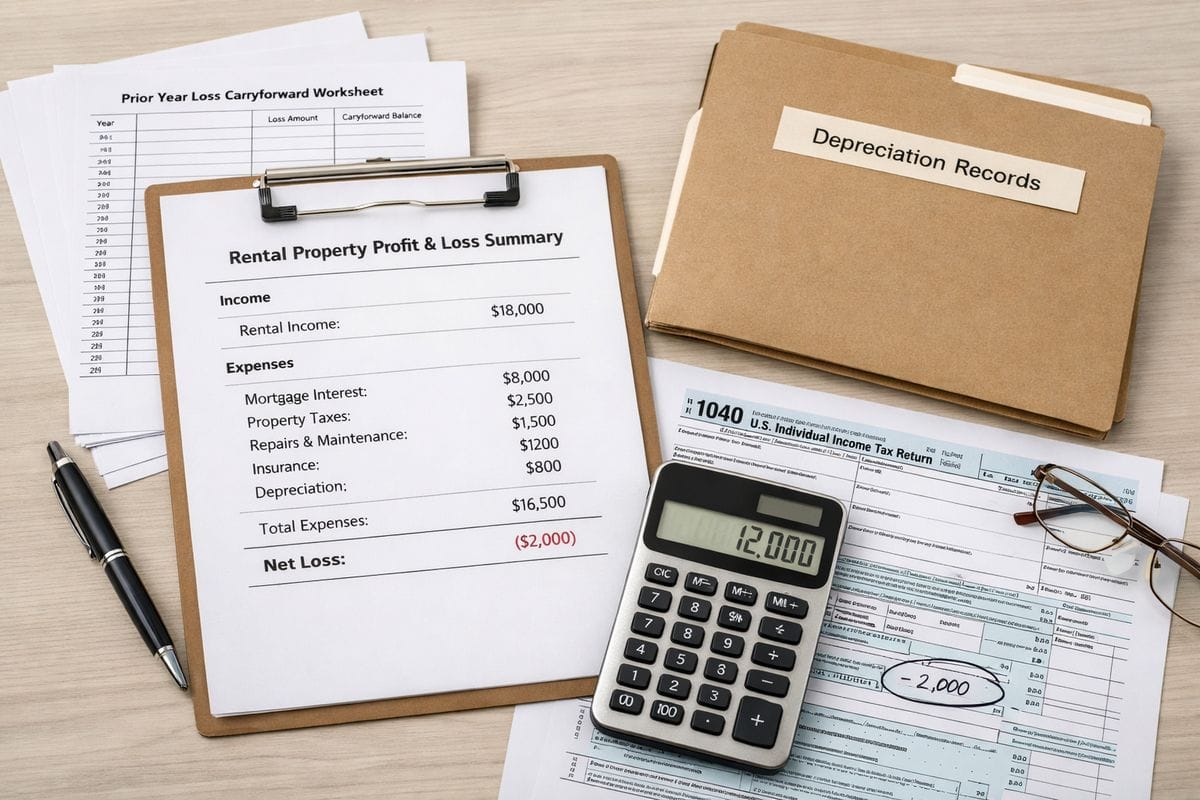
Form 6198 applies the at-risk rules. Form 8582 applies passive loss limits (IRS Form 8582, IRS Form 6198). Suspended losses carry forward indefinitely. When the property is sold in a fully taxable disposition, the suspended losses tied to that property release in full.
This is where preparer-switching becomes expensive. If suspended losses are not carried into the next return, deductions disappear from practical use. Keep your own running total by property every year.
Step 8: Handle special items that often get reported incorrectly
These are small lines with large consequences.
- Split mortgage interest from principal.
- Use mileage logs for local travel.
- Review contractor payments for 1099 filing.
- Move special transactions to the right forms.
Report mortgage interest and escrow items correctly
Deduct actual mortgage interest, not principal. Escrow is not automatically deductible when paid to the lender. Property taxes and insurance are generally deducted when actually paid from escrow for the rental.
Treat travel, mileage, and local transportation with records
Mileage for trips to inspect, maintain, collect rent, or meet contractors is deductible if supported by a contemporaneous log. Reconstructed mileage without dates and purpose is weak support.
Address contractor payments and 1099-NEC requirements
Contractors paid $600+ often trigger 1099-NEC reporting duties. Good year-end 1099 discipline supports the expense trail and reduces mismatch issues.
Reflect refinancing, casualty events, and property sales properly
Refinancing costs are amortized. Casualty losses can require separate treatment. Property sales usually move to Form 4797, not just Schedule E (IRS Form 4797).
Step 9: Review the return for the five most expensive Schedule E mistakes
Quality control belongs at the end, not after an IRS notice arrives.
Mistake 1: Claiming land as depreciable property
Land does not wear out for depreciation purposes. Claiming it distorts deductions every year until corrected.
Mistake 2: Deducting improvements as repairs
This inflates the current deduction and understates future depreciation. It also creates basis problems when the property is sold.
Mistake 3: Mixing personal and rental transactions
Commingling weakens audit defense and leads to missed or duplicated deductions. Separate accounts drive cleaner books and faster filing.
Mistake 4: Misreporting short-term rental activity
A short-term rental that operates like hospitality belongs under different rules. Filing it on Schedule E without checking the stay length and service level is a direct risk point.
Mistake 5: Ignoring prior-year suspended losses or depreciation schedules
Missing carryforwards overstates taxable income. Missing depreciation schedules complicate future filings and sales reporting.
Troubleshooting common Schedule E preparation issues
Problems usually come down to missing support or mixed records.
Missing receipts or incomplete expense support
Rebuild records from bank feeds, vendor statements, property manager reports, and contemporaneous notes. Do not guess. If a payment cannot be tied to a rental purpose, leave it out.
No prior-year depreciation schedule available
Reconstruct basis from closing documents, prior returns, and fixed-asset reports. Then rebuild annual depreciation from the placed-in-service date forward before filing the current year.
Rental used personally during the year
Personal-use days change the allocation of expenses and can trigger vacation-home rules. Track fair rental days and personal-use days carefully in the property information section.
Multiple properties with one bank account
Use class tracking, spreadsheets, and transaction coding to separate activity by property before entering anything on Schedule E. One bank account does not excuse mixed reporting.
What a completed Schedule E should produce and what to do next
A completed Schedule E should produce a clean profit or loss for each property that flows correctly to Form 1040. More importantly, it should give a year-end tax planning file: current depreciation, suspended losses by property, basis updates for improvements, and a clear record of whether entity planning or real estate professional analysis improves after-tax ROI before the next tax year.
The recommendation is to keep your own depreciation schedule and your own suspended loss schedule, even if a paid preparer files the return. That one habit prevents one of the most common and most expensive errors in rental tax reporting.
Frequently Asked Questions
Does every rental property go on a separate Schedule E?
Separate Schedule E forms are not required for each property, but each property should be reported separately in Part I with its own income, expenses, and property information. Property-level reporting creates cleaner records and stronger audit support.
Is depreciation optional if a rental already shows a loss?
No. Depreciation is treated as allowed or allowable. Skipping it does not preserve the deduction for later. It usually just creates a correction issue and affects gain calculations when the property is sold.
What happens to suspended passive losses?
Suspended losses carry forward indefinitely until you have passive income, qualify for an exception, or sell the property in a fully taxable disposition. On sale, the remaining suspended losses tied to that property generally release in full.
Can a W-2 earner deduct rental losses?
Yes, if active participation rules apply and modified adjusted gross income falls within the allowance range. Up to $25,000 of rental losses can offset other income, with the allowance phasing out between $100,000 and $150,000 AGI.
Should security deposits be reported as rent?
Not if you plan to return them. A deposit becomes income when you keep it for unpaid rent, damage, or other lease charges.
When does a short-term rental belong on Schedule C instead of Schedule E?
When average guest stays are 7 days or less and substantial services are provided, the activity can shift from rental real estate treatment to an active business. That classification changes tax treatment in a big way, so it needs review before filing.