

Rental property accounting determines how much cash a property actually produces, how many deductions get captured, and how painful tax season becomes. In plain English, rental property accounting is the system used to record rent, fees, expenses, assets, debt, and depreciation so financial reports and tax filings stay accurate. Get that system right early, and profit improves. Get it wrong, and tax drag, cleanup work, and audit risk pile up fast.
Rental Property Accounting: The System That Protects Cash Flow and Cuts Tax Drag
Based on analysis of landlord bookkeeping failures, the pattern is clear: poor accounting does not fail quietly. It hides vacancy loss, buries deductible expenses, overstates cash flow, and forces year-end reconstruction from bank statements. That is not bookkeeping. That is preventable value loss.
Rental property accounting works best as an operating system, not a filing chore. It gives visibility into property-level performance, supports faster closes, and keeps records aligned with IRS reporting. That matters even more as portfolios scale and as short-term rentals add more transaction volume. Research shows 59% of landlords say expense categorization is their biggest tax-prep challenge and 31% have missed deductions because of incomplete records. The recommendation is simple: build a system that captures transactions in real time and supports tax planning before year-end.
What Rental Property Accounting Includes
Rental property accounting includes rent collections, fees, deposits, expenses, mortgage-related costs, fixed assets, liabilities, equity, depreciation, and the records needed to support tax forms. That scope is wider than many owners expect.
Bookkeeping is the day-to-day entry and categorization of transactions. Accounting turns that data into reports such as profit and loss, cash flow, and balance sheet. Tax planning sits above both and decides how to treat improvements, depreciation, safe harbor elections, and timing decisions that directly affect tax liability.
The three jobs of rental accounting
The first job is bookkeeping. That means every rent payment, contractor invoice, HOA bill, reimbursement, and owner contribution gets coded correctly. If the coding fails, every report built on top of it fails too.
The second job is financial reporting. Clean books show which property earns, which property drains cash, and which operating costs are rising too fast. That shortens time-to-value because decisions stop depending on guesswork.
The third job is tax planning. Depreciation schedules, repair-versus-improvement treatment, and asset tracking directly affect ROI. That is where average accounting stops and proactive advisory work starts.
Cash basis vs. accrual basis for landlords
Most small landlords use cash basis accounting. Income is recorded when received, and expenses are recorded when paid. For portfolios with a handful of long-term rentals, this method usually matches how cash actually moves.
Accrual basis records income when earned and expenses when incurred. That becomes more useful once unpaid invoices, prepaid expenses, and larger entity-level reporting start to matter. For most owners with 1 to 5 properties, cash basis keeps the books clean without adding noise. As transaction volume rises, accrual reporting becomes more decision-useful.
Build the Right Accounting Setup Before the First Entry
Bad setup creates year-end cleanup. Good setup prevents it. Separate systems, clear categories, and property-level tracking stop commingling and keep deductions from disappearing into generic expense buckets.
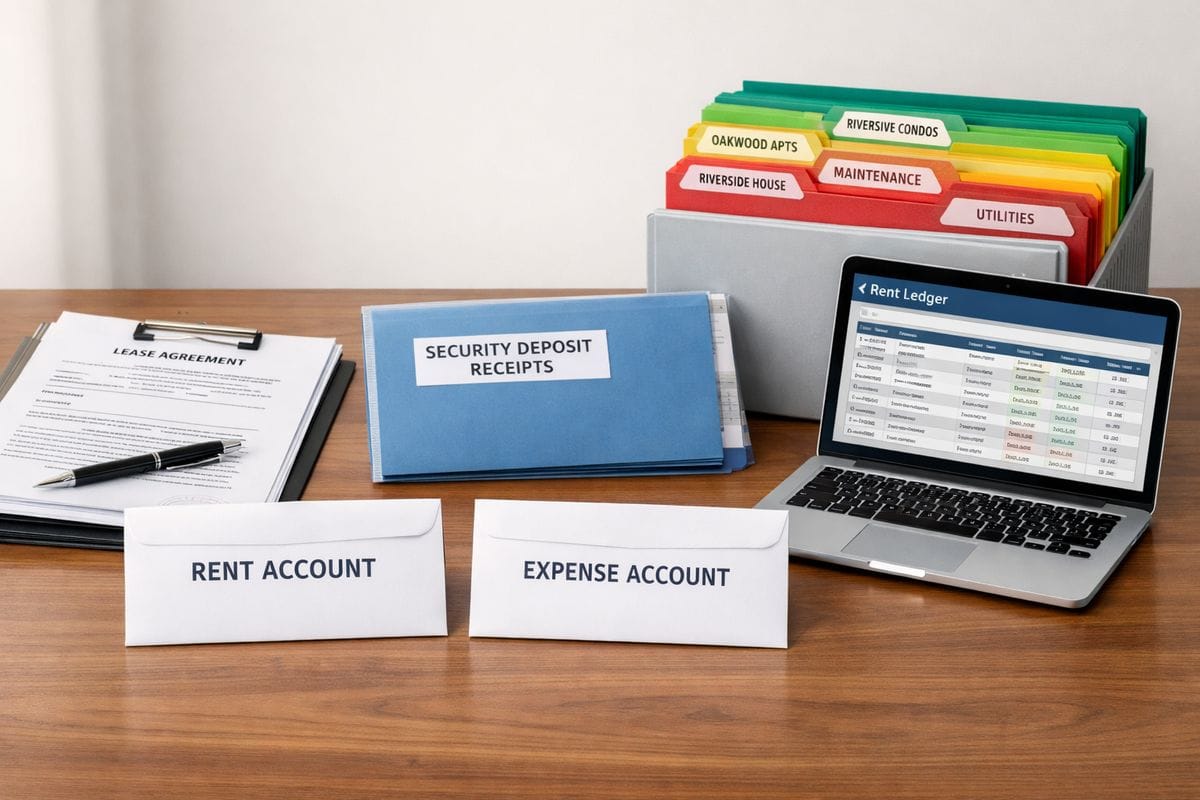
Open separate accounts for operations and deposits
Use a dedicated bank account for rental operations and a separate account for security deposits. Add a dedicated credit card if renovation or turnover spending is frequent. In Texas, clean handling of security deposits and clear documentation reduce disputes and keep refund or forfeiture treatment easier to prove.
Commingling personal and rental transactions always creates cleanup cost. It also weakens support for deductions because mixed statements force reconstruction instead of documentation.
Create a chart of accounts by property and activity
Set up income and expense categories by property, entity, and class. For a long-term rental, categories should separate rent, late fees, repairs, maintenance, insurance, taxes, HOA dues, utilities, management, and legal or accounting fees. For flips, inventory-style tracking and rehab capitalization matter more. For short-term rentals, nightly rent, cleaning fees charged to guests, platform fees, refunds, supplies, and turnover costs need separate lines.
That structure keeps reports decision-ready. Property-blind books tell almost nothing useful.
Choose software that matches the portfolio stage
A spreadsheet works for one property with low transaction volume and disciplined monthly review. Landlord software fits better once bank feeds, receipt capture, and property-level reporting are needed. Full accounting software becomes necessary once multiple entities, asset schedules, classes, or consolidated reporting enter the picture.
The market is moving fast toward automation. Research shows firms spend 13.8 hours per month on manual data entry and reconciliation and 43% cite manual or administrative work as the top accounting challenge. Software should reduce that burden, not add another dashboard to ignore.
Track Every Dollar of Rental Income Correctly
Rental income is not limited to monthly rent. Under IRS rules, advance rent, retained fees, and certain forfeited deposits count too. Misclassify inflows, and both tax reporting and property performance get distorted.
Income types to record
Record monthly rent, late fees, pet fees, lease-break fees, retained application fees, laundry income, parking income, reimbursed expenses, advance rent, and forfeited security deposits. The IRS makes clear that rental income includes more than collected monthly rent.
Short-term rentals require tighter gross-to-net tracking. Nightly charges, guest cleaning fees, host payouts, refunds, and booking adjustments all affect revenue quality. With cleaning costs for 1-bedroom vacation rentals up 25.08% since Q1 2021, sloppy coding quickly hides margin erosion.
Security deposits, owner contributions, and loan proceeds
A refundable security deposit is not income when received. Record it as a liability. If part of that deposit is kept because of damages or lease default, reclassify that retained amount to income.
Owner contributions are equity, not rent. Loan proceeds are debt, not income. Recording either as revenue inflates performance and creates tax return mismatches.
Short-term rental income complexity
Short-term rentals move faster and break more often at the accounting level. Platform statements show gross guest charges, host service fees, taxes collected, cleaning fees, adjustments, and net payout. Books should capture the gross charge and each offsetting fee or refund separately.
That detail matters because the short-term rental market is expanding, with projected growth at a 19.1% CAGR from 2022 to 2032, while occupancy pressure remains real at 56.4% in one 2023 projection. When revenue swings, clean accounting becomes operating control.

Categorize Expenses in a Way That Maximizes Deductions
Expense categorization is where tax value is won or lost. Field data shows this is the biggest friction point, and uncategorized expenses are where legitimate write-offs disappear.
The core operating expense categories
Track mortgage interest, property taxes, insurance, utilities, repairs, maintenance, HOA dues, legal fees, accounting fees, supplies, advertising, tenant screening, management fees, and travel or mileage where allowed. Those categories flow naturally into tax prep and give a usable picture of operating cost.
Repairs vs. improvements: the rule that changes your tax bill
Repairs keep property in ordinary operating condition. Improvements better, restore, or adapt the property and must be capitalized.
Patch drywall after a tenant move-out, that is a repair. Replace the full roof, that is a capital improvement. Repaint one damaged bedroom, repair. Full-property remodel tied to a major rehab, capitalize.
Startup, turnover, and vacancy costs
Track make-ready cleaning, locksmith charges, lawn care, leasing commissions, vacancy utilities, and minor touch-up work in dedicated categories. Do not dump them into uncategorized expenses. Those costs directly affect ROI and show how expensive each turnover really is.
Dollar examples by property type
For a long-term rental collecting $2,100 per month, a $175 locksmith bill, $260 cleaning invoice, and $190 lawn service during vacancy belong in turnover or make-ready categories, not repairs.
For a flip held for resale, $18,000 of rehab spend does not belong on Schedule E as current rental expense. It belongs in project cost tied to inventory or basis for resale accounting.
For a short-term rental with $6,400 monthly gross bookings, $1,050 guest cleaning fees, $640 platform fees, $420 refunds, and $900 cleaning contractor costs, each line should be separate. Net payout alone is not enough.
Depreciation, Capital Expenses, and the Deductions Most Owners Miss
This is where rental accounting becomes rental-specific. Three rules drive the tax outcome: depreciation is mandatory, land must be separated from building value, and capital improvements must be tracked as separate depreciable assets.
How depreciation works for residential rental property
Residential rental property is generally depreciated over 27.5 years once placed in service, using the building basis, not the land. If a property was purchased for $250,000 and the county tax assessment shows 20% land and 80% improvements, allocate $50,000 to land and $200,000 to building. Land is not depreciated. The annual building depreciation is about $7,273 before first-year convention adjustments.
Placed in service means ready and available for rent, not the purchase date if renovation delayed occupancy. Start the depreciation schedule then, not at tax filing time.
Appliances, flooring, roofs, and other capital assets
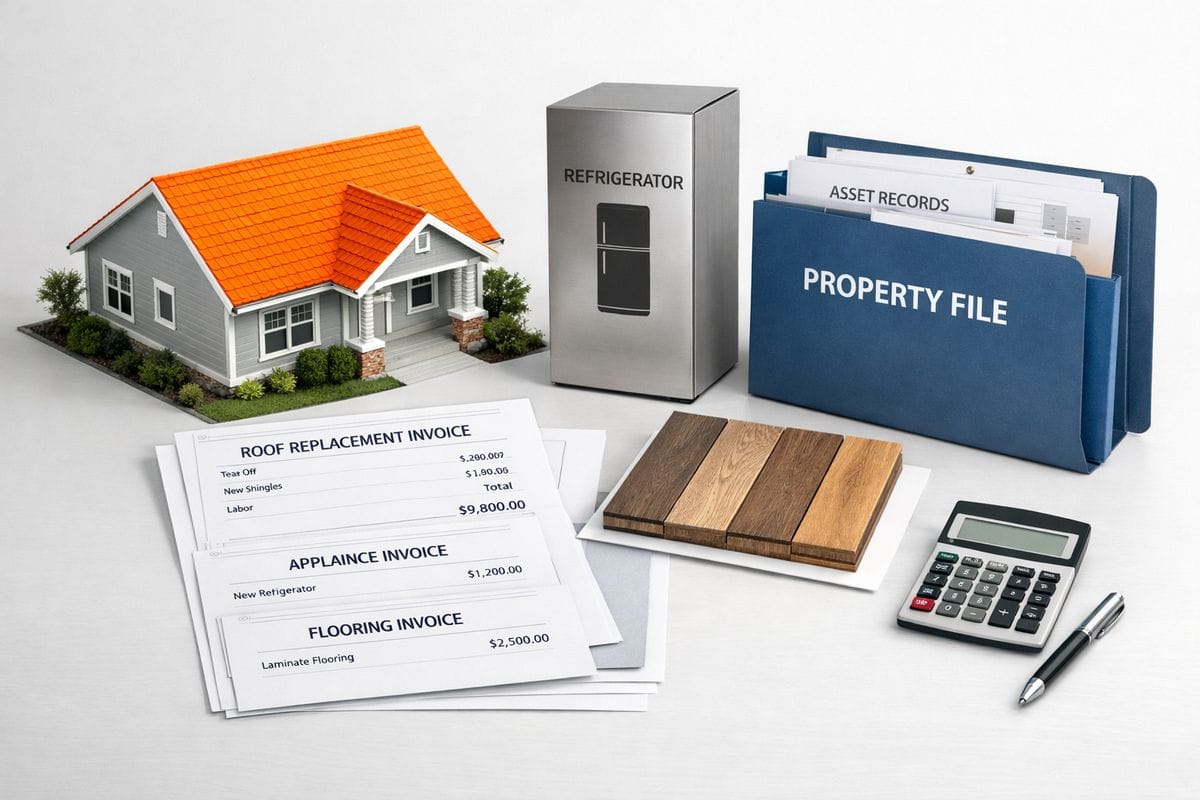
Capital items need asset-level tracking. Using the same $250,000 rental, assume a roof replacement costs $12,000 after purchase. That $12,000 is not an immediate repair deduction. It becomes a separate capital asset and is depreciated over 27.5 years for residential rental property, or about $436 per year before convention adjustments.
Lumping that roof into repairs creates an incorrect current-year deduction and raises amended-return risk. The same logic applies to flooring, HVAC systems, and major appliances when capitalization is required.
De minimis safe harbor and other write-off opportunities
The de minimis safe harbor election allows qualifying lower-cost items to be expensed rather than capitalized, subject to IRS rules and documentation standards. For landlords buying many smaller items, that election can accelerate deductions and reduce depreciation clutter.
The catch is documentation. Safe harbor treatment works only when invoices, books, and elections are handled correctly. IRS guidance on tangible property regulations and safe harbor elections should drive the setup.
Depreciation recapture is the rule many owners ignore until sale, then regret. Even if depreciation was never claimed, the IRS still treats allowable depreciation as reducing basis. Sell later, and recapture applies anyway. The recommendation is firm: claim depreciation annually because the tax cost at sale does not disappear by skipping it.
Cost segregation for larger tax savings
Cost segregation reclassifies certain building components into shorter recovery periods, accelerating deductions. That strategy makes sense when purchase price, taxable income, and holding period justify the study cost. For higher-value acquisitions or portfolios scaling past a few units, the tax savings often justify the analysis.
Keep Records That Stand Up to Tax Filing and IRS Scrutiny
Good records protect deductions. Weak records turn valid expenses into unsupported claims.
What records to keep and how long to keep them
Keep leases, settlement statements, invoices, receipts, bank statements, canceled checks, loan statements, mileage logs, repair records, and depreciation schedules. Keep basis records, improvement invoices, and closing documents for the entire ownership period plus the applicable tax record retention period after sale, because those documents support depreciation and gain calculations.
Real-time receipt capture and monthly reconciliation
Year-end scrambling loses data. Real-time capture keeps receipts tied to transactions while details are still obvious. Research shows 21% of landlords already use real-time receipt capture and 84% review finances monthly or quarterly. That pattern is moving in the right direction.
The monthly close checklist for rental owners
Use a standard close every month:
- Reconcile bank and credit card accounts
- Match rent collected to leases and deposits
- Review uncategorized transactions
- Confirm unpaid vendor bills or reimbursements
- Update mileage and receipt attachments
- Run a profit and loss by property
Understand the Tax Forms and Filing Rules That Control Reporting
Accounting only matters if it flows cleanly into tax reporting.
Schedule E and the forms that support it
For most long-term rentals, income and expenses flow to Schedule E. Depreciation and amortization generally flow through Form 4562. Asset purchases, placed-in-service dates, and depreciation schedules must support those filings.
When short-term rentals follow different tax rules
Short-term rentals can fall under different tax treatment when average guest stay and material participation change the analysis. That distinction affects loss treatment, self-employment tax analysis, and reporting posture. If short-term rental activity is growing, year-end tax prep is too late for strategy.
Entity structure and ownership reporting
A single-member LLC often remains disregarded for federal tax purposes, so bookkeeping still feeds the owner return. Partnerships require entity-level books and returns. S corporations are usually not the default choice for rental ownership, but bookkeeping must still match the filing structure in place. Accounting follows tax reporting reality, not marketing advice from entity-formation ads.
Use Financial Reports to Make Better Property Decisions
Tax filing is one use for accounting. Better decisions are the bigger one.
The three reports that matter most
Review the profit and loss monthly to see revenue, operating expenses, and net income by property. Review cash flow to see real money movement. Review the balance sheet to track loans, deposits, fixed assets, and owner equity.
Metrics that show whether a property is actually performing
Watch net operating income, operating expense ratio, maintenance as a percent of rent, vacancy loss, and cash-on-cash return. Clean books improve acquisition screening, refinance packages, and hold-versus-sell decisions because the numbers are credible.
Portfolio reporting for owners scaling past 1 to 5 properties
Once a portfolio grows, class tracking and entity-level reporting stop being optional. Spreadsheet systems break because one miscoded transaction distorts multiple properties. Scaling fails when accounting remains manual and property-blind.
Decide Between DIY Bookkeeping, Software, and a Real Estate Tax Advisor
The decision should be based on ROI, error reduction, and tax complexity.
When DIY works
DIY works with a small portfolio, low transaction volume, clean entity structure, and disciplined monthly review. If books are reconciled every month and asset tracking is current, software-assisted self-management remains efficient.
What software should automate
Software should automate bank feeds, recurring rent entries, expense rules, receipt capture, mileage logs, owner reports, and Schedule E summaries. Automation reduces categorization drift and cuts manual workload.
When a real estate tax advisor becomes the right move
Bring in a real estate tax advisor when multiple entities, heavy renovation spend, short-term rental activity, cost segregation potential, passive-loss limitations, or rising W-2 income increase the tax stakes. Research shows 77% of landlords using professional accounting help spend $500 or more annually. That cost is modest compared with missed deductions or bad capitalization treatment. Once complexity rises, proactive planning beats annual filing every time.
The Most Common Rental Property Accounting Mistakes
These mistakes reduce deductions, weaken compliance, and delay decisions.
Commingling personal and property transactions
Mixed accounts create weak records, cleanup cost, and avoidable audit exposure. Separate accounts fix this immediately.
Failing to reconcile monthly
Skipped reconciliations lead to duplicate income, missing expenses, stale liabilities, and incorrect owner draws. Books that are three months behind are decision-useless.
Treating every repair or purchase the same way
Expensing everything is wrong. Capitalizing everything is also wrong. Poor treatment of repairs, improvements, and assets distorts taxable income and depreciation schedules.
Waiting until tax season to organize records
Reactive accounting destroys time-to-value. It also increases the odds of missed deductions and incorrect filings. Clean records are built monthly, not reconstructed in March.
A 90-Day Rental Property Accounting Implementation Plan
The recommendation is to install the system in phases, then keep it boring. Boring books produce better returns.
Phase 1: Clean setup in the first 30 days
Open separate bank and deposit accounts. Choose software. Build the chart of accounts by property and activity. Connect bank feeds. Create cloud folders for leases, closing statements, receipts, and asset invoices. Enter the depreciation setup for each property immediately after placed-in-service.
Phase 2: Monthly operating discipline in days 31 to 60
Reconcile all accounts every month. Code transactions weekly. Capture receipts in real time. Run a property-level profit and loss. Review turnover and vacancy costs as separate lines. Fix uncategorized entries before the next month starts.
Phase 3: Tax planning and scale readiness in days 61 to 90
Review land-versus-building allocations, depreciation schedules, and every capital project. Separate repairs from improvements. Evaluate de minimis safe harbor use. If renovation spend, short-term rental activity, or tax liability is rising, shift to a real estate tax advisor before year-end. That move protects deductions when the stakes are still controllable.
Frequently Asked Questions
What is the best accounting method for rental property accounting?
Cash basis is usually the best fit for smaller rental portfolios because it tracks actual cash movement clearly and keeps reporting simple. Accrual becomes more useful when transaction volume, unpaid invoices, and entity-level reporting increase.
Do security deposits count as rental income?
A refundable security deposit is not income when received. It becomes income only if part of the deposit is retained for damages, unpaid rent, or lease default.
Can a new roof be deducted in one year?
No. A full roof replacement is a capital improvement, not a current repair expense. It must be capitalized and depreciated as a separate asset, typically over 27.5 years for residential rental property.
What happens if depreciation was never claimed?
The IRS still treats allowable depreciation as reducing basis. On sale, depreciation recapture applies even if prior returns never claimed the deduction. That is why depreciation should be recorded and claimed every year.
How long should rental property records be kept?
Routine monthly records should be kept for the standard tax record retention period. Documents tied to purchase basis, land allocation, improvements, and depreciation should be kept for the full ownership period and after sale long enough to support the final tax reporting.
When should a rental owner hire a real estate tax advisor?
The right time is when multiple properties, entities, heavy rehab spending, short-term rentals, or high outside income make tax strategy more valuable than basic filing. At that point, proactive planning usually produces a better return than DIY bookkeeping alone.