

The one big beautiful bill real estate investors care about is now law, and the headline is simple: your tax planning window just changed. Signed on July 4, 2025, this package locks in several high-value TCJA-era rules, adds a few targeted development incentives, and gives rental owners more certainty on deductions that directly affect cash flow, underwriting, and hold strategy.
What the One Big Beautiful Bill Means for Real Estate Investors
For real estate, this law is a net positive. Signed July 4, 2025, it makes several investor-friendly tax rules permanent instead of leaving them to expire or phase out without clear direction. That matters because tax uncertainty distorts acquisition models, refinance decisions, and entity planning.
The strategic stake is not political. It is economic. If your portfolio depends on depreciation timing, interest deductions, pass-through treatment, or long-hold gain planning, this law changes your numbers. It also leaves one painful rule untouched: passive loss limits under Section 469 still block many W-2 investors from using rental losses against salary income.
This article focuses on the provisions that actually change investor behavior. Not every section of the Act matters to your portfolio. These do.

The Five Drivers That Matter Most to Your Portfolio
Based on analysis of the statute and early market commentary, five drivers carry most of the value for investors. First, 100% bonus depreciation returns for qualifying property placed in service after January 19, 2025. Second, Section 163(j) becomes more favorable because the 30% limit is calculated from an EBITDA-style base again for tax years beginning after December 31, 2024. Third, Section 199A stays at 20%, which preserves a major deduction for qualifying pass-through rental income. Fourth, Opportunity Zones become permanent, turning a sunset-driven tactic into a long-range planning tool. Fifth, housing and community development credits expand, especially for affordable housing and redevelopment projects.
Those five provisions affect different investor profiles, but the pattern is consistent: better front-loaded deductions, better forecasting, and more confidence in long-term structuring.
100% bonus depreciation is back and permanent
The law restores 100% bonus depreciation for qualified property acquired and placed in service after January 19, 2025. For real estate, that usually means short-life assets identified in a cost segregation study, not the building shell itself.
Why it matters is straightforward. If your acquisition includes enough 5-year, 7-year, or 15-year property, full expensing accelerates losses into year one. That improves early cash flow and changes return timing in a meaningful way.
Section 163(j) gets more favorable again
Section 163(j) still limits business interest expense to 30% of adjusted taxable income, but for tax years beginning after December 31, 2024, the base moves back to an EBITDA-style calculation. That is better for real estate because depreciation and amortization get added back in computing the limitation.
For leveraged deals, that usually means a larger current deduction. The difference shows up fastest in acquisitions with high debt service, development deals with heavy depreciation, and refinancings under tighter spreads.
Section 199A stays at 20%
The permanent 20% Section 199A deduction is one of the biggest wins in the bill for pass-through owners. If your rental activity qualifies as a trade or business, income flowing through an LLC, partnership, or S corporation can still generate a 20% qualified business income deduction, subject to the usual rules.
Permanence matters here more than drama. Forecasting after-tax yield gets easier when the deduction no longer hangs on a sunset date.
Opportunity Zones become permanent
The Opportunity Zone regime now operates on a permanent framework, with new designation cycles every 10 years and new designations effective July 1, 2026. For investments made after December 31, 2026, capital gains invested in a QOF can receive a five-year deferral, a 10% basis increase after five years, and a fair market value basis step-up after a 10-year hold. Rural zones get a larger 30% step-up.
That changes OZ investing from a deadline scramble into a repeatable capital allocation tool.
Housing and community development incentives expand
Developers and community-focused investors also gain from a permanent New Markets Tax Credit, larger 9% LIHTC allocations, and easier access to 4% credits through a lower bond-financing threshold. These provisions matter less for small rental owners and much more for sponsors building affordable housing, mixed-use community projects, or redevelopment deals in underserved areas.
What Changes for Depreciation, Interest, and Pass-Through Income
This is where the law moves from headline to model. Depreciation affects year-one losses. Interest deductibility affects taxable income every year. Section 199A affects how much pass-through income you keep after tax.
Bonus depreciation and cost segregation after January 19, 2025
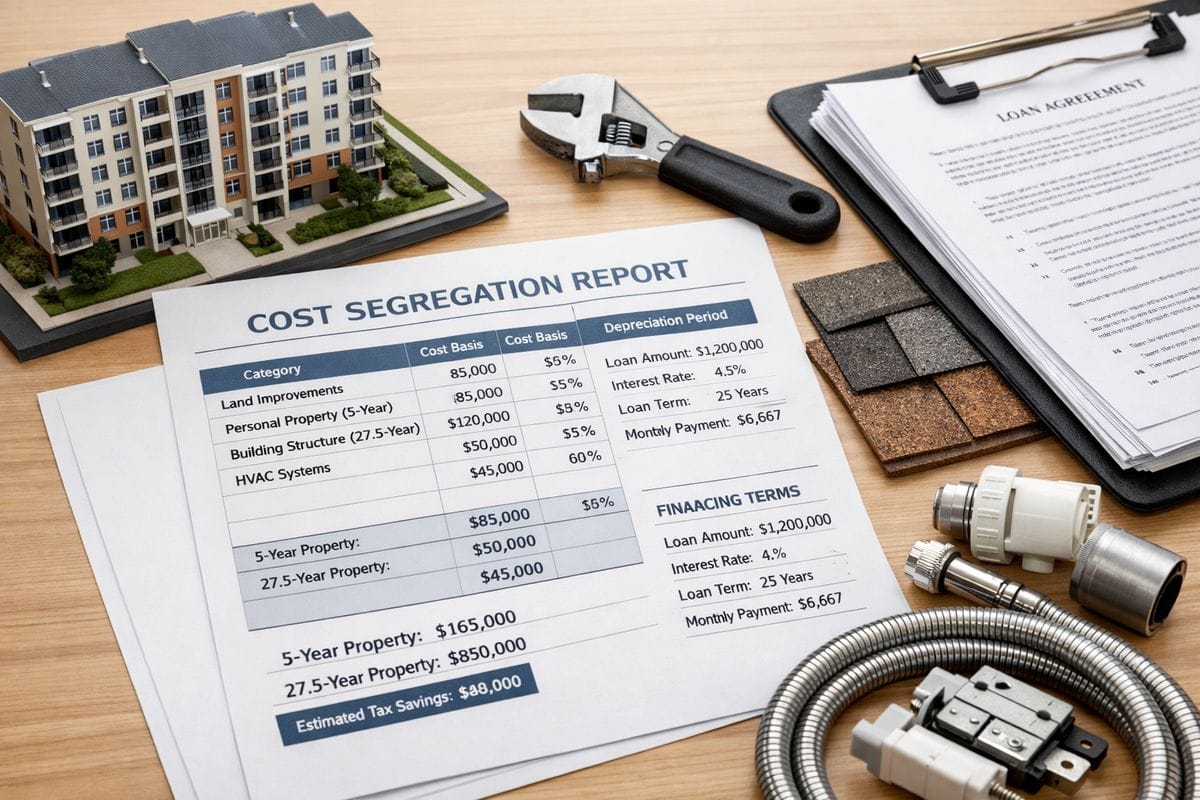
Placed-in-service timing controls the deduction. If qualified property is acquired and placed in service after January 19, 2025, Section 168(k) again allows immediate expensing for eligible assets. In plain English, a cost segregation study breaks a building purchase into components. Some components are building structure and stay on 27.5-year or 39-year schedules. Others, such as certain flooring, cabinetry, appliances, specialty electrical, site work, and land improvements, fall into shorter recovery periods and can qualify for bonus depreciation.
That timing point is not technical trivia. A property closed in 2025 but not actually placed in service on time can lose the expected first-year deduction. In underwriting, that is a real error, not a paperwork issue.
Section 163(j): how the EBITDA formula improves interest deductions
Section 163(j) caps business interest deductions at 30% of adjusted taxable income. Under an EBIT-style base, depreciation and amortization reduce that income before the cap is measured. Under an EBITDA-style base, those deductions are added back. The result is a larger base and, usually, more deductible interest.
For a heavily leveraged property with significant depreciation, the change is immediate. Your current deduction limit rises, which improves after-tax cash flow and reduces carryforward pressure. That is why this rule matters most for acquisitions with higher debt loads, development deals, and refinancing in an environment where cost of capital still dominates investor returns.
Section 199A for rental owners and real estate funds
Section 199A remains a 20% deduction for qualified business income, including certain REIT dividends and publicly traded partnership income. For rental owners, the key issue is still qualification. Permanence did not erase the trade-or-business requirement, the wage and UBIA limits where those apply, or the need for solid records.
That means your entity structure still matters, but documentation matters just as much. A pass-through structure alone does not create the deduction. The activity has to qualify under existing tax standards. For funds and larger operators, the value here is planning certainty. For smaller owners, the recommendation is to stop treating 199A as automatic and start treating it as a documented position.
What the Bill Does Not Fix: Passive Loss Rules and Real Estate Professional Status
This is the part too many tax summaries skip. Better deductions do not mean easier use of losses. Section 469 remains in place, and that is the rule that frustrates many rental owners with strong W-2 income.
Why rental losses are still limited for many W-2 investors
Rental real estate losses are generally passive. Passive losses offset passive income, not wages, bonuses, or portfolio income. The limited exception is the active-participation allowance, which permits up to $25,000 of rental loss against nonpassive income for taxpayers below the income thresholds, with phaseout as adjusted gross income rises. Many higher-income owners phase out of that benefit entirely.
So if your rental generates a large paper loss from depreciation, that does not mean your W-2 income drops by the same amount on the current-year return. Often, the loss is suspended and carried forward.
When Real Estate Professional Status changes the outcome
Section 469(c)(7) creates the main path out of that trap. Real Estate Professional Status requires more than 750 hours in real property trades or businesses during the year and more than half of your total personal service time in those activities. Then material participation still has to be satisfied.
The catch is administrative, not conceptual. Unless an aggregation election is made, material participation is tested property by property. That is why investors lose this benefit in audits: hours are estimated, logs are weak, and activities are not matched to the statutory tests.
Why bigger depreciation deductions do not automatically produce current tax savings
A bigger depreciation deduction creates a bigger loss. It does not create automatic current-year tax savings. If Section 469 blocks the loss, your benefit becomes deferred, not denied, but deferred still means no immediate wage offset.
That distinction matters in acquisition analysis. Bonus depreciation improves tax attributes and long-term efficiency. It does not eliminate passive loss rules. Investors who miss that point routinely overstate year-one tax savings.
New Real Estate Opportunities Created by the Bill
Beyond standard rentals, the law opens planning opportunities in production property, long-cycle OZ capital, and rural or community-focused finance.
Qualified production property: immediate expensing for certain nonresidential construction
The Act creates a new 100% expensing rule for certain newly constructed nonresidential real property used in qualified production activities. Construction must begin after January 19, 2025 and before January 1, 2029, and the property must be placed in service before January 1, 2031.
This is not a general rule for every warehouse or office project. It is targeted. But for manufacturing and production-linked real estate, immediate expensing can materially improve project ROI and payback speed.
Opportunity Zones 2.0: new timelines, new basis step-ups, more reporting
Opportunity Zones are now permanent, with new designations every 10 years. For post-2026 QOF investments, the structure is cleaner: five-year deferral, 10% basis increase after five years, 30% for rural OZs, and fair market value basis step-up after 10 years.
But compliance gets heavier. Enhanced reporting and impact assessment raise the value of disciplined fund governance, cleaner books, and clearer project documentation. The tax benefit is better, but the tolerance for sloppy administration is lower.
Rural and community investment provisions
Eligible lenders now exclude 25% of interest income on qualifying rural or agricultural real estate loans. Combined with the permanent NMTC and expanded LIHTC framework, this creates real value for rural lenders, affordable housing developers, and community redevelopment sponsors.
For investors deploying capital through debt, this is a niche worth watching. For most small rental owners, it is background noise.
Provisions That Matter Indirectly to Investors
Not every useful rule sits inside rental taxation. Some changes affect personal cash flow, estate planning, and household-level tax modeling.
SALT cap, standard deduction, and temporary 2025, 2028 deductions
The SALT cap rises to $40,000 for certain taxpayers and reverts to $10,000 in 2030. The higher cap phases out at higher income levels, so the benefit is uneven. In high-tax states, this is meaningful. In no-income-tax states, the value is much narrower and often tied mostly to personal residence property taxes. The standard deduction also rises to $15,750 single and $31,500 joint.
Temporary deductions for tips, overtime, seniors, and U.S.-assembled auto loan interest matter for household planning, not rental operations. Keep those items out of property-level models.
Estate and succession planning for appreciated real estate
The higher lifetime gift and estate tax exclusions, $15 million single and $30 million joint, matter for investors holding appreciated property, family LLC interests, and long-term transfer plans. If your estate plan assumed a lower exemption, this law extends your runway for gifting and restructuring.
Energy incentives that are narrowing or expiring
Some energy and building-related incentives are being reduced or terminated on fixed schedules. If your deal depends on efficiency credits or clean-energy subsidies, verify placed-in-service timing before assuming value. Tax projections built on expired credits are not aggressive. They are wrong.
The Four Timing Windows That Drive Tax Strategy in 2025, 2030
Tax value now depends heavily on dates. Based on analysis of effective dates, four windows drive most planning decisions.
Window 1: deals placed in service after January 19, 2025
This is the start date for restored bonus depreciation on qualifying property and the beginning of the qualified production property construction window. Acquisition calendars, renovation completion, and placed-in-service documentation now drive first-year deductions.
Window 2: tax years beginning after December 31, 2024
This is when the EBITDA-style Section 163(j) calculation applies. If your models still use an EBIT-style limitation, your projections are stale. Debt sizing and refinance analysis should already reflect the new interest capacity.
Window 3: post-December 31, 2026 Opportunity Zone investments
This is the date that governs the new OZ deferral and basis step-up framework. If your capital gains planning includes QOF investments, hold-period modeling should be tied to the five-year and 10-year benchmarks, not old sunset assumptions.
Window 4: 2030 and other scheduled reversions
Not every favorable rule is permanent in the same form. The SALT cap reverts in 2030, and several personal deductions expire after 2028. Permanent provisions and temporary ones belong in separate planning models. Mixing them produces false confidence.
The Recommendation: How to Respond Before the Next Filing Cycle
The recommendation is direct. Update your depreciation studies for post-January 19, 2025 acquisitions. Rework Section 163(j) models using the EBITDA base. Verify Section 199A qualification instead of assuming it. Test Real Estate Professional Status under Section 469 with real hour tracking and material participation support. Review Opportunity Zone pipeline timing against the post-2026 rules.
Just as important, separate tax benefits from operating risk. The market data shows transaction conditions are improving, but costs, supply constraints, and property-level exposure still control outcomes. Climate and resilience analysis cannot be ignored in acquisition or redevelopment planning, especially when property-level climate data remains uneven and underwriting errors stay expensive.
The best results come from pairing tax planning with disciplined asset selection, documentation, and timing. That is where this law creates value.
Frequently Asked Questions
Does the bill let rental losses offset W-2 income automatically?
No. Section 469 passive activity loss rules still apply. Rental losses generally offset passive income unless the $25,000 active-participation exception applies or Real Estate Professional Status and material participation remove the activity from passive treatment.
Is Section 199A now permanent for rental real estate owners?
Yes. The 20% deduction under Section 199A is permanent, including for qualifying pass-through income and certain REIT dividends. But your rental activity still has to qualify as a trade or business under existing standards.
Does 100% bonus depreciation apply to the whole building?
No. For most real estate investors, bonus depreciation applies to qualifying shorter-life assets identified through cost segregation, such as certain personal property and land improvements. The building structure itself generally remains on its regular depreciation schedule.
Who benefits most from the Section 163(j) change?
Highly leveraged owners, developers, and sponsors benefit most. The EBITDA-style calculation increases adjusted taxable income for the 30% limit by adding back depreciation and amortization, which usually increases current interest deductions.
Are Opportunity Zones still worth considering after 2026?
Yes. In fact, the permanent OZ structure makes them more useful for long-term planning. Post-2026 investments can use a five-year deferral, basis step-ups, and a 10-year fair market value basis election, but compliance and reporting standards are stricter.
What is the most common investor mistake under this law?
Confusing larger deductions with immediate usable tax savings. Bigger depreciation deductions improve tax attributes, but current-year benefit still depends on passive loss rules, trade-or-business qualification, and correct placed-in-service timing.