
A step up in basis real estate rule resets an inherited property’s tax basis to its fair market value at death. That one rule can protect a huge share of family equity, especially when a rental house, duplex, or small portfolio has appreciated for decades and heirs need to decide quickly whether to sell, hold, or keep renting.
What Step-Up in Basis Means for Inherited Real Estate
Step-up in basis means your inherited real estate usually gets a new tax starting point equal to its fair market value on the date of death. Basis is simply the number used to measure gain or loss when the property is sold. If the old owner bought a rental for $150,000 and it was worth $600,000 at death, your basis is generally $600,000, not the original $150,000.
At the business level, that changes everything. It cuts capital gains exposure, preserves more equity for your family, and improves flexibility. A property that looked “too tax-expensive” to sell under the old basis may suddenly become practical to sell, refinance, or reposition.
For multi-property estates, this matters even more. Each parcel can have a different basis, a different valuation record, and a different decision path. One heir may want to keep the highest-cash-flow rentals, while another may want to sell underperforming properties. Step-up makes those decisions cleaner because the old appreciation is generally removed from the tax equation.
Why this rule matters to heirs
The core outcome is simple: appreciation during the original owner’s lifetime is generally erased for capital gains purposes. If you sell later, tax is usually based only on appreciation after inheritance, not on the decades of built-in gain that accumulated before you took ownership.
That is why step-up in basis is one of the most valuable tax rules in estate planning. It does not make every sale tax-free, but it often reduces the taxable gain dramatically.
How Step-Up in Basis Works on Real Estate
The mechanics are straightforward once you see the sequence.
Start with the property’s inherited basis, which is usually the fair market value at death. Next, establish that value with documentation. Then compare that new basis to the eventual sale price. The difference, adjusted for later improvements, depreciation, and selling costs, determines gain or loss.
Inherited property also generally gets automatic long-term capital gains treatment, regardless of how long the property was held before death. That matters because long-term rates are usually better than ordinary income rates.
Think of basis like the scorekeeper in a real estate deal. The sale price gets attention, but basis determines how much of that sale is taxed.
The four drivers of the new basis
Four drivers control the new basis.
First is the date-of-death fair market value. That is the default rule and the number most heirs rely on.
Second is the alternate valuation date. If the executor files Form 706 and elects it, the estate may use the value six months after death instead of the date of death. That election is not automatic and does not apply just because a later appraisal exists.
Third is the decedent’s ownership share. If only a 50 percent interest passed at death, only that share generally gets stepped up unless community property rules produce a better result.
Fourth is what happens after inheritance. Capital improvements increase basis. Depreciation on a rental reduces basis over time and affects gain when you sell.
A simple sale example
Take a rental bought years ago for $150,000. At death, it is worth $600,000. You inherit it and later sell it for $625,000.
Your taxable gain is generally based on the $25,000 increase after inheritance, not the $475,000 of appreciation during the prior owner’s lifetime. That is the power of a step-up. Fidelity uses a similar taxable gain example to show how sharply this rule can reduce capital gains.

The Ownership Structure Changes the Result
Step-up is not one-size-fits-all. Title, state property law, trust design, and entity structure all affect the result. For investors with several rentals, this is where estate planning either protects ROI or creates a mess.
An LLC does not kill the step-up by itself. The real question is whether the ownership interest is included in the taxable estate and how the property is classified under state and federal tax rules. Trusts raise the same issue. The label matters less than estate inclusion and documentation.
Married couples: community property vs. common law states
This is where Texas stands out.
Texas is a community property state. When community property is structured correctly, a surviving spouse often gets a step-up on both halves of the property, not just the deceased spouse’s half. That is a major advantage for married rental owners. A duplex owned as community property in Texas can receive a full basis reset at the first spouse’s death, which dramatically lowers tax if the survivor later sells.
In a common law state, only the decedent’s share usually receives a step-up. If a married couple owns a property 50-50 and one spouse dies, only half of the property gets the new basis in most cases. The other half keeps the old basis. That is a much worse tax result.
For Texas investors, title review is not optional. It is one of the highest-ROI estate planning moves available.
Joint ownership, LLCs, and trust-held real estate
Joint ownership can be fine, but the tax result depends on the exact form of ownership and state law. A joint tenancy arrangement outside community property rules often means only the deceased owner’s portion gets stepped up.
LLCs are often used for liability and operational control, which makes sense. But an LLC does not create or eliminate a step-up on its own. If your membership interest is included in your estate, step-up can still apply. If assets are shifted in a way that removes estate inclusion, the result changes.
Revocable living trusts commonly preserve step-up treatment because the assets remain part of the estate for basis purposes. By contrast, lifetime transfers to certain irrevocable structures can block the reset. For real estate investors, that means trust and LLC planning must be coordinated, not handled as separate projects.
What Gets a Step-Up and What Does Not
Most capital assets inherited at death can qualify for a step-up. Real estate is the headline example, but the rule reaches far beyond rental houses and land.
Assets that generally qualify
Assets that generally receive a stepped-up basis include real estate, stocks, mutual funds, some business interests, collectibles, art, and similar capital assets. The rule applies because these assets carry a basis used to calculate gain or loss on sale.
Assets and transfers that do not work the same way
Not every inherited asset gets a new basis. Cash has no basis problem to solve. Bank accounts and CDs do not receive a meaningful step-up in the same way. Retirement accounts such as IRAs and 401(k)s, along with pensions and annuities, generally follow income tax rules instead of basis reset rules.
The biggest confusion point is gifts. Property transferred during life usually keeps the donor’s old basis. That is called carryover basis. If appreciated real estate is gifted to your child during life, the built-in gain travels with it. That is why gifting low-basis property is often a tax mistake.
What Heirs Need to Do Immediately After Inheriting Property
Based on analysis of common reporting mistakes, the first priority is documentation. Delay destroys evidence, and weak evidence creates tax exposure later.
Get a defensible date-of-death valuation
Get a professional appraisal tied to the date of death. Not three months later. Not after repairs. Not after the market moved.
This is the most common and most expensive mistake heirs make. Waiting too long means the appraiser has to reconstruct value after the fact, and that record is weaker. A CMA, county tax value, or rough comparable sales can support the file, but they should not replace a defensible appraisal for valuable real estate. The data shows that basis disputes usually start with poor valuation records.
Gather the records that drive tax reporting
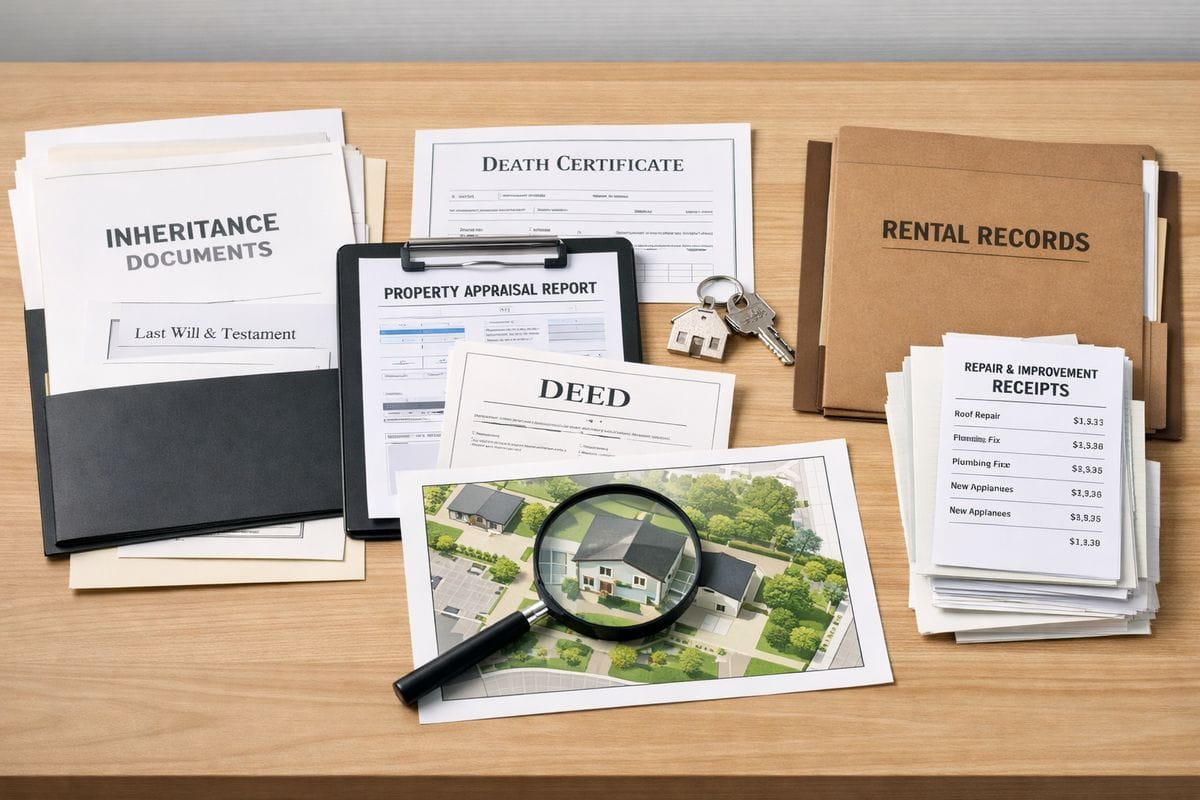
Secure the death certificate, deed, probate or trust paperwork, appraisal, and any estate tax filings. If the property was a rental, get prior depreciation schedules, rent records, expense records, and loan statements. Also keep records of post-death improvements, selling costs, and any period when the property was converted from personal use to rental or the reverse.
If Schedule A to Form 8971 is issued in an estate tax filing, basis consistency rules matter. Using a higher value than the final estate tax value can trigger accuracy-related penalties.
Understand depreciation after inheritance
If the inherited property becomes or remains a rental, depreciation starts over using the stepped-up basis allocated between land and building. That creates a new depreciation schedule.
This matters because future gain is measured against that adjusted basis, not just the date-of-death value. For long-term holds, this single reset can improve after-tax ROI for years.
How the Sale Is Reported and Where Heirs Get Tripped Up
When inherited property sells at a gain, the sale is generally reported on Form 8949 and Schedule D. The tax benefit is a reduced capital gain, not blanket tax-free treatment.
If the property sells below stepped-up basis, a capital loss may be available. Either way, basis drives the result.
Common mistakes that create tax exposure
The biggest errors are predictable: using the wrong basis, skipping the appraisal, ignoring ownership percentages, forgetting post-death improvements, mixing up gifted and inherited property, and overstating basis when estate tax consistency rules apply.
Another common problem shows up in multi-property estates. Heirs focus on one headline property and neglect the rest. Every parcel needs its own basis record, ownership review, and post-death accounting trail.
Special rule to flag
A special one-year rule blocks circular gifting strategies. If property was transferred from you or your spouse to the decedent within one year of death and comes back by inheritance, the expected basis step-up may not apply. That rule exists to stop last-minute basis engineering.
Estate Planning Decisions That Preserve the Tax Benefit
For highly appreciated real estate, holding until death usually produces a better tax result than gifting during life. That is the recommendation because step-up generally beats carryover basis by a wide margin.
Estate tax gets attention, but basis planning affects far more families. Federal estate tax exemptions are high enough that most real estate owners should focus first on title, basis, and documentation, not exotic transfer strategies.
When gifting real estate is the wrong move
Gifting low-basis rental property during life often destroys tax efficiency. You hand the embedded gain to the recipient and erase the future step-up opportunity. Cash gifts and high-basis assets create far less friction because there is little or no built-in gain to preserve.
For investors thinking about generational transfer, the plain-English rule is simple: keep appreciated real estate positioned for estate inclusion if the goal is maximum tax efficiency for heirs.
Clear recommendation for Texas real estate investors
Review title on every property. Confirm whether each married-owned asset is community property. Coordinate LLC ownership with trust planning so estate inclusion and liability planning work together. And document fair market value at death immediately.
For Texas investors, that is the highest-ROI move in this entire area. The community property advantage is real, the step-up can reset both halves of a property, and fast documentation protects the tax result when heirs decide to sell or hold.
Frequently Asked Questions
Does inherited rental property always get a full step-up in basis?
No. The result depends on ownership structure, state law, and what portion of the property was included in the estate. In Texas community property, both halves often receive a full step-up. In many other situations, only the decedent’s share does.
Does an LLC prevent a step-up in basis for real estate?
No. An LLC by itself does not block a step-up. The tax result depends on how the LLC interest is owned, whether it is included in the estate, and how the entity and title are structured.
What if the appraisal is done months after death?
A late appraisal is weaker. The best record is an appraisal tied to the actual date of death. Waiting too long makes the valuation harder to defend and raises the chance of basis disputes when the property is sold.
If inherited property is kept as a rental, what basis is used for depreciation?
Depreciation starts from the stepped-up basis, allocated between land and building. That creates a new depreciation schedule after inheritance.
Is inherited property tax-free when sold?
No. If you sell for more than the stepped-up basis, you owe capital gains tax on the increase after inheritance. The rule reduces gain sharply, but it does not eliminate tax in every sale.
Is gifting real estate before death better for heirs?
Usually not for appreciated property. A lifetime gift usually carries over the old basis, which passes built-in gain to the recipient. Holding appreciated real estate until death usually produces the better tax outcome.