

A passive activity loss carryforward is a rental or other passive loss you cannot deduct this year under IRC §469, so it gets suspended and pushed into a future year. That sounds technical, but the business impact is straightforward: these carryforwards change your current tax bill, your after-tax ROI, and the economics of holding, refinancing, grouping, or selling a property.
What Passive Activity Loss Carryforwards Are
A passive activity loss carryforward is a suspended loss from a passive activity that exceeds the amount you are allowed to deduct in the current year. For most rental owners, that means the property shows a tax loss on Schedule E, but the loss does not reduce wages, bonus income, or active business income today. Instead, it sits on the shelf until passive income shows up or a release event happens.
That timing matters more than most investors realize. Based on analysis of rental portfolios with recurring depreciation losses, suspended losses often become a hidden tax asset. A property that throws off negative taxable income for years can build a meaningful carryforward balance, then release it when passive income rises or the property is sold in a fully taxable transaction.
The governing idea is simple: §469 defers the deduction, it does not erase it. The IRS states that disallowed passive losses carry forward to the next taxable year. For a rental owner, that affects when tax value is realized, not just whether value exists at all.

The Three Rules That Decide Whether a Loss Gets Suspended
Three rules decide the outcome. First, determine whether the activity is passive or nonpassive. Second, apply the rental real estate rules, which usually force rentals into the passive bucket. Third, apply ordering rules, because basis and at-risk limits can stop a loss before passive loss rules even come into play.
This is why two investors with the same property loss can get completely different tax results.
Passive vs. Nonpassive Activity
Passive losses generally offset only passive income. That means rental losses and losses from passive partnerships usually cannot reduce W-2 wages, consulting income, or portfolio income. Interest, dividends, and most capital gains usually do not absorb passive losses either.
Think of passive losses as living in a separate tax bucket. If that bucket has passive income in it, the losses can offset it. If not, the losses remain trapped and become carryforwards.
Rental Real Estate Is Usually Passive by Default
Rental real estate is usually passive by statute, even when involvement is significant. That is the rule that surprises landlords most. Managing tenants, approving repairs, reviewing leases, and dealing with contractors does not automatically convert a rental into a nonpassive activity.
That default treatment is why rental losses so often become carryforwards. The only common ways around it are the $25,000 special allowance, Real Estate Professional Status combined with material participation, or a fully taxable disposition that releases suspended losses.
At-Risk Rules Come Before Passive Loss Rules
Before a loss reaches Form 8582, basis and at-risk limits apply first. IRC §465 can limit a deduction if enough money is not actually at risk in the activity. If the loss is blocked there, it never even enters the passive loss calculation for the year.
In practice, that means a rental loss can be limited in layers. First by basis, then by at-risk rules, then by passive loss rules. If the loss survives the first two layers and still cannot be used under §469, it becomes a passive activity loss carryforward.
How Passive Activity Loss Carryforwards Actually Work Year to Year
The year-to-year mechanics are more orderly than the terminology suggests. A loss is generated. The allowed portion is deducted. The unallowed portion is suspended. Next year, that suspended amount rolls forward and is tested again.
There is no expiration clock. Suspended passive losses continue until used against passive income or released by a qualifying disposition.
How Form 8582 Tracks Current-Year Limits and Prior-Year Carryovers
For individuals and other noncorporate taxpayers, Form 8582 is the core IRS tool. It combines current-year passive income and losses, brings in prior-year unallowed losses, and calculates what is deductible now versus what carries forward again.
That is why activity-level tracking matters. Form 8582 is not just a one-year computation. It is the bridge between years. If prior-year carryovers are wrong, every later year is wrong too.
What “Suspended” Means in Practice
Suspended does not mean lost. It means the deduction is parked at the activity level. It waits for one of three things: passive income from that year, a status change that turns the activity nonpassive, or a qualifying full disposition.
Separate tracking by activity is nonnegotiable. One rental’s suspended losses do not become another rental’s sale-release amount. If Property A is sold, only Property A’s suspended losses get the full disposition treatment tied to that activity.
How Long You Can Carry Passive Losses Forward
You can carry passive activity losses forward indefinitely. There is no expiration date built into the passive loss rules.
That makes these losses different from tax attributes with hard carryforward periods. A suspended rental loss from years ago still matters today if the activity remains in place and the records were maintained correctly.
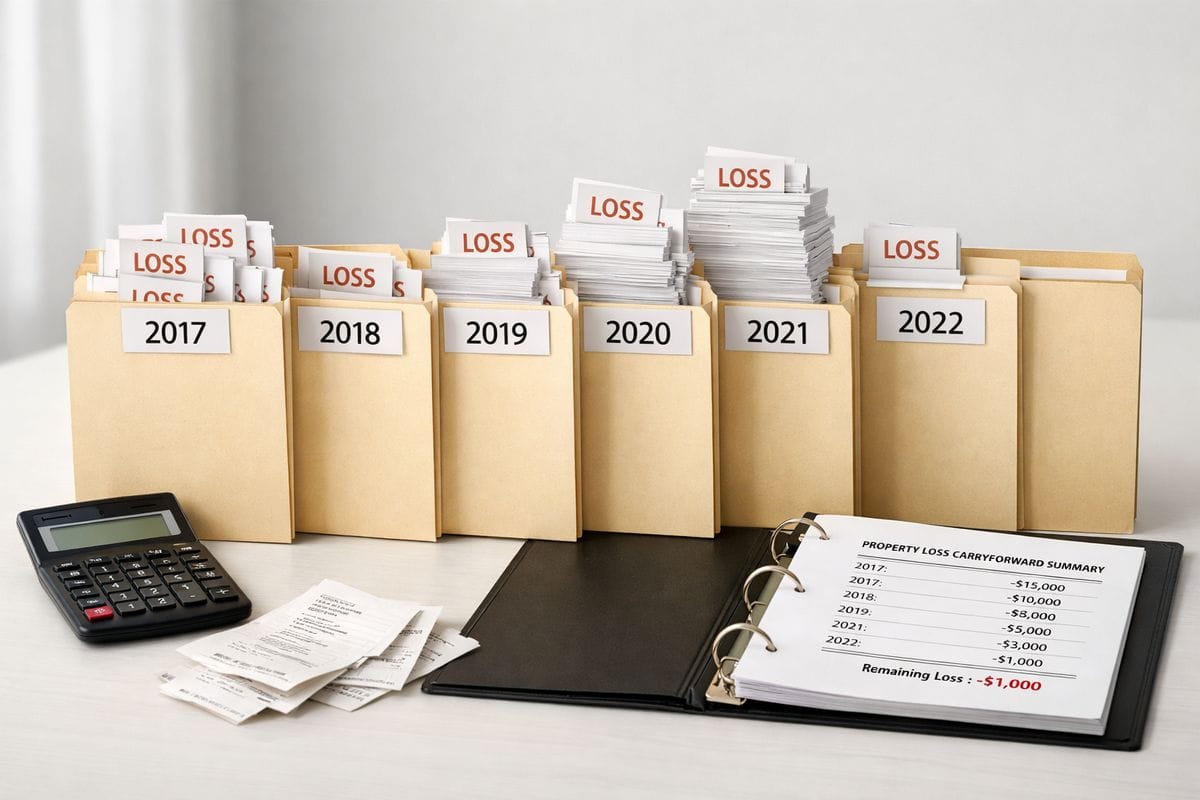
The Four Main Ways You Can Use Suspended Passive Losses
In the field, four release mechanisms drive nearly all planning value. Future passive income is the most common. The $25,000 rental allowance is the most misunderstood. Real Estate Professional Status is the highest-impact status election. A full taxable sale is the cleanest release event.
Offset Future Passive Income
The most common use is straightforward. A property generates a $12,000 passive loss in Year 1 and no passive income exists, so the $12,000 is suspended. In Year 2, a syndication K-1 reports $9,000 of passive income. That $9,000 absorbs part of the suspended loss, leaving $3,000 to carry forward.
The same logic applies across rentals, passive partnerships, and other passive investments. Future passive income pulls old losses off the shelf.
Use the Special $25,000 Rental Real Estate Allowance
IRC §469(i) gives certain rental owners a special break: up to $25,000 of rental real estate losses can offset nonpassive income if active participation and ownership rules are met. That requires at least 10 percent ownership and a real management role, such as approving tenants, setting rental terms, or authorizing repairs. The phaseout range starts at MAGI of $100,000 and ends at $150,000.
This is a lower standard than material participation. Many smaller landlords qualify for active participation. High-income W-2 earners usually do not get the benefit because MAGI wipes it out.
Qualify as a Real Estate Professional
IRC §469(c)(7) changes the result dramatically. If Real Estate Professional Status applies and material participation is satisfied, rental losses are no longer automatically passive. That can turn what would have been a carryforward into a current deduction against nonpassive income.
But this is not an automatic deduction. Status alone does not do the job. Material participation still has to be proved, and records have to support it.
Dispose of Your Entire Interest in the Activity
A full taxable disposition of your entire interest to an unrelated party usually releases suspended losses from that activity. The IRS confirms that entire interest dispositions free previously disallowed passive losses in that year.
The conditions matter. Partial sales do not do it. Related-party transfers do not do it. Gifts do not do it. A 1031 exchange does not do it either, which is where planning gets expensive fast.
Active Participation vs. Material Participation: Why the Difference Changes the Outcome
These standards sound similar. The tax result is completely different.
Active Participation for the $25,000 Allowance
Active participation is the lower bar. If you own at least 10 percent and make management decisions such as tenant approval, rental term approval, or repair approval, you usually satisfy it. Many hands-on landlords qualify even when a property manager handles day-to-day work.
This standard matters only for the special rental allowance. It does not make the rental nonpassive.
Material Participation for Nonpassive Treatment
Material participation is the higher bar. The common tests include more than 500 hours, or more than 100 hours when nobody else participates more, along with other regulatory tests. The practical question is whether involvement is regular, continuous, and substantial.
For rentals, material participation by itself does not usually change the passive result. Real Estate Professional Status has to remove the default rental rule first. Then material participation determines whether the loss becomes nonpassive.
Why Contemporaneous Records Matter
Courts routinely reject recreated logs and rough estimates. If hours are part of the tax position, records have to exist when the work happens, not after an audit notice arrives.
Track hours, dates, tasks, contractor oversight, tenant decisions, travel tied to the property, and ownership percentages. The recommendation is simple: if a deduction depends on participation, document participation like revenue depends on it, because after-tax ROI does.
Real Estate Professional Status: When Rental Losses Stop Becoming Carryforwards
For high-income investors, this is the biggest planning lever in the entire passive loss regime. If wages are high and depreciation is large, Real Estate Professional Status can convert trapped rental losses into current deductions. The value difference is often five figures per year.
That said, this area draws scrutiny because the tax benefit is large and the recordkeeping failures are common.
The Two Threshold Tests Under IRC §469(c)(7)
Two threshold tests apply. More than 50 percent of your personal service time in trades or businesses must be in real property trades or businesses. And more than 750 hours must be performed in those real property activities during the year.
Both tests must be met. If employee work is involved, counting those hours depends on ownership and other technical rules. This is one reason high-income W-2 earners often assume they qualify when the math says otherwise.
Material Participation Still Applies to Each Rental Activity
Real Estate Professional Status removes the automatic passive label from rentals. It does not make every rental nonpassive by default. Material participation still has to be shown for each rental activity unless a valid grouping election changes the unit being tested.
That is the point many returns miss. Status gets you through the gate. Material participation gets the deduction.
The Grouping Election for Rental Activities
A grouping election can treat all rental real estate interests as a single activity. That often helps satisfy material participation because hours across properties are combined rather than tested property by property.
Consistency matters. Once made, the election generally must be followed unless facts materially change or the original grouping was improper. Filing mechanics matter too, because the election must be attached by the return due date, including extensions.

Special Situations That Create Planning Opportunities or Traps
This is where carryforwards stop being academic. Certain structures create suspended losses year after year unless they are planned correctly from the start.
Self-Rental Rules
If property is rented to a business in which material participation exists, the rental income can be recharacterized as nonpassive. But rental losses generally stay passive. That asymmetry traps deductions.
A cost segregation study can make the problem larger. Large depreciation deductions in a self-rental often create big passive losses with no passive income to absorb them. Without proper planning, those losses become carryforwards and stay there.
Grouping Elections Beyond Real Estate Professional Planning
Grouping is not only for Real Estate Professional Status. It also matters in owner-operated business structures where a rental entity and an operating company function as one economic unit. A valid grouping election can change how material participation and passive loss limits apply.
The election must be timely attached to the return, including extensions, and the grouping has to fit the appropriate economic unit standard. Late or careless elections create years of friction.
Partial Dispositions, Installment Sales, and Related-Party Transfers
These transactions are classic traps. Selling part of an interest does not release all suspended losses. An installment sale complicates timing because the rules focus on a fully taxable disposition of the entire interest. Related-party transfers fail the release rule. Gifts fail it too.
Investors often assume any sale unlocks everything. That is wrong. The structure of the exit controls the tax result.
Passive Losses vs. Passive Activity Credits
Losses and credits are not interchangeable. This distinction gets blurred constantly, and the filing result is often wrong.
Form 8582-CR and Separate Credit Tracking
Passive activity credits are tracked separately on Form 8582-CR. They do not merge into loss carryforwards, and they follow a different limitation framework. That includes separate worksheets and separate carryforward logic.
If energy or rehabilitation credits are involved, this distinction matters immediately.
Why Credits Do Not Get the Same Disposition Relief
This is the trap. Passive losses are generally released on a qualifying full disposition. Passive credits are not. The IRS states that unused passive credits are not automatically freed just because the entire interest was disposed of.
That misunderstanding produces overstated tax benefits in exit-year projections. Losses and credits must be modeled separately.
Common Scenarios With Numbers
Numbers make the rules real. Here are three common patterns.
W-2 Earner With a Rental Loss and No Passive Income
Your salary is $200,000. One rental produces a $8,000 tax loss after depreciation. No passive income exists from other activities. MAGI is above the $150,000 phaseout ceiling, so the $25,000 rental allowance is gone. Result: the full $8,000 becomes a passive activity loss carryforward.
Repeat that for 10 years and the math becomes substantial. Year after year, $8,000 is suspended. After 10 years, the carryforward balance reaches $80,000.
Now the exit scenarios:
A fully taxable sale releases the entire $80,000. If gain and depreciation recapture would otherwise be taxed at a blended 25 percent rate, that release saves about $20,000 in tax. That is real cash.
A 1031 exchange does not release the $80,000. The suspended losses carry into the replacement property structure with no current benefit. Tax is deferred, but the old losses remain trapped.
Death is worse from a carryforward standpoint. The property receives a basis step-up, but the $80,000 suspended loss does not pass to heirs. It disappears. Planning implication: if the holding period is nearing its end and a large suspended loss asset has built up, the value of releasing that loss belongs in the 1031 versus taxable sale analysis.
Landlord Qualifying for the $25,000 Allowance
A rental produces a $30,000 loss. Active participation exists and ownership is above 10 percent. MAGI is $120,000. The $25,000 allowance is reduced by 50 percent of the $20,000 excess over $100,000, so the allowance falls by $10,000 to $15,000. Result: $15,000 is deductible against nonpassive income now, and the remaining $15,000 carries forward.
That is why AGI management matters. Inside the phaseout band, year-end planning directly affects current tax value.
Full Sale of a Rental Property With Suspended Losses
A rental has $18,000 of current-year taxable income before sale and $50,000 of suspended passive losses from prior years. The property is sold in a fully taxable sale to an unrelated buyer, generating gain. The $50,000 suspended loss is released in the sale year. It first offsets passive income and gain tied to the activity, and any excess becomes deductible under the disposition ordering rules for that year.
That is often the first year the investor realizes how valuable the carryforward was all along.
The 2026-2027 Tax Planning Angle: What Changes and What Stays the Same
The passive loss regime and the surrounding tax landscape are not the same thing. Keeping those separate leads to better decisions.
What the TCJA Sunset Does Not Change
The core passive activity loss rules under §469 do not disappear just because TCJA provisions sunset. The passive bucket, the Form 8582 framework, the rental default rule, and the disposition-release concept all stay in force unless Congress changes §469 directly.
So if the concern is that passive activity loss carryforwards somehow vanish after 2026 or 2027, that concern is misplaced. The core regime stays put.
What Can Change Your Strategy Before 2026-2027
What does change is the value of the deduction. Rate changes, AGI changes, itemized deduction dynamics, entity decisions, and timing of dispositions can all alter the ROI of using losses now versus later.
That shifts planning toward tax timing. If large suspended losses exist, rising future rates can increase the value of a later release. If AGI can be managed into the $25,000 allowance range, current deductions become more valuable. If a sale is already under consideration, the recommendation is to model taxable sale economics against exchange economics with the suspended loss asset included, not ignored.
The Most Common Mistakes That Keep Losses Suspended Longer Than Necessary
Most costly passive loss mistakes come from misclassification, weak records, or bad exit assumptions.
Mixing Up Active Participation and Material Participation
Active participation supports the $25,000 allowance. Material participation supports nonpassive treatment in the right structure. Confusing them leads to deductions that are either overstated or missed entirely.
Failing to Track Carryforwards by Activity
One summary spreadsheet for all rentals is not enough. Suspended losses have to be tracked by activity because release rules are activity-specific. If one property is sold, only that property’s suspended loss balance gets the disposition benefit.
Assuming a Sale Automatically Frees Every Suspended Amount
The sale must involve the entire interest, a taxable transaction, and an unrelated party. Credits are different. Partial exits and exchanges do not produce the same result.
Making Elections Late or Without Support
Late grouping elections and unsupported real estate professional positions are recurring errors. If the filing attachment is missing or the hours log is weak, the tax strategy fails when challenged.
What to Review Before Filing or Before Year-End
Execution is where tax value is won or lost.
The Five-Point Review
Review participation logs first. If hours support a status position, records need dates, tasks, and property-level detail.
Review MAGI projections next. If income is near the $100,000 to $150,000 phaseout range, timing deductions and income can improve current tax value.
Review Form 8582 carryforwards by activity. The data shows this is where inherited spreadsheet errors quietly compound for years.
Review planned sales, exchanges, gifts, and related-party transfers. Exit structure determines whether suspended losses release or remain trapped.
Review grouping election status. An election that was never made, or was made badly, changes the result.
When a Strategic Tax Review Pays Off
The recommendation is strongest when suspended losses are large, passive income is rising, a sale is planned, a self-rental exists, or Real Estate Professional Status is being pursued. In this kind of portfolio, a tax review is not administrative cleanup. It is a direct after-tax ROI decision.
Frequently Asked Questions
Can a passive activity loss carryforward offset W-2 income?
Not by default. Passive losses offset passive income, not wages. The main exceptions are the $25,000 rental real estate allowance for qualifying active participants and nonpassive treatment created by Real Estate Professional Status plus material participation.
Do passive activity loss carryforwards expire?
No. Suspended passive losses carry forward indefinitely until used against passive income or released in a qualifying full disposition.
Does a 1031 exchange release suspended passive losses?
No. A like-kind exchange does not trigger the same release as a fully taxable sale of the entire interest. The suspended losses stay tied to the continuing investment rather than producing a current deduction.
Are suspended passive losses inherited by heirs?
No. If death occurs before a qualifying release event, the suspended passive losses do not pass to heirs. The property may receive a stepped-up basis, but the carryforward itself is lost.
Can passive losses offset capital gains?
Usually no. Under normal annual limitation rules, passive losses do not offset most capital gains. In a qualifying full disposition, released losses interact differently in the sale year, which is why that year often produces the tax benefit investors have been waiting for.
What is the biggest recordkeeping mistake with passive losses?
Failing to track losses by activity. The second-biggest mistake is relying on reconstructed participation logs. Both errors weaken audit defensibility and delay the use of deductions.