

Opportunity zone tax benefits are federal tax incentives that let you defer eligible capital gains by reinvesting them into a Qualified Opportunity Fund, and in the right deal, permanently eliminate tax on future appreciation inside that fund. That matters because the program changes after-tax ROI, reduces immediate cash drag from a gain event, and rewards long holding periods, but only if timing and compliance are handled exactly right.
What Opportunity Zone Tax Benefits Actually Are
Opportunity zone tax benefits are not deductions, and they are not tax credits. They are a set of capital gains tax rules created to push private investment into designated distressed communities through a Qualified Opportunity Fund, or QOF. Based on analysis of IRS guidance and how actual deals are structured, the program works as a timing and basis strategy: defer tax on an eligible gain now, then improve the long-term tax outcome if the investment stays in place long enough.
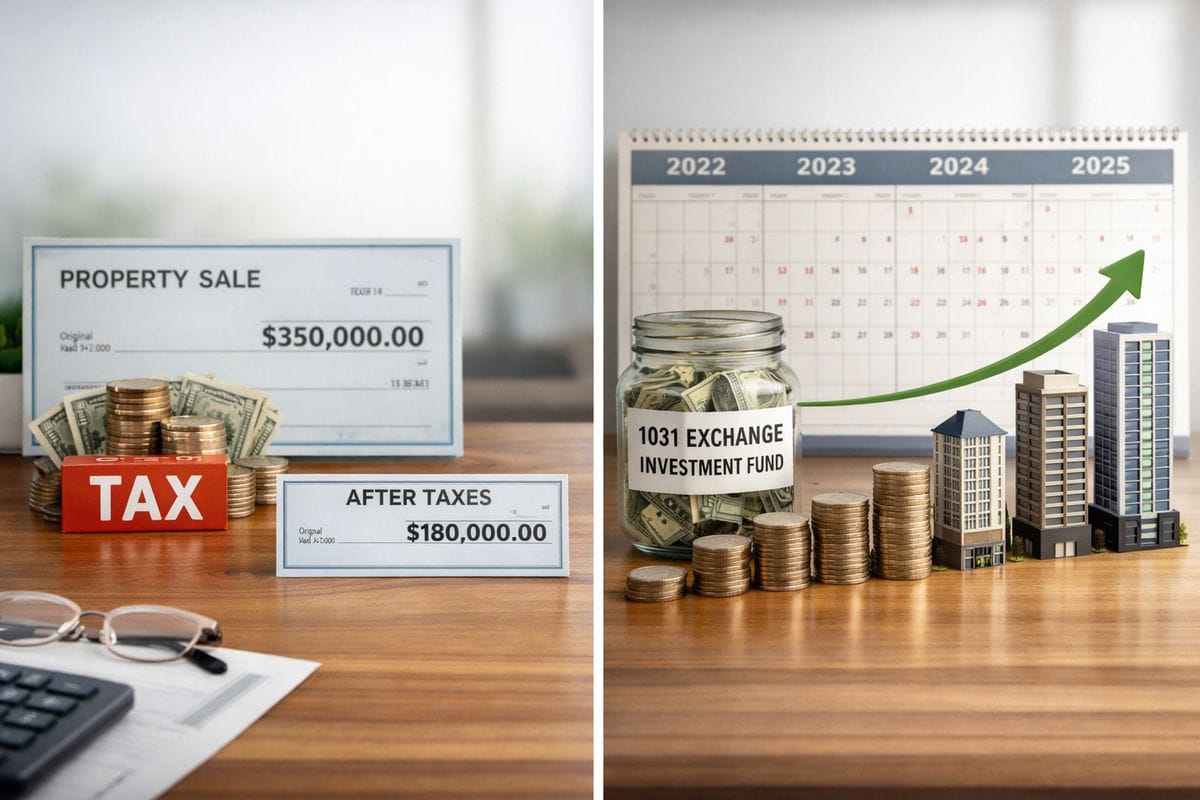
That distinction matters. If a rental property sale creates a large gain, paying tax immediately reduces investable capital on day one. A QOF election keeps that tax capital invested longer. For investors focused on wealth retention and long-term equity growth, that changes compounding in a meaningful way.
But the benefit is conditional. The gain must be eligible, the reinvestment must happen within the allowed window, the fund must remain qualified, and the hold period drives the final result. Miss one of those rules and the tax value deteriorates fast.

The Three Tax Benefits That Drive the Savings
The opportunity zone program has always revolved around three tax benefits: deferral of eligible gain, a partial reduction of deferred gain under the original legacy rules, and exclusion of post-investment appreciation after a 10-year hold. The recommendation is to separate these clearly, because a lot of online content still mixes expired benefits with the ones that still matter.
Deferral of Eligible Capital Gains
The first and most widely available benefit is deferral. If you realize an eligible capital gain and reinvest that gain into a QOF within the required 180-day period, recognition of that original gain is deferred until the earlier of the QOF investment being sold or December 31, 2026. The IRS lays out this basic structure in its Opportunity Zones guidance (IRS Opportunity Zones overview).
This is the immediate tax value. Instead of sending capital gains tax to the IRS right away, that money stays invested. For a real estate investor, that means more equity in the deal, more capital working for returns, and less upfront tax drag. In business terms, the benefit improves time-to-value because more of your gain remains productive from the start.
Basis Step-Up on Deferred Gain Under the Original Rules
Under the original design, investors who held a QOF investment for at least five years received a 10 percent basis increase on the deferred gain. At seven years, that basis increase rose to 15 percent. In practical terms, that reduced the amount of the original deferred gain that became taxable.
Here is where many articles go wrong: those legacy timing benefits are no longer the main story for new investors. Because deferred gain is recognized no later than December 31, 2026, new investments generally cannot satisfy the old five-year and seven-year holding thresholds in a way that preserves the full original step-up structure. Older investments made early in the program were different. New capital entering now is different.
So yes, the historical step-up rules matter for understanding older articles and older funds. No, they are not the primary reason to invest today.
Potential Exclusion of New Appreciation After a 10-Year Hold
The biggest active tax benefit is the 10-year exclusion. If your QOF investment is held for at least 10 years, you can elect to step up basis to fair market value when you exit, which can eliminate federal capital gains tax on the appreciation generated inside the QOF investment itself (IRS frequently asked questions on Opportunity Zones).
That is the source of outsized savings. Not the temporary deferral alone. Not the expired 10 percent and 15 percent basis step-ups. The real long-term value is turning future appreciation inside the QOF into potentially tax-free federal gain on exit.
Think of it like this: the original gain gets a postponement, but the gain created by the QOF investment gets the possibility of permanent exclusion after 10 years. That is why the program still attracts serious long-hold investors.
Who Actually Qualifies for Opportunity Zone Tax Benefits
Eligibility is narrower than the marketing suggests. Based on analysis of IRS rules and how funds are formed, most qualification mistakes happen because investors assume any sale proceeds, any property in an opportunity zone, or any income stream qualifies. None of that is accurate.
What Counts as an Eligible Gain
The tax benefit applies to eligible capital gains. It does not apply to ordinary income, rental income, wages, business operating income, or depreciation deductions by themselves. If your apartment building throws off monthly cash flow, that cash flow does not become tax-advantaged because an opportunity zone is involved.
Common eligible gain sources include the sale of appreciated real estate, appreciated stock, a business interest, or certain partnership interests. The key is the capital gain itself. Not gross sale proceeds. Not the full check received at closing. The gain portion.
That distinction is where tax planning either works or fails.
The 180-Day Reinvestment Window
You must reinvest the eligible gain into a QOF within 180 days. Miss that window and the opportunity zone election is gone. For direct investors, that deadline is usually straightforward. For gains flowing through partnerships, S corporations, estates, or trusts, timing can become more technical because the start date for the 180-day period can vary under IRS rules.
The business outcome is simple: timing errors destroy tax value. A strong deal placed into a QOF too late is just a taxable gain followed by a regular investment.
Why the Investment Must Go Through a Qualified Opportunity Fund
You do not get opportunity zone tax benefits by simply buying a property located in an opportunity zone. The investment has to go through a Qualified Opportunity Fund, which is the entity that self-certifies and is responsible for meeting fund-level requirements (IRS QOF guidance).
That matters because your tax result depends on fund compliance. If a fund fails operational tests, asset tests, or documentation standards, your expected tax benefit is exposed. For real estate investors used to direct ownership, this is a major shift. The zone location matters, but the fund structure is what activates the tax regime.
How the Savings Work in Real Numbers
This is where opportunity zone tax benefits become concrete. The field data shows that investors overvalue the deferral piece and undervalue the 10-year appreciation exclusion. The biggest permanent savings come from strong appreciation over a long hold.
Example 1: Tax Deferral on a Capital Gain Reinvested Into a QOF
Assume a $500,000 long-term capital gain from the sale of appreciated stock or a rental property. Assume a 20 percent federal long-term capital gains rate for illustration. Paying tax immediately means $100,000 goes to the IRS now, leaving $400,000 to invest.
If that same $500,000 gain is reinvested into a QOF within 180 days, the $100,000 federal tax is deferred until the earlier of exit or December 31, 2026. That means the full $500,000 remains invested for the deferral period instead of only $400,000.
That extra $100,000 is not free money. The tax bill still arrives in 2026 unless the investment is sold earlier. But from an ROI standpoint, keeping that capital invested improves compounding and increases the amount of equity working inside the deal during the deferral period.
Example 2: Long-Term Savings After a 10-Year Hold
Use the same $500,000 eligible gain. Compare two paths.
In a standard taxable investment, you pay $100,000 in federal capital gains tax immediately and invest the remaining $400,000. If that grows to $900,000 over 10 years, you have $500,000 of new appreciation. At a 20 percent federal capital gains rate, that appreciation creates another $100,000 federal tax on exit.
In a QOF structure, you invest the full $500,000. Assume that investment also grows to $900,000 over 10 years. Your original deferred gain becomes taxable by 2026, so the deferral does not erase that original tax. But if the QOF investment is held at least 10 years, the $400,000 of appreciation inside the QOF, from $500,000 to $900,000, can be excluded from federal capital gains tax on exit.
That is the concrete savings: compared with the standard taxable path, the 10-year QOF structure eliminates federal tax on that $400,000 of QOF appreciation. At a 20 percent federal capital gains rate, that is $80,000 of federal tax avoided on exit, plus the value of having deferred the original tax bill for years instead of paying it up front.
The practical point is clear. The old step-up benefits are largely a legacy issue. The active value today is deferral plus exclusion of future QOF appreciation after a 10-year hold.
What the Field Data Shows About Best-Case vs. Typical Savings
Best-case marketing usually highlights dramatic tax-free growth. That outcome requires exactly what the statute rewards: a large eligible gain, a properly structured fund, strong asset-level performance, and a hold period of at least 10 years.
Typical savings are narrower. If your hold period is short, the benefit is mostly deferral. If appreciation is weak, permanent tax savings are limited even if the structure qualifies. Based on analysis of how real estate deals perform, the tax wrapper matters most when the underlying investment has real upside. Tax incentives amplify a good deal. They do not rescue a mediocre one.
The Four Rules That Determine Whether the Benefit Holds Up
The value of opportunity zone investing depends as much on execution as on statute. Four rules determine whether the tax benefit survives contact with reality.
Rule 1: The Fund Must Stay Qualified
A QOF has to remain compliant on an ongoing basis. That includes maintaining required opportunity zone asset levels and following the program’s operational rules. Investor tax outcomes depend on fund behavior after your capital goes in, not just on the subscription date.
For that reason, fund governance matters. So do accounting controls, testing procedures, and sponsor discipline.
Rule 2: The Asset Must Meet Opportunity Zone Property or Business Standards
The underlying asset must fit the program. That can involve Qualified Opportunity Zone property, Qualified Opportunity Zone business property, or an operating business that satisfies opportunity zone standards. For real estate investors, this usually comes down to whether the property is structured and improved in a way that satisfies the rules, rather than simply sitting inside the right census tract.
A property address alone is not the tax strategy.
Rule 3: Holding Period Controls the Outcome
Short hold, limited benefit. Medium hold, still mostly deferral. Ten years or more, that is where the long-term exclusion becomes available. The recommendation is to treat opportunity zone investing as a long-duration strategy vehicle with illiquidity built in.
If your capital plan assumes a quick sale, this is the wrong structure.
Rule 4: Reporting and Documentation Must Be Accurate
Opportunity zone elections and reporting require precise tax filings and basis tracking. Incomplete forms, weak records, or missed election timing can reduce or eliminate the intended result. The IRS requires investor and fund reporting as part of the framework (IRS forms and instructions for Opportunity Zones).
For high-gain investors, documentation is not back-office trivia. It is part of preserving ROI.
What Opportunity Zone Tax Benefits Do Not Cover
This is where disciplined planning beats promotional content.
No Benefit on Ordinary Income or Ongoing Rental Cash Flow
Opportunity zone benefits do not convert rental income into tax-free income. They do not shelter wages. They do not eliminate operating income from a business. The incentive is tied to eligible capital gains and long-term appreciation inside the QOF investment.
If your main tax problem is current cash flow, this is not the answer.
No Automatic Shield From Depreciation Recapture or Every Related Tax
Real estate investors often assume a property sale gain can be pushed wholesale into a QOF and all tax disappears. That is not how the rules work. Opportunity zone benefits target eligible capital gains. They are not an automatic shield from every tax item tied to the sale, and they are not a blanket eraser for depreciation recapture or every state tax consequence.
That misconception costs investors money because it leads to bad projections and bad deadlines.
No Guaranteed Savings if the Investment Underperforms
Tax incentives improve after-tax economics. They do not fix weak occupancy, bad financing, poor sponsor execution, or a low-growth market. If the project underperforms, the tax benefit shrinks with it. Worse, you still absorb illiquidity and complexity.
The recommendation is straightforward: underwrite the asset first, then value the tax benefit second.
When an Opportunity Zone Strategy Makes Financial Sense
Opportunity zone investing is not universally attractive. It fits a narrow profile well, and outside that profile the structure often adds complexity without enough economic payoff.
Best Fit: Large Capital Gain, Long Time Horizon, High Appreciation Potential
The strongest fit is an investor with a meaningful recent capital gain, enough liquidity to leave capital tied up through 2026 and beyond, and conviction that the underlying deal has substantial appreciation potential over 10 years. In that setup, the strategy improves after-tax ROI in two ways: more money stays invested upfront, and future QOF appreciation can exit free of federal capital gains tax.
That is where the program earns its place in a portfolio.
Poor Fit: Need for Liquidity, Modest Gain, or Weak Deal Quality
If liquidity matters in the near term, if the gain is modest, or if the sponsor and asset quality are unconvincing, the recommendation is to pass. The structure is too long-dated and too technical to justify on tax marketing alone.
A mediocre deal inside a QOF remains a mediocre deal.
The Smart Evaluation Checklist Before Investing
A disciplined review process protects the tax outcome and the capital outcome. Based on analysis of successful implementations, three checkpoints matter most.
Confirm the Gain, Deadline, and Entity-Level Timing
Confirm that the gain is an eligible capital gain. Identify the exact 180-day reinvestment window. If the gain comes through a partnership, S corporation, estate, or trust, verify how entity-level timing affects the election date.
This is the first screen because no tax benefit exists without valid gain timing.
Verify QOF Structure, Compliance Process, and Underlying Asset Plan
Review whether the fund is properly organized as a QOF, how compliance is monitored, and what assets or businesses sit underneath the structure. Then review the actual business plan. For real estate, that means location, basis, construction or improvement plan, financing, lease-up assumptions, and exit strategy over a 10-year horizon.
The tax wrapper matters. The asset plan drives the outcome.
Model After-Tax ROI Before Committing Capital
Run the numbers against a non-opportunity-zone alternative. Compare expected appreciation, fees, liquidity constraints, tax drag, and exit timing. Use the tax benefit to improve a strong investment thesis, not to create one.
The recommendation is decisive: use opportunity zone investing only when the underlying deal stands on its own and the tax benefit materially improves after-tax returns.
Frequently Asked Questions
Are opportunity zone tax benefits still worth considering now that the old basis step-ups are gone?
Yes, if the deal has strong 10-year appreciation potential. The expired 10 percent and 15 percent basis step-ups were meaningful under the original timeline, but the main active value now is deferral of eligible gain and the potential exclusion of appreciation inside the QOF after a 10-year hold.
Can sale proceeds from a rental property qualify, or only the gain?
Only the eligible capital gain qualifies for opportunity zone treatment. Gross sale proceeds do not. Rental income and operating cash flow do not qualify either.
Does buying a property located in an opportunity zone automatically create the tax benefit?
No. The investment must go through a Qualified Opportunity Fund. Directly buying property in an opportunity zone, without the proper QOF structure and compliance, does not activate the federal tax benefits.
What happens to the original deferred gain?
The original deferred gain becomes taxable on the earlier of disposition of the QOF investment or December 31, 2026. Opportunity zone investing delays that tax. It does not erase it.
Is the 10-year exclusion the same as making all gains tax-free forever?
No. The 10-year exclusion applies to appreciation in the QOF investment itself, assuming the holding period and other rules are satisfied. It does not make ordinary income tax-free, and it does not eliminate every tax related to the original asset sale.
What is the simplest decision rule for evaluating an opportunity zone investment?
If the asset would not deserve your capital without the tax incentive, do not invest. If the deal stands on its own, your gain is eligible, the QOF is properly run, and the hold period fits a 10-year plan, the structure can materially improve after-tax returns.